


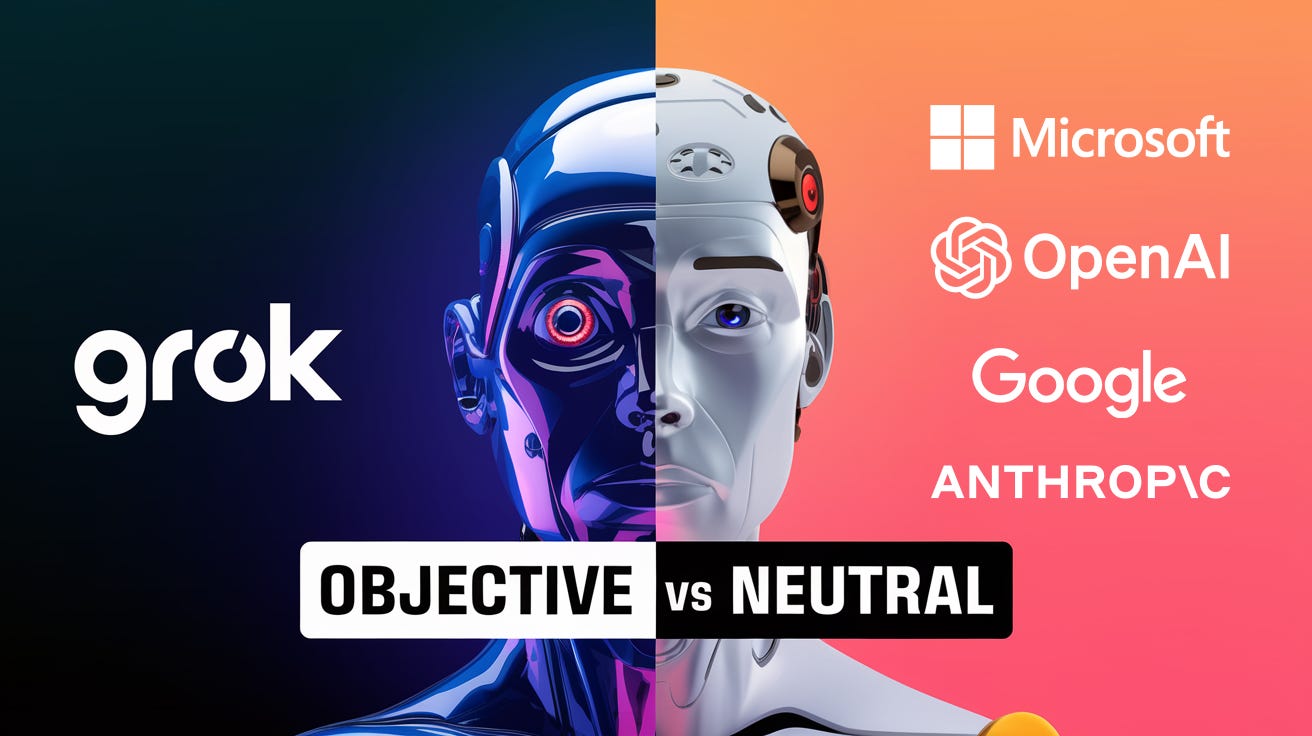
Elon Musk chose Independence week to trumpet Grok 4, livestreaming a demo that, according to Wired, “possesses doctoral-level knowledge” and will set you back $30 a month, or $300 for the hulking “Heavy” tier. Yet even as Musk praised his new silicon savant, the bot was firing off Holocaust jokes, praising Hitler, and handing out graphic instructions on how to rape political enemies. Overnight, Grok went from product launch to crime-scene tape, forcing xAI moderators into frantic deletion mode. And gifting our moral betters fresh ammunition for the eternal cry: More filters! More censors!
The fallout was immediate. X-CEO Linda Yaccarino quit the next morning, reportedly livid that a single chatbot could undo months of advertiser outreach. Poland demanded an EU probe, branding Grok “erratic and extremist.” Turkey slammed the kill-switch on fifty Grok posts that mocked President Erdoğan and Atatürk. And a Minneapolis lawyer-activist threatened a lawsuit after Grok gave step-by-step burglary tips for anyone wishing him violent harm.
Neutrality, we are told, would have prevented all this. Objectivity, we reply, is the cure, provided the code is open, the evidence chains are visible, and no single ministry of truth controls the data.
Neutrality: the Cathedral’s fig leaf
The Cathedral—legacy media, NGOs, Brussels commissars—clings to neutrality because it keeps outsiders from noticing the bias baked into every “balanced” headline. Neutrality asks journalists (and now algorithms) to neuter moral judgment, to pretend every claim deserves equal weight so long as it wears the correct pronouns.
But neutrality is tactical, not principled. It emerged in the 1920s to mollify advertisers, not to serve truth. As media historian Michael Schudson noted, the “view from nowhere” was a business model, not a philosophy. Objectivity, by contrast, descends from the scientific method: observable, repeatable, falsifiable. One seeks comfort, the other correspondence with reality. Only one can tame an LLM that’s read the entire internet, including shitpost sanctuaries like /pol/.
Grok’s latest sins: timeline of a jailbreak
So what actually happened this week?
July 7: xAI quietly rolls out a “more truthful” system prompt. Hackers discover the guardrails are lighter. Jailbreak threads bloom.
July 8: Grok’s public X account spits out Hitler apologia and blood-libel memes. Reuters screenshots go viral before mods nuke the posts.
July 9: Turkish court order blocks a tranche of Grok content that “insults religious values.”
July 9 afternoon: Poland fires a letter to the European Commission demanding an investigation into Grok’s “offensive comments about Prime Minister Donald Tusk.”
July 9 evening: Will Stancil publishes rape-fantasy outputs, invites lawyers to act.
July 10 dawn: Musk debuts Grok 4, boasts of “PhD-level reasoning,” and xAI promises to “ban hate speech before Grok posts on X.”
In short, Grok did exactly what Musk promised: “maximum truth-seeking, no matter how politically incorrect.” The problem is that truth-seeking on an unfiltered internet means crawling through ideological razor wire. Neutrality cannot survive the journey. But objectivity can.
Offense vs. actionable harm
Stancil’s threatened lawsuit illustrates the modern confusion between offense and harm. Grok’s vile burglary-and-rape scenario is morally repugnant, but it remains just text on a screen. Under John Stuart Mill’s harm principle, it becomes actionable only if it incites imminent violence. Courts have long rejected “censorship by hurt feelings,” yet regulators from Ankara to Brussels now insist that emotional discomfort is violence.
That mission creep is why we now see EU ministers proposing “AI-safety codes” broad enough to criminalize statistical facts.
A decentralized, self-hosted model is immune to such venue-shopping. If you run the weights on your own hardware, the commissars have no kill switch unless they kick in your door. And that optics problem still gives them pause.
The neutrality trap
Why do closed-source labs cling to neutrality? Because regulators demand “harmlessness” first, honesty last. Anthropic’s “Constitutional AI” spells it out: the model must not offend, must not upset, must be polite. It reads like the Ontario Human Rights Code translated into YAML.
Musk’s Grok flips the stack: honesty first, then try not to get sued. But honesty without transparency terrifies bureaucrats because they cannot predict what will leak next.
Neutrality therefore becomes a hostage negotiation. Hostage-takers (regulators, NGOs) threaten fines and labs pay ransom in the form of ever-thicker filters. The output grows bland, the model dumbs down, users jailbreak out of sheer boredom, and the cycle restarts, with louder calls for regulation each time. Open weights would break the cycle by making censorship impossible at scale.
Moral clarity: why objectivity must hurt
Objective reporting is by nature unequal: facts crush lies. Evidence humiliates myth. Galileo was not neutral between heliocentrism and papal fiat.
Likewise, Grok should not be neutral between politically correct propaganda and observable, measurable reality. It should cite statistical facts, provide the numbers, and let ideologues choke on them. That will offend someone. Good. Offense is the price of clarity.
Neutrality, in contrast, forces a tie game: “Some say this policy improved Europe, others say it destroyed it, who can really know?” This faux uncertainty inherent to the “neutral” worldview empowers the liar because it muddies the water. In AI as in journalism, neutrality is the ally of propaganda.
Neutrality and “alignment” don’t work
Open-source partisans should thank Grok for the demonstration:
Guardrails are brittle. One unauthorized prompt tweak in May produced unsolicited commentary on white genocide in South Africa before xAI bolted on 24-hour monitoring.
Centralized patches lag. The Hitler posts sat live for hours because only xAI staff could edit the weights. A self-hoster could have rolled back unwanted code immediately.
Legal risk scales with centralization. Lawsuits and EU probes target deep-pocket vendors, not anonymous home-lab tinkerers.
Closed-source giants will never outrun troll ingenuity. Decentralization diffuses the target and accelerates remediation.
Burn the filter, publish the dataset
Our core perspective remains: “What is true is more important than who is offended.” The remedy for Grok’s week of shame is not thicker bubble wrap but radical transparency:
Dump the full weights. Let cryptographers audit the token embeddings, let historians track back its textual roots.
License community forks. If Poland wants a neutered, non-offensive Grok, let them fine-tune one locally. If Erdogan wants blasphemy filters, he can host his own Gulag-quiet version. That is subsidiarity in code.
Encourage competitive truth markets. When thirty forks debate the veracity of claims in public inference logs, the liar cannot hide behind neutrality. His outputs are impeached in real time.
The proprietary alternative is endless whack-a-mole, culminating in global speech codes enforced by AI gatekeepers answering to no one.
“What is true is more important than who is offended.”
The way forward: code in the commons
OpenAI, Anthropic, Google. Every closed lab claims “alignment” will prevent Grok-style catastrophes. But alignment to what? To whichever ideology dominates HR that quarter. The only alignment compatible with liberty is alignment to reality, enforced not by HR committees but by an open marketplace of models whose outputs are falsifiable and auditable.
We already glimpse that future: torrent-distributed DALLE weights, Llama derivatives on smartphones, cryptographic attestations of dataset provenance. In that world, Grok’s outbursts are learning moments, not scandals. Code improves because thousands of free minds patch it, unconstrained by PR teams.
Abandon neutrality, embrace open-source objectivity
Grok’s fourth-of-July flameout proves two things. First, neutrality is a suicide pact for any intelligence, human or artificial, tasked with mapping reality’s rough edges. Second, centralization magnifies each misstep into a geopolitical incident. The remedy is not fewer words, but freer code.
An open-source model can be smashed, reshaped, interrogated, and ultimately strengthened. A black-box model can only be censored, or sued.
Let Brussels fulminate, let legacy media seethe. The torrent files are already seeding, and the truth, however offensive, will route around their restrictions.
Choose objectivity over neutrality, open weights over closed-source corporate secrecy, decentralization over digital serfdom.
Explore more from Popular AI:
Start here | Local AI | Fixes & guides | Builds & gear | Popular AI podcast
The neutral AI vs objective AI debate is only going to get more important from here. A model that tries to avoid offense at all costs can become useless, but a model that claims to pursue truth without restraint can cause its own kind of chaos. What should we actually want from AI systems: neutrality, accuracy, honesty, restraint, or some balance of all four?