


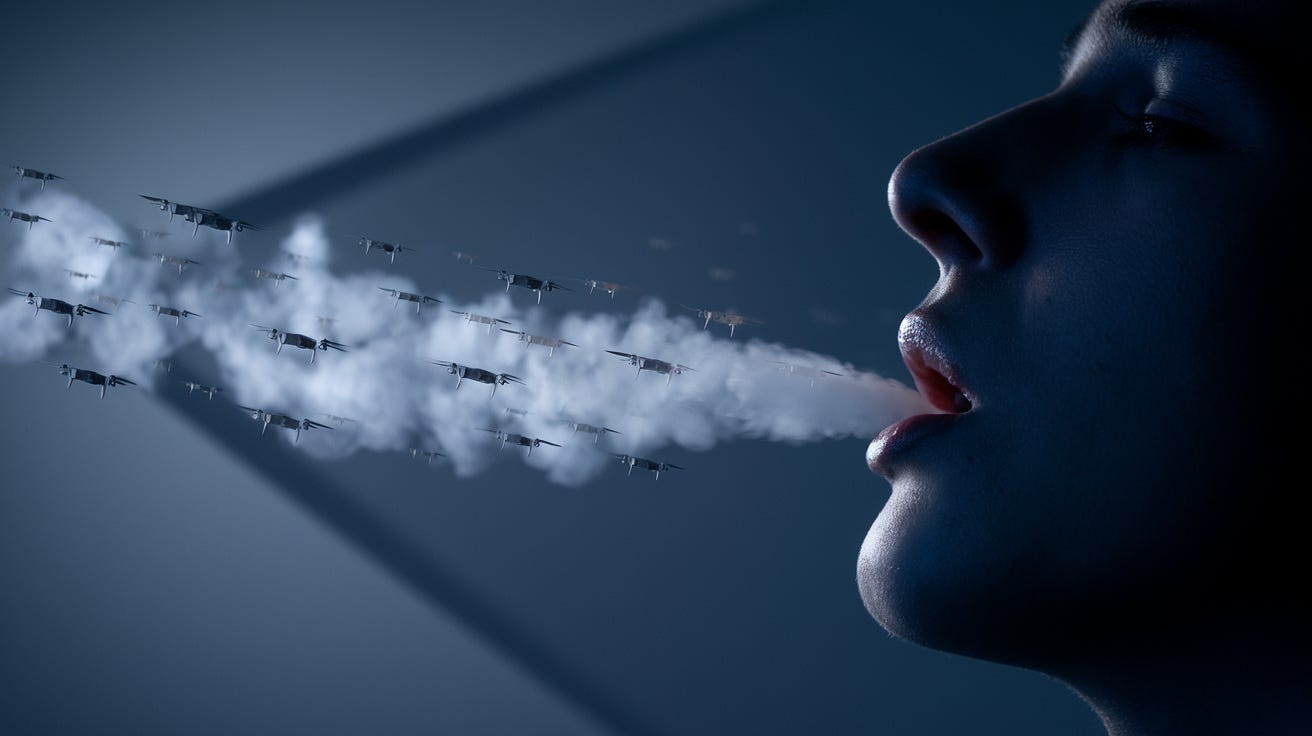
The boundary between civilian innovation and military expansion just blurred again. On February 14, fresh reporting described OpenAI partnering with defense contractors to help develop voice-controlled software for a U.S. military drone swarm trial. OpenAI’s public framing leans on a familiar reassurance: it is “only” translating spoken commands into digital instructions.
That distinction is doing a lot of work.
Because once the battlefield can be managed like a voice assistant, the center of gravity shifts. A commander does not need a specialized interface, a complex chain of typed inputs, or a roomful of operators to move a swarm. They speak, the system parses, the swarm responds. The friction drops. The tempo rises. And the practical barrier to deploying force becomes smaller than it has ever been.
If you have spent years watching the growth of what some call the military-industrial-digital complex, this is the kind of moment that matters. Not because it is the first time tech has served the state, but because it signals how normal this next phase is becoming.
One sentence can become an operation.
A partnership that lowers the friction of war
OpenAI’s defense hinges on a semantic boundary. The claim is that the technology will not be used for “weapons integration” or “targeting authority,” but for the interface between human commanders and autonomous units. That sounds like a clean line until you consider what interfaces really are.
An interface is not a neutral layer. It shapes what is easy, what is fast, what becomes routine, and what becomes thinkable. If you can speak a maneuver into existence, you are not simply improving usability. You are compressing the distance between intent and action.
The “translation only” story also creates a psychological buffer. It invites the public to focus on narrow definitions while the operational outcome stays the same: an expanding capacity to coordinate autonomous systems at scale.
And scale is the entire point.
Drone swarms are not a single aircraft with a remote pilot. They are many units moving as a coordinated whole, probing defenses, saturating sensors, and forcing adversaries into impossible tradeoffs. The value of a swarm is that it overwhelms. The value of a voice-controlled swarm is that it overwhelms faster.
The sanitize-and-scale playbook
There is a pattern here, and it is older than any large language model.
First comes sanitization. The work is positioned as non-lethal, defensive, or purely supportive. It is presented as a tool that keeps a “human in the loop.” The ethics are handled through careful wording and tighter scopes.
Then comes scaling. The enabling layer becomes the platform. The platform becomes the standard. The standard becomes the default procurement choice, especially when the vendor brings prestige and polish.
This is why the phrase “non-lethal technical assistance” often functions as an on-ramp. Systems rarely jump from zero to full-spectrum integration overnight. They move in increments that sound reasonable in isolation.
A voice layer here. A routing layer there. A workflow improvement. A user-friendly control surface. A model update.
Soon enough, the stack looks less like a set of separate parts and more like a single organism.
When the government enlists one of the world’s most prominent AI firms, it is not just buying capabilities. It is buying legitimacy. It is buying credibility. It is buying the idea that this is simply the modern way things are done.

Safety talk vs battlefield reality
For years, mainstream “AI safety” discourse has been dominated by the wrong kind of urgency. It often treats safety as a content problem, a matter of preventing chatbots from saying offensive things, spreading misinformation, or producing “unsafe” answers to social questions.
Those debates are not meaningless, but they are incomplete.
The deeper issue is power. Who gets to command advanced systems, at what scale, under what oversight, and with what transparency? A voice-command interface for swarms makes that question unavoidable.
This is also where the policy conversation gets slippery. Regulation and oversight are discussed in abstract terms while deployments happen through contracts, pilots, and classified programs. Even public-facing policy work, like a national artificial intelligence legislation tracker, can end up circling issues of transparency and accountability without ever touching the programs that matter most.
When AI becomes a defense capability, safety is no longer just about model outputs. It becomes about what the model empowers.
And what it makes easy.
Secrecy as a feature, not a bug
There is another consequence that rarely gets said plainly: defense work tends to reduce visibility. As OpenAI moves closer to national security institutions, its “open” branding runs straight into the logic of classification.
Dual-use systems live behind two walls at once.
One wall is corporate secrecy, built from proprietary training data, restricted weights, internal evaluations, and competitive advantage. The other wall is government secrecy, justified through national security, operational sensitivity, and the idea that the public should not see what the state can do.
The end result is predictable. Less audit. Less accountability. Less clarity about the real capabilities being fielded.
Even the broader legal and compliance environment reflects how quickly this space is tightening. Industry-facing summaries about heightened oversight of AI increasingly treat regulation as inevitable, yet the most consequential use cases are often the least inspectable.
This is how democracies drift into black-box governance. The most powerful systems become the least discussable.

Resisting the automated state
If you see the integration of AI into drone warfare as an anti-liberty development, the response cannot stay abstract. The system is moving toward automation because automation removes costs.
It reduces political friction. It reduces human exposure. It reduces the visibility of conflict. It makes force feel like a tool that can be applied with less consequence.
When a swarm can be directed quickly and intuitively, the “boots on the ground” deterrent weakens. The public’s ability to sense the weight of war weakens with it. That is not a technical detail. It is a change in the relationship between citizens and state power.
So what does resistance look like in a world where frontier models are increasingly tied to government priorities?
Part of it is cultural. Refuse the comforting story that “interface work” is neutral. Treat enabling layers as power layers, because that is what they are.
Part of it is local. If the establishment owns the frontier models for the battlefield, individuals and communities should build capacity for sovereign tools at home. That does not mean everyone needs to be an engineer. It means supporting a world where local computation, local inference, and local control are normal. The practical ecosystem is already forming, including guides to local LLM tools and models that reduce dependence on centralized clouds.
Freedom in the 2020s will be measured by distance.
Distance between your intelligence and the government’s cloud. Distance between what you can run and what you must rent. Distance between your ability to think privately and someone else’s ability to prompt your world into motion.
Explore more from Popular AI:
Start here | Local AI | Fixes & guides | Builds & gear | AI briefing