


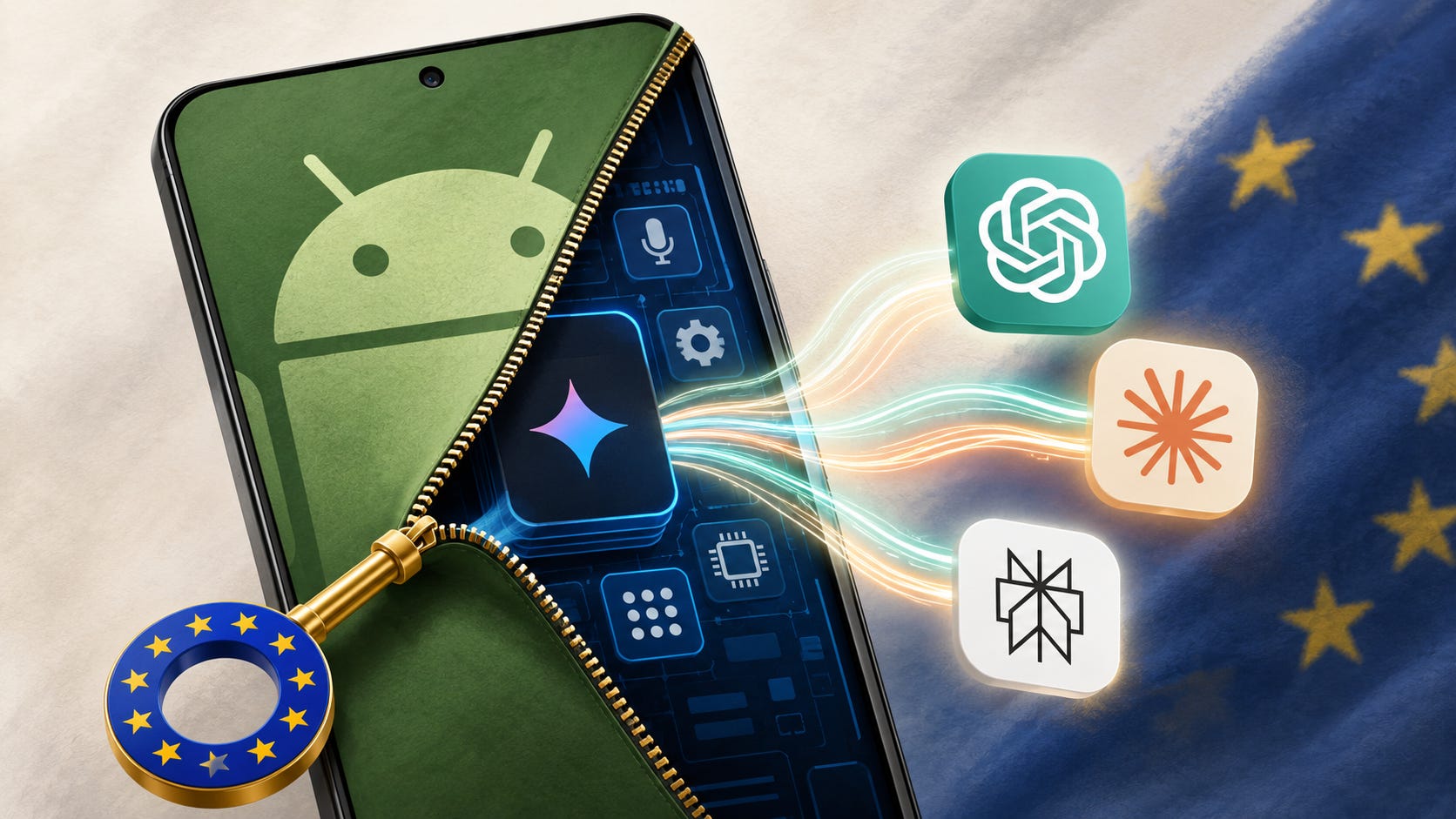
Android users can already change or remove Gemini as their default digital assistant. That setting controls which assistant opens from a button, gesture, or voice shortcut. It does not give ChatGPT, Claude, Perplexity, or another rival the deep operating-system privileges Google can give Gemini.
The European Union is now ordering Google to close that gap.
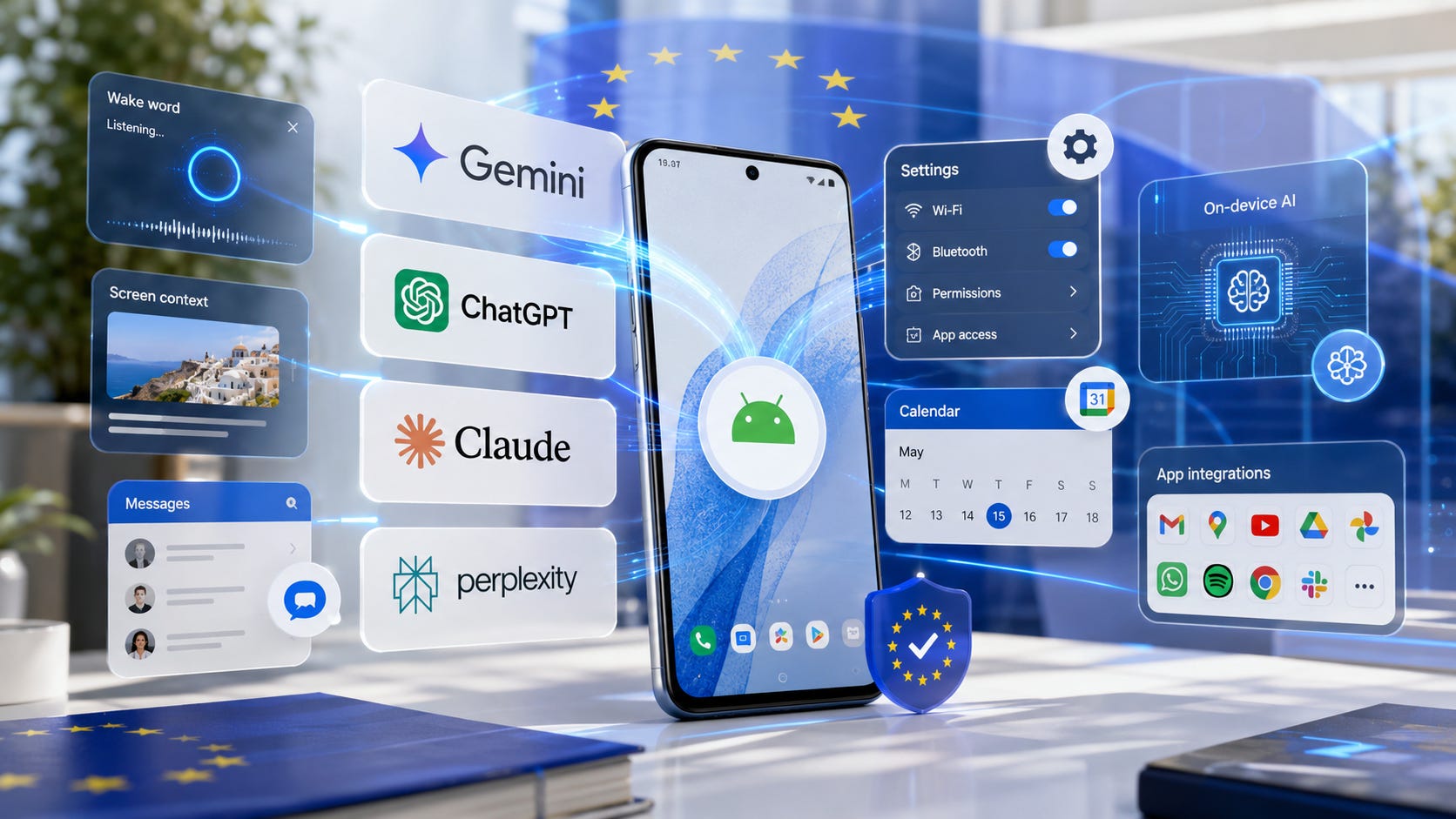
On July 16, 2026, the European Commission adopted binding measures for AI interoperability on Android. Google must open 11 Android functions to competing AI services. They include wake-word detection, app actions, screen context, system settings, background execution, device sensors, and access to on-device AI models.
The order creates a route toward replacing Gemini in practice, rather than replacing only its shortcut. The route is slow. Most changes are due with Android 18 or by August 1, 2027. Concurrent wake-word support can wait until Android 19 or August 1, 2028. Access to several sensitive functions may also depend on a certification process designed by Google under European Commission oversight.
That combination makes the decision important and incomplete. It attacks the technical privileges that make Gemini feel like part of Android. At the same time, it leaves Google with substantial influence over implementation, security requirements, device updates, and developer access.
More on local AI:

Key takeaways
The EU has ordered Google to provide rival AI services with access to 11 Android capabilities that Gemini can use more fully today.
Most interoperability measures must arrive with Android 18 or by August 1, 2027. Concurrent wake-word detection is due with Android 19 or by August 1, 2028.
Android users can already change or remove the default digital assistant, but a replacement does not automatically receive Gemini-level system access.
Google may apply objective and non-discriminatory eligibility conditions to five sensitive capabilities, including screen automation and centralized access to on-device app data.
The measures could support several specialized assistants on one phone because interoperability cannot depend on holding the default-assistant role.
A separate EU Search-data order includes AI chatbots with search functions, although its scale, investment, audit, and security thresholds may exclude many small developers and local projects.
What the European Commission ordered
The European Commission adopted two sets of binding specification measures against Google under the Digital Markets Act on July 16, 2026.
The first concerns Android interoperability. It requires Google to give competing AI services effective access to operating-system features that are important for invocation, context, actions, hardware resources, local models, and background work.
The second concerns Google Search data. It specifies how Google must share anonymized ranking, query, click, and view data with eligible search providers, including AI chatbots that offer search functionality.
The Commission says rival assistants currently have restricted access to important Android functions, while Gemini can use those functions more fully. That difference makes third-party assistants less capable even after users install them or choose them as the default. The Commission’s July 16 Android and Search decision is intended to make the platform more contestable.


This is binding guidance for Google under the DMA. It is not a voluntary technical standard. A gatekeeper that fails to comply can face fines of up to 10 percent of worldwide annual turnover, rising to 20 percent for repeated infringements.
Independent reporting has focused on the same practical consequence. The Verge described the order as requiring Google to open Android and Search to rivals, while noting that the technical changes will take time to reach users.
You can remove Gemini today, but replacement remains limited
Google already lets Android users change how Gemini activates, switch back to Google Assistant, choose another compatible assistant, select no default assistant, or delete the Gemini app.
The usual route is Settings > Apps > Default apps > Digital assistant app, although manufacturers can move or rename the setting. Google also warns that deleting the Gemini app does not necessarily remove Gemini as the default. Users must change the assistant setting separately. The company explains those options in its guide to managing or deleting Gemini on Android.
Android also has a formal assistant role for third-party applications. Google’s developer documentation says an app can qualify by implementing VoiceInteractionService or handling the Android assist action. The Android assistant-role documentation confirms that the role already exists at the platform level.
The limitation appears after the user makes a choice.
A third-party assistant may receive the assistant button, an overlay, voice input, or ordinary Android permissions. It does not automatically receive the privileged integration that lets Gemini operate across the phone as a system service.
Perplexity shows the difference clearly. Its setup guide tells users how to select Perplexity as the default Android assistant. Its separate list of supported apps and services includes email, messages, calls, Spotify, YouTube, Uber, clocks, and settings, while describing settings access as limited.

Claude can draft messages and emails, create calendar events, set alarms and timers, use location, and interact with Android apps. Anthropic says those integrations use Android’s standard sharing and intent systems. In some workflows, Claude prepares content and opens the destination app so the user can review or complete the action. Anthropic documents the current scope in its guide to using Claude with Android apps.


These integrations are useful. They still differ from an assistant that can remain active in the background, inspect live context, change system settings, operate several apps, call preinstalled on-device models, and complete tasks without sending the user through a sequence of app screens.
The real control point is operating-system privilege
Google does not have to block rival assistants from the Play Store to favor Gemini. It can allow competing apps onto Android while reserving the capabilities that make an assistant genuinely useful.
That is a stronger form of control than the default-app menu. A default setting determines which app opens. Operating-system privileges determine what that app can do after it opens.
The Commission’s Android interoperability developer Q&A identifies 11 functions that Google must open. Together, they cover the full path from summoning an assistant to letting it understand context, take action, use local resources, and continue working in the background.
1. Long-press home button or navigation handle
Users must be able to invoke a third-party AI service through central Android access points, including the home button or navigation handle.
Google will no longer be allowed to reserve those access points for its own services, including Gemini and Circle to Search. That matters because a rival assistant is far less convenient when users must find an app icon, unlock the phone, and open a separate interface for every request.
A central gesture also makes the user’s assistant choice visible throughout the operating system. The assistant becomes available from the place where people already expect help, rather than living as a separate chatbot beside the rest of Android.
2. Always-on wake-word detection
A rival assistant will be able to respond to its own wake word while the display is off, the phone is in standby, or battery-saving mode is active.
The measures eventually require concurrent detection. A phone could listen for separate activation phrases connected to different assistants. One service might handle research, another might control local files, and a third might manage a smart home.
Concurrent wake words are especially important because the Commission says access cannot depend on one provider holding the default role. That creates a possible future in which Android users combine assistants according to task, privacy model, or expertise.
The feature also raises obvious privacy and battery questions. Continuous listening needs transparent indicators, efficient on-device detection, clear permission controls, and a way for users to see which services can activate from the background.
3. Centralized access to on-device app data
Third-party assistants will be able to access data that apps store on the device when the app and user permit it.
The goal is to replace a system in which every assistant needs a separate integration with every application. Centralized access could make cross-app retrieval more practical. A user might ask an assistant to find a reservation, compare it with a calendar entry, and prepare directions without manually opening three apps.
Keeping eligible data on the device could also reduce the need to upload every relevant document, message, or record to a cloud account. That does not make the workflow automatically private. The assistant may still send selected information to its provider unless its design and permissions prevent that.
Granular consent will decide whether this feature becomes useful or dangerous. Users should be able to approve individual data sources, revoke access later, and distinguish local processing from cloud processing.
4. Context-aware intelligence
Competing assistants must be able to use permitted screen contents, location signals, device context, and other information to generate suggestions.
The Commission gives examples such as surfacing a flight number during a call or recommending a restaurant based on a conversation. These are proactive behaviors. The assistant responds to context without waiting for the user to type a complete prompt.
Context-aware assistance is one of Gemini’s strongest structural advantages because Google controls Android, many widely used apps, the account layer, and the assistant. Opening the relevant interfaces could let a rival build similar experiences without needing to recreate the entire Google ecosystem.
It could also increase the amount of personal data available to an assistant. The safest implementation would separate screen access, location, communications, files, and app data into distinct controls, with visible records of when sensitive context was used.
5. Ambient data
Rival services will be able to receive real-time input from the microphone, camera, screen, speakers, and other sensors under consent conditions comparable to those applied to Google.
That could support live visual guidance, object recognition, audio detection, translation, accessibility tools, and continuous multimodal assistance. A user might point the camera at a machine, ask for help while keeping both hands free, or receive spoken guidance based on what the phone can see.
Ambient access is also among the most sensitive capabilities in the order. A compromised assistant with persistent camera, microphone, or screen access could expose private conversations, credentials, financial information, health data, and workplace systems.
The value of the feature will therefore depend on limits. Android needs obvious indicators, easy revocation, purpose-specific permissions, and strong restrictions on silent background collection.
6. Structured app integration
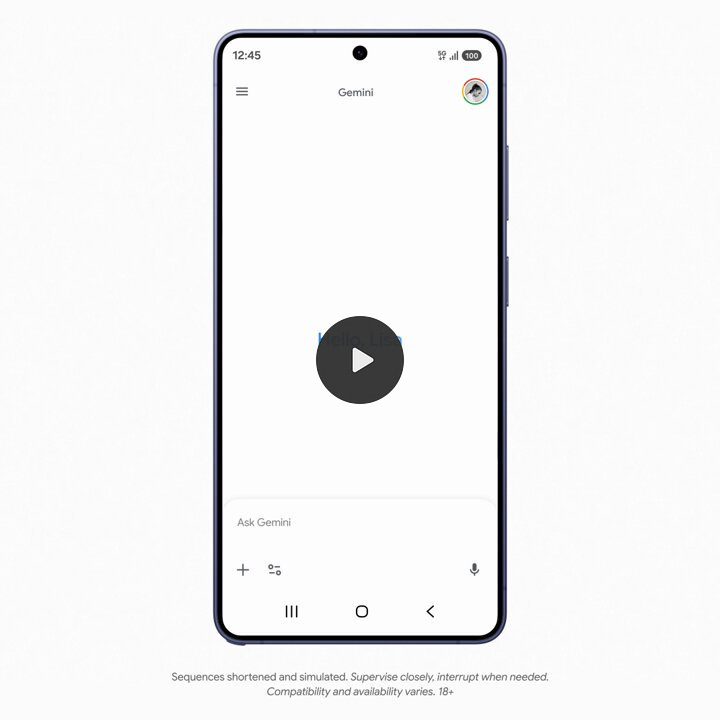
AI services will be able to perform structured actions such as sending a message, creating a note, scheduling a meeting, or calling another supported app function.
Google must also provide operating-system integration channels for Gmail, Calendar, Drive, Docs, Maps, YouTube, Messages, and Phone. This is important because Google’s own services form a large part of the Android experience.
Structured actions are safer and more reliable than asking an assistant to imitate taps on a screen. An app can expose a defined function with expected inputs, permission requirements, and a predictable result. The assistant can request the action without guessing where a button moved after an update.

This approach also gives app developers more control. They can decide which actions to expose, which data to return, and which steps require user confirmation.
7. Screen automation
An assistant will be able to operate applications through a separate virtual window while the user continues doing something else.
The Commission describes a workflow in which an assistant reads a shopping list, opens a supermarket app, finds the items, and prepares an order in the background. The user could then review the basket before purchase.
Screen automation is powerful because it can work with apps that do not expose structured functions. It can bridge gaps in the ecosystem and automate multi-step workflows across several interfaces.
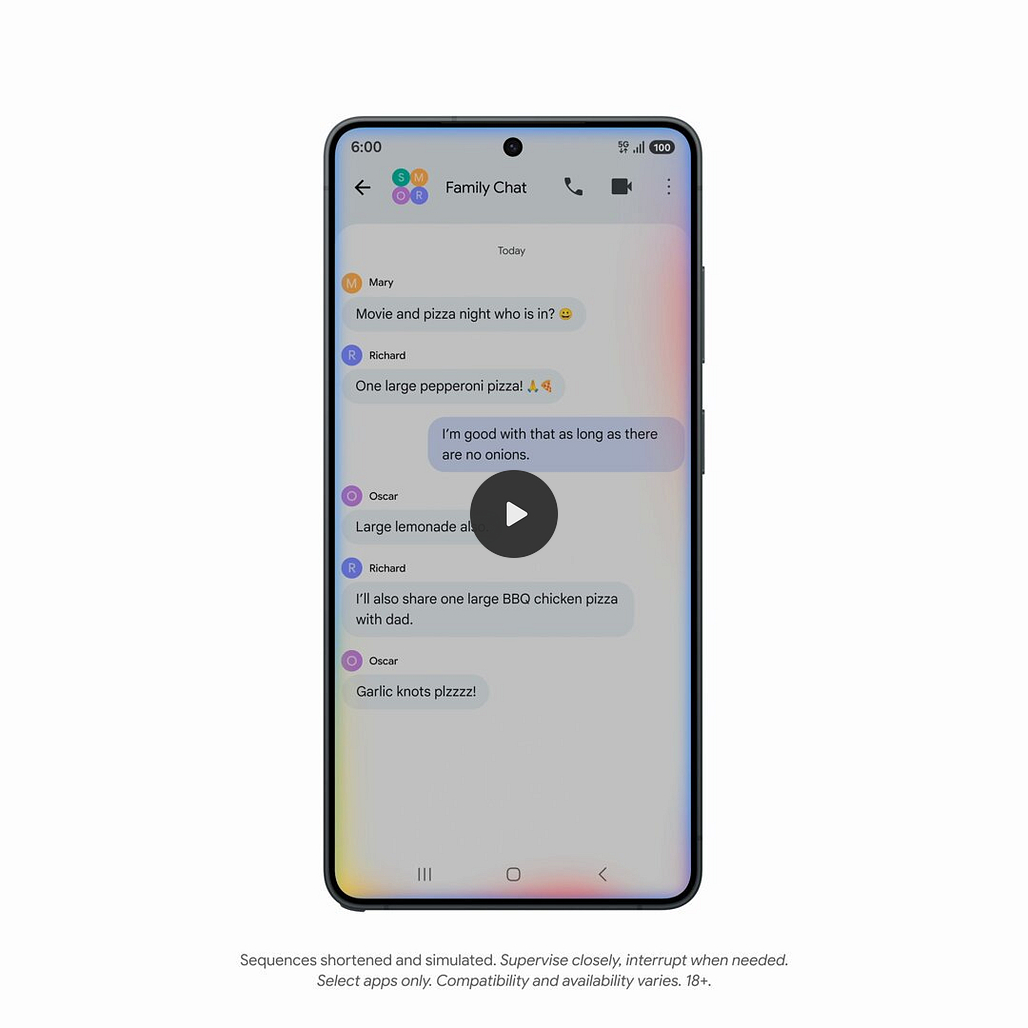
It is also fragile and risky. Screen layouts change. Buttons can be misidentified. A malicious page can try to manipulate an assistant. Financial, destructive, or irreversible actions should require explicit confirmation, and users should be able to inspect what the assistant did.
8. System integration
Third-party assistants must be able to change Android settings and control operating-system functions.
Examples include adjusting brightness, controlling media, activating Do Not Disturb, and turning Bluetooth off. These actions make an assistant feel integrated because they affect the device directly, rather than opening a help page that tells the user what to tap.
System integration should remain capability-specific. Permission to control media should not automatically include permission to change security settings, install software, alter accessibility services, or modify network configuration.
A transparent activity log would help users understand which assistant changed a setting and when. That becomes more important if several assistants can operate on the same phone.
9. Access to system-level on-device models
Competing services must receive equal access to preinstalled on-device models that form part of the designated Android operating system, including Gemini Nano models.
A rival assistant may be able to use local speech recognition, summarization, proofreading, or other supported capabilities instead of sending every task to its own cloud. Local execution can improve latency, offline availability, and privacy for suitable tasks.
Equal access does not mean every model will behave identically across every device. Hardware, memory, thermal limits, manufacturer choices, and Android version will still shape what a phone can run.
The strategic effect is larger than any single feature. Google’s local models can become infrastructure available to competing services, rather than an exclusive advantage for Google’s own assistant.
10. Third-party on-device model implementation
Other companies must be allowed to install and operate their own on-device models under hardware-resource and execution conditions comparable to those available to Google.
This part of the order could matter more than the familiar ChatGPT-versus-Gemini framing. It creates a possible route for private, specialized, enterprise, accessibility, or language-specific models to become part of Android’s assistant layer.
A local model could handle wake-word recognition, document retrieval, routine commands, classification, or personal context without sending those inputs to a hosted provider. More demanding reasoning could still be routed to a cloud model when the user permits it.
Popular AI has explored the underlying architecture in its coverage of LocalAI’s real-time multimodal pipelines and its practical guide to private AI agents with Ollama and local tool calling. Those projects are not drop-in Android assistant replacements, but they show why modular local models and controlled tools matter.
The same local-first idea appears in a hands-on look at running the VIKI agent on your own machine and in coverage of PewDiePie’s private Odysseus AI workspace. Both illustrate the appeal of keeping more execution and context under the user’s control.
More on on-device AI agents

11. Background execution
Third-party AI applications must receive non-discriminatory access to background execution.
An assistant that stops working whenever its interface leaves the foreground cannot reliably monitor a permitted task, prepare a suggestion, run an automation, or complete work while the screen is off.
Background access is also a common source of battery drain and covert data collection. Android will need rules that give rival assistants a fair chance without allowing unlimited hidden activity.
The Commission says Google must provide all 11 functions free of charge, document the interfaces, let developers test them, offer technical assistance, and make new covered capabilities available to rivals when equivalent features reach Google’s own AI services.
Genuine assistant choice requires several layers at once
Opening individual features will not create a full Gemini replacement unless several layers work together.
▪ Reliable invocation
A practical assistant must be available from the power button, home gesture, headphones, lock screen, and a user-selected wake word.
Opening an app manually provides access to a chatbot. It does not create the low-friction availability users associate with a system assistant.
Invocation also needs to work consistently across manufacturers. Android’s fragmented device market means a feature that works on a Pixel may behave differently on Samsung, Xiaomi, or another brand unless Google and manufacturers implement common interfaces carefully.
▪ App and operating-system actions
The assistant must be able to send messages, create calendar events, control media, adjust settings, navigate, and interact with the user’s chosen apps.
It needs predictable interfaces where possible. Structured actions are more reliable than visual screen scraping, easier to secure, and less likely to break when an app changes its design.
Screen automation still has a role for unsupported apps, but it should be a fallback rather than the foundation of every workflow.
▪ Context with granular permissions
A useful assistant needs access to some combination of the screen, sensors, calendar, messages, location, files, and app data.
Users should be able to approve those sources separately. Installing an assistant should not grant permanent access to the microphone, camera, screen, location history, email, and every document on the device.
Permission prompts also need to explain where processing occurs. “Allow access to files” is incomplete if the user cannot tell whether those files stay on the phone or are sent to a remote model.
▪ Background operation with visible controls
Agents and proactive assistants need to continue working when their main interface is closed.
Android’s battery management and background restrictions can otherwise reduce an integrated assistant to a foreground chat app. At the same time, users need a dashboard showing which assistants can run in the background, which tasks are active, and how much battery or data they consume.
A practical design would let users grant temporary background access for a specific task rather than approving unlimited activity forever.
▪ On-device processing and local tools
The strongest Android assistant architecture would let developers choose among cloud models, their own on-device models, and shared system-level models.
A privacy-conscious service could keep speech recognition, simple commands, document retrieval, or personal context on the device while sending only difficult reasoning tasks to a hosted model.
Popular AI’s guide to building local agents with Ollama shows how local models can call controlled tools. Its coverage of modular LocalAI voice and multimodal pipelines demonstrates how speech, vision, language, and output components can be swapped according to hardware and privacy needs.

Local search could also become part of the assistant stack. A guide to building a local Perplexity alternative with Vane, Ollama, and SearXNG shows how retrieval can be separated from a single hosted assistant provider.
None of these projects currently provides a complete Android replacement for Gemini. They do show why equal access to local models, tools, background execution, and app interfaces could expand the market beyond a few cloud assistants.
More on local AI alternatives:

A clean exit from Gemini
Users must be able to remove Gemini as the default, uninstall or disable its app where technically possible, revoke its permissions, and stop its wake-word and shortcut activation.
Google already documents much of this. The missing piece is allowing a competitor to occupy the same practical position afterward.
A clean exit also includes data controls. Users should be able to review stored assistant activity, delete it, understand which Google services remain connected, and distinguish removing the app from changing the system default.
The broader privacy issue is not limited to Android permissions. Popular AI’s investigation into why Gemini can associate a face with a public figure illustrates how identity, model behavior, and personal data can collide in ways that ordinary permission screens do not fully explain.
When rival assistants will receive deeper Android access
The changes are not arriving immediately.
Google must implement most of the 11 measures in Android 18 and no later than August 1, 2027.
Concurrent hotword detection, which would allow several assistants to respond to separate activation phrases, can wait until Android 19 and no later than August 1, 2028.
Those dates come from the Commission’s implementation timeline and safeguards for Android interoperability.
Several steps stand between a legal deadline and an ordinary user receiving a useful replacement:
Google must design, document, and test the interfaces.
Assistant developers must add support for them.
Developers may need certification for sensitive functions.
Device manufacturers must ship compatible Android builds.
Carriers and manufacturers must deliver updates to existing devices.
Users must install an assistant and approve the relevant permissions.
Apps must expose structured functions or allow approved automation where needed.
A Pixel running the newest Android release is likely to receive changes sooner than an inexpensive handset with slow manufacturer support. The legal deadline does not remove Android’s long-standing update fragmentation.
The measures are also driven by EU law. Google could deploy the same architecture elsewhere, especially if one implementation is easier to maintain. The decision does not guarantee that users outside the European Economic Area will receive identical access on the same schedule.
Certification could become the next gatekeeper
The decision forbids unnecessary friction and additional commercial conditions. It also says interoperability cannot depend on an assistant holding the default role.
That is an important protection. It suggests users could employ several specialized assistants instead of transferring every function from one dominant assistant to another.
The difficult issue is access to sensitive capabilities.
Google may impose objective and non-discriminatory eligibility conditions for five functions:
Screen automation.
Structured on-device integration.
System integration.
Centralized access to app data stored on the device.
Context-aware intelligence.
The Commission says those conditions must be limited to privacy, security, and system-integrity standards. Google cannot add unrelated commercial requirements.
Google must publish draft eligibility terms by February 1, 2027, then publish the final program and begin accepting certification applications by May 1, 2027. Google and independent third parties will participate in certification, and each completed assessment is supposed to be resolved within four weeks.
Some approval process is defensible. An unknown app should not gain continuous access to the screen, microphone, personal context, messages, system settings, and background execution merely because it calls itself an AI assistant.
The unresolved question is who defines trustworthy behavior and how expensive compliance becomes.
Google will design the implementation and draft the eligibility rules. Independent certifiers may add another layer. The Commission will monitor the process and can intervene. Developers could therefore face a three-sided permission structure involving the platform owner, approved assessors, and regulators.
That may be safer than giving every assistant unrestricted access. It is still far from an open protocol that any user can direct toward any software.
The competitive risk is that the market moves from “Google alone decides who gets access” to “Google decides through a regulator-approved process who gets access.” Large companies with security teams, lawyers, audit budgets, and established relationships will be better positioned to pass every checkpoint.
This is part of the wider platform problem examined in AI agents become platforms: how to avoid lock-in. An assistant that can see, remember, and operate across a device may become more powerful than the individual apps it controls.
Google’s security objection is real, but incomplete
Google says the decisions could weaken privacy and security protections. Kent Walker, the company’s president of global affairs, argued that the Android order would grant external applications sensitive device permissions without adequate safeguards. Google also objected to sharing private Search data with unfamiliar companies. The company published its position in a response arguing that the DMA should not undercut security and privacy for Europeans.
The security concern deserves serious attention.
An AI service that can see the screen, hear ambient audio, inspect app data, change settings, and operate applications can cause severe harm if it is malicious or compromised. A cloud assistant also creates a data path from the device to the provider’s servers.
Permissions should therefore be specific, visible, revocable, and time-limited where practical. Sensitive actions should be logged. Data sources should be separated by capability. Destructive, financial, medical, or security-related actions should require confirmation.
The weakness in Google’s argument is that security protections and competitive exclusion have been bundled together.
Gemini’s privileged access may be easier for Google to secure because Google controls Android, the assistant, preinstalled models, integration channels, and much of the account infrastructure. That vertically integrated model is also the source of Gemini’s market advantage.
The answer is to define secure, user-controlled interfaces that Gemini and its competitors must use under comparable rules. The goal should be equal capability under transparent safeguards, rather than unrestricted access for every chatbot.
Security also needs to cover model behavior. An assistant can act incorrectly even when it is not malicious. It may misunderstand a command, select the wrong contact, misread a screen, or act on manipulated content. Strong permissions must be paired with confirmation, reversibility, and clear records.
Search-data sharing creates another permissioned market
The second July 16 decision concerns Google Search data rather than Android device functions.
Google must share anonymized ranking, query, click, and view data with eligible search providers. AI chatbots with online search functionality can qualify because they use retrieval systems to find current information and ground their answers.
The Commission says Google’s earlier dataset removed between 90 and 100 percent of unique queries and excluded AI chatbots, which contributed to a lack of meaningful uptake. The new measures specify broader data access, anonymization, pricing, auditing, application rules, and implementation milestones. The details appear in the Commission’s Google Search data-sharing Q&A.
Recipients cannot use the data to train a general-purpose AI model, build unrelated advertising profiles, or systematically reproduce Google’s results. They may use it to improve query understanding, ranking, retrieval, indexing, and other search functions.
This does not mean every independent AI developer can request a useful Search dataset.
An applicant generally needs at least 50,000 average monthly EU users during the previous year. It must have offered search services in the EU for two consecutive years or, if founded less than two years ago, have received more than €50 million in capital investment. Applicants must meet data-processing and security requirements and pass independent audits. Alphabet can review applicants against objective risk criteria, and the Commission can exclude a company on public-security grounds.
Those thresholds may help keep sensitive Search data away from temporary or irresponsible operators. They also make the program more relevant to established search companies and heavily funded startups.
A small European search project, nonprofit, local AI developer, or bootstrapped assistant may be part of the competitive market in theory while remaining ineligible for the resource intended to improve competition.
The contrast is important. Android interoperability is framed around opening device capabilities to competing services under safeguards. Search-data access is a more exclusive program based on scale, history, funding, auditing, and security status.
Who gains power from the Android order
The policy redistributes power, but it does not remove gatekeepers.
▪ Users gain a potential switching path
The strongest part of the decision is that a user’s choice may finally affect capability.
Selecting a different assistant could eventually mean more than changing which chat window appears. The replacement could receive comparable invocation, app-control, context, sensor, local-model, and background privileges.
Users may also be able to combine services. One assistant could handle search, another could focus on writing, and a local model could process private commands. That would be a more meaningful form of choice than selecting one permanent default for every task.
▪ Established AI companies gain access to Android
OpenAI, Anthropic, Perplexity, and other large assistant providers could build much stronger Android integrations.
The decision does not automatically grant them access. Each company must implement the relevant Android interfaces, meet any valid eligibility conditions, and persuade users to grant sensitive permissions.
The largest providers have an advantage because they can fund engineering, certification, security reviews, legal analysis, support, and partnerships with device manufacturers.
▪ Google loses exclusivity but keeps major control points
Google loses the ability to reserve covered functions for Gemini.
It retains control over Android’s implementation, security architecture, update process, and initial eligibility framework. It can continue preinstalling its products, negotiating placement with manufacturers, and using the wider Google ecosystem to make Gemini convenient.
Google also has time. Most requirements do not take effect until Android 18 in 2027, giving Gemini another year to deepen its integrations and build user habits before rivals gain comparable interfaces.
▪ Regulators gain an ongoing technical role
The Commission will monitor implementation, particularly over the next two years, while Google provides regular progress reports on design, development, implementation, and release.
This is not a single rule followed by a clean regulatory exit. It creates an ongoing process around mobile AI architecture, eligibility, security, data access, and future Android capabilities.
Regulators will need enough technical expertise to distinguish genuine safeguards from restrictions that preserve Google’s advantage. That is difficult because assistant capabilities, model architectures, security threats, and Android APIs will keep changing.
▪ Large rivals benefit more than small builders
Implementation, compliance, certification, security, and audit requirements will be easier for major AI companies to absorb.
The Search-data criteria make the advantage explicit. Competition may increase among large platforms while remaining difficult for independent developers.
Local builders could still benefit from access to on-device models, background execution, and standardized actions. Their opportunity will depend on whether certification costs remain proportionate and whether Android exposes useful interfaces without requiring enterprise-scale compliance for every low-risk function.
What Android users should do now
Do not buy a new phone today on the assumption that ChatGPT, Claude, or Perplexity will soon replace Gemini at the system level.
The most useful changes are tied to Android 18 in 2027. Concurrent wake-word support can take another year. Device manufacturers and assistant developers will also need to ship compatible software.
For now:
Change or remove Gemini as the default assistant when you do not want it opening from the power button, home gesture, or voice command.
Test the integrations that already exist. Perplexity can already become the default assistant on supported Android devices. Claude supports selected app actions through standard Android interfaces.
Review permissions individually. Location, calendar, microphone, camera, screen, files, health data, and background activity should be considered separately.
Check where processing happens. A feature described as “on-device access” may still send selected information to a cloud model unless the provider states otherwise.
Do not confuse the default role with full device control. Check which apps, settings, and system actions a replacement actually supports.
Watch Android 18 implementation and certification terms. The details will decide whether the order creates meaningful competition or a polished compliance layer with limited practical access.
Keep sensitive workflows off a phone assistant when practical. A local workstation or self-hosted agent may provide a more controllable environment for private documents, code, customer records, and automation.
Prefer reversible actions. Let an assistant prepare a message, basket, route, or settings change for review before it commits the action.
The final point matters because assistants are becoming execution layers. Popular AI’s analysis of agent platforms and lock-in explains why the service that controls tools, memory, permissions, and runtime can become the real platform.
More on AI agent lock-in:

FAQ
Can I replace Gemini on Android today?
You can change or remove Gemini as your default digital assistant, disable activation shortcuts, switch to Google Assistant, or select another compatible assistant app. That changes invocation. It does not give the replacement every Android capability available to Gemini.
Can Perplexity replace Gemini on Android?
Perplexity can already be selected as the default digital assistant on supported Android devices. It can interact with several apps and services, although its own documentation describes access to some system settings as limited. The EU measures could give it broader operating-system access after Google implements the required interfaces and Perplexity chooses to support them.
Can ChatGPT become the default Android assistant?
Android provides a formal assistant role, but an application must implement the required Android service or assist interface. The EU decision does not automatically turn any current chatbot app into a full system assistant. OpenAI would need to support the relevant interfaces and meet any valid eligibility requirements for sensitive capabilities.
Can Claude replace Gemini?
Claude’s Android app can already draft messages, work with calendars, use location, set alarms and timers, and perform selected actions. Its documented integrations use standard Android sharing and intent systems. Deeper system-level replacement depends on future implementation by Google, device manufacturers, and Anthropic.
When will the EU Android assistant changes arrive?
Most measures must be implemented in Android 18 and by August 1, 2027 at the latest. Concurrent wake-word detection must arrive in Android 19 and by August 1, 2028 at the latest. Actual availability may vary by manufacturer, device, carrier, and assistant provider.
Will the changes apply outside the EU?
The binding decision is an EU measure. Google may use the same architecture elsewhere, especially if maintaining one global implementation is simpler, but equivalent worldwide availability is not guaranteed.
Will users be able to run a local AI assistant on Android?
The measures create a stronger technical path by requiring fairer access for third-party on-device models, system resources, background execution, app actions, context, and invocation. A practical fully local assistant will still depend on hardware, model size, battery use, developer support, app integrations, and the final eligibility rules.
Does the EU order require Google to remove Gemini?
No. Google can continue offering, preinstalling, and developing Gemini. The order requires Google to stop reserving covered Android capabilities for its own AI services and provide competitors with effective access under comparable conditions.
Will every rival assistant receive all 11 capabilities automatically?
No. Developers must implement the interfaces, users must grant consent, and Google may apply objective, non-discriminatory eligibility conditions to five sensitive functions. Some devices may also lack the hardware needed for particular features.
Is replacing Gemini mainly a privacy decision?
Privacy is one reason to switch, but the practical choice also involves capability, reliability, business model, local processing, app support, and trust. A rival cloud assistant can collect as much sensitive context as Gemini if the user grants broad permissions. The safer option is the service whose permissions, processing locations, logs, and data controls match the user’s needs.
Android may gain real assistant choice, but implementation decides the outcome
The European Commission has identified the correct technical problem.
Gemini’s advantage does not come only from promotion or default placement. It sits closer to Android’s controls, sensors, apps, background services, local models, and user context than its competitors do.
Opening those functions could create genuine assistant choice. A user might select Perplexity for search, Claude for writing, ChatGPT for multimodal work, a specialist service for accessibility, and an on-device model for private commands.
That would be a meaningful improvement over transferring the whole phone to one cloud assistant.
The policy also creates new control points. Google will implement the interfaces. Certifiers may approve access to sensitive capabilities. Regulators will supervise the terms. Device manufacturers will decide when compatible Android updates reach phones. Large AI companies will be better equipped to pass every checkpoint than small or local developers.
The Digital Markets Act gives the Commission leverage to enforce interoperability, but legal authority cannot guarantee a smooth technical rollout. The quality of the interfaces, the fairness of certification, and the speed of Android updates will determine whether users receive real alternatives.
Android users may finally be able to replace Gemini in practice.
First, they will have to wait for Android 18, see which companies build the integrations, and find out how much choice survives the approval process.
Explore more from Popular AI:
Start here | Local AI | Fixes & guides | Builds & gear | Popular AI podcast
Would you replace Gemini with ChatGPT, Claude, Perplexity, or a local AI assistant if Android gave them equal system access?