


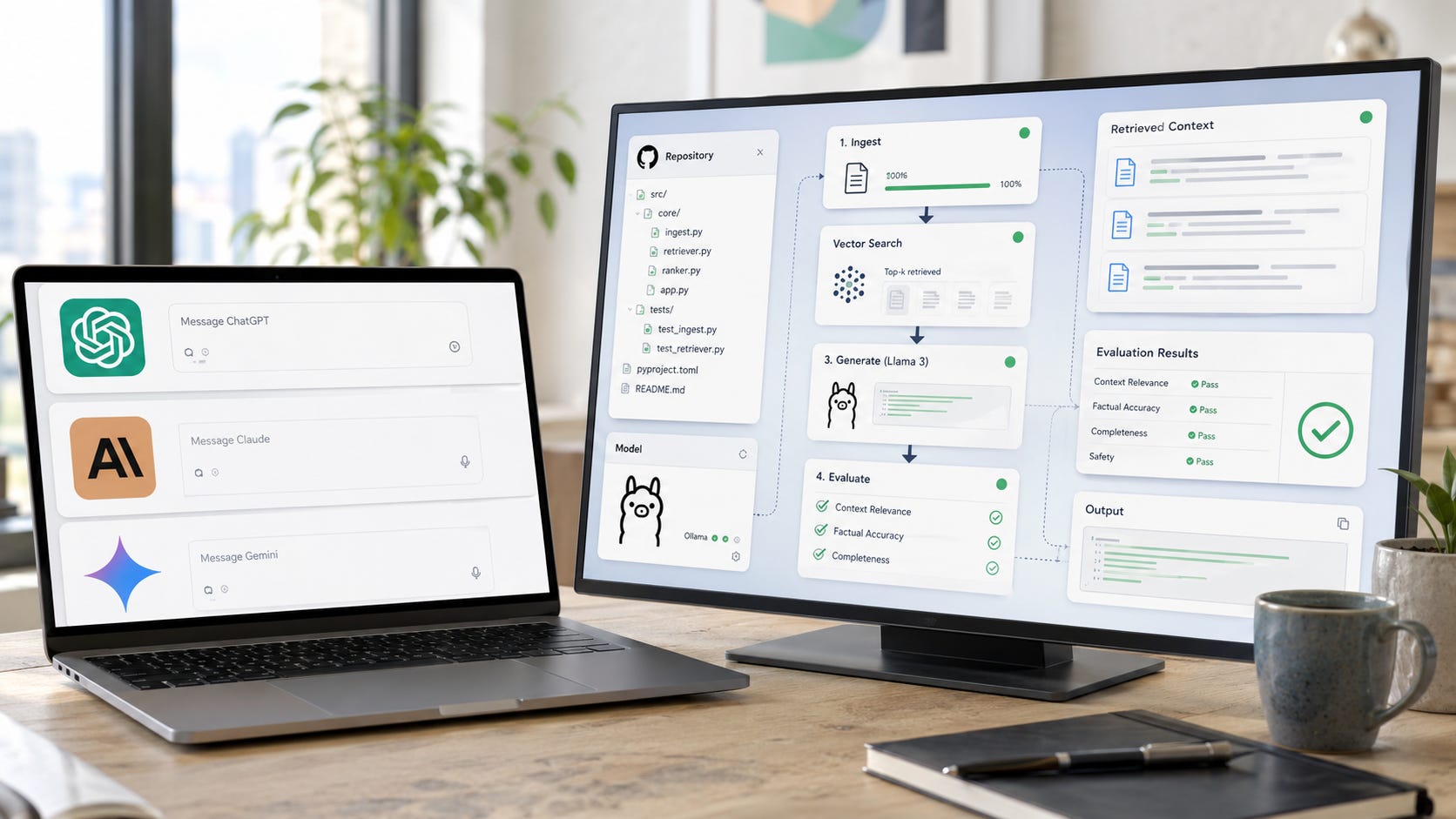
The strongest frontier AI models are still getting better. The harder question is whether their public benchmark wins tell you which model will work inside your workflow.
For many users, the answer is no.
Most teams do not need the model with the highest average score across a broad leaderboard. They need the model that can handle their edge cases, private documents, house style, legal labels, support tickets, medical workflow, codebase quirks, production failure modes, or internal review process.
That is why specialized AI models still matter, even as GPT, Claude, Gemini, and other frontier systems keep raising the ceiling. Broad benchmark optimization pulls general models toward the safe center. Specialized systems win when the task is specific enough, repeated enough, and important enough to measure on its own terms.
More on frontier AI models:

Key takeaways
Broad AI benchmarks are useful radar, but they are weak purchase orders. They can show general capability, but they cannot prove that a model fits your workflow.
The frontier is converging in the places public benchmarks can easily measure. As benchmark saturation increases, leaderboard gaps become less useful for real buying or deployment decisions.
Specialized AI models are not magic. A vertical wrapper around a general model can lose badly if it lacks better data, better retrieval, better evaluation, or tighter workflow integration.
The best specialized systems usually win through distribution fit. They use labeled examples, private context, task-specific tools, local deployment, custom tests, or feedback loops that match the job.
Local and open-weight models do not need to beat GPT, Claude, or Gemini on every leaderboard. They need to beat them on the repeated tasks where privacy, cost, control, and reliability matter most.
The useful version of specialization is specific
“Specialized AI models still win” is true only when specialization means something real.
A model or AI system is meaningfully specialized when it has at least one of four advantages. It has training or fine-tuning examples that match the task. It retrieves the right private or domain-specific context at the right moment. It runs inside a workflow with tools, schemas, tests, and feedback loops that match the job. Or it gives the user deployment control over privacy, latency, cost, versioning, availability, or access.
That is very different from a general-purpose model hidden behind a vertical SaaS interface with a few extra prompts.
The difference matters because the strongest general models can still beat tools marketed as domain-specific. A 2026 Nature Medicine study compared two specialized clinical AI tools with GPT-5.2, Gemini 3.1 Pro, and Claude Opus 4.6 across MedQA, HealthBench, and real clinical queries reviewed by clinicians. The frontier LLMs outperformed the clinical tools in all three evaluations, while the authors also noted that proprietary clinical tools can be hard to assess because their architectures and training pipelines are not public.
That is the cleanest version of the lesson. Small does not automatically beat big. Vertical does not automatically beat general. Domain branding does not automatically beat frontier scale.
Fit beats generic scale when the fit is real.
Broad benchmarks reward average strength
A broad benchmark rewards average strength across many tasks. That is useful when you are comparing general models. It becomes weaker when the top models cluster together and the benchmark stops separating them in ways that matter for practical deployment.
A 2026 paper on benchmark saturation, When AI Benchmarks Plateau, analyzed 60 language model benchmarks and found that nearly half showed saturation, with saturation increasing as benchmarks aged. The paper’s larger point is more important than the exact percentage: a benchmark can lose decision value once most serious models learn how to do well on it.
This creates a predictable incentive. Once a benchmark becomes a prestige scoreboard, developers optimize for the score. That does not require cheating. It can happen through training data choices, evaluation-aware post-training, benchmark-shaped prompting, and product pressure to advertise clean numbers.
The benchmark is still useful. It is no longer enough.
That is why newer evaluations try to avoid static-test decay. LiveBench was designed around frequently updated questions, objective ground-truth scoring, and a contamination-limited structure because test-set contamination can make older benchmarks less fair over time.
OpenAI’s own safety documentation shows a similar pattern in a different domain. The GPT-5.5 Instant system card says earlier standard evaluations for some categories had become “relatively saturated,” so OpenAI introduced production benchmarks built from more challenging, production-like examples.
That is the center problem. Public benchmarks become shared targets. Shared targets make models more comparable, but they also make models more similar.
The safe center is also a product choice
Benchmark pressure is only one force. Post-training is the other.
Modern frontier models are tuned to be helpful, safe, polite, compliant, and broadly acceptable to many users. That is a reasonable product goal. Most people want a model that answers clearly, refuses obviously dangerous requests, and does not act like an unfiltered autocomplete engine.
The tradeoff is that broad preference optimization can compress behavior toward the median. Research on RLHF from heterogeneous feedback notes that many RLHF approaches assume human preferences are relatively homogeneous and can be encoded by a single reward model, even though real preferences differ across people and contexts.
That is exactly where power users feel the loss. They may not want the most agreeable answer. They may want harsh editing, adversarial review, creative weirdness, aggressive debugging, domain-specific terminology, strict formatting, or a model that follows an internal process without smoothing it into generic advice.
Output homogenization research makes the issue more precise. The OpenReview paper LLM Output Homogenization is Task Dependent argues that sameness can be good or bad depending on the task. In math, convergence on the same final answer is usually desirable. In creative writing, sameness in plot, genre, setting, or narrative structure can make a model less useful.
That is the safe center in practice: polished, broadly acceptable, easier to defend, and often less useful at the edge.
Benchmark leaders can still fail the desk test
Some benchmarks are much better than others. SWE-bench is a strong example because it evaluates models on real GitHub issues where the model must generate a patch that resolves a described problem. SWE-bench Verified went further by creating a human-validated subset intended to improve reliability in that software-engineering evaluation.
That is progress. It moves evaluation closer to real work.
Even practical benchmarks remain benchmark-shaped. They cannot fully capture your repository, your test culture, your tooling, your code review standards, your flaky CI, your forbidden dependency list, or the half-documented tribal knowledge inside your team.
Popular AI has covered this gap in coding agents before. A model can look strong in evals and still break on a local desk when chat templates, tool parsers, streaming, SDK behavior, file edits, and local runtimes collide, as the earlier piece on Qwen 3.5 and the desk test argued.
The more serious the workflow, the more this matters. “Best model” stops being a leaderboard question and becomes an operations question.
More on local coding agents:

What specialized AI models actually specialize in
Specialization has several layers. Treating them as the same thing is where many AI deployments go wrong.
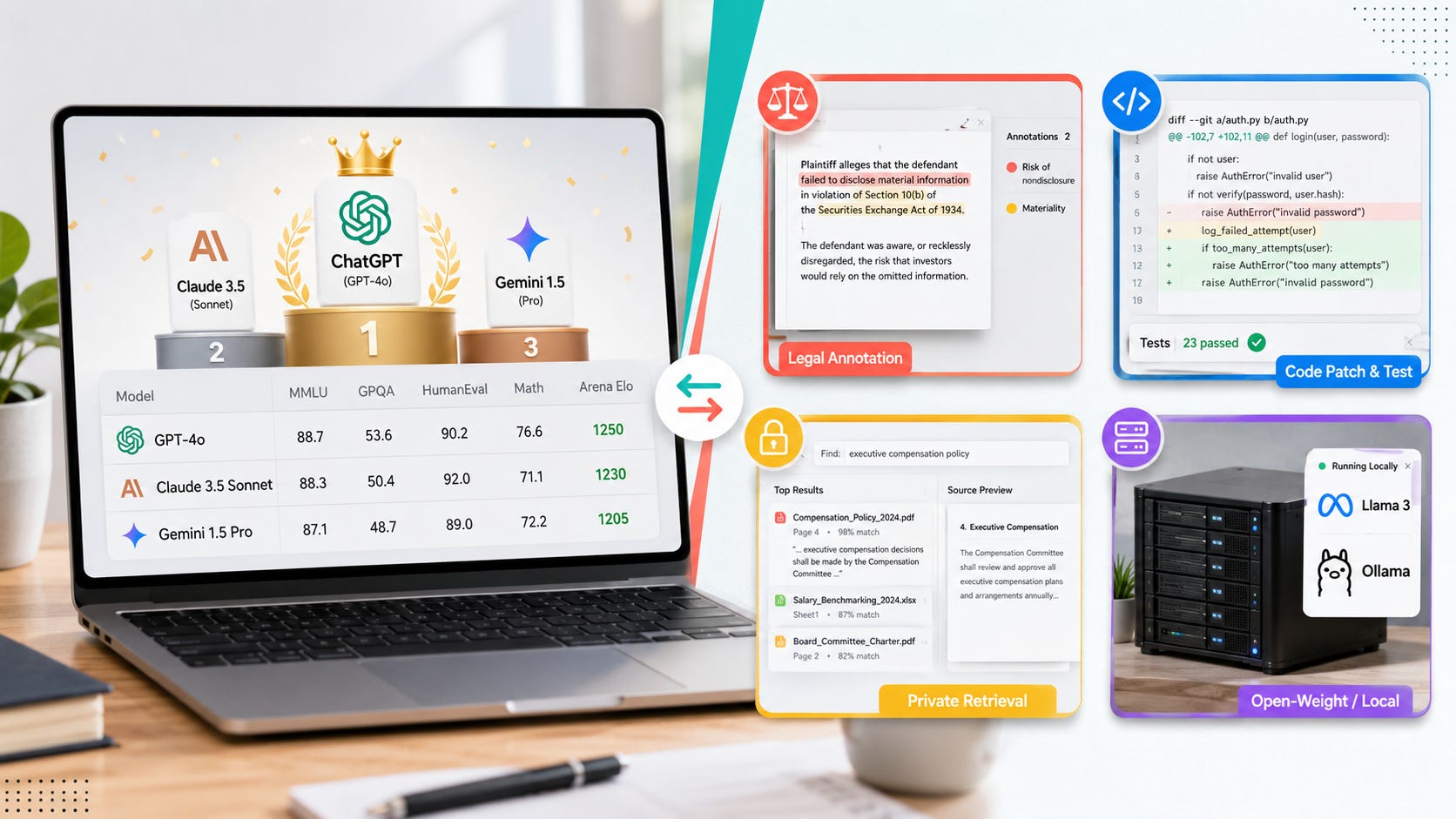
Data specialization is the obvious version. A model is trained or fine-tuned on examples that match the task. The legal annotation paper Lawma is a strong example. The authors built CaselawQA with 260 legal text classification tasks and found that a lightly fine-tuned Llama 3 model vastly outperformed commercial models such as GPT-4.5 and Claude 3.7 Sonnet. They also found that a few dozen to a few hundred labeled examples were often enough to beat the prompted commercial-model approach.
That is specialization working as advertised. The task is concrete. The labels exist. The output format is measurable. The model can learn the edge cases.
Retrieval specialization uses RAG to feed a general model private or domain-specific context from documents, tickets, contracts, manuals, customer records, or code. This can work extremely well when the main problem is missing context. It can also fail when retrieval brings in irrelevant material, misses the key document, or forces the model to reconcile bad context with its own priors. The same Nature Medicine study notes that RAG can hurt performance when irrelevant material is retrieved or poorly integrated by the base model.
So RAG needs more than a vector database and a confident prompt. It works only when retrieval, ranking, chunking, context windows, source selection, and answer synthesis are tested together.
Tool and workflow specialization can make an average chat model excellent inside a tuned system. For coding, that means repository indexing, test execution, patch validation, tool-call reliability, and rollback behavior. For customer support, it means policy retrieval, ticket classification, escalation rules, and CRM integration. For publishing, it means house style, source handling, fact checks, formatting rules, and editorial QA.
This is where open-weight and local models become more interesting. Our earlier piece on open weights versus closed APIs argued that agent reliability is becoming the real battleground because serious work depends on planning, tool use, state, execution, and error recovery, not merely pleasant chat.
Deployment specialization is sometimes the most important layer. The special part may be where the model runs, how stable it is, and who controls it. A local model can be weaker on broad reasoning and still win because it is private, cheap at high volume, stable across version changes, and available without an account. That is why local AI hardware can make sense when the purchase is about privacy, resilience, sustained usage, and control, as our guide to whether local AI hardware is worth it in 2026 explains.
For some users, local control is the edge case.
More on open weights vs closed APIs:

Where specialized systems have the best evidence
The strongest case for specialization comes from tasks with clear labels and repeatable scoring.
Lawma shows the legal-classification version of the argument. In the Lawma paper, a small number of examples could be enough for a lightly fine-tuned open model to beat larger commercial models when the task was structured and the domain labels matched the work.
Face recognition research gives another example outside text. A 2025 paper comparing generic foundation models with domain-specific face-recognition models found that domain-specific models outperformed zero-shot foundation models across the face benchmark datasets studied. The paper also found that combining a foundation model with a domain-specific model could improve accuracy at low false-match rates.
The lesson is not that every domain needs a giant domain foundation model. In some fields, the opposite lesson is more useful. An ICLR 2025 paper found that across genomics, satellite imaging, and time series, simple supervised workflows could match or outperform newer specialized foundation models.
That matters because specialization can become its own form of benchmark theater. A giant domain model may sound impressive, but the real question is whether it beats a strong baseline on the job at hand.
A retinal-imaging evaluation reached a similar conclusion. The paper When Do Domain-Specific Foundation Models Justify Their Cost? found that compact architectures dominated the Pareto frontier for several tasks, while the large domain-specific RETFound model justified its cost mainly for the more difficult diabetic retinopathy grading setting.
Specialization wins when it is targeted. Oversized specialization can waste money, compute, and time.
Where frontier generalists still win
The frontier model advantage is real.
Large general models benefit from massive training corpora, expensive post-training, broad tool ecosystems, fast iteration, and product feedback from millions of users. When the task is broad knowledge, cross-domain reasoning, communication quality, open-ended synthesis, or general instruction following, scale often wins.
The clinical-tool comparison is the cautionary example. In the Nature Medicine evaluation, specialized clinical AI tools did not outperform frontier LLMs. The authors concluded that clinical tools may carry institutional legitimacy, but their results did not show superiority over frontier models on knowledge, communication, or clinical alignment.
That means “specialized” should be earned, not assumed.
A model is not specialized because the product page says “for doctors,” “for lawyers,” “for finance,” or “for enterprise.” It is specialized when evidence shows better performance on the exact tasks that matter.
Distribution fit is the real reason specialized AI wins
Frontier models are trained to be broadly useful across the internet. Your workflow is not the internet.
That gap is easy to underestimate because general models are so fluent. They can explain almost anything, rephrase almost anything, and sound plausible across domains. But fluency is not the same as fit. A model can write a beautiful answer while missing the local rule, the internal exception, the required label, or the one citation your reviewer cares about.
Your workflow may contain uncommon labels, private terminology, internal style rules, weird documents, legacy code, industry acronyms, forbidden answers, required citations, risky edge cases, hard pass-or-fail criteria, human review bottlenecks, or data that cannot leave your machine.
A broad benchmark averages across tasks. Your business or project does not.
This is why a smaller model with the right data can outperform a giant model with the wrong default. The smaller model does not need universal intelligence. It needs to stop making the same mistakes on the same repeated task.
That is the underappreciated advantage of specialized AI models. They can narrow the target until the system is judged by the work, rather than by a leaderboard built for everyone.
How to test specialized AI in your own workflow
Do not argue about leaderboards. Build a small evaluation harness.
Start with 30 to 100 real tasks from your own work. Include ordinary cases, annoying cases, and cases where a wrong answer would be expensive. Remove private information only if the model being tested does not need it. If privacy matters, test at least one local or self-hosted path.
Score the outputs with practical criteria. Did the system produce the correct answer? Did it follow the required format? Did it cite or use the right source? Did it refuse when it should have answered? Did it answer when it should have escalated? Did it break hidden constraints? Did it preserve tone or style? Did it save time after human review? Did it run cheaply enough to use every day? Could you replay and debug the failure?
Then compare four setups.
First, test a top hosted frontier model. Second, test a cheaper hosted model. Third, test a strong open-weight model you can run locally or on your own server. Fourth, test a specialized path such as RAG, fine-tuning, a local adapter, a custom agent harness, or a task-specific classifier.
The winner is not the model with the prettiest answer. The winner is the system that passes your cases with the least review burden, acceptable cost, and the right level of control.
What this means for local AI users
Local AI users should stop asking whether a local model beats the top hosted model in general. That is usually the wrong question.
The better question is whether the local model can do a specific job well enough, privately enough, cheaply enough, and reliably enough that hosted access is no longer the bottleneck.
For some tasks, the answer will be no. Use the frontier model. Do not make a local workflow harder than it needs to be.
For repeated private work, the answer may be yes. A local model that scores lower on broad benchmarks can still be the better tool for sensitive documents, internal search, offline drafting, codebase-aware agents, bulk classification, first-pass extraction, and high-volume workflows where account limits or data exposure matter.
Our guide on how to choose the right local LLM for 8GB, 12GB, and 24GB VRAM is a useful next step if the bottleneck is VRAM, quantization, or model fit across different local hardware tiers.
The local model does not need to be the smartest model on earth. It needs to be smart enough, controllable enough, and close enough to your data.
More on choosing the right local LLM:

What frontier labs will do next
The labs will not abandon broad benchmarks. They will add better ones.
OpenAI’s GPT-5.5 release page leans heavily on agentic coding, computer use, knowledge work, scientific research, Terminal-Bench, SWE-Bench Pro, OSWorld-Verified, Toolathlon, BrowseComp, FrontierMath, CyberGym, expanded safeguards, red-teaming, and trusted-access paths for advanced cyber capabilities.
That is the next frontier: better benchmarks, more private benchmarks, more agent benchmarks, more production-like benchmarks, and more safety benchmarks.
This will help. It will not remove the need for your own tests.
A benchmark built for everyone still cannot know your edge cases.
FAQ
Are AI benchmarks useless?
No. Good benchmarks are useful for tracking progress and building a shortlist. The mistake is treating a public leaderboard as proof that a model will work in your specific workflow.
Why do frontier models feel more similar over time?
Top models are trained against many of the same public expectations: broad benchmark performance, helpfulness, safety, refusal behavior, speed, product polish, and mass-user preference. That does not make them identical, but it can compress default behavior toward a more polished center.
When should I use a specialized AI model?
Use a specialized AI model when you have repeated tasks, labeled examples, private documents, strict formatting needs, domain vocabulary, predictable failure modes, or edge cases that broad models keep missing.
When should I stick with a frontier model?
Stick with a frontier model when the task is broad, messy, creative, low-risk, or heavily dependent on general reasoning. Also use a frontier model as a baseline before investing in fine-tuning, RAG, or local deployment.
Is RAG enough to make a model specialized?
Sometimes. RAG helps when the main problem is missing context. It is not enough when the model cannot reason over the retrieved material, retrieves irrelevant documents, ignores instructions, or needs task-specific behavior that context alone cannot teach.
Can local AI models beat ChatGPT, Claude, or Gemini?
For general use, usually not. For specific local workflows, yes. A local model can win on privacy, cost at scale, repeatability, offline access, and task fit even when it loses on broad benchmark intelligence.
The edge still belongs to measurable fit
Use broad AI benchmarks to build the shortlist. Use your own workflow to choose the winner.
Pick a frontier model when the task is broad, exploratory, one-off, or benefits from maximum general reasoning. Pick a specialized AI model or specialized system when the task is repeated, measurable, private, domain-heavy, format-sensitive, or expensive to review manually.
The safe center is often exactly what a mass-market model needs to be. It is polished, predictable, and easier to support for millions of users.
The edge is different. The edge is where your labels, files, code, policies, style rules, privacy constraints, and failure modes live.
Specialized AI wins when you can define that edge, measure it, and build for it.
Explore more from Popular AI:
Start here | Local AI | Fixes & guides | Builds & gear | Popular AI podcast
Would you trust a top-ranked frontier model, or the specialized AI model that performs better on your own real-world tests?