


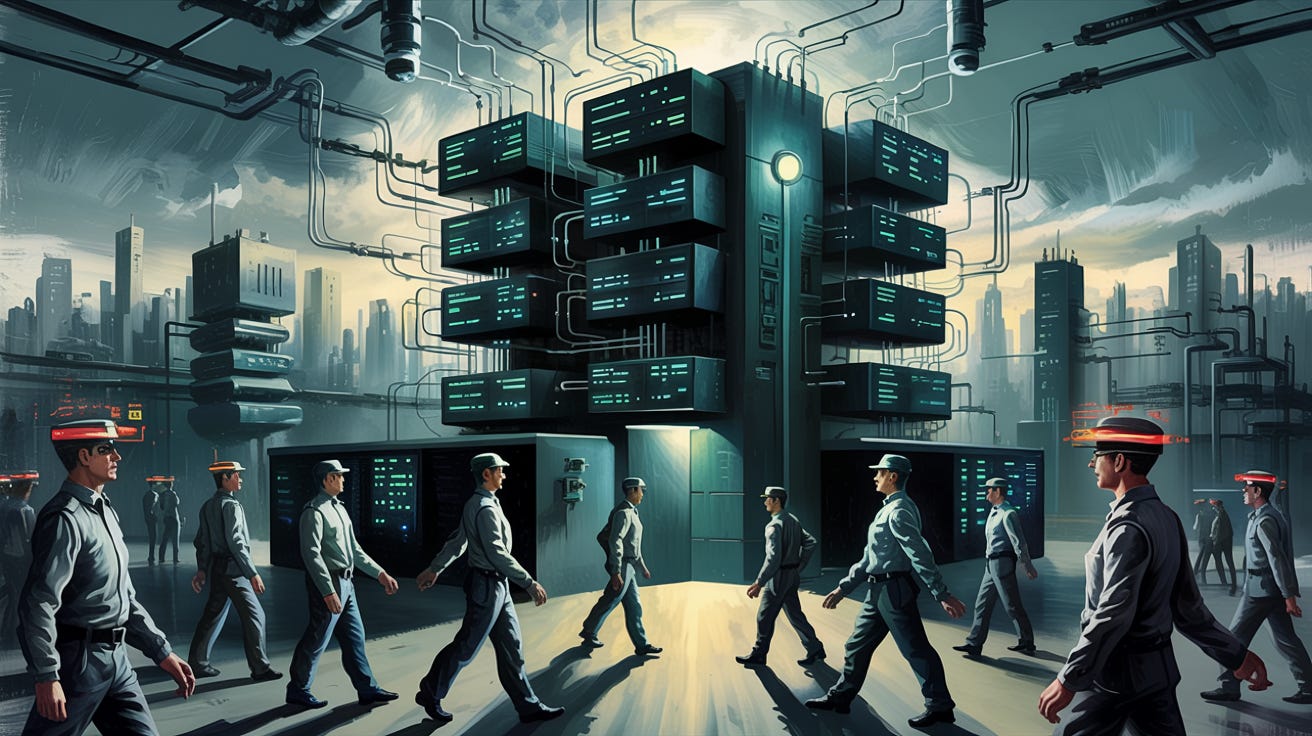
Like it or not, the chance that we will witness countries being (at least ostensibly) ruled by standalone AI agents in our lifetime is real. When searching for a term to describe such a system, “technocracy” doesn’t quite fit the bill. After all, a technocracy carries the implication that a human managerial elite still pulls the strings, and merely utilizes technology to direct, or oppress, society. What is coming at us in the near future is an entirely different beast.
“Algocracy” is a term coined and theorized by sociologist A. Aneesh, first in his book Virtual Migration in 2006 and then in his 2009 article “Global Labor: Algocratic Modes of Organization.” He used it to describe rule executed through code and procedures rather than human discretion. Although it was James Corbett who brough it to my attention.
Marc Andreessen introduces the concept like a product manager previewing the feature that will define your life:
“This is my belief and what I’ve been trying to tell people in Washington, which is if you thought social media censorship was bad, this has the potential to be a thousand times worse. And the reason is social media is important, but at the end of the day, it’s, you know, it’s quote, just people talking to each other. AI is going to be the control layer on everything. Right? So AI is going to be the control layer on how your kids learn at school. It’s going to be the control layer on who gets loans. It’s going to be the control layer on does your house open when you come to the front door? It’s going to be the control layer on everything. Right? And if that gets wired into the political system, the way that the banks did and the way that social media did, like we are in for a very bad future. And that’s a big thing that we’ve been trying to prevent is to keep that from happening.”
That is not so much a warning as it is a roadmap. “Control layer” basically spells out the intention of the whole thing. Interpose an AI model between a family and its front door and you have replaced consent with permission. Note the date. This exchange aired on November 26, 2024 on The Joe Rogan Experience #2234, and Andreessen had already used the same phrase a year earlier in his “AI Will Save the World” essay. The repetition is the tell. This is an agenda, not a slip.
Then comes the soft sell. Joe Rogan floats a “solution” that turns the roadmap into governance.
“I’ve said publicly, and I’m kind of half joking that we need AI government. It sounds crazy to say, but instead of having this like alpha chimpanzee that runs the tribe of humans, how about we have some like really logical fact-based program that makes it like really reasonable and equitable in a way that we can all agree to. Let’s govern things in that manner.”
This is how you launder power. Swap fallible men you can fire for inscrutable models you cannot audit. Call it “logical” and “equitable.” Never mind who tunes the weights or curates the data fed into the system. For the record, same episode, same date. The timeline matters because normalization requires repetition until resistance feels impolite.
If “control layer” still sounds abstract, we already have case studies of what happens when decision rights migrate into code. The Netherlands used automated risk profiling in its childcare benefits system, flagging thousands of innocent families as fraud risks and financially crushing them. The scandal helped topple the government in 2021. That is algocracy in the wild, not in a white paper.
Across the Channel, the United Kingdom tried to algorithmically grade A-levels during lockdown. The model disproportionately hammered students from larger state schools and advantaged elite schools. Public outrage forced a U-turn within days.
If you think the “control layer” stops at paperwork, look to places where payments, identity and messaging are fused. Shenzhen’s jaywalking fines were auto issued by facial recognition and deducted through integrated payment rails. You cross the street and the money is already gone. This is not science fiction. It is the natural endpoint of an everything-app architecture welded to state enforcement.
There is no neutral “AI government.” There is only an administrative class hiding behind models it controls and updates without consent. Once a control layer mediates schooling, credit and access to your own front door, every dissident act becomes toggleable policy. The Dutch scandal shows families can be ruined by a classifier that never meets their eyes. The UK fiasco shows legitimacy cannot be retrofitted after the model runs. The American risk-score debate shows that even when watchdogs bring receipts, the machine keeps humming.
All available precedents illustrate that it would not be wise to outsource national or democratic sovereignty to software. Leveraging AI to improve society does not mean we should accept algorithmic governance we cannot inspect. In that light, there is a decisive bifurcation forming in the area of AI-enhanced government.
On one hand, some governments will embrace the opportunity to hide behind closed-source algorithms. We will see them justify the most draconian instances of abuse and overreach with the excuse that it is not the political hierarchy that is responsible, but instead, they were just following instructions passed down from the computer gods.
On the other hand, we will hopefully see more democratically inclined governments choosing decentralized and localized open-source AI applications, allowing full transparency without delegating democratic sovereignty from the public to a glorified chatbot.
Or, knowing the nature of government, is that just wishful thinking?
Explore more from Popular AI:
Start here | Local AI | Fixes & guides | Builds & gear | Popular AI podcast