


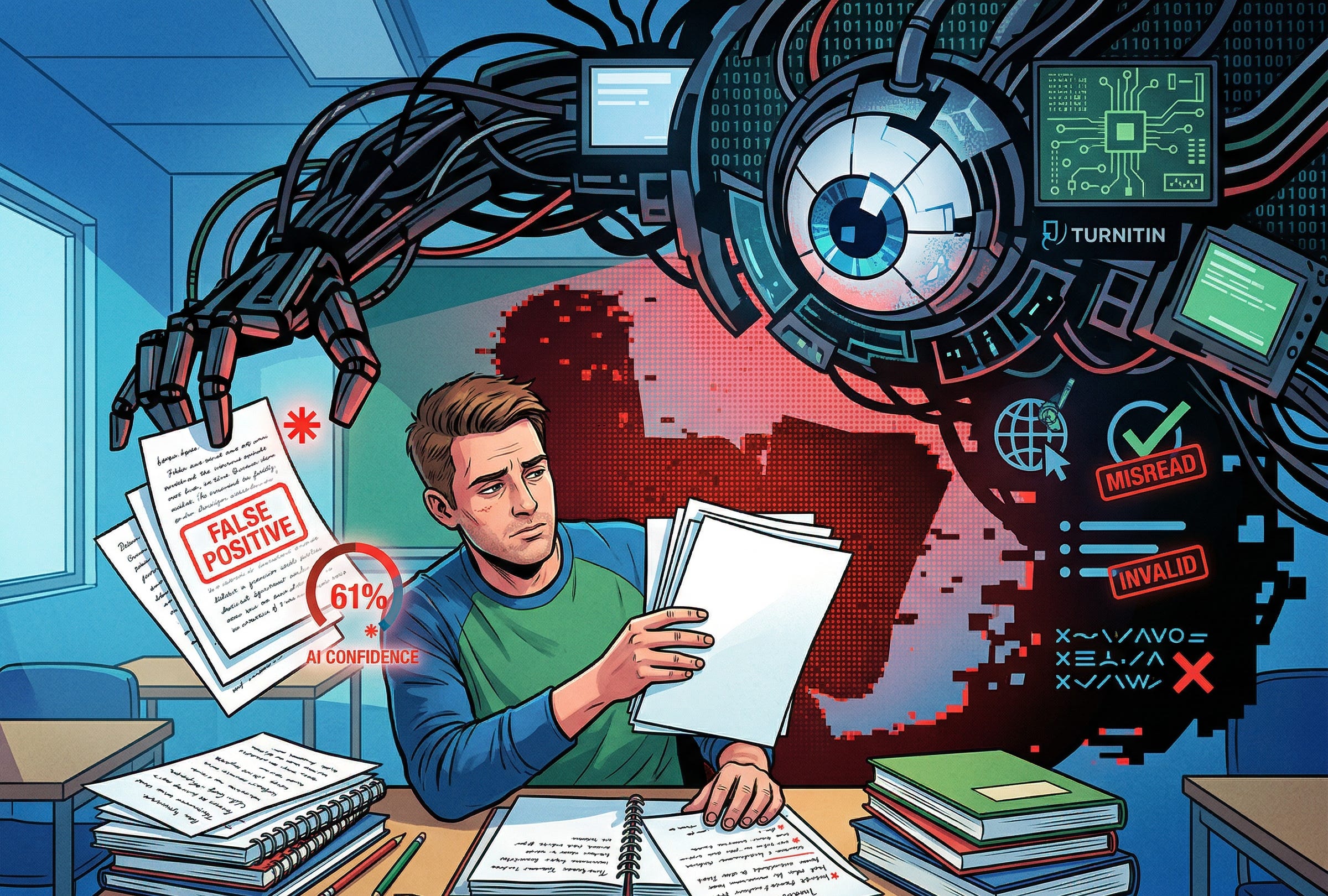
Turnitin false positives are no longer an awkward edge case in the AI era. They sit at the center of how schools investigate writing, assign suspicion, and decide whether a student deserves the benefit of the doubt. That is why the paper trail matters so much. Since Turnitin launched AI writing detection on April 4, 2023, the company has repeatedly adjusted the tool, refined its interface, and warned educators that the output can be wrong. Its own release notes archive documents changes tied to false-positive concerns, while the current AI Writing Report guide says the model may misidentify human-written, AI-generated, and AI-paraphrased text.
That warning should have settled the core question. A detector score is not proof. Yet in many classrooms and conduct offices, the score still lands with the force of a verdict. The danger starts with the way the tool is framed. Turnitin separates the AI indicator from the similarity score, and the company’s guidance makes clear that the AI highlights are not even visible in the Similarity Report. That means an instructor can see a machine judgment that a student cannot independently inspect unless it is shared.
The company’s own language has become more careful over time. In its public false positives explainer, Turnitin said it had prioritized a less than 1 percent false-positive rate while still acknowledging a real risk of error. In the newer guidance, the warning is blunter. Scores in the 0 to 19 percent range are treated as less reliable, and low scores are now suppressed with an asterisk rather than displayed as exact percentages. That is a meaningful change, because it reflects the same point critics have been making from the start. Low-confidence AI judgments are easy to overread and hard to challenge once they are attached to a student’s name.
The release notes make the story even harder to ignore. Turnitin says results between 1 and 20 percent had a higher incidence of false positives, raised the minimum prose length to 300 words, and adjusted how the model handles sentences at the beginning and end of a document. The current guide also says the tool does not reliably process short-form and non-prose writing such as bullet points, tables, and annotated bibliographies. Taken together, those changes describe a system that has needed ongoing correction in the wild.
More on AI detectors

What the vendor record actually shows
One fact matters more than anything else in the Turnitin debate: the company itself has tried to stop people from treating the detector like courtroom evidence. The AI Writing Report guide says the tool should not be used as the sole basis for adverse action against a student. The Turnitin blog post on false positives makes the same point and urges educators to assume positive intent when the evidence is unclear.
That is an extraordinary disclaimer for a product that is now woven into academic integrity workflows. When a vendor says a score can misidentify human writing and should not stand alone in a misconduct case, schools do not get to pretend the warning is boilerplate. It goes to the heart of fairness. A plagiarism checker can at least point to matching source text. An AI detector does something much fuzzier. It infers authorship from patterns, predictability, phrasing, and model-like regularity. That may sound technical enough to inspire confidence, but it still leaves institutions making high-stakes decisions from probabilities rather than direct evidence.
The same record also shows how easy it is for the tool’s operational limits to become due process problems. Turnitin’s report is built for instructors, not students. Purdue’s guidance for instructors explicitly states that the AI writing detection indicator and report are visible to instructors and not visible to students. In practice, a student may be told that software found likely AI writing while never being given the same clear, immediate access to the underlying report. That gap matters because opaque evidence tends to harden suspicion rather than invite scrutiny.
The cases that broke the illusion of certainty
The public warning signs appeared almost immediately. In spring 2023, The Washington Post’s test of Turnitin’s detector found that original student work could be wrongly flagged. High school senior Lucy Goetz’s essay was partially marked as likely AI-generated even though it was her own writing. The broader test also showed how mixed human and AI material could confuse the system, which is exactly the kind of edge case schools should expect in real classrooms.
Then came the kinds of classroom stories that matter more than product marketing. In The Markup’s reporting on false accusations against international students, Johns Hopkins instructor Taylor Hahn described a student who defused a Turnitin accusation by producing drafts, highlighted materials, and the kind of messy evidence real writers actually generate. Hahn later saw another paper flagged even though he had personally worked with the student through the outline and draft process. Those details cut through the abstraction. When a teacher has watched a paper develop and the software still says it is mostly AI, the problem is no longer theoretical.
A similar pattern runs through Robert Topinka’s account in The Guardian. He described receiving a Turnitin result that labeled a student essay as 100 percent AI-generated, even though the student was a strong writer before ChatGPT entered the classroom. The case became more complicated when approved writing support tools with limited generative features entered the picture. That is exactly where detector culture becomes dangerous. Accessibility tools, spelling support, grammar help, translation assistance, and legitimate drafting aids can all start to look suspicious when staff are primed to read polished writing as machine-authored.
Outside those individual stories, broader reporting has shown the same institutional pattern. AP’s reporting on colleges scrambling to “ChatGPT-proof” assignments quoted Temple University staff who tested Turnitin’s detector and found it “incredibly inaccurate,” especially with hybrid work. That point matters because hybrid work is exactly what instructors are likely to encounter, whether that means light editing, translation support, paraphrasing tools, or a student who used AI in ways that fall into a gray area rather than obvious ghostwriting.
The scale of the fallout becomes even clearer in ABC News reporting on Australian Catholic University. ABC reported that ACU recorded nearly 6,000 alleged academic misconduct cases in 2024, that about 90 percent were AI-related, and that a substantial share were dismissed after investigation. ABC also reported that ACU later abandoned the Turnitin tool after finding it ineffective. At that point, the issue is no longer a few bad calls. It becomes a model of institutional overreach powered by software that was never strong enough to carry that burden.
Why false positives keep happening
False positives are not a glitch that can be wished away. They follow directly from how these systems work. As the University of Iowa’s case against AI detectors explains, detector tools look for linguistic patterns and statistical regularities that are more common in machine-generated writing. That is a very different task from plagiarism detection, where a system can point to source overlap. AI detection is an inference engine. It does not show copied passages from a database. It makes a probability judgment about whether a piece of writing looks too predictable, too formulaic, or too smooth.
That is why so many false-positive cases involve writing that is structured, polished, cautious, or conventional. It also explains why Turnitin has had to refine how it handles introductions, conclusions, short submissions, and formatting issues. These are precisely the places where rule-bound academic prose can resemble the statistical regularity that detectors are trained to spot. The closer a student writes to an expected pattern, the more the detector may mistake competence for artificiality.
This dynamic creates an especially serious fairness problem for non-native English writers. The Stanford-led study published in PMC found that seven widely used detectors misclassified non-native English writing as AI-generated at an average false-positive rate of 61.3 percent. That finding lines up with The Markup’s reporting, which documented instructors noticing that international students were being flagged more often. Once that pattern appears, continued blind faith in the tool stops looking like neutrality and starts looking like disparate impact.
The failure runs in the other direction too. In the PLOS ONE blind test from the University of Reading, researchers submitted AI-generated exam answers into a real university assessment system and found that 94 percent went undetected. Those AI submissions also outperformed real students on average. That leaves institutions with the worst combination possible. The software can miss real AI use while still accusing innocent students. A system that both under-detects and over-accuses creates liability rather than reassurance.
How a detector score turns into a presumption of guilt
The practical problem for students is simple and brutal. Once a detector score appears, the burden often shifts. Instead of the institution having to prove misconduct with clear evidence, the student is pushed to reconstruct their writing process and explain why the machine was wrong. That reversal is easy to miss if you only look at policy language. It becomes obvious the moment you look at what students are actually asked to do.
The University of Melbourne’s guidance on Turnitin and AI writing detection says an AI writing detection report alone is not sufficient evidence for an allegation. That is the right principle. But the same page also tells students they may be asked to explain how they developed their argument and to provide drafts or notes from earlier stages of the assignment. In other words, the software may not be enough on its own, but it can still trigger a process in which the student has to defend authorship after the fact.
That burden becomes even heavier when institutional procedures are slow, opaque, or punitive. ABC’s reporting on ACU described students waiting months to be cleared, seeing results withheld, and being asked for handwritten notes or internet search histories to rule out AI use. Even when a student is eventually exonerated, the accusation itself can still do damage. Academic records are delayed. Job applications suffer. Trust in the classroom collapses.
The official guidance that universities publish often sounds more careful than what students experience. The University of Sydney’s AI policy page says the Turnitin detector score would not be the only evidence relied upon in an academic integrity case. That is a sensible position. So is Vanderbilt’s explanation for disabling Turnitin’s AI detector, which steers staff away from detector dependence and toward clear expectations and better assignment design. The gap between those policies and the lived experience of many accused students is where the real story sits.
What students should do the moment their work is flagged
The first move is to ask for the full basis of the allegation. Students should request the AI report, the highlighted passages, the course policy on AI use, and a clear explanation of what evidence exists beyond the score itself. That request reflects basic procedural fairness. Both the University of Melbourne guidance and The University of Sydney policy page make clear that a detector result should not stand alone.
The second move is to preserve the writing trail immediately. Save version history from Google Docs or Word. Keep outlines, notes, screenshots of revision history, research tabs, feedback from classmates or instructors, and earlier drafts. The reason this matters is visible across the public record. In The Markup’s investigation, students and instructors were able to puncture bad AI accusations by showing the messy trail of real authorship. Melbourne’s guidance also points students toward drafts and notes when questions arise.
Students should also be ready to explain authorship in concrete detail, rather than simply deny the allegation. That means being able to talk through the thesis, the structure, the sources, and why specific revisions happened. A convincing explanation is often more powerful than a flat statement of innocence because it shows how the paper came together. That kind of explanation helped in documented false-positive cases, including the ones described by The Markup and The Guardian.
It is also important to document every permitted tool that shaped the work. If Grammarly, spelling correction, translation support, dictation software, or accessibility accommodations were involved, students should say so clearly and describe what those tools actually did. Detector systems flatten these distinctions. A grammar aid, a language support tool, and a ghostwriter can all get swept into the same cloud of suspicion if the institution has not drawn careful lines.
One more caution belongs here. Students should not panic and start submitting their papers to random detector websites or so-called AI humanizers. Melbourne’s guidance warns that public detector sites may be inaccurate and may create new academic integrity or intellectual property problems. The impulse is understandable, but feeding coursework into unknown services can make a bad situation worse.
How students can lower the risk before submission
The best protection is a visible drafting process. Work in software with version history turned on. Keep a simple outline. Save notes and research snapshots. When AI use is permitted, record how it was used and keep the outputs. The University of Sydney’s guidance explicitly tells students to keep track of how generative AI was used and to keep copies of outputs as evidence of the writing process. That advice is practical because it turns authorship into something you can demonstrate rather than something you hope a detector will infer.
Students should also read assignment rules closely because the important distinction now is assessment-specific policy. Many institutions are moving away from blanket panic and toward rules tied to the purpose of the task. Sydney’s framework distinguishes between secure assessments, where AI is generally prohibited unless allowed, and open assessments, where AI may be used if properly acknowledged. That kind of clarity helps everyone. It gives students a workable standard and reduces the temptation to treat software detection as a shortcut for policy design.
What institutions should do instead
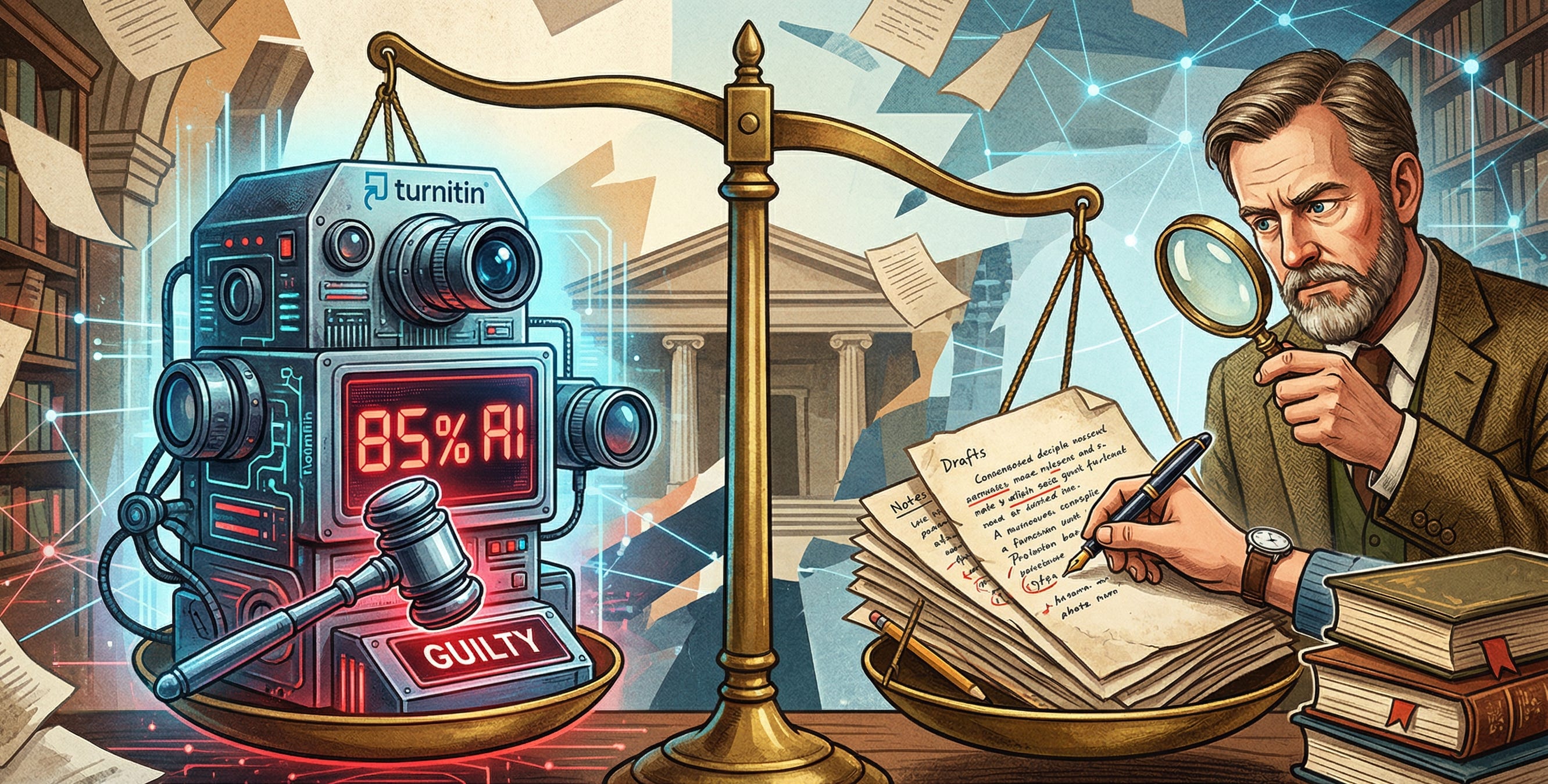
The first reform is simple. Ban detector-only allegations. If the vendor says the score should not be the sole basis for adverse action, institutions should put that sentence into their own policy. Turnitin says it in the AI Writing Report guide. Melbourne says the report alone is not sufficient evidence. Sydney says the score will be considered alongside other evidence. Schools that continue to use detectors should at least write those guardrails into procedures that staff have to follow.
The second reform is transparency. If a report is part of the case, the student should get the report, the highlights, and a clear explanation of how the institution is interpreting them. There is no principled defense of secret machine evidence in academic discipline. That is one reason Purdue’s cautionary guidance is so telling. It states outright that the report is instructor-facing and not visible to students. That design choice might make workflow sense for a product. It makes far less sense in a misconduct process.
The third reform is to shift away from product-policing and toward process evidence. Vanderbilt’s decision to disable the detector points instructors toward clearer communication, better assessment design, and conversations about what is allowed. The University of Iowa goes further and tells instructors to refrain from using AI detectors on student work because of their inherent inaccuracies and the risk of false accusations. That is the more honest direction. Ask for outlines. Use oral check-ins where appropriate. Build assignments that reveal process. Require disclosure when AI is allowed. Those measures are slower than clicking a score, but they are more defensible and more educational.
The fourth reform is to separate ghostwriting from legitimate support tools. The current panic often collapses those categories into one. That is unfair to students who rely on grammar assistance, translation help, dictation, or disability accommodations. The Guardian’s account from Robert Topinka shows how quickly a student can be pushed into suspicion because approved software sits too close to prohibited AI in the institutional imagination.
The fifth reform is equity auditing. Once research shows a detector hits non-native English writers harder, institutions have a duty to treat that as a policy issue rather than a technical footnote. The PMC study on detector bias against non-native English writers makes that risk impossible to brush aside. Any school still using detector outputs in disciplinary settings should be able to explain how it monitors for disparate impact and what corrective measures it has in place. Most cannot.
Further reading
The most revealing thing about the debate over Turnitin false positives is how often the strongest warnings come from the institutions and publications closest to the problem. The Washington Post, AP, ABC News, Vanderbilt, Iowa, and Purdue all point toward the same conclusion from different angles.
Turnitin false positives have exposed a basic truth about AI detection in education. The software produces weak evidence with strong consequences. It is probabilistic, opaque, and limited enough that the vendor itself warns against treating its output as a disciplinary verdict. Schools do not need more automated suspicion. They need transparent process, narrower claims, clearer policies, and human judgment that begins from fairness rather than from machine-made doubt.
Explore more from Popular AI:
Start here | Local AI | Fixes & guides | Builds & gear | Popular AI podcast
AI detectors and Turnitin false positives are becoming a real academic integrity problem, especially when students cannot fully inspect or challenge the result. Have you seen schools, teachers, or students handle this well anywhere, and what would fair due process around AI detection actually look like?