


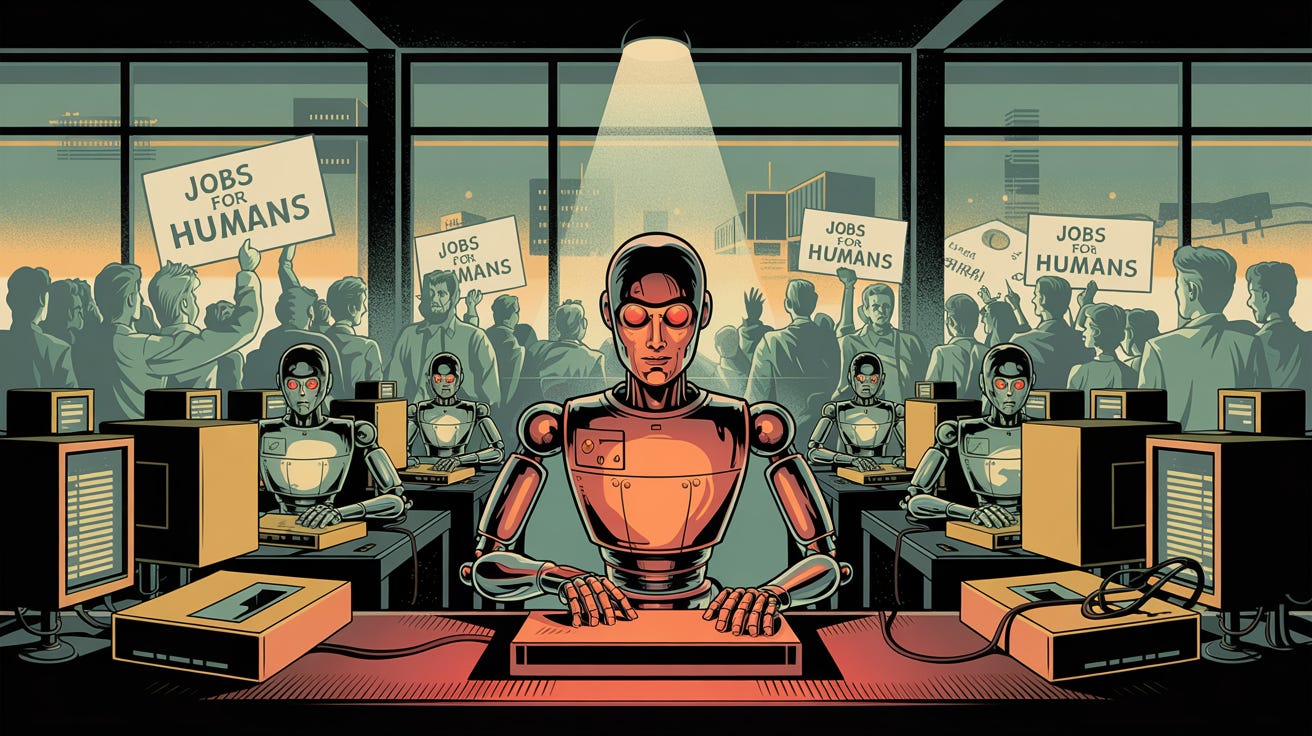
Silicon Valley’s priest-kings like to mutter about “augmenting humans,” but their balance sheets tell the truth. If a task can be done faster by a GPU rack, the meat is gone. Below are the ten roles most likely to vanish first, with hard evidence and a few pointed remarks for those still clinging to HR talking-points about “upskilling.”
10. Customer-Service Representatives
The call center is vanishing. With natural language models now capable of fielding customer queries at scale, many companies are replacing live agents with chatbots and voice assistants that work around the clock. These systems don’t get sick, don’t form unions, and don’t ask for raises. The Bureau of Labor Statistics is already ringing the bell:
“These occupations include […] customer service representatives, whose employment is projected to decline by 4.7 and 5.0 percent, respectively, through 2033.”
9. Data-Entry Clerks
There is no future in typing data into spreadsheets. Robotic process automation, combined with optical character recognition and document ingestion models, has already made manual entry look like horse-drawn accounting. The World Economic Forum spells it out:
“Jobs expected to become redundant include routine-based white-collar roles, such as data entry clerks, accounting and payroll clerks.”
Corporations don’t want accuracy. They want scale and speed. Accuracy is assumed to be a problem that will be solved after the jobs are gone.
8. Accounting & Payroll Clerks
Same World Economic Forum warning as above, because bean-counting drudge work dies the same day the data-entry drone does. Why pay three clerks to track payroll and expenses when an AI can reconcile accounts while executives sleep?
The modern CFO doesn’t need accuracy. He needs plausible deniability and a clean spreadsheet delivered without personnel drama.
7. Paralegals & Legal Assistants
Law used to require armies of junior staff to sift through case files, format contracts, and check citations. No longer. AI tools like Harvey and CoCounsel are already handling basic legal research, contract parsing, and discovery faster than the best paralegal ever could. Even mainstream institutions are admitting the truth:
“Among legal occupations, paralegals and legal assistants are expected to see the strongest employment impact from the productivity gains afforded by GenAI.”
6. Medical Transcriptionists
The same Bureau of Labor Statistics line that dooms customer-service reps also condemns medical scribes. This job is already being reduced to a rounding error. With speech-to-text systems now trained on terabytes of clinical conversations, doctors can dictate notes directly into the record. There’s no need for a human intermediary anymore. The Bureau of Labor Statistics delivers the forecast in plain English:
“Over the 2023–33 projections period, AI is expected to primarily affect occupations whose core tasks can be most easily replicated by GenAI in its current form. These occupations include medical transcriptionists…”
5. Interpreters & Translators
Machine translation is no longer a novelty. It’s now seen as a baseline requirement for global platforms, and real-time interpretation is being built into conferencing tools, chat systems, and operating systems. Microsoft’s internal Copilot readiness study made the conclusion unavoidable:
“According to the paper, the top ten jobs where AI applicability overlaps the most with expected tasks are: Interpreters and Translators.”
When software handles multilingual content natively, humans are the backup plan, not the default.
4. News Reporters & Journalists
Once the watchdogs of society, journalists are being replaced by neural nets that generate content with no need for coffee breaks or editorial oversight. Corporations have already decided that AI is more profitable than press freedom. Business Insider has been open about it:
“Business Insider is laying off about 21% of its workforce, an internal memo showed on Thursday, as the financial news outlet grapples with shrinking search traffic and the growing use of generative AI tools such as ChatGPT.”
This isn’t innovation. It’s a eulogy for human reporting.
3. Retail Cashiers
The retail industry never wanted to pay wages to begin with. Self-checkout was the warning shot. Now, entire checkout systems are being removed and replaced with surveillance-based automation that tracks purchases and bills customers as they walk out. Sam’s Club, owned by Walmart, made its plans crystal clear:
“Sam’s Club is set to remove self-checkout machines from all 600 stores in a significant overhaul of its checkout system. The replacement will be the Scan & Go system, allowing customers to scan items with a smartphone app and pay without queuing at traditional checkouts. The company’s President and CEO, Chris Nicholas, announced the changes at Walmart’s 2025 Investment Community Meeting, emphasizing the goal to reduce friction for customers.”
Consider that “friction” is corporate-speak for “employees” and you’ll get the point.
2. Telemarketers
Robotic cold-callers now handle outreach at a scale no human operation could match. They adjust tone and script based on customer responses, they operate 24/7, and they never flinch at rejection. This is not some fringe use case. It’s already displacing thousands. The BLS confirms it:
“Telemarketers … employment change –18.3 thousand, –21.5 percent.”
What began as a mass annoyance is now a mass layoff.
Insurance Claims Adjusters
This one is practically done. Insurance companies now use drones and smartphone uploads to document damage, and AI models generate repair estimates before a human ever opens the file. Appeals are filtered through black boxes. The old days of a trusted adjuster reviewing the facts are over. The Bureau of Labor Statistics cites Mckenzie Intelligence Services:
“Once photographs are taken, the analysis and initial payout estimates, traditionally prepared by an adjuster, can be autogenerated by AI. In addition, AI can speed up other tasks performed by claims adjusters, examiners, and investigators, including summarizing “policies, documents and other unstructured forms of content.”
The Bottom Line
Make no mistake. The oncoming avalanche of AI-related lay-offs isn’t just a shift in labor allocation. It’s a seizure of control. AI is being deployed not to empower the average employee working a 9 to 5, but to eliminate them from the economy entirely. When technocrats say “productivity,” they mean “profits without people.” What disappears first are not the jobs no one wants, but the jobs that are easiest to digitize and most profitable to remove.
2025 is only the beginning. Too few people realize that there are really only two choices. You can join us here at Popular AI, become AI-savvy and learn to wield this emerging technology for your own benefit. Or you can resist the rising tide, cry in your milk about your job being replaced by soulless silicon, and become a broke, unemployable luddite.
Explore more from Popular AI:
Start here | Local AI | Fixes & guides | Builds & gear | AI briefing