


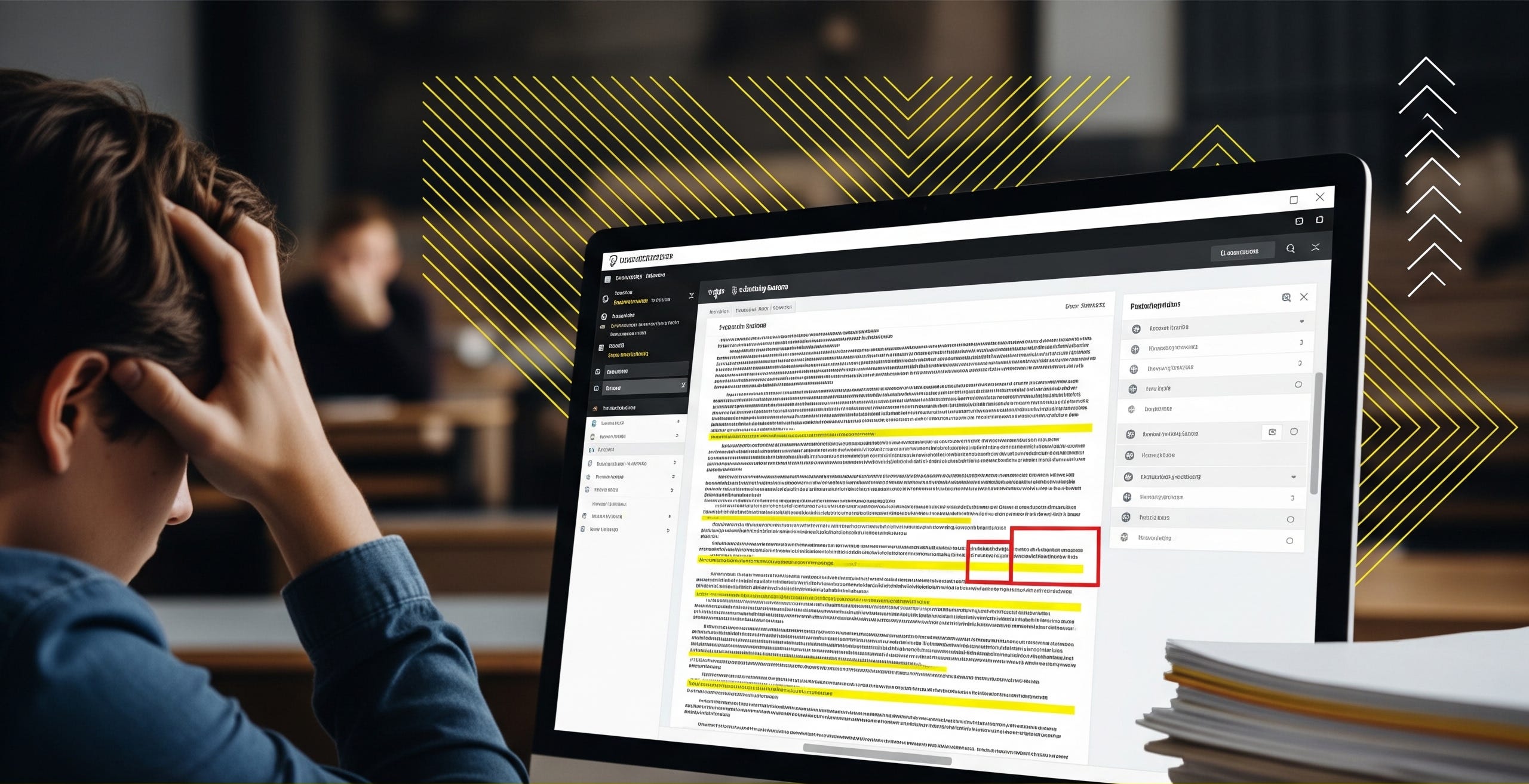
A reader problem that looks small on paper can turn ugly very quickly in real life. The case at the center of this story started with a speech outline, a Turnitin AI score, and a university process that treated software output with far more confidence than the software maker says it deserves.
In the Reddit thread that sparked the article, a student says he was pulled into an academic misconduct process after Turnitin labeled his communications-class outline 100% AI-generated. The accusation did not come with evidence of copy-pasting in Google Docs. The school reportedly admitted there was no evidence of copy-pasting in the version history. Even so, the case moved forward and the student had to defend himself with drafts, timestamps, writing-center records, a presentation video, earlier writing samples, the assignment rubric, and the professor’s original positive feedback.
That is the part people cannot stop reacting to. A student did not just have to explain a paper. He had to build a case file to prove he wrote his own work. Four days after the hearing, he says he was found not guilty. The outcome matters, but the process matters more. If this can happen to a student with unusually strong documentation, it can happen to students with much less.
More about Turnitin

Why this case hit a nerve
People are not upset simply because AI detectors exist. They are upset because a detector score can become a bureaucratic shortcut. In this case, the student says the accusation leaned on three weak pillars: a detector percentage, criticism of citation style, and the idea that the outline looked too polished or too well organized. The work looked organized, the student followed the rubric, and that was somehow allowed to count against him.
That is what turns a campus dispute into a broader education story. Once a school starts treating an AI score like lab evidence, the burden quietly shifts to the student. Instead of the institution proving misconduct with independent evidence, the student is pushed into disproving a black-box conclusion. And because the tool is opaque, the student often cannot meaningfully challenge how the number was produced in the first place.
For readers trying to understand the stakes, that is the real issue here: Turnitin false positives are not just a technical glitch. They are a due-process problem.
What happened in the Turnitin 100 percent AI case
The timeline in the student’s account gives the story its force. He says he wrote a communications speech outline in fall 2025 on Mazda rotary engines, visited the writing center on October 27, submitted a rough draft that did not raise plagiarism issues, submitted the final outline on October 30, delivered the presentation the same day, and received positive instructor feedback. Then, in December, he got an email saying Turnitin had flagged the final outline as 100% AI-generated.
The school reportedly acknowledged there was no copy-pasting visible in the Google Docs history. That should have cooled the case down. It did not. Instead, the student says the process continued and he had to defend himself at a formal hearing.
His evidence package is exactly what any fair review should want to see. He had incremental edits spread across multiple days, tutoring confirmation, a video of the actual presentation, the rubric that shaped the paper’s organization, prior writing samples, and the professor’s original comments. Commenters on the thread told him to keep repeating one point: software output alone is not proof. After the hearing, he reported the not-guilty outcome.
That does not read like a clean win for the system. It reads like a warning about how much damage a detector score can do before a student ever gets cleared.
What Turnitin says about AI detection
Turnitin’s own documentation is more cautious than many campus responses. In Turnitin’s guide on using the AI Writing Report, the company says its AI writing model may not always be accurate and should not be used as the sole basis for adverse action against a student. It also explains that the AI percentage is separate from the similarity score, which matters because no plagiarism found and AI detected are different claims inside the same product.
The company makes the same point again in its reviewer guidance for the AI writing report. Turnitin says the report is not meant to provide definitive answers in isolation. It is supposed to be one data point among others, weighed by an educator who also knows the student, the assignment, and the institution’s policy.
That should change the way schools approach these cases. A high AI score can justify a conversation. It cannot honestly justify a finding by itself when the vendor itself says the result is not definitive.
The same caution appears in another version of Turnitin’s AI Writing Report guide, which lays out the file requirements and the idea of qualifying text. That matters because the technology is narrower than many people assume.
Why an outline is exactly the kind of assignment that can cause trouble
The first hard truth is technical. Turnitin says the model is built to assess qualifying text, meaning prose sentences in long-form writing. In its own guidance, it says the detector does not reliably identify AI-generated text in short-form or unconventional writing such as bullet points, tables, annotated bibliographies, poetry, scripts, or code. A speech outline sits much closer to those edge cases than to a conventional essay.
That detail is not a side note. It goes to the heart of this case. If an assignment is organized in bullets, short bursts, section labels, or compressed phrases, the document is already moving into a format the tool says it does not handle reliably. A neat percentage on top of that document may look authoritative, but the format underneath it is still a warning sign.
The second truth is statistical. Turnitin explains that the system evaluates chunks of qualifying text and works from patterns and probability, not direct knowledge of authorship. A formulaic assignment, predictable transitions, highly regular sentence structure, or plain classroom prose can all look more machine-like to a classifier than a human reader might expect. This is part of why detector output should be treated as suggestive, not conclusive.
The third truth is institutional. In Turnitin’s release notes for the AI writing detection model, the company documents a series of fixes and threshold changes. The notes describe a December 2023 bug that allowed some submissions under the stated word requirements to receive AI scores anyway. They also describe bug fixes for bibliography highlighting and text-formatting issues that affected AI percentages. Later updates stopped surfacing exact percentages below 20 percent because false positives were a known concern in that lower range.
Put all of that together and the number starts to look less like a verdict and more like a fragile output sitting on top of file requirements, formatting assumptions, model thresholds, and repeated product updates.
The broader research on AI detector false positives is not comforting
This is not just a Turnitin problem. It is a detector problem. Independent research keeps landing in roughly the same place.
A large 2023 study of 14 AI detection tools found that the systems were neither accurate nor reliable, with even the best results coming in below 80 percent accuracy. The study also found both false positives and false negatives. That means real writing can be mislabeled as AI, and actual AI-generated writing can slip by undetected.
A second study on the efficacy of AI content detection tools found detectors were better at spotting GPT-3.5 text than GPT-4 text and still produced false positives and uncertain classifications on human-written control samples. That is a bad combination for a high-stakes academic process. The innocent student can get flagged, while the student who lightly edits generated text may slide through.
The bias problem is even more troubling. A Stanford-linked paper on detector bias against non-native English writers found that across seven detectors, human-written TOEFL essays were falsely flagged as AI at an average rate of 61.3 percent. The paper ties that problem to predictability signals such as perplexity. In simple terms, more predictable human writing can look suspicious to a detector even when it is completely authentic.
A 2025 review of academic AI detector accuracy and limitations reaches a more measured version of the same conclusion. Detectors can separate some human and AI text in some conditions, but they remain fallible, and false positives are serious enough to put innocent authors at risk. The review also notes that uniform sentence structure and low tonal variation can trigger suspicion.
Even OpenAI’s own AI text classifier page ended up as a cautionary example. OpenAI discontinued the classifier on July 20, 2023, citing its low rate of accuracy. In the company’s published evaluation, the tool correctly identified only 26 percent of AI-written text as likely AI-written and falsely labeled human-written text as AI-written 9 percent of the time.
Once you see the broader literature, the core lesson becomes hard to ignore. AI detectors are weak in exactly the way a disciplinary system can least afford. They are uncertain enough to accuse innocent people and porous enough to miss motivated cheaters.
More on AI in education:

Why process evidence matters more than a detector percentage
What helped the student in the Reddit case was not rhetoric. It was process evidence. The defense centered on the visible trail of human work.
That is the right instinct because authorship is often easier to show through workflow than through stylistic debate. A version history with incremental edits over multiple days says more than a software score. Tutoring records, notes, saved drafts, professor comments, presentation recordings, and consistent writing across earlier assignments all help show that the final document emerged from an ordinary human process.
This is also where schools often get turned around. A detector score feels neat. A workflow record looks messy. But the messy record is usually more probative. Real writing leaves traces. Drafts get reshaped. Sentences move. Citations get cleaned up. Feedback changes the structure. That is what authentic student work looks like in the wild.
Turnitin itself points educators in that direction. Its reviewer guidance says the report should be reviewed alongside educator judgment and other evidence. Its guide on using the AI Writing Report also makes clear that the AI score is separate from plagiarism findings and should not carry a case by itself.
There is also an awkward irony here. The students most exposed to a detector false positive may be the ones who write in careful, predictable, assignment-shaped prose. Meanwhile, a student who uses AI and then revises aggressively may end up looking more human to the model than the human writer who followed the rubric closely.

What schools should do instead of treating AI scores like verdicts
If institutions actually want fairness, they need a slower and more evidence-based process.
That starts with treating a detector hit as a prompt for review, not a conclusion. Educators should ask what exact text was flagged, whether the assignment format fits the tool’s documented strengths, whether the student can show a writing process, and whether there is any independent evidence beyond the score. Those are basic questions. In too many cases, they seem to arrive only after the student has already been pushed into a defensive posture.
The school should also pay attention to assignment type. A bullet-heavy outline, table-rich handout, script, annotated bibliography, or mixed-format submission should immediately raise caution because Turnitin itself says those formats are less reliable for AI detection. That warning belongs near the front of any review, not buried after the accusation has already hardened.
Some institutions have already decided the risk is too high. Vanderbilt’s guidance on why it disabled Turnitin’s AI detector cites reliability concerns, limited transparency, and the potential scale of false accusations. The original article also points to MIT Sloan teaching guidance that makes a similar argument and pushes for clearer policies, better dialogue, and stronger assignment design.
Even Turnitin’s own blog post about how an AI checker can support original writing frames the tool as a way to trigger educator intervention and conversation, not as an automatic judgment machine.
That is the gap this case exposes. The vendor language is cautious. The campus process, at least in stories like this one, can become much more absolute.
The power problem behind AI detection in education
There is a deeper issue here that goes beyond one student or one product. Detector systems concentrate power in exactly the place least accountable to the person being accused: the opaque model and the administrator reading the report.
The student is expected to explain. The system that made the accusation usually is not.
That is a bad structure even when everyone involved is acting in good faith. It gets worse when staff are overloaded, policies are vague, and a crisp-looking percentage offers a tempting shortcut. Once the number is on the page, people start treating it as if it carries its own authority. But the underlying model cannot sit in a hearing and explain why a specific sentence, paragraph, or outline section was flagged. It cannot describe uncertainty in a way a student can cross-examine. It cannot answer for edge cases in real time.
The result is what this case made visible. A detector score can feel more solid than the student’s actual evidence, even when the student has drafts, timestamps, tutoring history, and performance evidence showing command of the material.
That is not a small process flaw. It is the central fairness problem.
The bottom line for students, teachers, and administrators
The not-guilty result in this case should be ordinary, not exceptional. A detector percentage should open a conversation, not settle it. When a student’s real writing gets flagged as AI, the most persuasive response is usually to show the work as a process rather than a static document.
For students, that means preserving version history, notes, and drafts as soon as a question appears. For instructors, it means comparing the submission to prior work and asking how the assignment format may have affected the score. For administrators, it means refusing to let software output stand in for proof.
If schools want to reduce academic dishonesty without punishing legitimate writers, they need better assignment design, clearer AI-use rules, and a more disciplined review process. What they do not need is automation theater dressed up as certainty.
The student in this story won because the documentary evidence beat the black box. That outcome aligns with the vendor’s own warnings, with the academic research on false positives, and with the institutions that have already stepped back from overreliance on AI detection. The lesson is simple. Document the process. Demand independent evidence. Keep the focus on facts.
Further reading
For readers who want to dig deeper into the specific source trail behind this case, the original reporting thread is on Reddit. Turnitin’s relevant product pages include Using the AI Writing Report, How should I review the AI Writing report?, and the company’s AI writing detection model release notes.
Explore more from Popular AI:
Start here | Local AI | Fixes & guides | Builds & gear | Popular AI podcast