


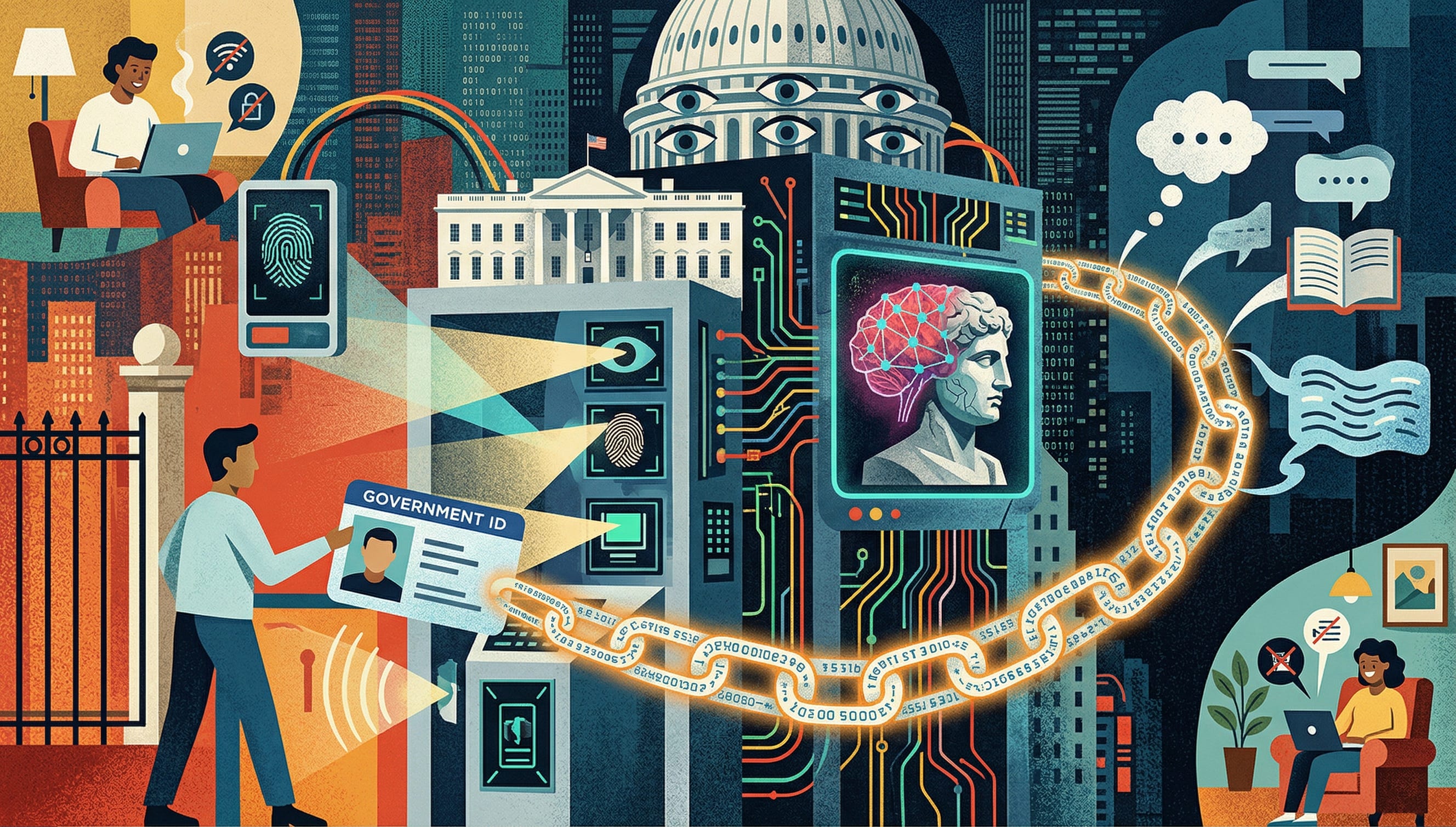
Washington is moving toward AI age verification, and the case for it is being framed as common sense. On March 20, 2026, the White House released a national AI framework that combines child safety language with a push for one national approach to AI law. Read alongside analyses of the National AI Legislative Framework and the administration’s call for federal preemption of state AI laws, the direction is hard to miss: Washington wants a clearer line of authority over how AI is governed and who gets access to it.
The framework covers far more than youth protections. It also addresses copyright, speech, infrastructure, workforce policy, and the balance of power between Washington and the states. Still, the provision that will land closest to ordinary users is the one that says Congress should create age rules for AI services likely to be used by minors. That is where a broad national AI policy starts to look a lot like a digital checkpoint.
Why age assurance changes the privacy equation
The White House recommendations say Congress should establish commercially reasonable and privacy-protective age-assurance rules for AI platforms likely to be accessed by minors, with parental attestation listed as one possible route. Reporting from the privacy-focused IAPP on those privacy-protective age assurance requirements makes clear that age assurance is now central to the administration’s AI safety pitch.
That phrasing sounds softer than an outright ID mandate, but the underlying privacy problem does not disappear because the language is gentler. Once a platform has to sort adults from minors at scale, it has to collect more information itself or hand that job to another service. For people who use AI to think through legal questions, health concerns, personal research, or politically sensitive topics, that matters. It means the boundary between a private prompt and an identified account history gets thinner, and perhaps much thinner over time.
That is why the fight over AI age verification is bigger than a debate about child accounts. It is a debate about whether general-purpose AI remains easy to access anonymously, pseudonymously, or with minimal disclosure. The framework does not say adults must upload a driver’s license to ask a chatbot a question. It does, however, move the policy conversation in a direction where identity checks become easier to justify and harder to avoid.
One federal rulebook for AI
The second major story is preemption. The White House recommendations say Congress should preempt state AI laws that impose undue burdens and argue that states should not be permitted to regulate AI development because it is an inherently interstate issue. That position was also highlighted in coverage from Governing on the push for broad preemption and in the IAPP’s reporting.
There are limits written into the proposal. The framework says states should still keep their traditional authority in areas such as child protection, fraud prevention, consumer protection, zoning, and rules governing their own use of AI in public services. Even so, the center of gravity shifts sharply toward Washington. The practical result would be a national standard shaped far more by Congress and federal agencies than by fifty separate statehouses.
Supporters will call that clarity. Critics will see a simpler battlefield for the largest companies and the most sophisticated lobbying shops. A patchwork of state laws is frustrating for industry, and that is the point supporters keep emphasizing. A single federal lane, though, is also easier for major incumbents to influence once the real negotiations move behind closed doors.
Copyright, censorship, and agency power
The framework also opens a friendlier door for AI companies in the copyright fight. As Finnegan’s overview of the framework notes, the administration wants the courts to resolve whether fair use protects AI training on copyrighted material, and the White House recommendations say Congress should avoid interfering with that judicial process. For frontier labs that trained on enormous pools of online material, that is a meaningful signal. It suggests the federal government is inclined to keep the fair use question alive rather than close it legislatively.
The free speech section points in a different direction, but it comes with the same pattern of broad principle and thin detail. The White House says Congress should stop the federal government from coercing AI providers to alter or suppress lawful expression and should give Americans a way to seek redress when agencies pressure platforms. At the same time, the framework says Congress should not create a new federal AI rulemaking body and should rely instead on existing agencies with subject-matter expertise, a point also highlighted by the IAPP’s coverage of existing regulatory bodies. That may sound restrained on paper, but it also leaves room for entrenched regulators to expand their AI role without a brand-new agency ever appearing on the letterhead.
The practical privacy fallback
For users who do not want more identity checks attached to everyday AI work, the most realistic response is technical rather than rhetorical. Moving routine drafting, coding, summarization, or brainstorming onto local large language models reduces your dependence on a few cloud platforms and gives you more control over where prompts are stored. That GitHub project is a broad directory of generative AI tools and resources, which makes it a useful starting point for anyone trying to map the local AI landscape.
The same goes for open-source AI platforms built for self-hosted use. Open WebUI describes itself as a feature-rich self-hosted AI platform designed to operate entirely offline while supporting common model runners and OpenAI-compatible APIs. That does not make local AI frictionless, and it does not solve every security problem by itself. It does, however, offer a clearer escape hatch for people who do not want their prompt history, usage patterns, or identity checks tied to a commercial gatekeeper.
The administration is presenting this framework as child protection, competitiveness, and regulatory order. The larger question is what happens when access to general-purpose AI starts to resemble access to a controlled service that increasingly knows who you are. Once identity, compliance, and AI use begin to converge, the argument stops being only about children. It becomes a debate about how much privacy adults will still have when they ask a machine to think alongside them.
Explore more from Popular AI:
Start here | Local AI | Fixes & guides | Builds & gear | AI briefing
AI age verification sounds limited when it is pitched as child safety, but it raises much bigger questions about anonymous access, federal control, and how tightly AI platforms may be tied to identity. Do you see this as a reasonable safeguard, or the start of a broader push to make AI use less private and more permissioned?