


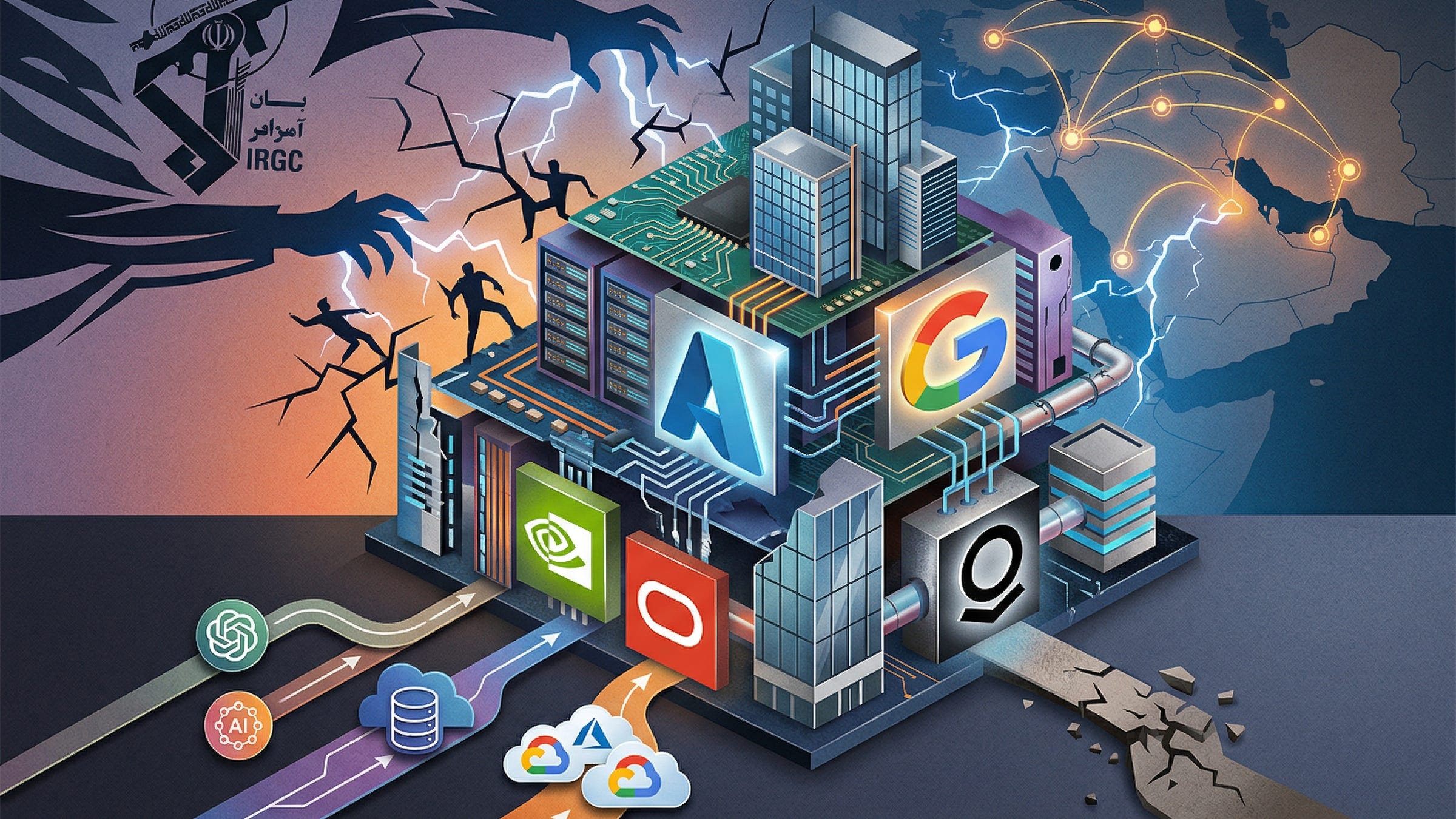
For AI power users, this is more than another Middle East flashpoint. It is a warning about how much modern AI depends on a small group of cloud, chip, networking, and software companies that many teams now treat as basic infrastructure.
When that infrastructure becomes part of a geopolitical target set, the question is not whether every threat is carried out exactly as stated. The real question is what happens when your models, APIs, data pipelines, and enterprise workflows rely on a handful of vendors with visible regional footprints.
That is why Iran’s latest threat matters to anyone who relies on hosted AI.
More AI in the news:

Why this matters beyond the headline
Reporting on March 31 said Iran’s Islamic Revolutionary Guard Corps threatened US-owned infrastructure and companies in the Middle East, with major tech and AI-linked firms named in coverage of the escalation, including Microsoft, Alphabet, Oracle, Palantir, Nvidia, Cisco, IBM, Intel, HP, Apple, and Boeing, while staff at regional offices were reportedly warned to leave. That is the immediate headline, and Reuters’ report on the threat is what turned it into a global business story.
The deeper story is about the AI stack itself.
These are not fringe vendors. They sit close to the operating layer of modern AI. Microsoft’s Azure global infrastructure pages show active regional presence in places such as Qatar and the UAE. Google Cloud’s Dammam region access documentation spells out region-specific access and purchasing controls in Saudi Arabia. Oracle’s public cloud regions and data centers documentation and its regions architecture documentation describe the kind of physical security, regional distribution, and encrypted inter-region traffic that now underpin enterprise compute.
That means the firms being threatened are tied to inference, identity, storage, networking, enterprise workloads, and the infrastructure around AI deployment. In 2026, that is strategic terrain.
Why AI companies are now part of strategic infrastructure
At one level, this is retaliation. Iran says these companies help support intelligence, communications, and AI-related functions used by the US and Israel.
At another level, this is a sign of how power works now.
A decade ago, a regional adversary signaling pressure against American influence would have focused on military bases, energy assets, ports, and telecom systems. Those targets still matter. But cloud regions, AI compute clusters, chip supply chains, network backbones, and data platforms now belong on the same map.
That shift matters because many of these companies still present themselves as neutral infrastructure providers. In practice, their platforms can support governments, defense contractors, logistics networks, and dual-use analytics at the same time. Once that overlap becomes visible, it becomes easier for a hostile state to blur the line between civilian technology and military enablement.
There is also a symbolic layer. Threatening an oil company gets attention. Threatening Microsoft, Google, Nvidia, Oracle, or Palantir signals that the modern command layer is now in scope.
That does not make every threat equally credible. It does explain why AI infrastructure companies have become politically attractive targets.
What a real attack would probably look like
The most dramatic scenario is a direct physical strike on an office, facility, or data center. That cannot be ruled out. It is also not the most likely first move.
The more realistic near-term playbook is cyber pressure mixed with intimidation, disruption, and stress on local operations.
US agencies warned in a 2025 joint CISA, FBI, DC3, and NSA statement and the related advisory PDF from IC3 that Iranian-affiliated actors and aligned hacktivists often exploit unpatched or outdated systems, default passwords, exposed internet-facing devices, and weak credential hygiene. The same warning flagged increased risk of disruptive cyberattacks, DDoS activity, ransomware, and data theft.
The UK’s National Cyber Security Centre alert from March 2 added that organizations with a presence or supply chains in the Middle East should review their cyber posture, increase monitoring, and assess their external attack surface.
That is the practical model to focus on.
A first wave could involve DDoS pressure against public-facing services, login portals, status pages, and customer dashboards. That is cheap, noisy, and useful for headlines.
A second wave could center on phishing, credential theft, and reseller or contractor compromise, especially where regional support teams have privileged access.
A third wave could target operational technology, facility controls, building-management systems, networking gear, or access-control systems around critical sites. CISA has already warned that IRGC-affiliated cyber actors exploited PLCs in multiple sectors, which is a reminder that Iranian operators do not only look at office IT.
Then comes the reputational layer. Data theft, leaks, defacement, and panic can be useful even when the attacker does not create a long-running outage.
The important point is that the most realistic risk is not some movie-style AI blackout. It is a messy blend of service degradation, account issues, regional friction, security shutdowns, and cascading operational noise.
Why a total AI collapse is still unlikely
This threat matters. Panic still misses the mark.
Middle East AI infrastructure is growing, but it is not one single switch. Cloud capacity is spread across multiple sites, operators, networks, and failover designs. Oracle’s own cloud materials emphasize regional distribution, secure interconnection, and disaster recovery design, while Microsoft and Google document the region-specific architecture that enterprises already use for resilience.
So a successful disruption could impose cost, delay, or local outage pressure without causing an oil-shock-style collapse in AI availability.
That distinction matters for serious users. The risk is real. The fragility is uneven.
What NATO, the US, the UK, and the EU have done so far
The Western response has been broad rather than AI-specific.
The White House position, as reflected in Reuters’ March 31 reporting, is that the US military is prepared to thwart attacks following Iran’s threat against American firms.
The UK has paired military signaling with cyber warnings. On the cyber side, the NCSC has been explicit that exposed organizations should harden defenses and improve monitoring. On the regional security side, the UK has also moved additional defense assets and support into the theater, according to public reporting around the same escalation.
NATO’s March 19 statement on talks with Gulf partners said Allies and Gulf partners discussed the Middle East security situation, condemned Iranian attacks, and pointed to cooperation in areas such as critical infrastructure protection and countering uncrewed aerial systems.
The EU has continued leaning on its cyber sanctions framework. The Council of the EU’s cyber sanctions page and its March 16 sanctions announcement show that Brussels is still using economic and legal pressure against actors tied to cyber operations affecting member states and partners.
There is no new AI doctrine here. What exists is deterrence, regional defense coordination, cyber hardening guidance, and sanctions.
That is revealing in its own way. Governments increasingly understand that AI infrastructure belongs inside national security planning, even if they are not labeling it that way yet.
What this means for AI power users
If you use ChatGPT casually for brainstorming, this does not mean your tools disappear tomorrow.
If you run client work, research, automation, software delivery, analytics, or internal knowledge systems on hosted models, the lesson is sharper. Centralized AI comes with concentration risk.
The near-term danger is not limited to outright downtime. It includes degraded regional performance, login friction, identity outages, traffic rerouting, contractor disruption, export-control tightening, and platform overreaction.
That last point matters more than many people realize. When vendors feel exposed, they tighten controls. They may add verification, reroute workloads, change regional rules, limit access in sensitive geographies, or adjust account enforcement. For users, the result can feel like instability even without a headline-grabbing cyberattack.
This is especially relevant for companies with customers, contractors, or deployments in the Gulf. Google’s Dammam region access rules are a good example of how region-specific controls already shape availability and procurement. In a crisis, those dependencies get more important, not less.
What to do before this becomes urgent
The boring resilience work matters most.
Export and back up the assets that actually matter to your operation. That includes prompts, system instructions, datasets, embeddings, fine-tuning artifacts, internal knowledge bases, automation scripts, and model evaluation workflows.
Mirror critical files outside a single vendor. If your revenue depends on one hosted model, identify a second provider and test it before you need it.
If your workflow is pinned to one cloud region, figure out what breaks if that region degrades, who has access to failover controls, and how identity, storage, and networking dependencies behave under stress.
For heavier users, keep one local model workflow alive even if it is weaker than your main stack. A local fallback will not match frontier APIs for every use case. It can still preserve research, drafting, classification, retrieval, and private analysis when cloud access gets messy.
For teams with any Middle East exposure, this is also a moment to review MFA coverage, contractor access, VPN logs, SSO logs, exposed admin panels, remote vendor pathways, and any operational technology links that touch facilities. The official advice from US cyber agencies and the UK NCSC points in exactly that direction.
The new AI risk is concentration risk
Iran’s threat against AI-linked companies is a signal that strategic pressure is moving up the stack.
AI firms are no longer just software brands. They are part of the infrastructure layer that supports communications, compute, analytics, identity, logistics, and decision-making. Adversaries now see them that way.
The practical takeaway is simple. Do not build your AI life around one company, one region, one account, or one brittle chain of trust.
The latest threat does not prove a major AI outage is imminent. It does prove that AI infrastructure now sits inside the target set. For power users, founders, consultants, and technical teams, that is reason enough to harden your stack, diversify your dependencies, and test what still works when the default path fails.
Further reading
For readers tracking the infrastructure side of this story, Microsoft’s Azure regions list is useful for understanding regional availability, while Oracle’s backup and disaster recovery overview adds useful context on how enterprise failover and continuity are designed in cloud environments.
Explore more from Popular AI:
Start here | Local AI | Fixes & guides | Builds & gear | Popular AI podcast
Iran’s warning to major tech firms is a reminder that AI is now infrastructure, and infrastructure becomes a target. If your workflow depends on one cloud, one account, or one vendor, you have a resilience problem. In this piece, we break down the real risk to cloud AI, model access, and what power users should do now. What part of your stack is still a single point of failure?