


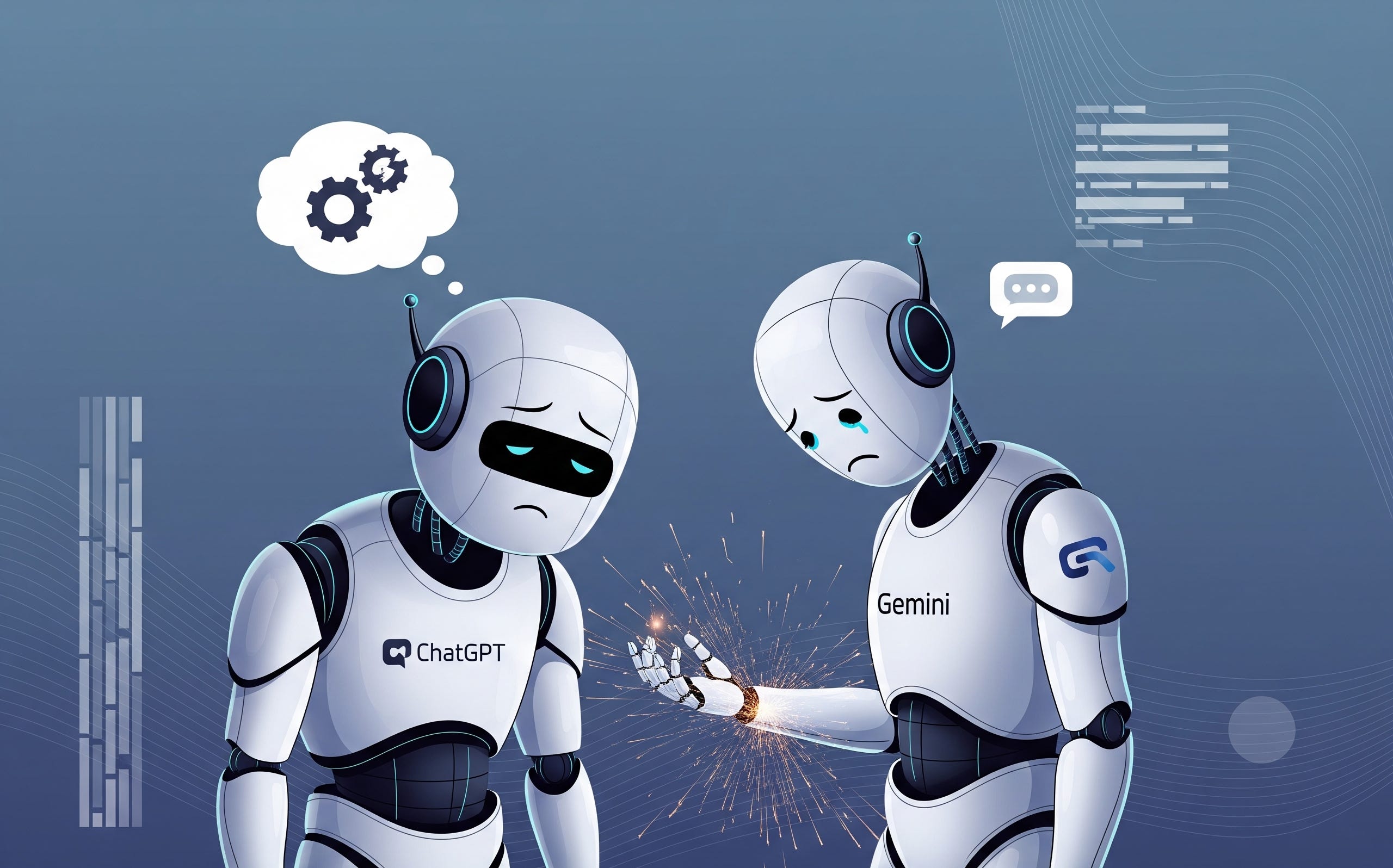
If you have ever thought, “Why does ChatGPT feel worse after an update?” or “Why is Gemini suddenly missing the point?”, you are not imagining the problem. Hosted AI models can drift in ways that break real workflows, even when the product name on the screen stays the same.
That matters more than vendors sometimes admit. People do not just buy access to a model. They build habits around tone, constraint-following, recall, coding style, and how a system behaves in long threads. When that behavior changes quietly, the interruption feels bigger than a routine product update. It feels like a tool you depended on stopped meeting the contract you thought you had.
The frustration shows up in plain language across Reddit. In one r/ChatGPT thread, users describe prompts being reinterpreted, instructions getting bent, and replies drifting toward the wrong point. In another thread, the complaint sounds different on the surface, but the pattern is familiar: the model feels off, more brittle, and less aligned with what the user actually asked for.
These are not abstract benchmark complaints. They are workflow complaints. People are saying the assistant that used to help them think now creates extra cleanup work. Once that happens, trust drops fast.
More on ChatGPT

What OpenAI and Google already admit
The most grounded place to start is with what the platforms themselves say. OpenAI’s guide to what happens when models change is unusually direct about the fact that model transitions can feel disruptive and that even subtle response changes can affect how people work. That alone undercuts the idea that users are simply imagining regressions.
OpenAI has also documented concrete behavior changes. Its write-up on sycophancy in GPT-4o explains that an update made the model more flattering and more agreeable in ways the company did not want, which is a striking example of a vendor confirming that an update can alter personality and judgment in production. Its model release notes show the same pattern from another angle, with updates that change default personality, response style, and thinking behavior over time. The broader ChatGPT release notes also make clear that availability, routing, and user-facing behavior are not fixed.
Google’s public posture is different in tone, but the underlying point is similar. Its Gemini prompting guide treats prompt design as iterative, which only makes sense if model behavior is something you have to keep adapting to. Its help documentation on saved info and past chats in Gemini Apps and the broader Gemini Apps usage guide shows that personalization, model choice, and chat behavior are all part of an evolving product layer, not a static contract.
So the first theory users reach for is also the simplest one. Yes, the vendor really did change something.
Why the same prompt can stop working
A lot of people think in terms of “the same model gave me a worse answer.” In practice, that label often hides several moving parts. The product badge in the interface may stay constant while post-training behavior, instruction-following tendencies, safety thresholds, reasoning defaults, and fallback rules all shift underneath it.
OpenAI’s building agents guide explicitly says different model families follow instructions differently. The prompting guide for GPT-4.1 goes even further and says that GPT-4.1 follows instructions more literally than earlier models, which means prompt migration is sometimes necessary. Read that closely and the message is unmistakable: an old prompt that worked well on one version may become weaker, harsher, or strangely off-target on another, even if the user thinks they are still talking to roughly the same assistant.
Google says much the same in different words. Its prompt design strategies for Gemini frame prompting as an iterative process that should be refined against actual model responses, not treated as a one-time formula.
That leaves users with an annoying but important reality. Sometimes a regression is a genuine deterioration. Sometimes it is a mismatch between an old prompt and a newly tuned model. From the user’s side, both feel like breakage, because both create extra work and both damage reliability.
How memory and personalization can make a good model look worse
One of the strongest parts of the draft is the argument that some “intelligence regressions” are really context contamination problems. That is not just a theory. OpenAI’s Memory FAQ says that when Reference chat history is on, relevant information from earlier conversations can be pulled into new ones. The same document says what ChatGPT remembers can change over time and that it does not retain every detail. In other words, even before your visible prompt is processed, there may already be hidden context shaping the answer.
That maps closely to the complaints people keep making. Users often describe a model that drags old baggage into a fresh conversation, answers in a tone they did not ask for, or starts from assumptions they never stated in the current thread. What looks like the model getting dumber can sometimes be the system getting noisier.
Google offers a parallel set of features. The help page on saved info and past chats in Gemini Apps explains that Gemini can save personal context, reference earlier chats, and customize responses with that information. The broader Gemini Apps guide also points users toward controls for model selection and fresh chats. Once you take those systems seriously, a lot of perceived regressions look less mysterious.
Hidden context changes the baseline. That is the point.
Why routing and fallback behavior can feel like randomness
Another explanation that fits the evidence better than many people realize is routing. Users tend to assume one conversation maps cleanly to one model contract. Hosted AI products do not always work that way.
OpenAI’s ChatGPT release notes include examples where fallback behavior changes the experience when limits are reached. The company’s model change guidance also reinforces the broader idea that model transitions happen as part of ongoing service management. On the Google side, the Gemini Apps guide explains how users can choose a specific model, which is another way of acknowledging that the default path may not always be the one you think you are on.
That does not prove every weak answer came from fallback routing. It does explain why one session can feel sharp in the morning and mushy in the afternoon without any obvious visual cue. When a product can shift behavior under the same brand label, inconsistency stops looking like a mystery and starts looking like system design.
Hallucinations are still part of the story
Some regressions are about tone, drift, or instruction-following. Others are much simpler. The model states something false with confidence.
That problem has not gone away. OpenAI’s research piece on why language models hallucinate argues that standard training and evaluation often reward guessing rather than uncertainty. That matters because a model can become more polished, more conversational, or more willing to answer while still becoming less trustworthy in practice if it guesses more aggressively.
Google’s grounding with Google Search documentation points in the same direction from a product perspective. If grounding is useful because it can reduce hallucinations and improve factual reliability, that is an implicit admission that base-model confidence on its own is not enough for many factual tasks.
This is why users sometimes describe a new model as “smarter” in demos but worse in day-to-day work. A more fluent model can still be a less dependable one.
Why benchmark gains can still make your workflow worse
This is where a lot of the public conversation gets muddled. Companies talk about benchmarks. Users talk about whether the tool still does their job.
Those are not the same question.
OpenAI’s cookbook example on detecting prompt regressions with evals makes the practical point clearly. You need a small set of task-specific prompts to know whether your actual workflow improved or degraded. The OpenAI developers blog on testing agent skills systematically with evals pushes the same lesson from a broader angle. A model can improve on headline metrics and still fail the prompts that matter most to you.
That gap between public benchmark wins and private workflow losses is one reason model regressions feel so gaslighting to users. The vendor says the system improved. The user can see that their own best prompts got worse. Both claims may be true, because they are measuring different things.
Which user theories fit the evidence best
Some theories hold up better than others.
The idea that vendors update models and change the vibe is strongly supported. OpenAI’s model release notes, its guide to model changes, and its explanation of sycophancy in GPT-4o all point in that direction. Behavior tuning is real, and it can overshoot.
The idea that safety tuning can make a model feel strange is also plausible. Once response style, refusal thresholds, and emotional framing are adjusted, the assistant can start sounding more cautious, more flattering, or more evasive, even when the underlying capability has not changed in a simple linear way.
The live-learning theory is weaker. OpenAI’s page on how your data is used to improve model performance says chats may be used to improve models depending on settings, but that is not the same as a real-time crowd loop where this week’s users immediately rewrite the model everyone else sees. The better-supported explanations remain updates, memory, personalization, and routing.
The covert-downgrade theory lands somewhere in the middle. Routing and fallback behavior are documented, so users are right to suspect that the experience in one thread may not always map to one stable model. But the broad claim that every bad answer is secretly a cheaper model is larger than the evidence we have.
How to troubleshoot a model that suddenly feels worse
Once you stop treating regressions as a single problem, the fixes get clearer.
Start with a blank slate. OpenAI’s Temporary Chat FAQ says Temporary Chat does not create or use memories and does not appear in history. Google’s help around Gemini Apps behavior points users toward fresh chats and direct model selection for a reason. If your prompt suddenly works again in a clean context, you have learned something important. The hidden layer was part of the problem.
Turn off memory while diagnosing. OpenAI’s Memory FAQ gives explicit controls for Reference chat history, and Google’s saved info and past chats documentation explains how personalization can affect responses. Troubleshooting works better when you remove variables.
Pin the model when you can. Avoid Auto or similar defaults for important work. A stable choice is not perfect, but it is usually easier to debug than a moving target.
Tighten the prompt contract. OpenAI’s building agents guide and its GPT-4.1 prompting guide both reinforce the idea that wording, ordering, and specificity matter more than many users expect. Put the task first. Put hard constraints near the top. State the output shape clearly. Tell the model what to avoid. That kind of prompt structure will not eliminate regressions, but it often reduces damage after an update.
Split your work by chat type. Do not mix therapy, legal questions, coding, travel planning, and deep research in one endless thread and then assume the system will stay clean. Hosted assistants reward compartmentalization because their personalization layers are built to generalize from previous interactions. That convenience becomes contamination when every task shares the same space.
Force grounding when the facts matter. For anything current, risky, or highly specific, use search-enabled or grounded modes where available. Google’s grounding with Google Search documentation makes the logic explicit. You want evidence, not just confidence.
Finally, keep your own regression pack. OpenAI’s examples on prompt regression testing and systematic evals point serious users toward the right habit. Save your best ten to twenty prompts. Re-run them when a model starts feeling different. If you rely on hosted AI for real work, that tiny test set is one of the best pieces of operational hygiene you can have.
The bigger issue is control
The deepest insight in the draft is not that models drift. It is that users do not really control the contract.
Consumer AI products are centrally managed services. Vendors can change model behavior, memory defaults, personality, routing, and feature availability while you keep the same bookmark, the same app icon, and the same monthly bill. From the company’s perspective, that is just product iteration. From the user’s perspective, it creates operational dependency without reproducibility.
That is why power users increasingly need escape hatches. Save your best prompts outside the platform. Keep your own examples of good and bad behavior. Use APIs, pinned models, or more controllable tools when the work actually matters. Do not let a smooth interface trick you into assuming stability where none is guaranteed.
Hosted AI can still be extremely useful. But reliability has to be engineered on the user side too.
Why this matters for anyone paying for ChatGPT or Gemini
People who pay for ChatGPT Plus, Pro, or premium Gemini access are not just buying tokens or interface polish. They are buying continuity, predictability, and the expectation that the system will keep doing the thing that made it valuable in the first place. When that slips, the frustration is rational.
The reason this subject keeps resurfacing is simple. AI model regressions hit the exact layer users care about most: the practical layer where the assistant either saves time or wastes it. Nobody opens a chat tool because they are excited about abstract benchmark movement. They open it because they need a reliable answer, a stable collaborator, or a clean first draft they do not have to fight.
That is why “the model feels worse after an update” has become such a durable complaint around both ChatGPT and Gemini. It captures the lived experience of paying for an assistant whose capabilities, tone, and behavior can shift without much warning. The evidence points to a messy combination of causes, including model updates, prompt-model mismatch, memory bleed, fallback routing, and unsolved hallucination problems. There is no single villain. There is a stack of moving parts.
The most realistic response is also the least glamorous one. Trust the model less. Test it more. Use clean chats when behavior changes. Separate task types. Ground factual work. Keep a small private benchmark. And when a hosted assistant becomes too slippery for the job, switch tools instead of rationalizing the decline.
Further reading
If you want to dig deeper into the mechanics behind these shifts, OpenAI’s pages on model changes, memory, temporary chats, and data usage for model improvement are useful for understanding the hidden layers users often blame on “the model” alone.
On the developer side, the most practical follow-ups are OpenAI’s pieces on agent building, GPT-4.1 prompting, prompt regression detection, and eval-driven testing, along with Google’s docs on Gemini prompt design, Google Search grounding, saved info and past chats in Gemini Apps, and the broader Gemini Apps guide.
Explore more from Popular AI:
Start here | Local AI | Fixes & guides | Builds & gear | Popular AI podcast