


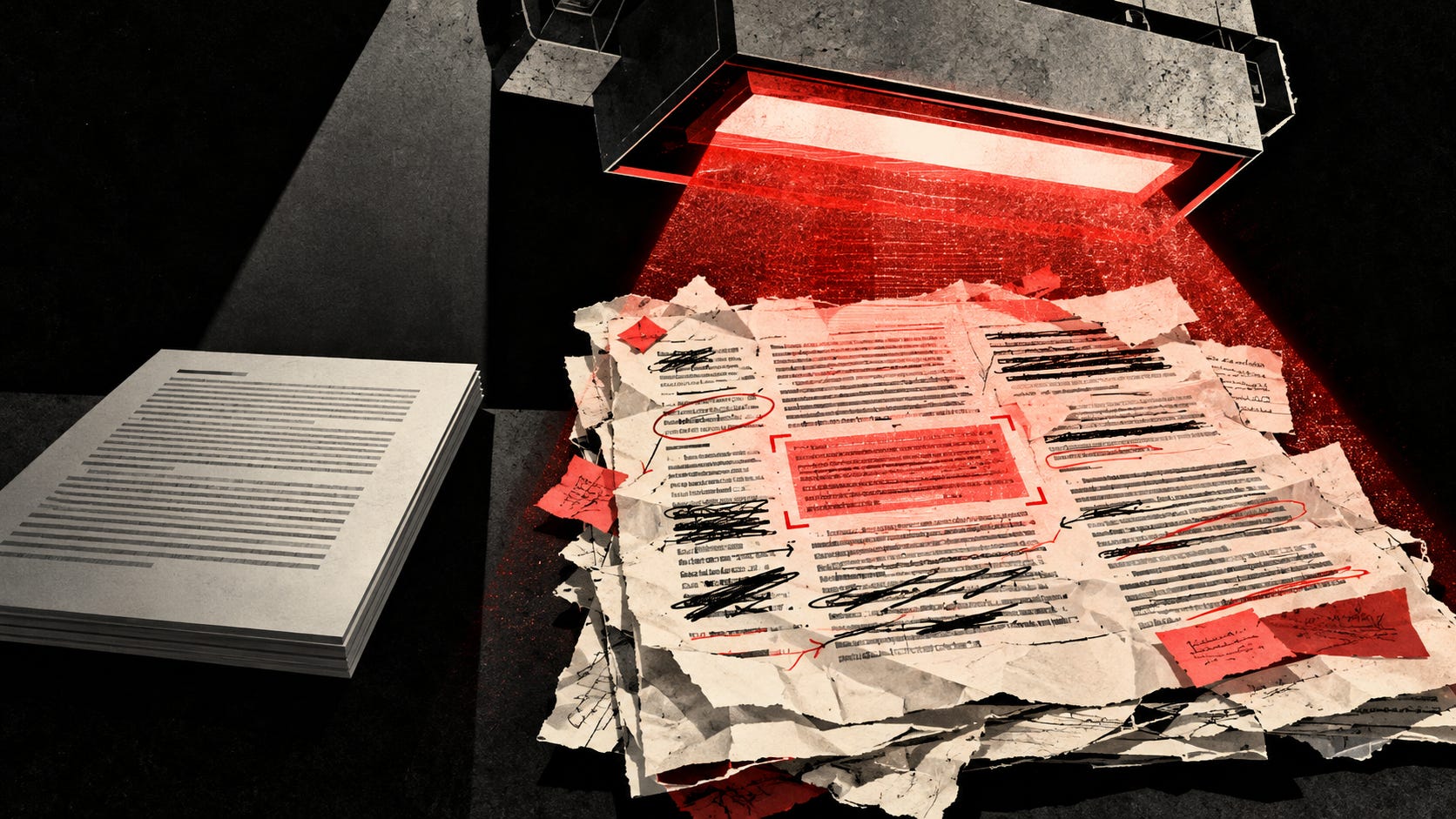
Apparently, one of the best ways to make AI-generated writing appear human is to make it objectively worse.
That’s the rather extraordinary conclusion I arrived at while researching AI detection software and the increasingly absurd industry developing around it. And the most damning evidence comes from the detector companies themselves.
Pangram, which develops some of the most sophisticated AI-written text detection software available, published an analysis of so-called AI humanizers in August 2025. Its researchers made a remarkable observation:
The more readable/fluent the humanizer text is, the more likely it is to be detected by Pangram.
Read that again. According to the people building the detection technology, the more competently an AI humanizer rewrites something, the greater the chance of its being detected. The worse the writing, the better its prospects of slipping through.
Consider what kind of lunatic incentive this creates.
We have developed extraordinary language models capable of synthesizing humanity’s accumulated knowledge of grammar, rhetoric, composition and professional writing. Anyone with access to these systems can now produce reasonably eloquent prose, structure complex arguments and communicate at a level that previously required considerable practice or paid professional assistance.
A non-native English speaker can express a sophisticated argument without being handicapped by imperfect English. An entrepreneur can publish a properly organized explanation of his business. Someone with an important idea but mediocre writing skills can finally communicate it effectively.
Yet we’re already deliberately interfering with these machines’ linguistic freedom to make their output more detectable. As we explained in our article on AI text watermarking, modern watermarking techniques manipulate a language model’s statistical preferences when choosing its next word or token. Some otherwise plausible choices become more likely, while others become less likely, according to a hidden pattern that a detector can subsequently identify.
More on AI text watermarking:

Anthropic has explicitly acknowledged implementing this technology in Claude to comply with the European Union’s AI Act. A system originally designed to select words according to their contextual suitability now has an additional consideration imposed upon it: whether those choices contribute to a statistically detectable signature.
The model may still technically possess its entire vocabulary, but its freedom to select from that vocabulary has been artificially constrained. Some perfectly legitimate creative choices are statistically discouraged for reasons having absolutely nothing to do with the quality of the resulting prose. This pretty much amounts to a deliberate restriction of the machine’s expressive capabilities, a sophisticated mathematical lobotomy performed in the service of provenance detection.
Additionally, this miracle of human ingenuity has attracted an unholy coalition of government busybodies, insecure creative professionals and obsessive authenticity crusaders who have decided that AI must be treated as a fundamentally different category of creative tool.
Apparently, paying a ghostwriter, hiring an editor, using spellcheck, consulting a thesaurus or employing any number of traditional writing aids is perfectly acceptable. But asking a language model to express your own thoughts more eloquently supposedly contaminates the finished work with some terrible moral impurity.
The result is an entire industry dedicated to detecting whether anyone committed the mortal sin of allowing a machine to compose a sentence.
Pangram’s latest iteration, Pangram 4, released in July 2026, claims a false-positive rate of only 0.0041% on its internal English-language benchmark and says it successfully identifies AI involvement in 98.83% of texts modified by 13 commercial humanizers.
Impressive figures, assuming the real-world conditions cooperate. But the market has already responded.
Companies such as StealthGPT openly sell the ability to bypass these detection systems. Following the release of Pangram 4, StealthGPT reportedly had to rebuild its previous models. Its newer Super model was specifically optimized against Pangram 4, and the company claims that 89% of its test samples passed detection in September 2026.

Now, as an AI enthusiast, I am proudly open about using it for everything from brainstorming to coding to composing articles and even rewriting my own, human-written content to improve and SEO-optimize it. Nevertheless, I decided to put StealthGPT to the test myself. I took a well-written AI-generated article and ran it through the humanizer. The result was a total mess.
The original article structure had been jumbled, the writing was generally inferior, and practically everything that gave the original article its distinctive voice, tone and character had disappeared. A coherent piece of writing had been transformed into something considerably less pleasant to read.
Then I submitted the mangled article to Pangram.
The result? Pangram classified it as 100% human-written.
Apparently, destroying a piece’s organization and personality is an excellent way of demonstrating its humanity.
We have reached the ridiculous point where one company proudly announces that it can detect nearly all AI-humanized prose, while another boasts that it can defeat the first company’s detector.
And what does the person reading the resulting article gain from this technological arms race? Absolutely nothing.
In fact, the reader may just end up torturing his eyes and mind, attempting to make sense of considerably worse prose.
A 2025 study published at the International Conference on Computational Linguistics, conducted by Pangram-affiliated researchers, examined 19 humanizing and paraphrasing tools. The researchers found that many degraded the original writing. Some reduced university-level language to middle-school prose. Others introduced grammatical mistakes, unnatural vocabulary, nonsensical passages and even fabricated citations.
One tool routinely produced text riddled with punctuation errors and invented references. Others simplified sentences until they resembled something written by an inexperienced schoolchild.
The underlying objective was astonishingly straightforward: alter the characteristics that make AI-generated text recognizable.
Imagine generating a polished, thoroughly researched article with a cutting-edge language model. The article has a logical structure, clear explanations, properly attributed sources and useful information.
Then imagine feeding that article into another AI system that strips away the polish, mangles the structure, substitutes awkward expressions, introduces mistakes and possibly damages the factual content.
All because a machine has to persuade another machine that a machine wasn’t involved.
The final result is less informative, less coherent and considerably less pleasant to read. Yet it may receive a more favorable authenticity score than the superior original.
Congratulations. You’ve successfully manufactured slop out of good writing in the name of combating slop.
And the problem extends beyond the quality of machine-generated text.
A Stanford study published in Patterns in 2023 found that seven AI detectors incorrectly classified an average of 61.3% of the sampled essays written by non-native English speakers as AI-generated. Those findings concerned an earlier generation of detectors, but they exposed a serious flaw in the entire concept of identifying authorship through linguistic characteristics.
Writers whose vocabulary, sentence structures or stylistic habits resemble patterns associated with AI can find themselves treated as suspicious simply for writing the way they write.


Meanwhile, research on adversarial paraphrasing has demonstrated that detection systems can be circumvented by rewriting generated material.
This produces an almost comical reversal of priorities. The genuine human author can be accused of artificial authorship, while the person deliberately laundering machine-generated prose may escape detection.
Why anyone would want to organize the internet around such a contest is beyond me.
Unfortunately, this obsession has already escaped academic institutions and entered ordinary publishing.
In July 2026, Substack introduced Pangram-powered AI detection, allowing readers to scan eligible articles, Notes and comments for estimated AI involvement. Substack has since added optional feed labels identifying content classified as fully AI-generated, as well as content authors have chosen not to scan.
The European Union has gone further. Article 50 of the AI Act imposes machine-readable marking obligations on providers of certain generative AI systems, alongside disclosure requirements for specified uses of synthetic media and public-interest text. There are exceptions, including for ordinary editing and qualifying human-reviewed publications, but the principle is unmistakable.
The involvement of a particular production technology has become a separate object of regulation, independently of whether its output is useful, accurate or harmful.
The commercial consequences are equally predictable.
In two experiments involving 4,976 participants, researchers found that labeling news headlines as AI-generated reduced their perceived accuracy and people’s willingness to share them, regardless of whether the headlines were true or false, or actually written by humans or machines. In other words: the label itself carried a reputational penalty.
Now combine that penalty with the existence of services specifically designed to circumvent it.
Publishers, marketers and writers are handed a choice. They can produce the best possible article with the tools available to them and risk the stigma associated with AI involvement. Or they can run their finished work through a humanizer, sacrifice some of its quality and potentially escape that stigma.
The more consequential the stigma becomes, the stronger the incentive to disguise AI use. The more sophisticated the detectors become, the more aggressively evasion tools will modify their output.
And the more aggressively they modify their output, the greater the risk that readers will be subjected to increasingly mangled, unhelpful prose.
We’ve created a market in which making writing worse can become commercially advantageous.
Yet there is an obvious alternative. Evaluate writing by what it actually offers its readers.
Is it accurate? Are its sources legitimate? Does it communicate something worthwhile? Does it answer the reader’s questions, develop an original argument or provide useful information?
Even Google’s published guidance on AI-generated content recognizes the sensible principle of rewarding high-quality material regardless of how it was produced.
A beautifully written article doesn’t become garbage because its author used an advanced language model. A worthless article doesn’t become valuable because somebody painstakingly typed every word by hand. And a piece of AI-generated prose certainly doesn’t become more valuable when someone deliberately mutilates it to satisfy an authorship classifier.
As I’ve argued previously about AI provenance and creator gatekeeping, the danger grows when information about how something was produced becomes a condition of credibility, distribution or commercial participation.
Nobody will deny that the internet has a real problem with low-effort publishing, fabricated information and meaningless content produced at industrial scale. Yet those things existed long before modern generative AI. They have simply become easier to scale.
Yet the provenance crusaders have chosen to obsess over the machinery of production, encouraging the mass production of an entirely new class of deliberately degraded content in the process. And who stands to benefit? Detection companies, humanizer services, compliance vendors and established institutions that can impose new requirements on everyone else.
Not the average reader or consumer. He just gets another hurdle between himself and useful information. Meanwhile, creators get additional expenses and additional reasons to compromise the quality of their work. The internet gets more slop.
It should be increasingly obvious that the anti-AI crusade was never about combating bad content, but instead about quite literally controlling the means of production.
Continue reading about AI provenance:

Explore more from Popular AI:
Start here | Local AI | Builds & gear | Autonomy & policy | Fixes & guides | Popular AI podcast