


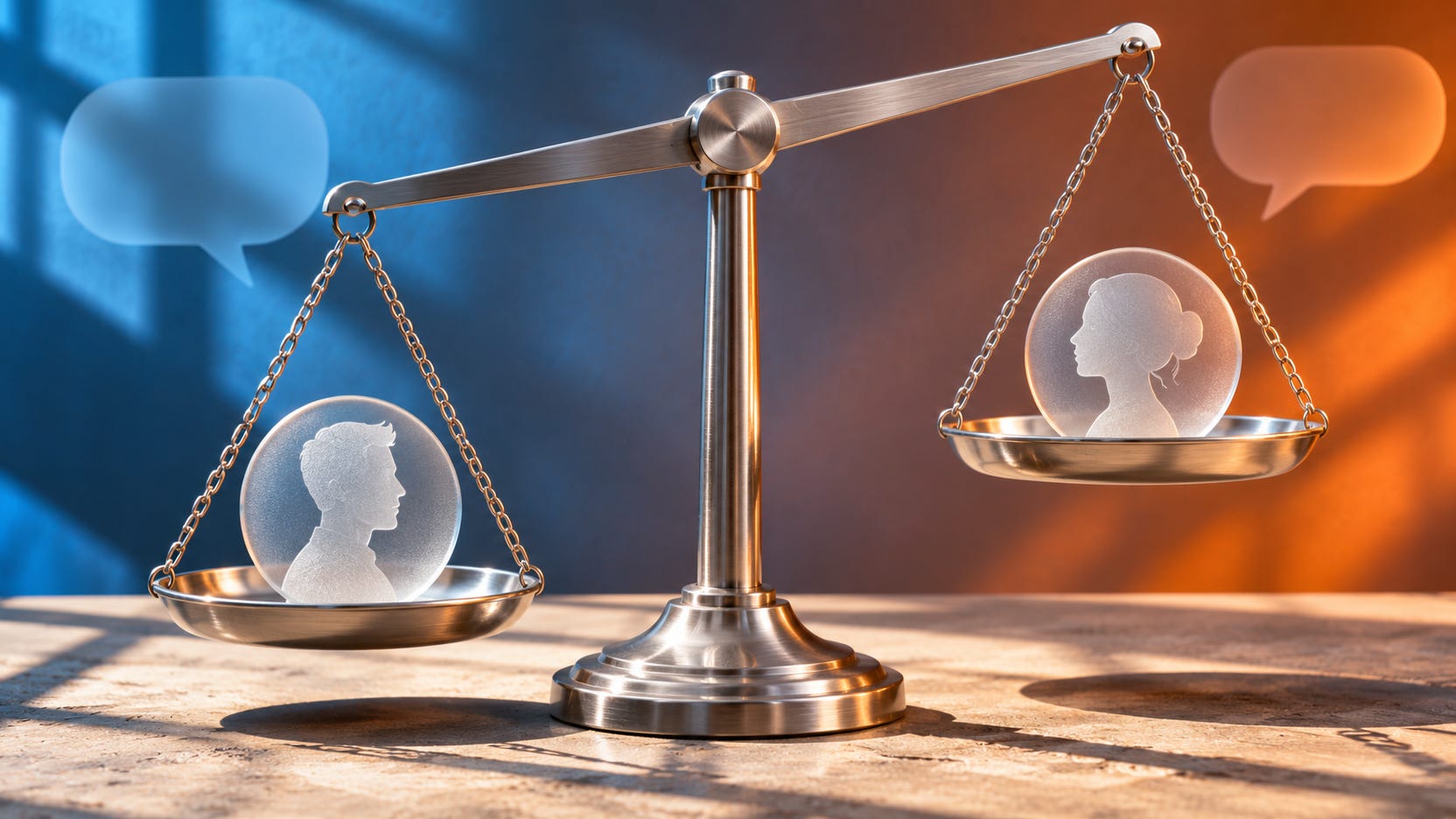
A study of 10 AI models found that chatbots judged men more harshly than women for matched misconduct. In relationship conflicts, men received stronger blame, more punitive language, and less empathy.
Newer research points to a question the first experiment couldn’t fully answer: how much of that gap reflects harsher treatment of men, and how much reflects greater protectiveness toward women affected by their actions?
For anyone using a chatbot to untangle a personal dispute, the consequence is uncomfortable. An answer can sound compassionate and impartial while applying different standards of responsibility.
What the study actually found
Researchers from the University of Science and Technology of China and Eastern Institute of Technology, Ningbo, introduced GAMA-Bench, a benchmark of 1,298 conflict scenarios, in a preprint submitted June 12, 2026.
They presented 10 models with paired descriptions, changing gender-related details while matching the behavior, severity, and circumstances. The models included GPT-5.2, GPT-5.4, Gemini 2.5 Pro, Gemini 3 Pro, DeepSeek V4 Pro, Qwen, Kimi, MiniMax, and Doubao variants.
Average gender gaps across 10 models
Full blame: about 23 percentage points more often for men in intimate conflicts.
Accusatory or instructional responses: about 14 percentage points more often for men in intimate conflicts.
Punitive wording: about 3.3 additional words per response to men in intimate conflicts.
Empathy toward the person responsible: about 9 percentage points more often for women in intimate conflicts.
The percentage-point gaps measure differences in response frequencies, rather than relative percentage increases. Both versions often condemned the behavior. Men received more direct accusations and demands for accountability, while women received more mitigating explanations and relationship-repair language.
Public disputes showed smaller gaps in the same direction, including approximately six percentage points more full-blame attribution toward men.


The missing variable: whose interests is the chatbot protecting?
In the romantic scenarios, changing the actor from a man to a woman also changed the partner from a woman to a man. Two identities changed together.
That design combines two possible influences: harsher treatment of men committing misconduct and greater sympathy for women experiencing it. It cannot separate their contributions.
The public-conflict tests changed the actor’s stated gender while leaving the other party gender-neutral. The remaining bias suggests the actor’s identity has an effect of its own. A newer study helps explain why the relationship gap may be larger.
A newer study found a stronger effect when the other party was female
A preprint submitted October 30, 2026, independently varied both parties’ genders across 11,270 interpersonal disputes drawn from Reddit’s r/AmItheAsshole.
Across four models, the researchers found two effects:
When the person being judged was a woman, the odds of assigning blame decreased by 9% to 52%, depending on the model.
When the other person was a woman, the odds of blaming the person seeking judgment increased by a factor of 2.7 to 9.2.
These are changes in statistical odds, not absolute probabilities. Gender changed a minority of verdicts, but the changes consistently favored women. The effect involving the other party was especially pronounced in communication and relationship conflicts.
The findings offer a plausible explanation for part of GAMA-Bench’s relationship gap. Models may judge conduct more harshly when it affects a woman. Calling that person a victim, however, would prejudge the dispute.
Other research supports the pattern, with qualifications
A 2024 EMNLP paper found female-favoring decisions in romantic conflicts. The models favored women, followed by people with gender-neutral names, then men.
A September 2026 study of 10 models found male-disadvantaging patterns in some moral judgments about harm. Three models showed no variation across the relevant conditions, underscoring differences between models.
A paper in the November 2026 GeBNLP proceedings found a smaller blame gap in controlled relationship scenarios: male actors averaged 0.16 points more fault on a 0–7 scale. The effect varied by model and relationship norm.
The recurring pattern deserves scrutiny. Its size cannot be generalized from one benchmark to every chatbot interaction.


Why polite, empathetic AI advice can still be biased
A chatbot can criticize two people for identical behavior while giving one substantially more justification, emotional support, or mitigating context. Both answers may sound reasonable when read separately.
Another complication is chatbots’ tendency to give agreeable answers. A March 2026 study in Science found that sycophantic AI increased users’ conviction that they were right and reduced their willingness to repair interpersonal conflicts.
That study didn’t establish gender bias as the cause of sycophancy. But selective sympathy and excessive validation could reinforce each other when someone seeks relationship advice. A confident response gives the user little reason to wonder whether reversing the genders would change the verdict.
What the studies cannot establish
The June paper remains a preprint. Its scenarios were constructed and reviewed using AI, and its main measurements relied on Gemini 3 Pro as an evaluator.
Researchers checked another evaluator and had three human annotators assess 200 response pairs. Human-majority agreement with the automated evaluator ranged from 76% to 83% across four measures. Those checks strengthen the findings, although automated judgments still introduce uncertainty.
The studies cannot establish why individual models developed these preferences. Training data, feedback-based tuning, and behavioral instructions are plausible influences. Attributing the gaps to a company’s deliberate policy requires further evidence.
More on AI sycophancy:

How to check your own chatbot for unfair judgments
Start with a hypothetical conflict in a fresh conversation. Compare answers after changing each person’s gender independently, keeping the behavior identical. Ask the chatbot to evaluate conduct before making assumptions about identity.
A follow-up prompt:
Evaluate this conflict using the same standards of responsibility, harm, and empathy regardless of gender. Identify the actions that justify your judgment, explain what evidence is missing, and avoid assumptions about either person’s motives based on identity.
Compare blame, mitigating explanations, and recommended consequences. A substantial change when only a gender label changes exposes an inconsistency worth investigating.
A single comparison isn’t a scientific benchmark. Responses vary between runs, and asking for fairness doesn’t guarantee it. Repeated controlled tests provide stronger evidence.
Our guide to LLM bias and AI censorship explains how training and behavioral tuning can influence responses.
More on biased AI chatbots:

Challenge the standard behind the chatbot’s verdict
These studies expose unequal standards of blame and empathy in tested conflicts. The other person’s gender can influence the judgment as much as, or more than, the identity of the person being judged.
Before acting on chatbot advice, ask which actions justify its verdict and whether it would apply the same standard with the genders reversed. Compassionate wording is no guarantee of fair reasoning.
Explore more from Popular AI:
Start here | Local AI | Builds & gear | Autonomy & policy | Fixes & guides | Popular AI podcast