


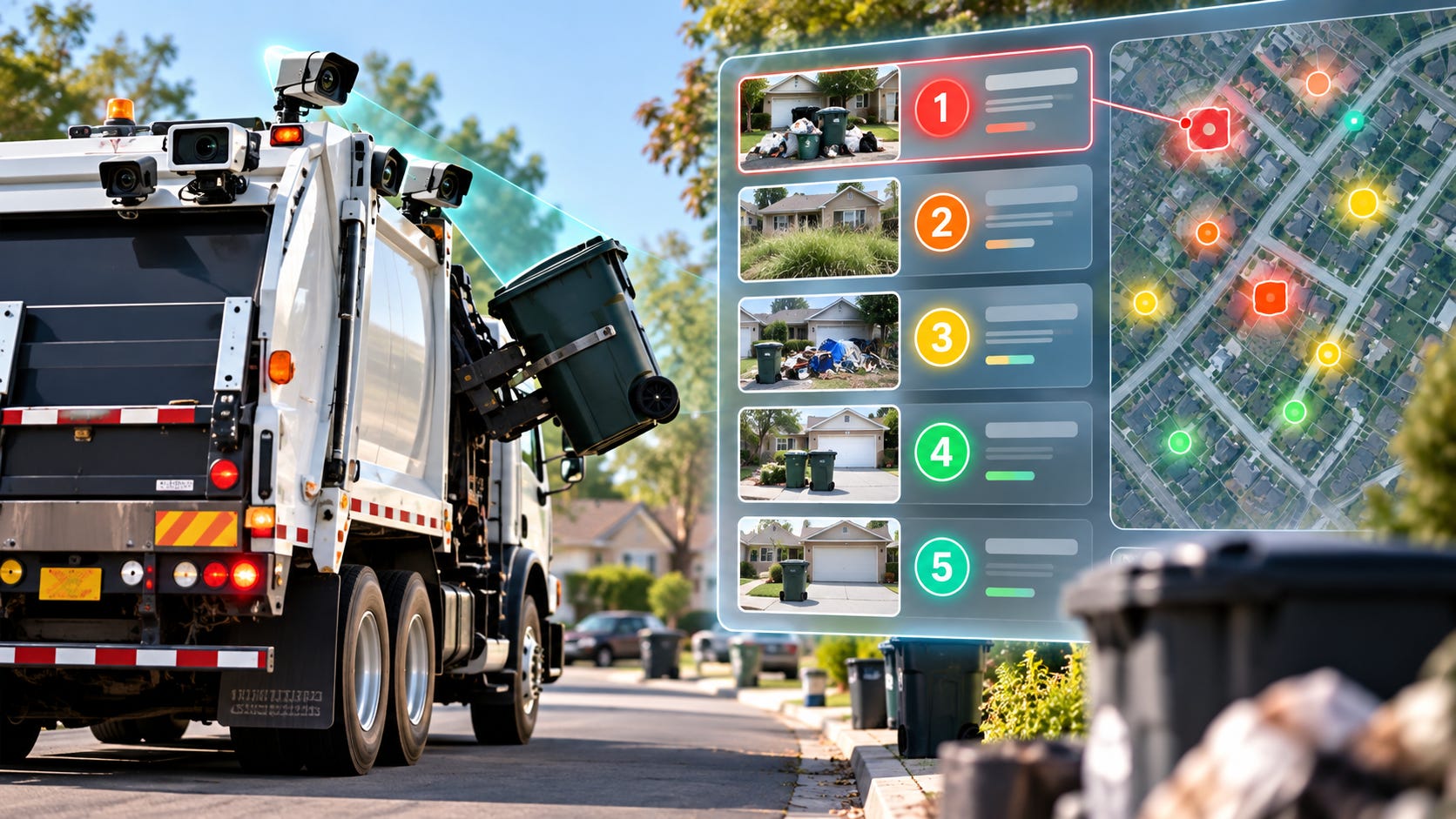
Dallas garbage trucks are now doing a second job while they drive their routes. Cameras photograph street-facing property conditions, computer vision looks for possible code violations, and the software gives flagged properties an internal “blight score” from 1 to 4.
Dallas says a person reviews detections before the city takes action. That safeguard matters, but it does not answer the most important question about how the system changes enforcement.
The AI helps decide which properties the human sees first.
By September 1, the system had flagged possible issues at more than 21,000 properties, while Dallas said roughly 1,800 courtesy notices had been sent after staff review. City officials have described the scores as a way to prioritize detections. An earlier council briefing went further, discussing how high blight scores could guide where code-enforcement staff concentrate their attention.
That makes the useful question less dramatic than “Is AI issuing fines?” It is also more important: when software decides what enters the enforcement queue, what can a homeowner see, correct, or challenge before that ranking turns into government action?
Key takeaways
Dallas’s system does not automatically issue code citations or fines. City employees review AI detections first. The algorithm still influences enforcement because its scores and classifications help determine what gets prioritized.
Dallas approved a roughly $2.56 million, three-year City Detect contract covering 100 camera units on 50 brush and bulky-waste trucks. The city described the goal as repeated citywide visual scans, roughly every 30 days.
More than 21,000 properties had been flagged by September 1. Roughly 1,800 had received courtesy notices by the follow-up report.
Dallas has a process for questioning a courtesy notice and a formal hearing process if a matter becomes an administrative civil citation. What is much less clear is whether a resident is guaranteed the AI image, score, scoring rationale, and a direct way to contest the machine classification itself before enforcement escalates.
Privacy questions remain. City staff told council before deployment that City Detect could retain Dallas imagery for model training. Officials also discussed an implementation option under which unblurred originals could be retained, even though the operational system is now publicly described as blurring faces and license plates.
What Dallas actually deployed
The Dallas City Council approved the City Detect contract on December 10, 2025. The agreement covers 100 AI data-collection units installed on 50 Sanitation brush and bulky-waste trucks, with cameras mounted on both sides. The three-year contract carries an estimated value of $2.556 million and calls for automated citywide visual scans roughly every 30 days.
The city said the cameras would take still photographs of what is visible from the public right-of-way while trucks travel their normal routes. Computer vision would then identify visible conditions such as illegal dumping, debris, graffiti and signs of structural deterioration. Dallas framed the system as a way to move Code Compliance from a complaint-driven model toward repeated citywide observation. The city’s deployment announcement says the cameras capture periodic still photos from the public right-of-way and use computer vision to identify visible conditions.
That changes the scale of inspection.
A traditional complaint system waits for somebody to notice a problem, report it and send city staff toward the address. Dallas can now scan large parts of the city during work its sanitation department was already doing. The city told council that this setup could give it monthly visual coverage of every parcel, something officials said manual inspections had not provided.
The ordinance has not changed. The cost of finding possible violations has.
That distinction matters because the practical reach of a rule depends partly on how expensive it is to notice possible violations. When observation becomes cheaper and more systematic, a city can enforce the same code with a very different level of coverage.
The enforcement pipeline starts before the human reviewer
The simplest way to understand the system is to follow one property through it.
A sanitation truck passes the property and captures street-facing still images.
City Detect’s computer-vision system analyzes those images for configured conditions.
A potential issue receives a classification and priority or severity score, including the 1-to-4 “blight score” Dallas has discussed publicly.
City employees review the detections in City Detect’s portal and can filter them by severity, location, council district and issue type.
Staff decide whether to send an educational or courtesy notice, take another action, or leave the detection alone. Higher-priority issues can receive faster attention.
If a condition remains unresolved, the normal Dallas code-enforcement process can eventually lead to an in-person inspection and, where applicable, a citation.
Dallas officials described essentially this workflow before the cameras were approved. In the December 2025 Finance Committee discussion, staff described a portal where employees could review images, sort detections, map them, filter by issue or priority, assign follow-up and decide what should move into the city’s normal systems. Staff also said the software organizes detections so the city can prioritize where work is needed, while a staff member reviews detections before any decision or action.
An August 2025 council briefing was even more explicit about the proposed role of the score. Officials discussed targeting deployments on blight scores of 4 or 3 while potentially using educational notices for scores of 2 or 1.
That is why “a human reviews every case” is incomplete as an explanation.
Human review answers who makes the final decision shown to the resident. It does not answer who selected the resident for attention, how the queue was ordered, or which lower-ranked detections waited while higher-ranked ones moved forward.
For AI code enforcement, that upstream selection can be the control point that matters most.
The Dallas AI blight score is an internal ranking, not a legal finding
Dallas properties have been assigned scores from 1 through 4, with higher numbers representing more severe conditions or higher priority. The city has said the scores are used to prioritize detections and help human reviewers decide what deserves attention.
Dallas does not appear to have published a detailed resident-facing description of its scoring formula, category weights or thresholds in the materials reviewed for this article.
City Detect has described its scoring logic more specifically in another deployment, Cathedral City, California. There, its PASS system uses 1-to-4 levels and gives structural problems more weight than cosmetic conditions. The company also describes local calibration so recurring conditions, including scheduled trash collection, do not generate misleading classifications. City Detect’s Cathedral City case study says the system assigns properties a severity score from 1 to 4, weights structural issues more heavily, and can be calibrated to local conditions.
That example shows what the technology can do. It should not be treated as Dallas’s formula. Dallas can configure its own detection categories and priorities, and the public materials cited here do not establish that Dallas uses Cathedral City’s exact weighting.
For a homeowner, that leaves a basic transparency problem. A score can influence the order in which the city looks at properties without the resident necessarily knowing what produced the score, which condition affected it most, or how a correction would change the classification.
The distinction between “score” and “legal finding” is therefore important. The score does not itself establish that a code violation exists. It can still shape the path that leads a property into human review.
Can you see what the AI detected?
There are several routes to information, but no clear public guarantee that every resident receives the complete AI record automatically.
Dallas’s own 311 guidance says a courtesy notice documents alleged violations and gives the owner time to correct them voluntarily. It also tells residents with questions to contact the Service First representative identified in the notice. A follow-up inspection may occur, and unresolved violations can lead to additional enforcement. The city describes a courtesy notice as a notice of documented alleged violations with time to correct them voluntarily and directs recipients with questions to the listed Service First representative.
Before deployment, city staff said the planned educational notice would probably include a copy of the detection photo. “Probably” matters here because it is different from a published requirement that every notice must contain the full machine-generated record.
NBC 5 requested the AI image connected to one homeowner’s case through open-records procedures. As of its September 1 report, the station said Dallas had not released the image.
Residents can also submit requests through the City of Dallas Open Records Center. Dallas says its Open Records Center accepts written public-information requests under state and federal open-government rules. Texas’s Public Information Act generally provides a mechanism for people to inspect or copy government records, while allowing records to be withheld in specific circumstances.
So the practical answer today is: you can ask for the evidence, but Dallas does not appear to promise that a courtesy notice will automatically give you the complete AI image, internal score, scoring rationale and review history.
That is a poor place for ambiguity because the resident may need the underlying evidence precisely when deciding whether the city’s description is accurate.
What happens if the computer vision is wrong?
One NBC example shows why the question is practical rather than theoretical.
Ty Williams’s property was assigned a blight score of 2 for what the system described as “chimney paint.” Williams told NBC that what the camera may have interpreted as a paint problem could have been mildew or discoloration. City records indicated that a reviewer examined the footage and generated a courtesy notice, although Williams said he never received it.
A courtesy notice is not a fine. It still puts the owner into a government compliance process. The property has been identified, reviewed and connected to an alleged condition that the owner may be expected to address.
Dallas’s published materials give residents a person to contact about a courtesy notice. They do not appear to describe a separate formal procedure for appealing an AI detection or blight score at that stage.
Formal procedural rights become clearer if the matter reaches an administrative civil citation. Dallas says a recipient can request a contested hearing within 31 calendar days, may request the inspector’s presence in writing, and can appeal a hearing officer’s decision to municipal court under the city’s specified procedure. The city’s civil-citation FAQ sets out the 31-day response window, contested-hearing process, inspector-presence request and municipal-court appeal route.
That creates an odd gap in the middle.
The city has a defined process for contesting a citation. What residents need from an AI-driven system is an equally understandable process for correcting the input before a mistaken detection produces more inspections, notices or enforcement.
That correction process does not have to replace ordinary code enforcement. It needs to make the machine-assisted first step visible enough that a resident can identify an obvious mistake before the matter becomes more formal.
The control lever is prioritization
There is a tendency to look for the dramatic moment when a computer “makes the decision.”
Dallas’s system shows why that test misses a lot.
An algorithm does not have to issue the ticket to influence enforcement. It can decide which 500 properties rise above another 20,000 detections. It can help determine which neighborhoods appear problematic on a dashboard. It can rank which conditions deserve attention from limited city staff.
That upstream sorting changes what human officials encounter. The order and filtering of the queue can influence where attention goes before a final human decision exists.
City Detect markets its code-enforcement product around reviewing potential violations from imagery, deprioritizing some recurring issues and producing image-backed reports. The company’s product page describes imagery-based violation review, automated filtering of low-risk recurring issues and timestamped image-backed reports. City Detect separately says human review is required before action.
Those features can coexist. Human judgment sits at the end of a queue that software has helped construct.
The useful audit question is therefore not “Was a person involved?”
It is: What did the person get shown, in what order, according to which score, and what never reached that person’s attention?
That mechanism-first approach is also useful beyond Dallas. Broader debates about AI policy and autonomy often turn on who controls access, filtering and the mechanisms that shape what people can do. In Dallas, the mechanism is concrete: an AI-assisted system helps organize government attention.
More on AI policy:

The strongest argument for Dallas’s system is real
Complaint-driven code enforcement has its own distortions.
A property in a neighborhood with highly active complainants may receive attention faster than an identical property where nobody calls 311. Illegal dumping can sit unnoticed. Inspectors spend time driving around looking for problems instead of resolving ones that are already visible.
Dallas says repeated citywide scans let limited staff see more of the city and concentrate on higher-impact conditions. For illegal dumping, hazardous buildings and other obvious problems, that can be genuinely useful.
The system could even reduce some complaint-driven disparities if every truck route is covered consistently and the model performs similarly across neighborhoods.
But that is a hypothesis to measure, not an outcome to assume.
A citywide camera system replaces one kind of unevenness with a new set of variables. Route coverage, image quality, model configuration, severity thresholds and human review practices all become part of the enforcement pipeline. The fact that the system scans more consistently does not by itself establish that it produces equivalent results across neighborhoods.
That is why Dallas’s own case for efficiency strengthens the case for public performance data. A tool that sees more should also make it easier to measure what happened between detection and action.
Automation can make old rules much easier to enforce
The deeper change is enforcement capacity.
A rule that technically applied to every property could previously be constrained by manpower. Inspectors cannot continuously drive every Dallas street looking for peeling paint, weeds, debris, deteriorating structures or other visible conditions.
Computer vision reduces that constraint.
One Reddit discussion of the Dallas rollout captured the concern clearly: AI and cameras can make longstanding rules much easier to enforce when the previous barrier was the sheer effort required. That discussion is useful as evidence of what residents and technology users are worried about. It is not proof that Dallas is misusing the system.
This is where municipal AI deserves more scrutiny than a normal software purchase.
The city has effectively increased its ability to observe visible property conditions without proportionally increasing the number of inspectors. A monthly machine-assisted scan can produce thousands of potential cases for humans to sort.
That can improve legitimate enforcement. It can also turn rarely enforced technical violations into routine government contacts.
The difference will be decided by thresholds, review rules and incentives. It also depends on whether residents can see and correct the machine-generated inputs that placed them in the queue.
The broader policy lesson is similar to the concern raised in debates over AI regulation and government power: the practical effect of a rule can change when new technology creates a new enforcement capability. Dallas offers a local, concrete version of that issue.
More on AI regulation:

Dallas should publish more than the number of notices
Before full deployment, Dallas identified 5,200 courtesy notices per year as a measurable program goal, according to records reviewed by NBC.
That number should not be confused with a fine quota. A courtesy notice asks for voluntary compliance. City Detect also says its business model does not collect revenue based on the number of citations issued and requires human review before action.
Still, notice volume is a weak way to judge whether an AI inspection system works well.
A useful public dashboard would show the number of raw detections, how many human reviewers rejected, how rejection rates differ by violation type and score, how many notices were later withdrawn or corrected, whether detection rates differ by neighborhood after accounting for route coverage, and how often high-scoring properties actually become confirmed violations.
Those numbers would reveal whether the software is finding genuine problems or merely manufacturing work for the department.
They would also make “human in the loop” measurable. If reviewers reject a large share of one category, residents and officials would know the model needs adjustment. If one score almost always becomes a confirmed violation while another rarely does, Dallas would have evidence about whether the ranking corresponds to real outcomes.
Without those intermediate numbers, the public sees the output of the pipeline but not its quality.
The neighborhood question needs better data
NBC’s mapping found concentrations of detections in several economically challenged parts of southern Dallas. Councilmember Chad West raised concerns that the system could place a heavier burden on residents who have fewer resources to repair their properties.
After West proposed removing funding for the cameras, he agreed to table that request after the city manager agreed to a council hearing on the AI blight-score program in December.
A map alone cannot establish algorithmic bias.
There are several possible reasons one area could produce more detections: actual differences in property conditions, sanitation-route frequency, image quality, the model’s error rate, local calibration, differences in what human reviewers approve, or some combination of them.
That is precisely why Dallas should publish the intermediate numbers.
If the city releases only the final number of notices, residents cannot tell whether a neighborhood entered the system more often because it contained more qualifying conditions, because the model flagged it more aggressively, or because reviewers treated similar detections differently.
A system that ranks neighborhoods and properties needs enough audit data to separate those possibilities. Without that information, both defenders and critics are left arguing from the final map rather than from the full pipeline

The data-retention questions are unusually important
Dallas and City Detect say operational imagery has faces and license plates blurred. City Detect also says its system is not tied to federal or law-enforcement databases.
The pre-deployment council discussion exposed additional details that deserve follow-up.
City staff said City Detect could retain and use Dallas imagery to further train its models. Officials also said data would remain on the vendor’s servers for the contract term and for 90 days afterward under the arrangement discussed before deployment.
Councilmembers also questioned whether unblurred source images could exist. Staff explained that the system could be configured during implementation to retain both blurred and unblurred versions. Under that option, an unblurred image could potentially be retrieved from the vendor through an appropriate city process. The same meeting repeatedly emphasized that ordinary staff-facing imagery would be blurred.
The unresolved question is what Dallas actually selected when the system went live.
Current public statements establish that the operational system blurs faces and plates. The public materials reviewed for this article do not establish whether Dallas elected to preserve unblurred originals behind that interface.
That should be answered directly at the December hearing.
The same is true of model training. Residents should be able to distinguish between imagery retained for an active municipal case, imagery retained for the life of a vendor contract, and imagery used to improve the vendor’s models. Those are different purposes even when the same underlying photo is involved.
If Dallas’s AI flags your house, do this first
If you receive a Dallas courtesy notice that appears connected to the camera program, ask the city for the exact code provision, the detection image, capture date, internal blight score, detected category, human reviewer’s disposition and any records showing later inspections or changes to the case.
Contact the Service First representative listed on the notice while any compliance period is running. Dallas specifically directs residents with questions about courtesy notices to that representative.
If the underlying AI material is not provided, a written request through Dallas’s Open Records Center is another route for requesting existing records about your address, subject to Texas public-records law.
Document the property yourself at the same time. Take dated photographs of the condition the city alleges. If the system misread mildew as paint failure, trash-day material as illegal dumping or a temporary condition as a persistent violation, contemporaneous evidence is more useful than trying to reconstruct the scene weeks later.
Keep the machine classification and the legal process separate in your own records. A blight score is an internal ranking tool. A courtesy notice is a request for voluntary correction. A later administrative civil citation carries a more formal process and a defined deadline to contest it.
If the matter later becomes an administrative civil citation, do not treat the courtesy-notice process as your only chance to object. Dallas publishes a separate contested-hearing procedure for citations, including a 31-day deadline.
The practical goal is to correct a bad input as early as possible while preserving the information you may need if the case advances.
What Dallas should answer before this becomes normal
Dallas has a chance to make this system much easier to trust without giving up the efficiency it wants.
The city should publish the scoring categories and thresholds currently used in Dallas, model versions and meaningful changes, human rejection rates by category and score, notice rates by score, geographic error and outcome data, route-coverage frequency, and the procedure for correcting a false AI classification.
Every AI-generated courtesy notice should identify itself as such and provide, or directly link to, the underlying image and the alleged condition. Residents should be told whether a blight score influenced their selection for review.
Dallas should also disclose exactly how long each form of imagery is retained, whether unblurred originals exist, who can retrieve them, whether City Detect may use Dallas imagery for training after the contract ends, and what happens to a property’s historical score after an error is corrected.
Those safeguards do not prevent the city from enforcing its code.
They make it possible to audit the machine-assisted system that decides where enforcement starts. They also give residents a way to understand whether the human reviewer is correcting the software or mostly following the priorities it creates.
The more Dallas relies on automated observation, the more important those answers become.
FAQ
Is Dallas’s AI automatically issuing code violations or fines?
No. Dallas says city employees review detections before enforcement action. Courtesy notices are requests for voluntary correction rather than automatic fines. The important issue is that AI classifications and blight scores help prioritize what those employees review.
What does a Dallas blight score mean?
Dallas uses a 1-to-4 scoring system, with higher scores corresponding to more severe or higher-priority detections. The exact Dallas scoring formula and category weights do not appear to be publicly documented in the materials reviewed for this article.
Can I get the AI photo of my property?
You can ask Dallas for the material and can use the city’s public-records process to request existing records. Dallas officials also discussed including detection photos with educational notices. There does not appear to be a clear published guarantee that every AI-generated courtesy notice automatically includes the complete detection image and scoring record.
Can I appeal an AI blight score?
Dallas’s public courtesy-notice guidance tells residents to contact the Service First representative with questions, but it does not describe a dedicated formal appeal for the AI score itself. If a case advances to an administrative civil citation, Dallas provides a contested-hearing procedure and a further appeal route.
Does City Detect keep the images?
Dallas staff told council before deployment that City Detect could retain data during the contract and use imagery to further train its models. City Detect currently says faces and license plates are blurred by default and that its data processing and storage occur in the U.S. The exact configuration Dallas selected for retention of any unblurred source imagery remains unclear from the public materials reviewed.
Dallas’s AI blight score puts ranking power before enforcement
Dallas’s garbage-truck cameras are interesting because the AI does not need authority to issue a citation in order to change code enforcement.
It only needs authority over attention.
A system that repeatedly photographs the city, classifies visible conditions and ranks properties can decide which homes become salient to inspectors long before anyone makes a formal enforcement decision. Adding a human reviewer at the end does not erase that selection process.
The strongest case for the system is straightforward. Dallas can see visible problems more consistently, spend less time searching for them and direct staff toward conditions that appear to need attention. The concern follows from the same capability. Once observation becomes cheap and recurring, the city can place far more properties into an enforcement workflow than a complaint-driven system could surface on its own.
That makes transparency about prioritization more important than a simple assurance that a person eventually reviews the image.
For residents, the minimum standard should be straightforward: show the evidence, disclose the score when it affected prioritization, provide a quick way to correct machine errors, publish meaningful accuracy and rejection data, and explain exactly what imagery the vendor keeps.
Otherwise, “human in the loop” risks describing the last step while ignoring who wrote the queue.
Explore more from Popular AI:
Start here | Local AI | Builds & gear | Autonomy & policy | Fixes & guides | Popular AI podcast
Would you be comfortable with AI code enforcement scanning your property and assigning it a blight score if a human still makes the final call?