


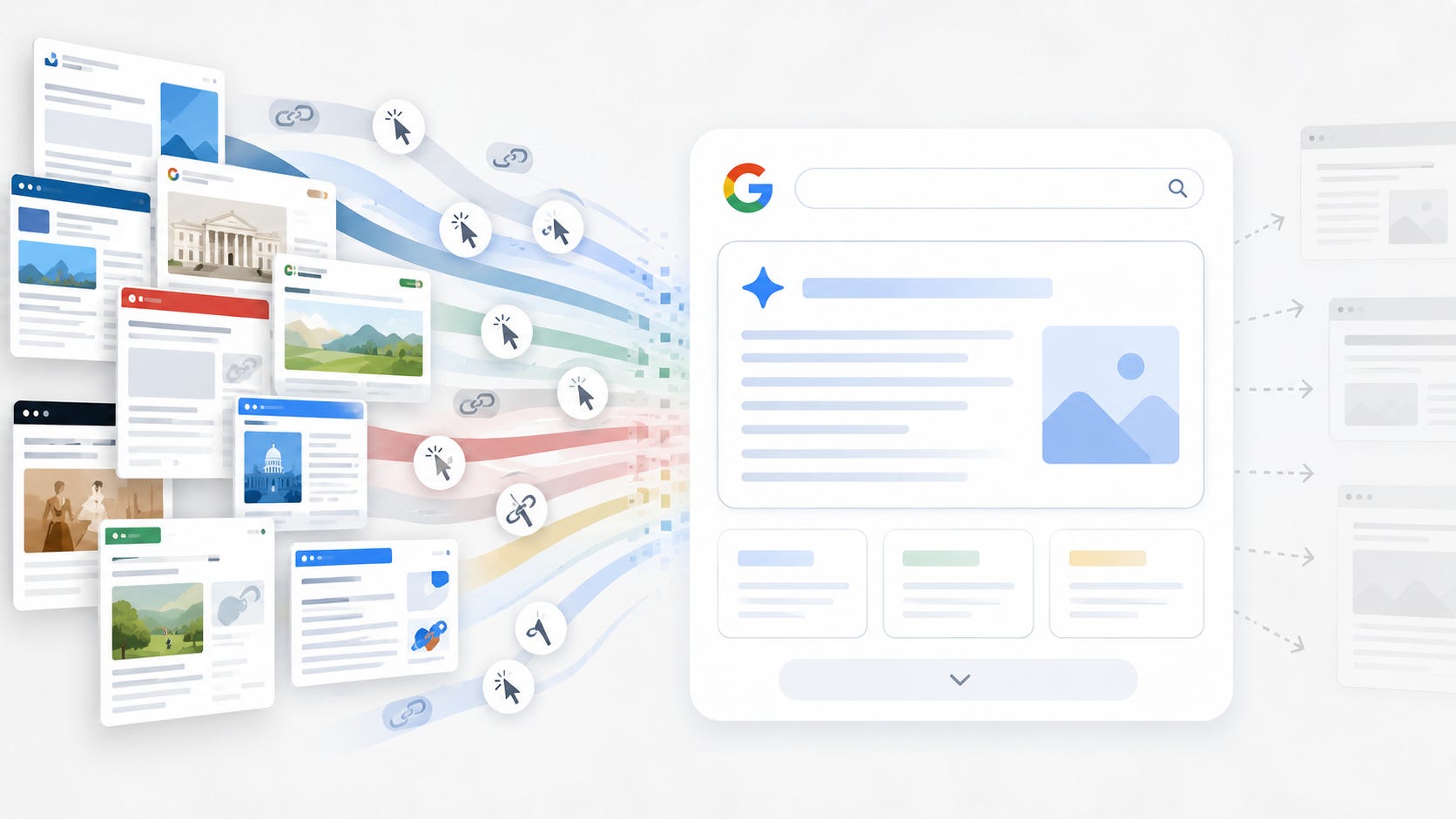
French publishers have asked France’s competition authority to intervene over Google AI Overviews, arguing that Google has turned their content into answers that can satisfy a search before the reader reaches the source.
The complaint is new. The power problem is not.
Google sits between publishers and a huge share of their potential audience. It crawls the page, ranks the page, decides whether to cite the page, generates an answer from web content, and controls the interface in which the user decides whether a click is still necessary.
That makes the fight over AI Overviews bigger than a dispute about summaries or licensing. The control lever is Google Search itself.
On August 11, 2026, the Alliance de la presse d’information générale, or APIG, asked France’s Autorité de la concurrence to enforce commitments Google made in 2022. APIG alleges that Google introduced AI Overviews and AI Mode in France before transparent, good-faith negotiations with publishers. It says publishers were offered an update to existing licensing arrangements while the alternative was a technical withdrawal that would reduce their visibility.
That is an allegation in a new complaint. It is not a finding by the competition authority.
The timing is awkward for Google because French regulators have dealt with a structurally similar problem before. The recurring question is whether a publisher can meaningfully refuse a new AI use of its work when the same company also controls the discovery channel that sends it readers.
Key takeaways
French publishers are challenging the conditions under which Google introduced AI Overviews and AI Mode rather than demanding that Google abandon generative AI. APIG says publishers were left with an opt-out that would cost them visibility.
France fined Google €250 million in 2024 for breaching publisher-related commitments. The decision criticized an earlier arrangement in which publishers could not refuse use of their content by Bard without also affecting display on Search, Discover, and Google News.
A new August 2026 study of browsing behavior from 900 U.S. adults found that users clicked sources cited inside AI Overviews in only about 1% of observed AI Overview visits.
A separate randomized field experiment found that, when AI Overviews appeared, outbound organic clicks fell 39.8% and zero-click searches rose 34.5%. Sponsored clicks did not decline.
Google is trying to make source discovery more prominent, but better citations are economically different from actual visits. If the answer is consumed on Google, the publisher may receive attribution without receiving the reader.
What happened in France
APIG represents French newspapers and magazines. Its August 11 complaint asks the Autorité de la concurrence to enforce commitments Google made after years of disputes over neighboring rights for press publishers.
The association says the rollout of AI Overviews and AI Mode happened before transparent negotiations over the new uses of publisher content. Its statement says publishers were offered an adjustment to their existing licensing arrangement, while the alternative involved technical withdrawal that would reduce visibility.
Reuters independently reported the complaint and said Google did not immediately respond to its request for comment. That wording matters because the complaint is still at the allegation stage. A report that Google did not immediately comment is different from saying Google has no response to the substance of the case.
APIG is asking for intervention similar to measures France’s competition authority imposed on Meta in July. In that separate case, the regulator ordered Meta to resume good-faith negotiations with French publishers and provide information needed to evaluate remuneration offers. The authority said the practices at issue were likely to constitute an abuse of dominant position and could cause serious and immediate harm.


None of that establishes that Google has breached its commitments through AI Overviews. The Autorité still has to assess APIG’s complaint.
What makes the case unusually important is that France already has a regulatory record dealing with the relationship between Google’s AI products and publishers’ dependence on Google Search. That history gives regulators a concrete earlier example of the same basic control problem now sitting underneath AI Overviews.
France has seen this control problem before
In March 2024, the Autorité de la concurrence fined Google €250 million for failing to comply with several commitments it had made in 2022.
Those commitments included good-faith negotiations, enough information for publishers to assess remuneration, and measures intended to ensure that negotiating neighboring rights would not damage publishers’ other economic relationships with Google.
The AI portion of that decision now looks particularly relevant.
The authority found that Google had used content from press publishers and agencies in connection with Bard’s foundation model, grounding, and display without informing the publishers or the regulator. It also found that, until Google introduced Google-Extended in September 2023, publishers could not object to Bard’s use of their material without using crawling restrictions that also affected Search, Discover, and Google News.
The regulator explicitly found that Google had breached a commitment by linking publishers’ ability to refuse AI use to their visibility on Google’s other services. At the same time, it stressed that the broader legal question of whether AI use of press publications falls within neighboring-rights protection had not yet been settled.
That distinction is important today.
The current French case does not need to prove that every AI-generated summary is unlawful before it raises a competition question. A separate issue is whether a dominant discovery platform can make access to ordinary search visibility practically inseparable from accepting new AI uses of the same content.
That issue is much closer to the fight APIG has now brought back to the regulator.
The control lever is Google Search
Publishers have always had an uncomfortable relationship with Google. They want Google to crawl their pages because Google can send them readers. The same dependence becomes more consequential when Google can use information from those pages to answer the search directly.
AI Overviews change the bargain because the destination can become optional even when the source remains visible.
Traditional search broadly worked like this:
Publisher creates information → Google indexes it → Google shows a result → user clicks → publisher gets the visit.
AI search can instead look like this:
Publisher creates information → Google indexes it → Google synthesizes an answer → publisher appears as a supporting source → user gets enough information and never leaves Google.
The source can remain visible while the visit disappears.
Google’s own documentation makes clear how tightly its AI features are integrated into Search. Google says AI is “built into Search and integral to how Search functions,” while site owners are directed toward Googlebot access and Search preview controls such as nosnippet, data-nosnippet, max-snippet, and noindex. The same documentation says Google-Extended is used to limit AI training and grounding in some other Google systems.
That distinction is easy to miss and central to the publisher complaint.
Google-Extended is not presented as a general switch that lets a publisher stay in ordinary Search exactly as before while separately opting out of AI Overviews. For AI features that Google treats as part of Search, the relevant controls run through the Search layer itself.
That is why APIG’s claim about losing visibility if publishers withdraw is so consequential. A theoretical ability to say no creates limited bargaining power when saying no threatens the distribution channel on which the publisher depends.
The practical question is therefore larger than whether a control technically exists. The question is what refusing actually costs.
That is the competition angle beneath the technical documentation. Publishers are not simply deciding whether they like a new search feature. They are deciding whether to accept a new use of their content while remaining dependent on the same platform for discovery. When the distributor also determines the terms of participation, an opt-out can exist on paper while carrying a commercial penalty large enough to weaken its practical value.
The distinction between technical choice and economic choice is crucial. A crawler directive can be clear and functional, yet the publisher may still be unable to use it without sacrificing reach. For regulators, that shifts attention from whether Google offers controls at all to whether publishers can exercise those controls without undermining the separate search relationship they rely on.
AI Overviews add another editorial layer
AI Overviews also give Google another decision to make beyond classic ranking: which sources become part of the generated answer.
A May 2026 preprint examining 55,393 trending Google queries found that nearly 30% of domains cited in AI Overviews did not appear among the conventional first-page results shown alongside them. The researchers described that result as evidence of a source-selection mechanism distinct from Google’s ordinary ranking algorithm.
That has an important consequence for publishers.
Getting ranked and getting cited are becoming different competitions. Getting cited and getting clicked are different again.
A publisher that performs well in classic organic search may still fail to appear inside an AI-generated answer. A publisher that does get cited may still receive almost no traffic from that citation. Those are separate stages, each controlled by the platform’s interface and systems.
Google therefore occupies several critical positions in the transaction. It determines discoverability, whether an AI Overview appears, which sources are selected, how those sources are presented, and the interface surrounding the outbound link.
A publisher can optimize its content for all of those systems. It still does not control whether Google gives the reader enough information to make visiting the source unnecessary.
That is why the AI Overview debate cannot be reduced to a new form of ranking. The search result itself can now consume more of the value that used to be delivered only after the click.
Google’s answer is to make sources easier to find
Google is clearly aware of the source-discovery problem and has been changing how links appear around its AI answers.
In May 2026, the company announced changes intended to make websites and original sources easier to discover from AI Mode and AI Overviews. They include additional links for further exploration, links placed closer to relevant text, more context around sources, and labels that highlight publications to which a user already subscribes. Google said its early testing found users were significantly more likely to click links labeled as their subscriptions.

Google also says that clicks coming from search pages containing AI Overviews can be higher quality, defining that as users being more likely to spend more time on the destination site.
These are legitimate counterarguments.
A user who receives an immediate answer and still clicks because they genuinely want the full source could be more valuable than someone bouncing through a list of blue links. AI Overviews can also be useful to users. A good summary can resolve a simple question quickly, surface sources someone might otherwise miss, and help refine a complicated search.
The economic problem for publishers starts one step earlier.
A higher-quality click does little for a publisher if far fewer clicks happen in the first place. Better source presentation can improve the experience for the subset of users who decide to leave Google, but it does not answer the question of how many users still need to leave.
The click data is getting harder to dismiss
On August 5, researchers Athena Chapekis, Anna Lieb, Sono Shah, and Aaron Smith published an analysis of one month of browsing activity from a representative panel of 900 U.S. adults.
They found that links to sources cited directly inside AI Overviews were clicked during only about 1% of AI Overview visits. AI Overviews were also associated with fewer clicks overall and a greater likelihood that the browsing session ended after the search. Those relationships persisted in the researchers’ statistical model after accounting for user and query characteristics.
That study is observational. It can identify strong associations, but it cannot by itself prove that AI Overviews caused every lost click.
A separate 2026 field experiment gets closer to the causal question.
Saharsh Agarwal and Ananya Sen used a custom Chrome extension to randomly assign users to regular Google Search with AI Overviews or a version without them. According to the study abstract published by the Toulouse School of Economics, when an AI Overview appeared it reduced outbound organic clicks by 39.8% and increased zero-click searches by 34.5%.
Sponsored clicks were not significantly affected. Neither was overall search frequency. Among users who did click through, the researchers found no difference in downstream website engagement between the two groups. They also found no measurable improvement in users’ perceived search quality or ease of finding information.
It is one experiment, and the results should not be treated as a universal estimate of what every news site will lose.
But it poses an uncomfortable challenge to the “fewer but better clicks” defense. In this experiment, sponsored clicks remained stable while organic publishers lost a substantial share of outbound traffic, and the remaining visitors did not show stronger downstream engagement.
That is a platform-power question as much as an SEO metric. If the interface can reduce organic exits while leaving paid exits intact, publishers have a strong reason to ask who captures the value created by the search page.
Attribution is not the same thing as referral
Much of the argument around AI search gets trapped in a debate about whether Google provides links.
It does.
The harder question is whether those links still perform the economic function that helped make the open web sustainable.
Publishers spend money producing reporting, reviews, documentation, analysis, photography, databases, and other material. Search historically gave them a chance to recover some of that investment through advertising, subscriptions, affiliate revenue, product sales, donations, or simply a relationship with a new reader.
An AI answer can preserve the attribution while weakening that exchange.
The site becomes a source for the answer, but the platform can keep the audience.
That distinction is especially important for independent publishers. Brand exposure can be useful, but a citation does not pay a writer, sell a subscription, show an advertisement, grow an email list, or create a direct relationship with the reader unless somebody actually visits.
The emerging currency of AI search may therefore be visibility without possession of the audience.
That is a difficult trade for businesses built around referral traffic. A publisher may gain the status of being cited while losing the measurable actions that historically made search visibility commercially useful.
Who benefits and who gets squeezed
Users receive the clearest benefit. Some searches genuinely are faster when Google can summarize several sources into a useful answer.
Google gains something different. It retains control of the interface for longer and decides where the user’s attention goes next.
The field experiment is particularly interesting because organic outbound clicks fell when AI Overviews appeared while sponsored clicks did not. That does not prove a particular revenue effect for Google. It does show why publishers are worried about the asymmetry between the organic sources that help support the answer and the paid placements that remain inside Google’s commercial interface.
Publishers with strong direct brands may be able to absorb more of the change. If readers already seek out a newspaper, newsletter, specialist database, forum, or creator by name, Google is less essential to the relationship.
The most exposed businesses are those for which Google has effectively been the front door.
That includes independent publishers, smaller news operations, specialist information sites, and creators whose economics depend on turning search visibility into visits.
Their problem is no longer simply lower rankings. A publisher could rank perfectly and still lose the visit if the search result itself has become the finished product.
That shifts the competitive question from “Where do I rank?” toward “Does ranking still produce a visit?” For publishers, those are materially different problems.
It also changes how publishers should interpret visibility metrics. A strong ranking position can look reassuring while referral traffic weakens because more of the user’s task is completed on the results page. The old assumption that visibility naturally converts into a measurable visit becomes less reliable as the answer layer grows more capable.
Why France is an unusually important test
France is not the first European authority to scrutinize Google’s use of publisher material in AI.
The European Commission opened a formal antitrust investigation in December 2025 into possible anticompetitive conduct involving Google’s use of web publishers’ and YouTube content for AI purposes.


France is interesting for a different reason.
The French authority already has binding commitments from Google concerning its relationship with publishers. It has already fined Google over failures to comply with those commitments. The 2024 decision also examined the specific problem created when a publisher’s ability to refuse an AI use was entangled with visibility on Search, Discover, and News.
It has also shown a willingness to use interim measures. On July 8, 2026, it ordered Meta back into good-faith negotiations with French publishers while that separate case continues.
So the interesting question is not whether France will “ban AI Overviews.” APIG says publishers are not asking Google to stop innovating.
The important question is whether existing competition commitments can constrain the terms under which a dominant search platform converts third-party content into an answer layer above those same third parties.
That could be a much more consequential precedent than a narrow dispute over a particular summary format.
It also fits a wider European battle over Google’s gatekeeper position. The EU has recently required Google to open additional Android capabilities and certain Search data to eligible competitors, an issue covered in Popular AI’s analysis of the EU rules intended to open Gemini’s Android advantages to rival AI services.
The common thread is control over a bottleneck. In one case it is access to mobile operating-system capabilities. In another it is the search interface that determines whether information discovery turns into traffic for the publisher that produced the information.
Related:

What publishers should do now
Whatever French regulators decide, waiting for an antitrust case to restore old referral patterns is a poor business strategy.
Treat search traffic as rented distribution. Keep doing SEO where it produces results, but build assets Google cannot take away with an interface change. Email lists, direct subscriptions, RSS, memberships, apps, bookmarks, and repeat visitors turn borrowed discovery into a relationship you control. Search can remain valuable without being treated as an owned audience.
Measure AI visibility separately from ordinary search. Google launched dedicated generative AI visibility reports in Search Console in June 2026 for a subset of sites. The initial reports show impressions, pages, countries, devices, and dates, with Google saying additional metrics may come later. Export what is available and build a baseline before the interface changes again. Visibility data cannot replace referral data, but it can help show whether a site is appearing in AI experiences even when traffic does not move in the same direction.
Understand Google’s controls before blocking anything. Google points publishers toward
nosnippet,data-nosnippet,max-snippet,noindex, and normal Googlebot controls for AI features inside Search. Google-Extended governs some other AI uses. Those are different mechanisms, and an aggressive Search restriction can cost the visibility you were trying to protect. The key is to understand which control affects which surface before treating “opt out” as a single technical action.Create things that are harder to replace with a paragraph. Original reporting, proprietary datasets, searchable tools, calculators, active communities, firsthand testing, downloadable resources, and deeply specialized expertise give a reader a reason to leave the search page. Generic informational pages are easier for an answer engine to substitute because the user’s need may be satisfied by a compact synthesis.
Diversify discovery. Google may remain the largest source of search traffic for many publishers, but it should not be the only route into the business. Track referrals from other search engines, AI assistants, newsletters, communities, social platforms, partnerships, and direct traffic. The goal is not to abandon Google. It is to reduce the damage any single interface change can do to the entire acquisition funnel.
Preserve evidence. Publishers negotiating licenses or considering complaints should retain Search Console exports, analytics, AI Overview screenshots, crawler settings, contractual terms, and dated records of traffic changes. A vague sense that traffic disappeared is less useful than a documented before-and-after record that shows what changed, when it changed, and which acquisition channels moved with it.
Popular AI’s broader AI regulation and platform-control guide tracks the same underlying question across AI markets: what is the actual control mechanism, and what happens when a user or smaller competitor refuses the platform’s preferred terms?
That is also the right question for publishers. The practical risk is not simply that AI becomes more capable. It is that the party controlling discovery can change the conditions of discovery while every downstream business is forced to adapt.
Related:

Why Google AI Overviews make the click the real battleground
Google can add more citations. It can make those citations more prominent. It can highlight subscriptions, add context around sources, and give users more information about where an answer came from.
Those improvements are worthwhile.
They do not resolve the central economic conflict: a source link is not a substitute for a source visit.
For most of the web’s history, Google benefited from organizing information while publishers benefited when users left Google to consume it. AI Overviews let Google move further down that value chain. The search engine can now synthesize and present enough of the information that leaving Google becomes optional.
France’s complaint puts that change under a particularly revealing microscope because regulators there have already confronted the question of whether publishers can refuse Google’s AI use without giving up access to Google’s discovery machine.
The answer will matter well beyond French newspapers.
If regulators conclude that a dominant platform cannot tie meaningful search visibility to acceptance of new AI uses, the case could influence how other markets think about consent, remuneration, technical controls, and bargaining power. If the complaint fails, publishers will still face the same commercial reality: the platform that once sent the click can increasingly decide whether the click needs to happen at all.
Publishers should keep competing for search visibility while it remains valuable. They should also stop treating visibility as ownership of an audience.
Google controls the search page. Publishers control what they build beyond it.
The safest long-term position is a business that can still benefit from Google without depending on Google to make the click mandatory.
Explore more from Popular AI:
Start here | Local AI | Fixes & guides | Builds & gear | Popular AI podcast
If Google AI Overviews can answer a search using publisher content without generating a visit, does being cited still have real value for publishers?