


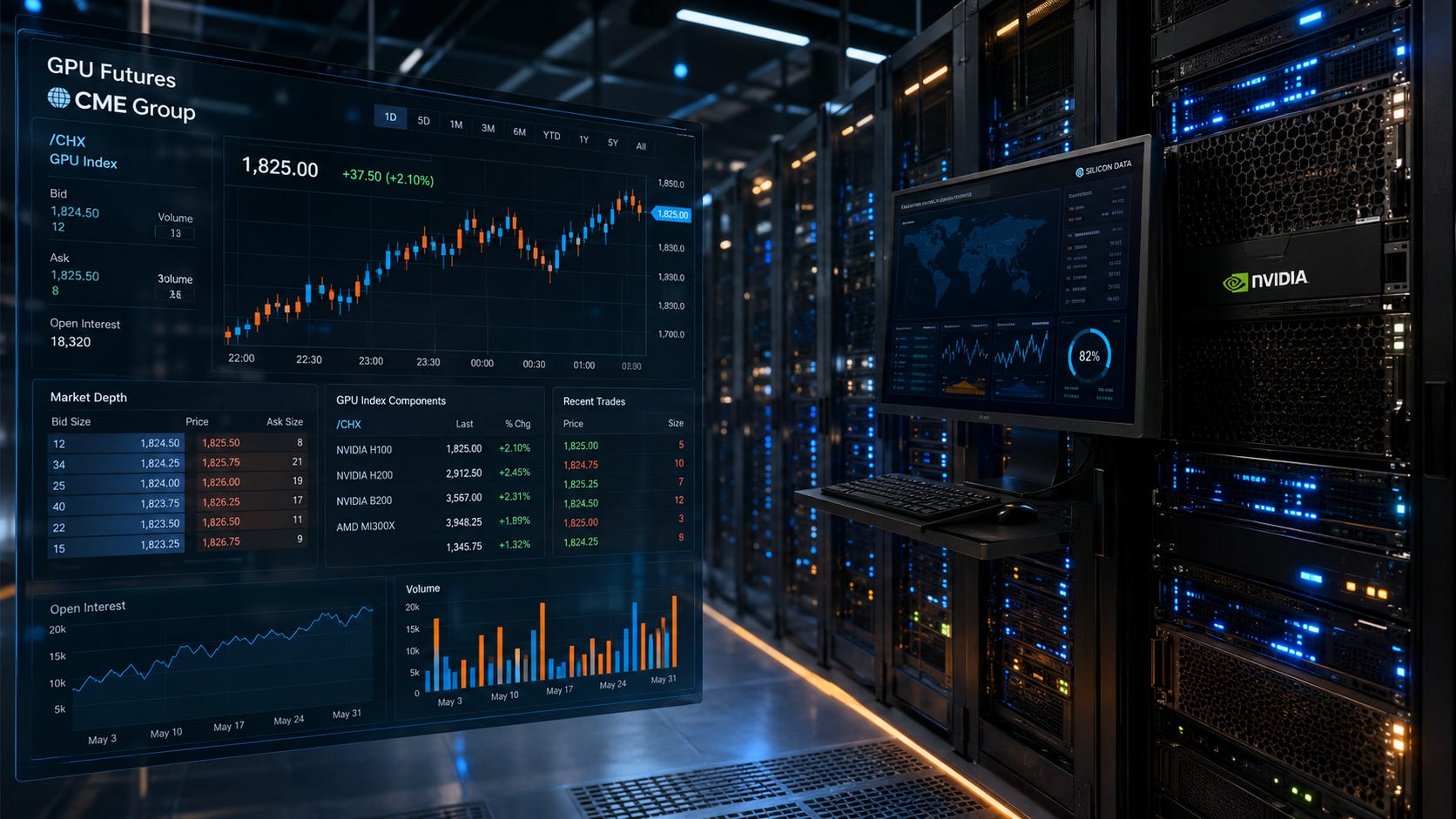
If your company expects a large cloud GPU bill next year, GPU futures could hedge one part of that risk: the benchmark price of renting H100 or B200 capacity. They cannot guarantee capacity, erase provider markups or make an H100 hour on every cloud economically identical. That mismatch is the part buyers need to understand before treating compute futures as insurance.
On August 19, the U.S. Commodity Futures Trading Commission opened a request for comment on compute derivatives. The move came just after CME Group announced plans for H100 and B200 rental futures targeted for October 5, 2026, pending regulatory review. Together, the announcements move GPU-price hedging closer to a regulated futures market, but they do not make the underlying compute market any more uniform.
The opportunity is real. So is the mismatch. A futures contract can help offset a change in a benchmark rental price while leaving the buyer exposed to the provider-specific, configuration-specific and availability-related costs that determine the actual cloud bill.
Key takeaways
GPU futures could reduce exposure to rising benchmark rental prices, especially for companies with large, predictable H100 or B200 requirements.
They do not guarantee that GPUs will be available when you need them. The planned contracts are financial hedges, not reservations for an actual cluster.
The biggest problem is basis risk. Your real cloud bill may move differently from the rental-price index used to settle the futures.
Compute is unusually difficult to standardize because provider, geography, contract length, networking, cluster size and machine configuration can materially change the value of the same GPU model.
The CFTC is already asking whether fragmented pricing and thin markets could allow providers or traders to influence a compute benchmark.
For most AI companies, futures should sit behind good procurement, provider diversification and capacity planning, not replace them.
What happened with CME GPU futures and the CFTC
CME says it plans to introduce compute futures on October 5, subject to regulatory review. The initial market is built around two products, Silicon Data H100 Rental Index Futures and Silicon Data B200 Rental Index Futures.
The more detailed announcement says both contracts will track Silicon Data indexes measuring hourly GPU rental costs, with each contract representing one month’s rent for the corresponding Nvidia GPU and listing on NYMEX. That makes the intended exposure relatively clear. The contracts are designed around standardized rental-price benchmarks for specific GPU models.


Then the CFTC asked the market what rules and safeguards compute derivatives may need. The public-inspection notice is scheduled for Federal Register publication on August 21, with the comment period running for 60 days after publication. The agency is seeking information about the size and liquidity of compute markets, market oversight, manipulation concerns, customer protection and perpetual compute futures.


The request does not impose a new rule telling AI companies how they must buy compute. Instead, the agency is gathering information to determine how compute derivatives fit within the existing futures-market framework and whether characteristics of the underlying compute market create risks that need particular attention.
That distinction matters because designated contract markets already operate under rules aimed at market integrity. The CFTC’s notice explains that a designated contract market must list contracts that are not readily susceptible to manipulation and must have systems to prevent manipulation, price distortion and settlement disruption. Exchanges can submit new contracts through the established listing process.
A Reuters account described the CFTC request as an early regulatory step toward markets that could help companies manage the cost and availability of compute. The cost part is plausible. Availability needs a much bigger qualification because a financial hedge and a capacity reservation solve different problems.
What a GPU future would actually hedge
Suppose an AI company knows it will need substantial H100 capacity six months from now.
Its price risk is straightforward. Rental rates could rise before that capacity is purchased. A long H100 futures position could potentially offset part of that increase. If the benchmark rental price rises, the futures position should gain value. The company still pays the higher cloud bill, but the gain on the hedge can reduce the effective increase in the portion of spending that behaves like the benchmark.
A GPU provider faces the opposite exposure. It owns or controls H100 capacity and worries that rental rates will fall. Selling futures could offset part of the decline in rental revenue. That is familiar commodity-hedging logic applied to GPU rental time.


The key is how the contracts settle. Silicon Data describes the emerging market as standardized, cash-settled and dollar-denominated, with positions settling against a reference benchmark rather than through physical delivery of compute.
That changes the practical meaning of the hedge.
A winning futures position does not reserve a GPU for you.
You could hedge the benchmark price well and still discover that the cluster you need is unavailable when your training window arrives. The derivative can pay out against a price move, but it cannot turn an unavailable cluster into an available one.
You could hedge H100 rental rates and still pay more because your preferred provider raises networking charges, storage costs or another service component that is outside the settlement benchmark.
You could also hedge a standardized GPU hour and discover that your workload needs a particular interconnect, cluster topology, geography, reservation structure or service level that trades at a premium to the benchmark.
This is why the phrase “hedging compute” can be too broad. The contract covers a defined price exposure. It does not standardize the rest of cloud procurement.
Basis risk is the central problem
Commodity hedgers already have a name for the mismatch between the price being hedged and the price a company actually pays: basis risk.
CME defines basis risk as uncertainty over whether the spread between the cash price and the related futures price will widen or narrow while a hedge is open. Even in established commodity markets, the cash price a company faces can diverge from the futures price because the real transaction has its own location, quality, timing or delivery characteristics.
GPU rentals add more dimensions to that problem.
The CFTC’s compute-market questions focus on fragmentation, private pricing and comparability. The agency says its preliminary understanding is that compute markets are fragmented and that price formation primarily occurs in opaque bilateral transactions. It also asks how much of the market is publicly observable, whether compute units are fungible across producers and what quality or grade adjustments might be necessary.
That creates a difficult benchmark problem.
A futures market needs a settlement number. Real AI infrastructure procurement produces many numbers.
A company might pay one provider for H100 instances in one region under a short on-demand arrangement, while another buyer pays a different provider under a longer reservation with different networking, cluster-scale and service terms. Both purchases can involve H100 capacity while behaving differently enough that one benchmark cannot perfectly describe both.
The more closely a company’s actual invoice follows the settlement index, the more useful the hedge can be. The less closely the two prices move together, the more of the original price risk survives in another form.
The same H100 can already have very different prices
Silicon Data’s own indexes show how wide the gap can be even before a futures market begins trading.
As of August 19, its index page showed an H100 neo-cloud rental benchmark of $2.68 per GPU-hour and a hyperscaler reading of $7.28 per GPU-hour. Silicon Data publishes separate H100 series for the two market segments because those segments price differently.
Both figures refer to H100 rental capacity. That does not make the services economically interchangeable.
Silicon Data says its methodology standardizes machine specifications, rental terms, platform performance, interconnect, cluster scale and geography to produce a like-for-like rate. That kind of normalization is exactly what a compute benchmark needs if it is going to support a cash-settled derivative.
It also shows why procurement teams should inspect the final contract specifications and index methodology rather than stopping at the words “H100 futures.”
A hedge can be directionally right and still be financially disappointing. If your cloud spend behaves like one segment while the futures settle against another, both prices can rise over time and still move far enough apart to leave you under-hedged or over-hedged.
In that case, the company has reduced outright GPU-price exposure while accepting more basis risk. The question is no longer simply whether H100 prices rise. It becomes whether the settlement benchmark and the company’s actual H100 economics rise and fall together closely enough for the hedge to do its job.
Why compute is harder to commoditize than oil
The oil comparison is appealing because futures markets turned a major industrial input into something companies can price and hedge far in advance.
Compute has awkward differences.
A barrel that meets a defined crude grade can be transported, stored and delivered under standardized terms. GPU capacity is more service-like. An unused GPU-hour today cannot be put in a tank and consumed next month. Its value is tied to a particular moment, infrastructure stack and service environment.
The CFTC is probing this directly. It asks how compute compares with non-storable commodities, whether units from different producers are genuinely fungible and what adjustments would be required when they are not. Those questions matter because a benchmark becomes less representative when supposedly equivalent units carry meaningful differences that buyers actually pay for.
Then there is technological obsolescence.
An H100 is a specific product today. AI infrastructure moves quickly enough that a company’s workload mix can migrate to H200s, B200s, newer Nvidia architectures, AMD accelerators or specialized hardware while a hedge program is still running.
CME addresses the most obvious version of that problem by separating H100 and B200 futures rather than treating all GPU compute as one commodity. That helps because each contract points to a specific hardware benchmark. It does not eliminate the differences between providers, configurations, regions or future hardware transitions.
The more compute resembles a standardized rental unit, the easier it is to hedge. The more its economic value depends on the surrounding service, the harder it becomes to compress that value into one tradable number.
The benchmark is the real control point
The most consequential part of a cash-settled compute future may be the index rather than the futures contract itself.
The settlement benchmark determines what a “GPU price” means for financial purposes. If that reference price is robust and representative, market participants have a credible number against which to settle. If it is thin, concentrated or easy to influence, the hedge inherits that weakness.
The CFTC’s questions are unusually specific. The agency asks whether a provider could influence a settlement index by changing posted rates, moving capacity onto or away from a venue included in the benchmark, or selectively transacting during the observation period. It also asks what transaction volume, contributor concentration, surveillance and information-sharing arrangements would be necessary to support a credible reference price.
The concern follows naturally from the structure of the underlying market. A benchmark becomes more fragile when the cash market is thin, fragmented or opaque, particularly when the firms supplying capacity are also important contributors to the data used to calculate the reference price.
Developers were raising a related issue before the CFTC request. In a Hacker News discussion of an experimental GPU perpetual-futures platform, one commenter asked whether a relatively small rental price feed could be moved by deliberately renting enough capacity at extreme prices.
That discussion does not prove a real benchmark can be manipulated. It illustrates the technical problem exchange designers and regulators have to solve: a settlement index needs enough representative, verifiable price information that one participant cannot cheaply distort the number everyone else is settling against.
The CFTC is also asking whether compute derivatives should settle against prices that the agency may be unable to fully observe, verify or surveil. That question may prove more important than the headline idea of turning GPU time into a tradable asset.
Futures will not fix bad cloud procurement
An AI company should not treat GPU futures as a substitute for negotiating better infrastructure contracts.
The futures price is one component of the economics. The actual bill still depends on the provider, reservation structure, region, cluster configuration, networking, storage, utilization, reliability and the software environment around the GPU.
A company paying too much because it chose the wrong cloud architecture can hedge the H100 index perfectly and remain expensive.
A company with poor capacity planning can hedge B200 prices and still miss its training window.
A company locked into a provider can collect a futures gain while its vendor-specific bill rises even faster than the settlement index.
These examples all point to the same decision rule. The useful question is not whether the company can trade GPU futures in the abstract. The useful question is how much of its real infrastructure bill actually behaves like the benchmark the contract settles against.
That requires procurement and finance to look at the same exposure from two directions. Procurement knows what is actually being bought. Finance needs to know which part of that purchase behaves closely enough like the benchmark to justify a hedge.
If those teams skip that mapping exercise, a futures position can look precise on paper while protecting a price that the company does not actually pay.
Who could actually benefit from GPU futures
The clearest users are companies with large, recurring and reasonably predictable exposure to the GPU models represented by the futures.
An AI lab expecting substantial variable-price H100 usage has a plausible exposure. If the lab expects to buy capacity later and worries that the benchmark price will rise, a long hedge has a logical connection to the risk.
A neo-cloud provider worried about falling H100 rental rates has the opposite exposure. If its revenue depends on the market price of the capacity it controls, selling futures could potentially offset part of a decline in that benchmark.
A company that has already negotiated fixed-price GPU capacity for several years may have much less reason to hedge the benchmark during that fixed-price period. Its dominant risk may sit elsewhere in the contract.
A business whose main risk is simply finding enough capacity has a different problem entirely. A price hedge can compensate for a benchmark move, but it cannot guarantee a cluster exists when the workload is ready.
Likewise, a company whose workloads move between H100s, H200s, B200s and other accelerators may need more sophisticated cross-hedging than buying one standardized contract. A hedge tied to one GPU model becomes less useful as the actual workload migrates away from that model.
The decision variable is the relationship between the benchmark and the real bill. Companies with stable, measurable exposure to the settlement index have the clearest case. Companies with unstable hardware mixes, highly customized infrastructure or primarily fixed-price contracts have a weaker one.
What AI companies should do before using compute futures
Before treating GPU futures as infrastructure insurance, map the exposure first.
Separate GPU rental prices from the rest of the cloud bill. Identify how much spending actually moves with GPU-hour prices. Networking, storage, support and other charges can behave differently, so including them in the hedge calculation can make the coverage look larger than it really is.
Break exposure down by hardware. H100 risk and B200 risk are already separate futures products for good reason. A company that expects its mix to shift between GPU generations should avoid treating all accelerator spending as one homogeneous exposure.
Separate neo-cloud, hyperscaler, region and contract type. A benchmark based on one market segment may not hedge another cleanly. The larger the pricing gap between the benchmark universe and the company’s actual procurement, the more attention basis risk deserves.
Measure the historical basis. Once the contracts have sufficient history, compare movements in real invoices with movements in the settlement benchmark before scaling up the hedge. The goal is to learn whether the benchmark tracks the price the company actually pays, not merely whether both prices move in the same broad direction.
Treat capacity planning separately. Use reservations, multiple providers and owned infrastructure where appropriate to manage availability. Futures cannot produce a cluster when the physical market is sold out, and a profitable hedge does not repair a missed training or deployment window.
Wait for actual liquidity before assuming the hedge works at scale. A theoretically well-designed contract is much less useful if large orders move the market or bid-ask spreads consume too much of the protection. The real test will be whether buyers and sellers can enter and exit meaningful positions without creating a new source of cost.
For organizations deciding whether more recurring workloads belong on hardware they control, Popular AI’s AI GPU and compute reviews for local models cover the hardware side of the decision, while its guide to building local AI clusters instead of sending every workload to cloud GPUs covers the scale-out approach.
Financial hedging and owning compute solve different problems. Some companies may eventually use both because one manages benchmark price exposure while the other changes the procurement model itself.
Related:


What remains uncertain about the GPU futures market
The biggest unknown is liquidity.
CME can create the contract. It cannot guarantee that enough AI companies, cloud providers, market makers and investors will trade it to create a deep market. A contract that looks useful in theory still needs enough participation for buyers and sellers to trade efficiently.
The cash benchmark also needs to remain representative as GPU generations, providers and commercial arrangements change. A benchmark that works well for today’s H100 market may need to evolve as the center of AI compute spending moves to different hardware and different contract structures.
The CFTC appears focused on both risks. Its request asks what safeguards are needed to keep thin liquidity from producing disproportionate price moves and whether exchanges may need information-sharing arrangements with compute venues and capacity providers whose prices feed into settlement references.
Perpetual compute futures are another open question. The agency specifically asks whether perpetual contracts could provide commercial risk-management features that fixed-date futures cannot, and what additional risks or safeguards those products might introduce.
The October 5 launch target also remains subject to regulatory review. Until trading begins and real participants put meaningful capital behind the contracts, questions about spread quality, depth, basis behavior and benchmark resilience will remain largely theoretical.
GPU futures hedge benchmark risk, not your entire cloud bill
GPU futures could become genuinely useful infrastructure for the AI economy.
A company facing millions of dollars in variable GPU rental costs has a legitimate reason to want a public forward price and a way to hedge it. Cloud providers have the mirror-image reason to protect rental revenue. If the market becomes liquid and the settlement benchmark tracks real procurement costs closely enough, both sides gain a tool they do not currently have in a standardized exchange-traded form.
But the contract is not your cloud bill.
A standardized H100 price does not include every provider premium, architecture decision, reservation term, networking charge or availability problem that determines what a company ultimately pays. A cash-settled contract can compensate for movement in the benchmark while the physical procurement problem follows a different path.
The most useful way to think about GPU futures is therefore narrower than the idea that compute has simply become the new oil. The contracts can let companies exchange some outright benchmark-price exposure for a mix of lower price risk and basis risk.
If that basis stays stable and predictable, the hedge could be valuable.
If the index and the real bill regularly diverge, a carefully designed futures position may protect the wrong price.
Good cloud procurement still comes first. Capacity planning, provider diversification and contract design remain the foundation. GPU futures can sit on top of that foundation as a financial risk-management tool when the benchmark matches the exposure closely enough.
FAQ
Can GPU futures lock in my company’s cloud GPU costs?
They can potentially hedge the portion of your costs that tracks the underlying H100 or B200 rental benchmark. They cannot lock networking, storage, support, provider premiums or unrelated cloud charges unless those costs happen to move with the benchmark. The closer your total GPU bill tracks the settlement index, the more complete the hedge can be.
Do compute futures guarantee access to GPUs?
No. The planned market is designed around financial exposure to GPU rental prices. Because the contracts are cash-settled, the hedge does not deliver physical GPU capacity at expiration. A company can make money on the hedge and still fail to secure the cluster, region or configuration it needs.
Why might my hedge fail even if H100 prices rise?
Your provider-specific cost may rise faster or slower than the settlement index. That difference is basis risk. Geography, provider segment, contract structure, networking and configuration can all contribute to it. A hedge can therefore be directionally correct while offsetting less of the real bill than expected.
Are CME’s GPU futures definitely launching October 5?
CME is targeting October 5, 2026, but the launch remains pending regulatory review. Until the contracts begin trading, companies should treat the date as a target rather than a guaranteed start date.
Explore more from Popular AI:
Start here | Local AI | Builds & gear | Autonomy & policy | Fixes & guides | Popular AI podcast
Would you trust GPU futures to protect your AI compute budget, or is GPU capacity simply too messy to hedge cleanly?