


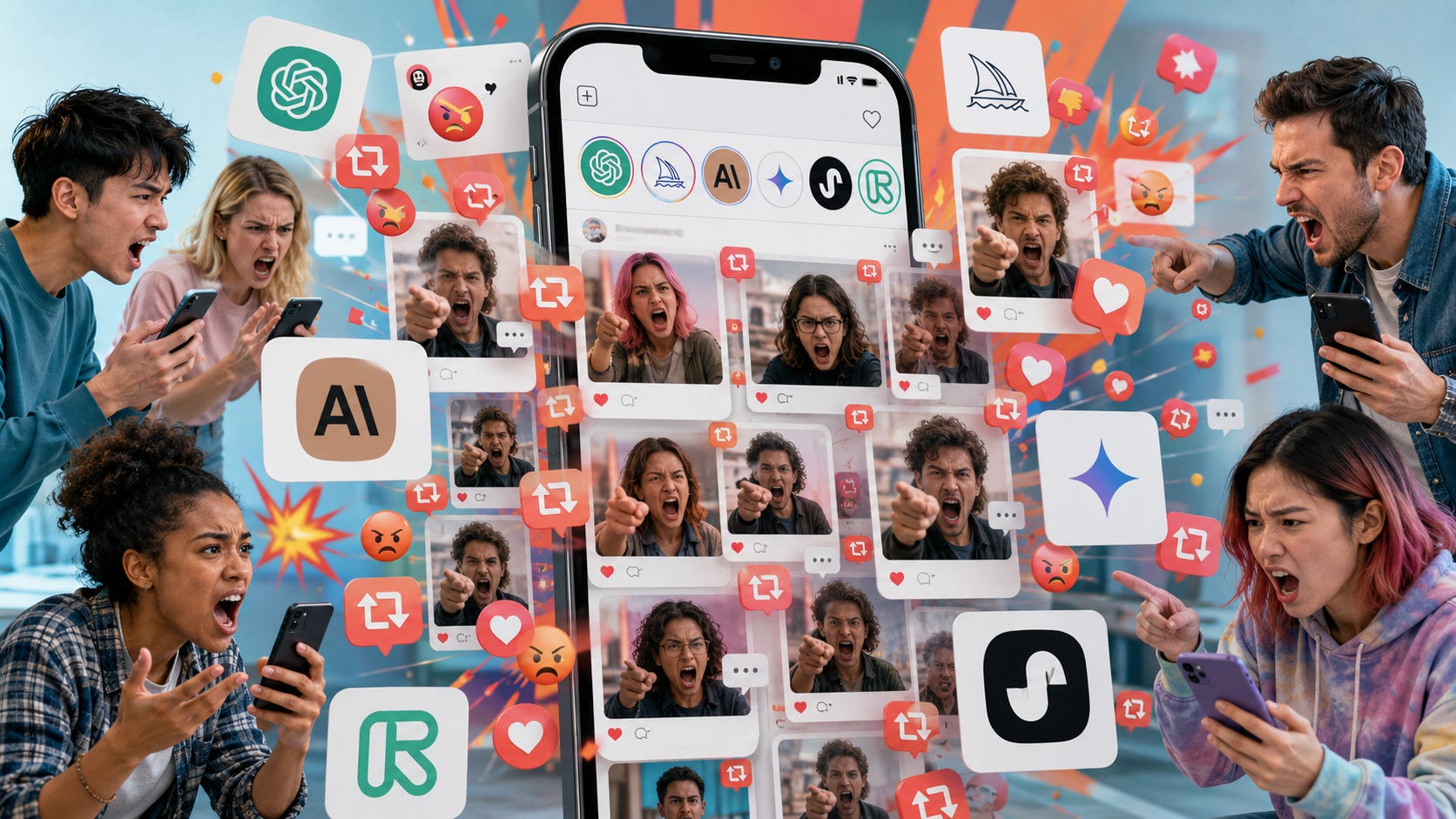
There is supposedly an epidemic of AI slop on social media.
Perhaps there is. I would not know, because my feeds increasingly contain something far more repetitive, more tiresome and considerably less creative: human beings complaining about AI.
Scroll for five minutes and you will encounter the three canonical forms.
First, the furious denunciation of some AI-generated image, song or paragraph that nobody would have noticed had the outraged critic not dutifully shared it with thousands of people.
Second, the solemn declaration of personal purity:
“I will NEVER use generative AI.”
Thank you for the announcement. The world was anxiously awaiting clarification on how you intend to produce your watercolor drawings of sad frogs.
Third, there is the desperate public plea:
“Pleeeeeaaaaase stop using AI.”
Stop using a technology that saves time, lowers costs and gives ordinary people access to capabilities previously controlled by credentialed specialists. Why? Because someone with 600 followers and an Etsy store feels spiritually unsettled by it.
This is human slop: low-effort, repetitive, emotionally manipulative content produced by humans who imagine that their hostility toward machines constitutes an original personality.
And it is everywhere.
More on generative AI:

The anti-AI content mill
The pattern has become so predictable that one can perform the experiment at home.
Find a viral post lamenting the death of human creativity, then click through to the author’s profile. After the theatrical language about souls, theft, authenticity and the sacred human hand, you might expect to discover the lost heir of Michelangelo, Bach or Dostoevsky.
Instead, you find badly proportioned fantasy portraits, generic ambient music, unfinished webcomics or prose that reads like a first-year creative-writing assignment.
At best, the work is mediocre. At worst, the person’s primary creative output appears to be posting about how much more creative he is than people who use AI.
I am clearly not the only person to have noticed this. Designer Navin Harish recently described posts complaining about AI slop as “inescapable”, while published writer Nicolas Cole has argued that there is already more human slop than AI slop. Artist and philosopher Francesco D’Isa went further in an essay titled “The Idea of ‘AI Slop’ Is Slop”, pointing out that derivative, forgettable and ugly human production existed in industrial quantities long before anybody had heard of Midjourney. Generative AI merely made the hypocrisy surrounding bad content harder to ignore.
The complaint is rarely about quality alone. Social media was drowning in low-quality human art, corporate filler, recycled opinions, algorithm bait, stock music and SEO prose for decades. Nobody organized a moral crusade against the 40 millionth indistinguishable acoustic cover uploaded to YouTube.
The hostility begins when the machine crosses a protected boundary.
It can draw. It can write. It can compose. It can perform the visible surface work that once served as evidence that the person possessing the skill was special.
That is the real offense generative AI committed.
The machine did not create the insecurity
The objections to generative AI are often presented as disinterested moral concerns. Copyright, consent, fraud and disclosure are legitimate subjects for debate, but they cannot fully explain the strange emotional intensity of the anti-AI crusade.
What explains it rather better is status anxiety.
A 2026 preprint surveying 378 verified professional visual artists found that most respondents were strongly opposed to generative AI and reported workplace pressure, additional stress and reduced job opportunities. Sure, that does not prove every complaint is motivated by insecurity, but it does confirm that the economic threat is neither imaginary nor confined to a handful of hysterical social media accounts.
These artists are absolutely right to feel insecure because generative AI attacks the scarcity on which much of their economic value depended. Producing a technically competent illustration, commercial soundtrack, book cover, voice-over or marketing text once required years of practice, paid specialists or both. Those requirements acted as gates, and anyone who passed through those gates could charge a scarcity premium.
Those gates are now being dismantled, and most creative professionals never saw this coming.
A person no longer needs to be a painter to sell paintings. He does not need to play several instruments to produce music, and he does not need to possess flawless spelling and grammar before publishing readable prose. He still requires ideas, judgment and some capacity to distinguish good work from garbage, but the mechanical skills needed to translate an intention into a finished result are becoming dramatically more accessible.
That is excellent news for almost everybody except the people who mistook the technical production process for creativity itself.
Creative skills are not worthless
For centuries, technical skill served as both a tool and a barrier. You could imagine a magnificent painting, but without the ability to paint, it remained inside your head. You might have had brilliant cinematic ideas, but without cameras, actors, editors, sound engineers and a large budget, you would never create a movie.
Generative AI weakens those barriers. It does not instantly make everyone a great artist, but it gives almost everyone access to increasingly powerful instruments of artistic production.
This distinction is fatal to the mediocre creative professional: great artists retain their taste, experience, judgment and ability to communicate a coherent vision. Mediocre artists merely lose the ability to hide behind technical procedure and financial barriers to entry.
A recent controlled experiment involving 50 professional artists and 49 matched laypeople offers an important clue about what comes next. Both groups used the same text-to-image system, yet the professional artists produced more accurate copies and more divergent creative ideas. Their traditional expertise transferred into the new medium, even when the mechanical act of drawing had been removed.


This is exactly what competent creative professionals should want to hear. Their education and experience have not become entirely useless. Those assets can help them use AI more effectively than an untrained newcomer, provided they are willing to learn.
The problem is that many would rather cling to the old gatekeeping system than master the new way of doing things.
From production to selection
The creative economy is moving from a production bottleneck to a selection bottleneck. When few people can produce a competent image, the physical ability to produce that image is valuable. When everybody can generate thousands of competent images, the valuable abilities become choosing the right one, refining it, packaging it, positioning it and finding someone prepared to buy it.
Taste becomes more important than brush control. Direction becomes more important than manual execution, while branding, distribution, marketing and sales decide which work reaches an audience.
This shift offends people who believe the market owes them compensation for effort. It does not. Customers pay for results, not for the private suffering you may have inflicted on yourself in producing them.
Evidence from a natural experiment on a major Chinese art-outsourcing platform illustrates this economic change. After an advanced image generator suddenly became available, average prices for affected artwork fell by 64 percent. At the same time, order volume increased by 121 percent and total revenue rose by 56 percent, largely because cheaper production attracted new personal commissions. Incumbent creators retained most of the market share and captured much of the benefit.
That is what democratization looks like.
Prices fall. Supply explodes. New customers enter. Established producers who adapt can do more work. Those who refuse to adapt complain that the market has betrayed them.
No, the market has discovered that their old scarcity premium is no longer justified.
More on AI provenance:

The anti-slop performance
The anti-AI purity pledge now performs the same function as many other online status rituals. It signals membership in a supposedly authentic creative caste, separating the righteous human producer from the contaminated prompter.
Procreate, for example, managed to compress the entire ritual into one corporate slogan:

Yet nobody has prohibited these people from drawing, writing or composing. Nobody is entering their studios and confiscating their pencils. Nobody is prohibiting anybody from spending six months painting a bowl of fruit. What has changed is that other people no longer require their permission, their training or their rates to produce an acceptable result.
Status loss often feels like persecution to the person losing status.
That helps explain why so much anti-AI rhetoric is directed at other users rather than at the technology itself. The goal is to stigmatize adoption, shame customers and preserve the old hierarchy for as long as possible. Instead of learning the new tools, improving their work or acquiring the commercial skills needed in a more competitive market, they enter damage-control mode and attempt to keep everyone else down.
A 2026 analysis of 25 million comments on Reddit and Hacker News found that the share of AI-use accusations employing pejorative labels rose more than tenfold. The term “slop” accounted for 94 percent of the pejorative language studied, while the textual characteristics that statistically distinguished AI writing from human writing did not predict which human comments were accused of being AI-generated. The researchers concluded that these accusations were increasingly functioning as social gatekeeping and in-group signaling rather than reliable detection.
A recent game review captures the mechanism perfectly:


In plain English, “AI slop” is rapidly becoming another way of saying: “This person is not a member of my preferred cultural caste.”
Why your feed is full of it
There is a straightforward reason you may encounter more anti-AI complaining than actual AI-generated art, music or writing. Outrage is exceptionally well suited to the incentives of social media.
A drawing may receive a few polite likes. The same drawing posted alongside an AI image, accompanied by a declaration that TECHNOLOGY IS DESTROYING THE HUMAN SOUL, can attract thousands of angry supporters. The artist receives attention, reassurance and membership in a moral community, while the platform receives engagement.
Research supports the existence of this feedback loop. A Science Advances study of online moral outrage found that users who received positive social feedback for expressions of outrage became more likely to express outrage again. An earlier PNAS study of more than 563,000 social media messages found that each additional moral-emotional word increased diffusion by roughly 20 percent within ideological groups.
Negativity enjoys a similar advantage. A Scientific Reports study examining 95,282 news articles and more than 579 million social media posts found that users were 1.91 times more likely to share links to negative news stories.
The anti-AI hobbyist has therefore discovered an ideal content strategy. Ordinary creative work struggles for attention, while moral panic about AI spreads easily and produces social rewards. Over time, the complaint performs better than the creation, and the artist gradually becomes an anti-AI influencer who occasionally remembers to draw.
This is human slop in its purest form: mechanically reproduced moral indignation, optimized by engagement incentives, wearing authenticity as a costume.
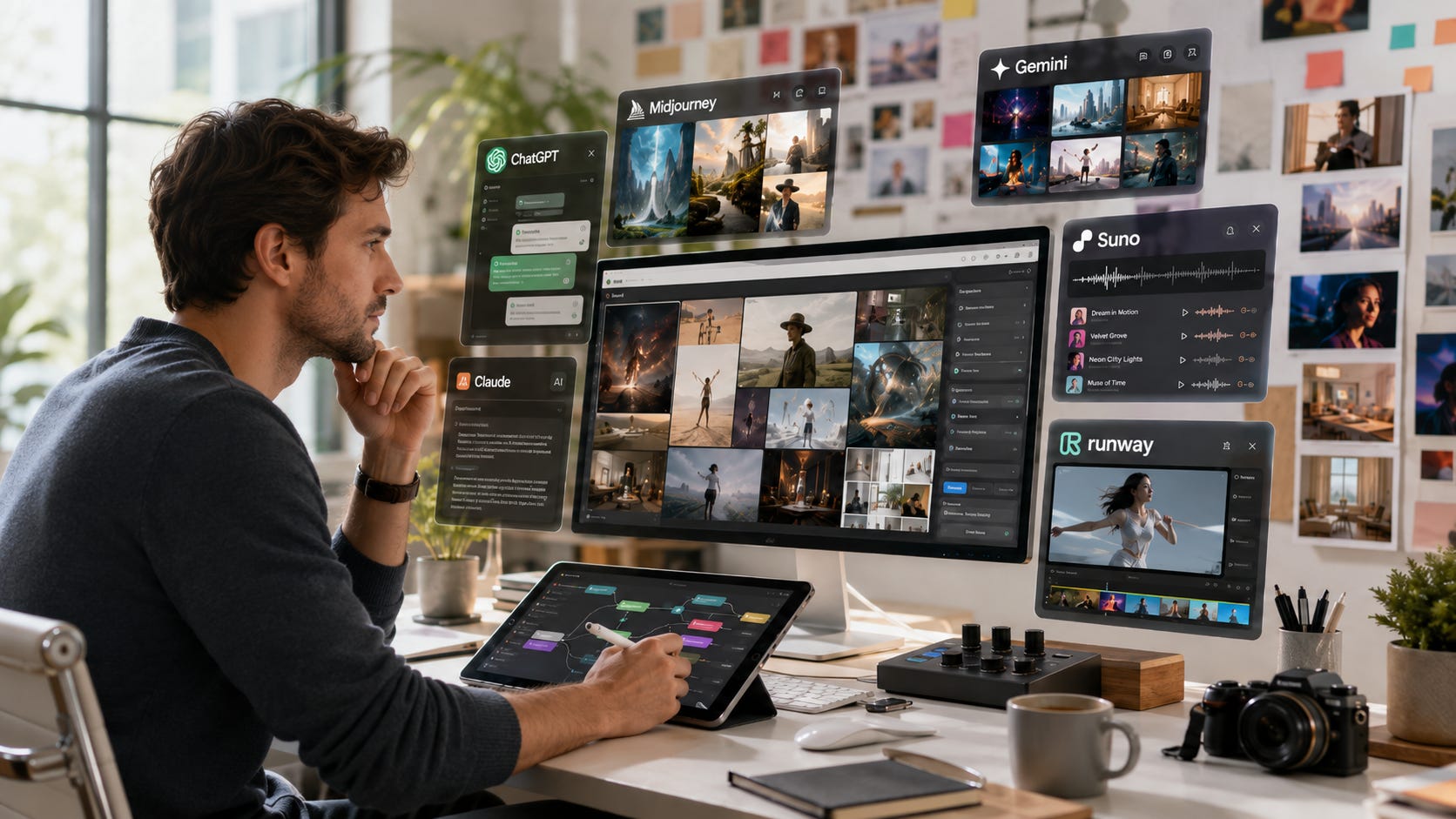
Adaptation is not optional for professionals
Creative professionals should observe how other skilled occupations are responding.
In a randomized experiment involving professional writing tasks, ChatGPT reduced average completion time by 40 percent while increasing assessed output quality by 18 percent. The gains were particularly helpful to weaker participants, which should trouble anyone whose professional position depends primarily on doing routine work slightly better than an amateur.
The evidence from programming is more mixed, which makes it more instructive. A Google randomized controlled trial estimated that AI assistance reduced completion time on a complex enterprise coding task by about 21 percent. By contrast, a METR study of experienced open-source developers found that early-2025 AI tools made participants 19 percent slower when they worked on mature codebases they already knew intimately.
This shows us that AI doesn’t automatically make everyone ten times more productive. The lesson is that intelligent adoption requires experimentation, workflow redesign and knowledge of where the tool helps or hinders.
Competent programmers did not generally respond by demanding that everybody return to writing code in Notepad. They tested the tools, learned their failure modes and incorporated them where they produced an advantage.
Creative professionals should do the same. A trained illustrator ought to direct and correct an image model better than a random newcomer. A composer should recognize weak structures, repair arrangements and impose coherence on generated music. A serious writer should be better at identifying clichés, controlling argument, checking facts and preserving a consistent voice.
For example, Adobe’s training material treats generative AI as part of the modern creative workflow, stressing that the professional remains responsible for direction, selection and refinement:
Their existing skills should become leverage whereas refusing to adopt new technology merely converts those skills into a museum exhibit.
Generative AI is becoming part of creative work, and professionals should accept the unpleasant reality, learn to use it and become better at it than the newcomers who lack their background.
Instead, too many are demanding that everyone else voluntarily use worse tools so that their old skills retain their former market value.
Hobbyists face a harder question
The professional can adapt his business model but the hobbyist must examine his motives.
Do you genuinely enjoy creating art, or did you merely enjoy being one of the few people in your social circle who could create it? Do you genuinely love the private process of drawing, writing or composing, or did you merely love the attention and identity it provided?
These questions were easy to avoid while technical ability remained scarce. Praise for the finished object could be confused with love for the process, and the social status attached to being “an artist” could be mistaken for genuine artistic devotion.
Then, generative AI comes around and clearly separates them.
Someone who genuinely loves painting can obviously just continue to paint. The existence of image generators cannot prevent him from studying light, mixing pigments or spending an afternoon on a canvas. Someone who loves writing can freely continue arranging words, while someone who loves music can continue practicing an instrument.
The fact that I’m using Suno in a project to preserve historical music, something I couldn’t possibly do by myself before, doesn’t mean I don’t enjoy picking up a guitar and playing some cool riffs every once in a while. But I do these things for very different reasons, and in the pursuit of very different ends.
The person who struggled through the technical creation process because he loved the status of being called an artist faces a more serious crisis. A five-year-old can now press a button and produce something that, at a glance, appears more technically impressive than work that took an adult years to learn.
Perhaps those years were worthwhile because the process itself was worthwhile. Perhaps they produced taste, discipline and perception that can now be combined with better tools. Perhaps the person was never attached to art at all, and was instead attached to the admiration, identity and emotional comfort that came with it.
Regardless, it is a question that generative AI has now made impossible to avoid and one that people are most certainly asking about the formerly unique creators they follow online: “Are they truly in it for the art, or for the things it afforded them?“
AI arrived at an old landfill
This panic repeats the mistake I addressed in an earlier Popular AI article, “No, AI didn’t kill the internet. It was already murdered.”
The internet was already saturated with corporate filler, recycled opinions, clickbait, search-engine bait, low-effort video, algorithmic manipulation and industrial quantities of human-generated garbage. AI arrived at a crime scene and was immediately accused of killing the victim.
Generative AI systems can certainly multiply bad content. They can also multiply useful, beautiful, strange and highly personalized content that would previously have been too expensive or difficult to produce.
The fundamental problem remains filtering. A healthy platform lets users freely reject garbage and reward quality. Content that is not useful and does not fulfill a real need for users will sink to the bottom on such platforms. A corrupt platform rewards whatever generates compulsive engagement, which currently results in outrage about AI slop outperforming said slop itself.
The result is your feed filled with humans endlessly warning that machines are filling your feed. One could hardly design a better parody.
More on AI slop criticism:

Make something better
There are legitimate disputes about copyright, consent, disclosure, fraud and commercial misrepresentation. There is also a considerable quantity of dreadful AI-generated material, because giving people powerful tools does not automatically give them taste.
Ignore it, block it or produce something better.
What deserves contempt is the attempt to convert personal insecurity into a universal prohibition. Nobody owes mediocre creatives an artificial scarcity regime. Nobody is morally required to spend more time and money producing an inferior result so another person can continue feeling exceptional.
The future belongs to artists who combine taste with leverage, writers who can think and edit, musicians who can transform generated material into something people actually want to hear, and entrepreneurs who know how to package creative work for an audience.
Generative AI did not make these people mediocre. It merely removed the tariff that protected their mediocrity from competition.
Stop begging everyone else to use worse tools.
Make something worth seeing.
Explore more from Popular AI:
Start here | Local AI | Fixes & guides | Builds & gear | Popular AI podcast
Has generative AI actually made your feed worse, or has the backlash against it become the bigger source of slop?