


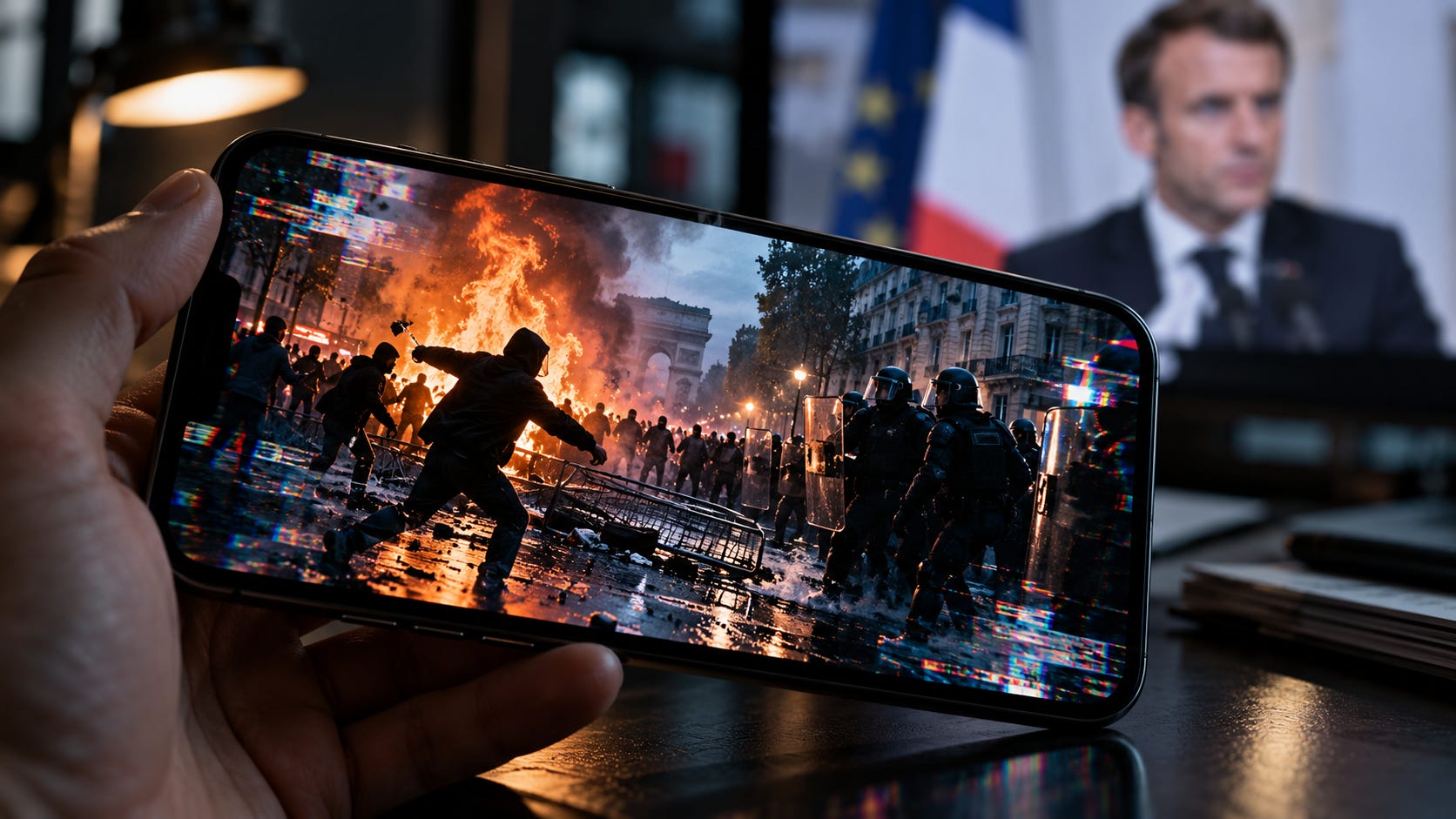
When a president calls circulating images AI-generated, the public needs more than his assurance. Emmanuel Macron’s remarks after France’s October 17 riots show why: genuine violence and fabricated imagery can circulate together, leaving authentic recordings vulnerable to sweeping doubts.
Four days after some of France’s worst urban unrest in years, Macron accused foreign political leaders of amplifying AI-generated imagery and false narratives about the riots. He did not, however, identify the particular images he disputed. That leaves an accountability gap at the center of the controversy.
As convincing synthetic videos become commonplace, the mere suggestion that a recording was generated by AI may be enough to make viewers doubt what they have seen. Simultaneously, governments across Europe are introducing rules to identify synthetic content, promising greater transparency.
What Macron actually said about the French riots
On October 21, speaking to reporters in Doha, Qatar, Macron criticized foreign leaders who had attributed the recent unrest in France to immigration and Islamic extremism.
According to AFP, he accused foreign figures of manipulating the events for political advantage, particularly during election campaigns. He also alleged that AI-generated images had circulated showing events that never happened in France.
His comments followed statements by U.S. President Donald Trump and Israeli Prime Minister Benjamin Netanyahu linking the unrest to immigration and Islamism. Macron rejected those explanations and argued that foreign political narratives had distorted the events.
However, the Associated Press reported that Macron did not identify the images or explain how their falsity had been established. Without those details, readers cannot assess his allegations clip by clip.
There is evidence that fabricated protest imagery circulated online, alongside extensive independent documentation of genuine violence and destruction.
His remarks still raise a legitimate accountability question. When a president publicly declares that circulating imagery is fabricated, people should be able to examine the examples and the evidence behind that judgment. An unspecified allegation can cast doubt well beyond the material an official intended to challenge.

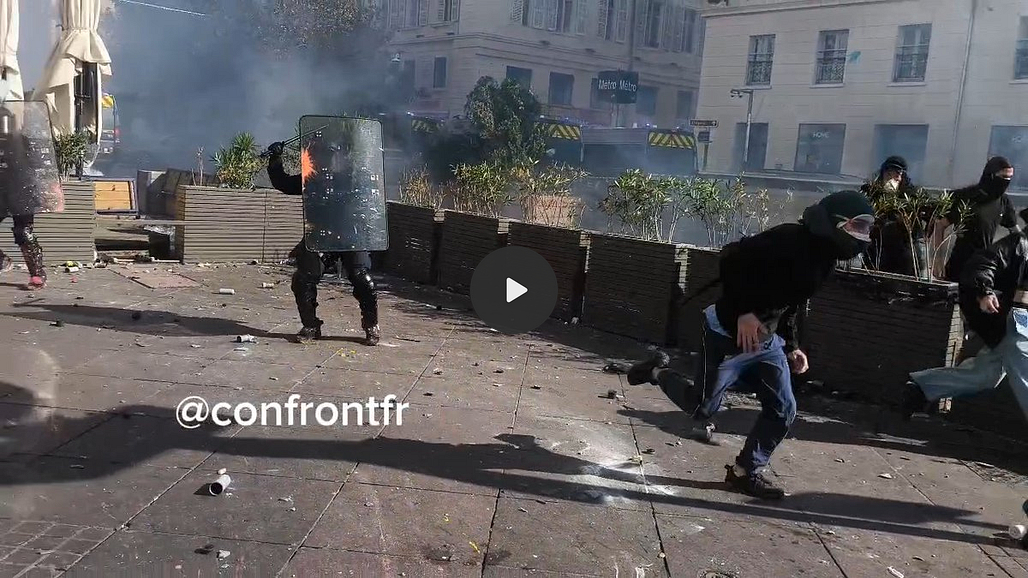
The riots were real. Some viral images were not.
The October 17 demonstrations grew out of student complaints about school conditions and broader anger over living costs. Reuters documented clashes, fires and police responses. Le Monde described livestreamed violence and looting alongside allegedly AI-generated protest images, including a Pink Panther-costumed demonstrator and an elderly couple supposedly stripped during the unrest. Footage of police vehicles being pelted with stones drew millions of views. German public broadcaster ZDF also examined synthetic and misleading protest imagery.
Those findings undermine blanket assumptions in either direction. A viral recording is not necessarily real. A riot also does not become imaginary because fabricated pictures circulate alongside authentic recordings. And images of actual violence do not, by themselves, establish who participated or what motivated them.
How the liar’s dividend weakens video evidence
Legal scholars Robert Chesney and Danielle Citron described the problem in their 2019 analysis of deepfakes. They called it the liar’s dividend: as convincing fakes proliferate, someone confronted with genuine evidence can more plausibly deny it.
Imagine independently recorded footage of police misconduct, attacks on a business, or the destruction of public property. The responsible authority need not produce a competing recording. Raising doubts about the original may suffice to confuse the public until attention moves elsewhere. The witness then has to defend the recording before anyone addresses what it shows.
That mechanism can serve governments, opposition movements, corporations, and private individuals alike. During politically charged unrest, officials may have incentives to minimize failures, while their opponents may exaggerate incidents. AI gives both a new argument for attacking the evidence, even when no one has demonstrated that the disputed file was manipulated.
Europe’s AI-labeling rules face an accountability test
Under Article 50 of the EU AI Act, providers of certain generative systems must mark synthetic outputs in machine-readable form, while professional users face disclosure obligations for qualifying deepfakes. The European Commission says these transparency obligations began applying on August 2, 2026, with transitional provisions for some existing systems.
These requirements are ostensibly intended to help people identify synthetic material: a label can tell a viewer something about how content was produced, but the accusation that an unlabeled recording is fake still needs its own supporting evidence.
Public officials maintain a double standard if they demand technical disclosures from creators while expecting their own declarations of fakery to be accepted without comparable evidence. A credible public standard should require a named clip, a reproducible verification method and a correction when the allegation is wrong.
Macron’s failure to name specific clips, while not proving directly that the president dismisses real footage as fake, does leave his public allegations difficult to scrutinize. Officials’ claims about authenticity deserve the same examination as those made by ordinary publishers.
More on the EU AI Act:

Provenance can authenticate a file, not the event it depicts
The C2PA Content Credentials standard attaches cryptographically signed information about a file’s creation and editing history. It can help verify where material came from and whether recorded changes are reflected in its provenance.
But provenance alone cannot determine whether media is factually true. A correctly authenticated camera video might be staged or miscaptioned. A genuine clip may have no credentials because its metadata was removed. Those are different problems, and neither can be resolved simply by checking whether a badge appears beside a post.
We previously examined how AI labels can make human-made content suspect. For witnesses and independent creators, the danger is having an absent credential treated as a reason to disregard otherwise credible evidence.

For footage of unrest, meaningful verification often requires the original upload, location and time checks, matching landmarks, independent camera angles, eyewitness reporting and contemporaneous records.
No AI-detector score or presidential assertion should substitute for that work.
More on AI provenance:

Ask officials to identify the footage they dispute
When governments face protests over their performance, claims that inconvenient footage is synthetic carry special weight. Officials possess communications departments, public records and investigative resources that ordinary witnesses lack. They can specify the disputed material and publish the basis for their conclusions.
The public should ask for exactly that. Preserve original files when possible, compare independent reporting, avoid repeating unverified claims about perpetrators, and resist treating a missing authenticity badge as evidence of fabrication.
If AI transparency is meant to help people distinguish real events from invented ones, public authorities should disclose the evidence behind their accusations of fakery. In this case, that means identifying the images Macron disputed and explaining exactly how they were verified.
The public should be able to inspect the evidence before an official’s assertion becomes a reason to dismiss it.
Explore more from Popular AI:
Start here | Local AI | Builds & gear | Autonomy & policy | Fixes & guides | Popular AI podcast