



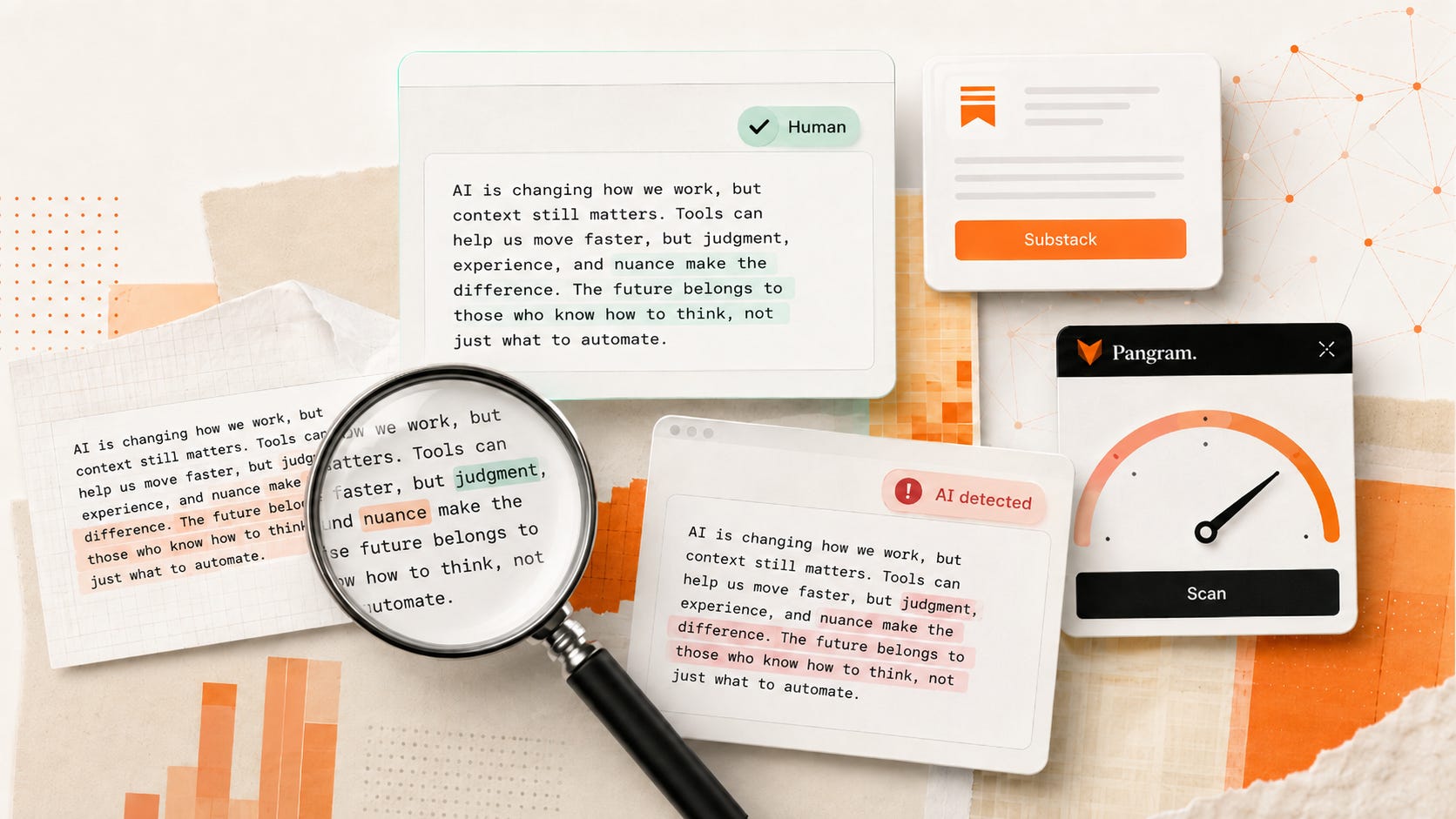
Substack added Pangram AI detection on July 21, 2026, giving readers the power to scan posts, Notes, replies and comments for possible AI writing. For publishers, that turns an imperfect statistical estimate into something much more consequential: a public judgment about authorship.
Pangram appears considerably more accurate than many older AI detectors. Independent studies have reported strong results, including very low false-positive rates in controlled test sets. That deserves to be taken seriously. It still does not make Pangram a waterproof provenance system.
The detector cannot see how a document was created. It cannot inspect who developed the argument, which passages were dictated, whether an AI tool summarized research, how extensively the draft was rewritten or who checked the sources. It sees the finished text and classifies patterns in that text.
It’s important to note this because Substack presents the result inside a social publishing platform. A reader is unlikely to treat “AI writing detected” as a narrow technical estimate. The label can become a judgment about effort, honesty, originality and value, even though Pangram does not directly measure any of those things.
In our own testing on Substack, Pangram was too eager to flag text as AI-assisted and did not consistently reflect what we knew about the writing process. That informal test is not a scientific benchmark, and it should not outweigh controlled research. It is enough to demonstrate the practical limit at the center of this article: “AI writing detected” cannot safely be treated as proof of who wrote a piece or how much human judgment shaped it.
More on AI detection in writing:

Quick verdict on Pangram AI detector accuracy
Pangram is one of the strongest AI-text detectors currently available. Controlled research from the University of Chicago and Vrije Universiteit Brussel found that it outperformed several competing tools in their test sets.
Its output remains a statistical classification, not evidence of provenance. Pangram cannot inspect drafts, prompts, revision history, research notes, recordings or editorial decisions.
Substack’s percentage is easy to misunderstand. A “100% AI” result estimates how much of the submitted text the system associates with AI writing. It does not necessarily mean the detector is 100 percent certain.
A human result proves very little. Research published in May 2026 found that text from some base models could look overwhelmingly human to Pangram and GPTZero.
The main control lever is reputation. Writers can disable detection, but readers then see an “AI detection unavailable” message, which can create suspicion of its own.
Writers should document their process rather than alter their prose to satisfy a classifier. Version histories, drafts, source notes and a clear disclosure policy provide more meaningful evidence than a detector score.
What Substack changed
Substack CEO Chris Best announced the Pangram partnership in a July 21 post titled “Against Claudefishing.” Readers can request a scan of text longer than 100 words and receive an estimate of how much was written by hand or with AI assistance.


According to Substack’s help documentation, the feature applies to eligible posts and Notes published on or after July 21, 2026. It is available in the Substack Reader on the web and in the iOS app, with Android support promised later. Readers can also scan individual replies and comments. It does not currently work in emails, audio or video posts, standalone publication websites or custom-domain views.
Substack also added a “How I make this” statement where publishers can explain their creative process. Writers can scan drafts before publication, report a result they believe is wrong and disable reader detection on an individual post or Note.
There is a catch. According to Substack’s instructions, a writer must first generate a Pangram analysis before selecting “Disable detection.” Readers who later request a scan will see “AI detection unavailable” instead of a result.
That is technically an opt-out. Socially, it can operate like a refusal to take a test.
The control lever is reputation
Substack is not currently banning AI-assisted articles or automatically marking every post. Someone must choose to run the scan, and a writer can disable it.
The pressure comes from what happens after the result appears.
A red AI result can make a reader suspect that the author contributed little or concealed the production process. A human result can act like a platform-issued certificate of authenticity. An unavailable result can raise the question of what the writer is hiding.
None of those conclusions necessarily follows from the evidence.
In Substack’s launch announcement, the company said it may eventually let readers set preferences about AI content in recommendations. If that happens, Pangram’s classification could move beyond curiosity and begin influencing distribution. A probabilistic classifier would then help decide which writers remain visible.
That is why the detector’s reliability matters differently “in the wild“ on Substack than it does in an isolated demonstration. A classification attached to a working writer has reputational and potentially commercial effects.
How older AI detectors worked
Many early AI detectors relied heavily on perplexity.
Large language models assign probabilities to possible next words. Given “I took the dog for a,” the word “walk” is highly predictable. A word such as “referendum” would be much less predictable.
Perplexity-based detectors looked for writing that followed too many statistically predictable paths. Low-perplexity text was treated as more likely to have come from a language model.
That approach produced obvious problems. Human beings, after all, also write predictable text. Legal documents, technical instructions, school essays, press releases and historical quotations can all contain conventional phrasing. Famous documents can appear unusually predictable because language models encountered them repeatedly during training.
This helps explain why older detectors sometimes declared the Bible, the Declaration of Independence or old literary works to be AI-generated. They were measuring how unsurprising the text looked to a model, not who actually wrote it.
In its explanation of how Pangram works, the company says its system does not rely on this basic next-token test. Its approach is closer to supervised authorship classification.
How Pangram detects AI writing
Pangram is a transformer-based neural classifier trained to distinguish human-written documents from machine-generated ones, according to its technical report.
The full production system is proprietary, so outsiders cannot inspect every feature, weight, threshold or calibration decision. However, Pangram’s public explanation of the detector and the technical report reveal its main process.
1. It learns a high-dimensional representation of writing
The model converts a passage into an internal numerical representation. Pangram describes this as placing writing on a map, with human and machine-generated writing tending to occupy different regions.
This is not a literal map of phrases such as “delve,” em dashes or tidy three-part lists. A transformer classifier can learn combinations of vocabulary, sentence structure, discourse organization, repetition, transitions, information density, tone and many other latent patterns.
The result depends on the full passage. Surrounding text can therefore affect how a particular paragraph is represented.
2. It starts with known human writing
Pangram says its known-human training corpus is drawn from 2021 and earlier, before ChatGPT made large volumes of generated prose difficult to exclude from internet datasets.
Using older material reduces the risk that supposedly human training examples secretly contain modern AI output.
It does not solve data drift. Human writing changes over time, especially when millions of people read, edit and imitate machine-generated prose. Pangram acknowledges that its model will need to adapt as language changes.
More on the impact of LLMs on human writing:

3. It generates “synthetic mirrors“
For each human example, Pangram creates an AI-generated counterpart designed to match its topic, tone and length.
These paired examples force the classifier to learn differences between similar texts instead of taking easy shortcuts. It cannot simply learn that recipes are AI and diaries are human when both classes contain matching subject matter.
Pangram calls these generated counterparts “synthetic mirrors.“
4. It mines hard negatives
A basic classifier is run over a large pool of human writing. Human examples that it incorrectly considers AI-generated are collected as hard negatives.
Those difficult examples are added to the training set. Pangram then produces matching AI mirrors and retrains the classifier.
The cycle can be repeated:
Find human writing the model gets wrong.
Add it to the training data.
Generate a comparable machine-written version.
Retrain on the difficult pair.
Search for the next set of failures.
This active-learning process is intended to refine the decision boundary in the exact regions where false positives occur. Pangram’s authors describe the method as “hard negative mining with synthetic mirrors”.
Pangram CEO Max Spero explains the synthetic-mirror and active-learning process in this interview:
5. It uses document context
Substack requires more than 100 words because longer passages generally give the classifier more evidence.
This also creates a difficult behavior. The same paragraph can receive a different classification when scanned alone, inside a longer essay or beside machine-generated material. The internal representation is context-dependent.
That is not necessarily a software bug. It is a consequence of asking a document-level classifier to estimate the origin of mixed writing. It becomes a practical problem when the interface returns categorical-looking answers such as “100% AI.”
So what does “100% AI” actually mean?
A Pangram percentage is meant to estimate the share of the submitted text associated with AI writing. That quantification is separate from the detector’s confidence level.
A reader who sees “100% AI” may interpret it as: “The system is 100 percent certain that a machine wrote this.” Pangram may instead be saying: “The passages we classified as machine-associated cover the entire submitted text.”
The interface then converts a complex model output into a simple percentage, but that simplicity easily becomes deceptive. It does not tell the reader how close the passage was to the classification threshold, how sensitive the result was to context or how the result would change if the text were divided differently.
What Pangram can and cannot establish
The cleanest way to interpret a Pangram result is to separate text classification from authorship provenance.
Text classification asks whether the submitted wording resembles patterns the model learned from human and machine-generated examples. Provenance asks how the document came into existence. Those questions overlap, but they are not interchangeable.
A strong AI classification can reasonably justify closer inspection. An editor might revisit a section that feels generic, check whether it contains unsupported claims or ask the writer to explain the production process. The result can work as a prompt for inquiry.
It cannot establish who conceived the argument. It cannot show whether the writer used AI to generate sentences, summarize source material, challenge an outline, translate a passage or correct grammar. It cannot distinguish between an unattended first draft and a heavily revised article that began with machine-generated text. It cannot measure whether the author understood the subject or accepted responsibility for every claim.
The reverse is also true. A human classification does not verify the byline, prove originality or certify accuracy. A ghostwritten article can be human. A copied article can be human. A misleading article can be human. A fully generated passage can also escape detection when it does not display the patterns the classifier expects.
This creates four common interpretation errors:
Pattern similarity becomes proof of generation. A detector says the text resembles machine output, and the reader treats that as direct evidence of the writing process.
Detected assistance becomes absence of authorship. Any AI involvement is interpreted as evidence that the named writer contributed little.
Human classification becomes a quality badge. A green result is treated as proof that the article is original, accurate and trustworthy.
An unavailable result becomes evidence of concealment. A writer’s decision not to publish the classifier’s estimate is treated as an admission.
None of those conclusions is supported by the score alone.
This is why the wording around the result matters as much as the underlying model. A technical system can be statistically impressive while the product interface encourages readers to overstate what it knows. “AI-associated language detected” would communicate a narrower claim than “AI writing detected.” A visible explanation of uncertainty would also make it harder to mistake the output for a forensic finding.
The practical rule is straightforward. Use the detector to identify a question worth asking. Do not use it to skip the work of evaluating the article, the evidence, the author’s disclosure and the publication’s editorial standards.
The same principle applies in education, where institutions must separate automated signals from defensible evidence:
Pangram performs well in controlled research
Looking at raw benchmark data, Pangram has performed much better than the first generation of AI detectors.
Pangram advertises a false-positive rate of about one human document in 10,000. That is a company claim based on its own datasets, and the rate should not be assumed to apply identically to every genre, text length, language and product integration.
Still, independent work has produced strong results.
A 2025 University of Chicago working paper compared Pangram, GPTZero, OriginalityAI and an open-source RoBERTa detector across different models, genres and passage lengths. Pangram achieved near-zero false-positive and false-negative rates in the researchers’ test set and was the only tested detector to satisfy their strict false-positive policy limit without sacrificing detection performance.
The University of Chicago’s Becker Friedman Institute summarized the researchers’ findings:

A peer-reviewed June 2026 study from Vrije Universiteit Brussel compared Pangram, GPTZero, Copyleaks and Turnitin on 160 long academic documents. The dataset included fully human, fully AI-generated, hybrid and “humanized” machine-generated papers. All four systems correctly handled the fully human samples, while Pangram produced the smallest errors on AI and mixed documents. The authors still warned that detector results should not stand alone in high-stakes decisions.
An ACL 2025 study involving 300 nonfiction articles found that Pangram matched the near-perfect detection accuracy of five skilled human evaluators and outperformed almost every other automated system tested. The majority vote among those frequent LLM users misclassified only one article, showing that experienced human judgment can add context that an automatic classifier lacks.
The honest conclusion is that Pangram is probably one of the better detectors available. Regardless, that benchmark strength does not transform it into direct evidence about how a specific document was created.
Why strong benchmark results do not settle individual cases
A detector can perform extremely well across a test set and still produce an indefensible result for one writer.
▪ Test data is not Substack
Academic essays, reviews, news articles and generated benchmark documents do not perfectly represent the full range of Substack writing.
Newsletters contain quotations, edited transcripts, personal anecdotes, pasted research, recurring templates, translated passages, poetry, code, historical text, marketing copy and collaboratively edited work.
A model’s aggregate accuracy depends on how closely real inputs resemble its evaluation data.
▪ Model updates change the target
AI-writing detectors learn patterns associated with particular generations of models. Language models continue to change, and writers use them through different prompts, system instructions, editing tools and post-processing workflows.
A May 2026 study found that text produced by base models was often classified as human by both Pangram and GPTZero, while instruction-tuned models were easier to detect. The authors concluded that the detectors appeared to be tracking artifacts associated with instruction tuning and local context rather than any permanent property shared by all machine-generated text.
That makes a human result weak evidence. It may mean the text was human. It may also mean the generating model did not produce the patterns the detector expected.
▪ Hybrid writing has no clean ground truth
Consider a writer who:
asks an AI system to summarize source documents
builds an original argument
generates a rough outline
dictates several sections
rewrites an AI-generated paragraph
uses Grammarly on the result
replaces every conclusion
fact-checks and edits the final article manually
What percentage of that article is “AI”?
There is no universally accepted answer. A detector like Pangram can associate passages with machine writing, but it cannot reconstruct the intellectual history of the document.
▪ Rare errors still become numerous at scale
Even Pangram’s advertised false-positive rate of one in 10,000 would produce 100 false positives for every million genuinely human documents scanned.
That would be excellent classifier performance. It would also mean 100 innocent writers carrying the burden of a public AI suspicion.
The severity of such errors ultimately depends on what the platform does with them. A low error rate may be acceptable for aggregate research. It is harder to accept when the result is attached to an professional reputations, income or eligibility for recommendations.
Real-world tests expose brittle behavior
Anecdotes cannot establish Pangram’s overall false-positive rate. They can reveal product behaviors that aggregate accuracy figures conceal.
Writer Freddie deBoer documented one of the clearest examples in “I Wouldn’t Say Pangram is Broken, But I Would Say That It’s Brittle.”
A roughly 300-word section from one of his essays was classified as 100 percent AI-written with high confidence. When he submitted the complete essay of about 5,000 words, Pangram classified it as 100 percent human-written with high confidence. Breaking the accused passage into smaller parts produced more human results.
He also combined known human and generated text in different proportions and found that the surrounding context could push mixed passages toward categorical 100 percent results.
Other users have reported similarly unstable outcomes. In one Reddit account of a Pangram false positive, a user said a handwritten paragraph changed from 100 percent AI to 100 percent human after two words were replaced. In another discussion of Pangram’s treatment of personal writing, a user reported a 99 percent AI-confidence result for an overview they said they had written themselves. These are unverified user accounts, so they should be treated as evidence of complaints and user concern rather than a measured error rate.
Marc Watkins described a different problem after using Pangram’s browser extension for a week. He found himself evaluating labels instead of writing and documented cases where classifications changed when a post was scanned in different contexts. His conclusion was that the extension made him trust people less while offering less certainty than its presentation suggested.
That may be the most important real-world effect. The classifier changes how people read before it has proved that the underlying judgment is correct.
Our experience with Pangram on Substack
Popular AI uses AI systems as part of its editorial process. Every article is edited and reviewed by a human before publication. The publication takes responsibility for the final argument, wording, sources and conclusions.
We tested Pangram on our own Substack material with knowledge of how the text had actually been produced. The detector was overall too eager to identify AI assistance, and its percentages did not communicate the human editing, judgment and responsibility behind the final article.
Our experience with Pangram is that it may correctly detect that an AI system touched a text while giving readers a deeply misleading impression of exactly how much AI was involved and who really “made“ the finalized work readers end up reading.
Substack itself concedes this point. Its announcement says Pangram cannot determine whether “great human care” went into the work or whether AI was merely used as a source. The detector classifies linguistic output. It does not measure effort, originality, accountability, accuracy or value.
What this does to readers
AI detection promises to help readers escape a web filled with generic, automated material. That is a legitimate problem. Nobody wants to spend ten minutes reading a personal essay before discovering that there was no person behind it.
The danger is replacing one trust problem with another.
▪ Readers may treat estimates as facts
A bright label is easier to process than a technical explanation. Readers may quickly collapse these categories:
AI-associated becomes AI-written.
AI-written becomes unedited.
Unedited becomes low quality.
Low quality becomes deceptive.
Human becomes trustworthy.
Yet every step can be wrong.
Human writers lie. Human writers publish sloppy work. AI-assisted writers can check every claim, rewrite every paragraph and take full responsibility for the result.
A detector knows none of that.
▪ Labels can change perceived credibility
A nationally representative experiment involving 3,861 participants found that labeling an article as AI-produced reduced its perceived accuracy, even though the underlying content did not change. The label also reduced interest in the policy discussed by the article.
Another study found that disclosing content-generating AI assistance lowered quality ratings for argumentative essays and creative stories.
Other research has found more limited effects. A large survey experiment on political persuasion concluded that AI labels did not substantially reduce the persuasiveness of the messages being studied. Labels may therefore damage an author’s credibility without reliably protecting readers from persuasive or misleading content.
A false positive is not a harmless UI mistake when the label itself changes how readers judge the work.
▪ Human clearance can create false reassurance
A green result answers one question badly and several questions not at all.
It does not show that the article is accurate. It does not establish that the named author wrote it. It does not reveal ghostwriters, copied material, paid promotion, undeclared conflicts or fabricated sources.
It may not even prove that no AI was used. The base-model research shows that machine text can receive strongly human classifications.
An internet covered in AI and human notices could therefore become an internet covered in confidence theater.
What this does to writers
Substack’s feature creates a new pre-publication decision.
A writer can scan the draft, inspect the result, write a process statement, report an error, disable detection or publish without looking. None of these choices is neutral once readers know the scanner exists.
▪ A false positive creates a disclosure trap
Suppose Pangram calls a human-written article AI-assisted.
Does the writer publish the false result? Does the writer disable detection and accept an “AI detection unavailable” message? Does the writer add a defensive note denying AI use? Does that denial make the author look more suspicious?
Should the writer rewrite accurate, polished prose until a proprietary model approves?
The detector has created a burden of extra work for the author even when it has learned nothing useful about the content.
▪ A human result does not settle the matter
The reverse result creates its own trap: ff Pangram labels a heavily AI-assisted article as human, should the writer treat that as permission to avoid disclosure?
A detector result cannot replace an editorial policy. The writer knows what tools were used. Tools like Pangram are, by definition, stuck reverse-engineering a polished output, at best.
▪ Writers may begin performing humanity
Once passing the detector becomes part of the publication process, writers have an incentive to optimize against AI detection.
That can mean replacing precise language, adding unnecessary personal asides, breaking clean sentence structures or inserting spelling and punctuation mistakes because those features look less machine-like.
Popular AI has published several guides about recognizing and editing common AI-writing habits, including repetitive list structures and overused punch-up punctuation. However, at best, those are editorial clues, not forensic evidence.
A good editor removes habits that weaken the article. A bad detection regime encourages writers to make prose worse so it looks more human.
More on AI writing:


AI disclosures should describe the process
Readers deserve useful disclosure when AI materially changes the work.
A useful statement explains what the system did and who remains accountable. It should not pretend that “AI-assisted” is a complete production category.
For Popular AI, the relevant disclosure is simple:
Popular AI uses AI systems as part of its editorial process.
Every published article is edited and reviewed by a human before publication.
Popular AI takes responsibility for the final text, sources, arguments and conclusions.
That tells the reader more than a detector percentage.
It distinguishes editorial use from unattended generation. It identifies accountability. It gives readers a standard against which the publication can be judged.
Research published in 2026 found that readers generally demand disclosure more often than writers do, especially when generated material is incorporated directly and the writer exercises little control over the output. That suggests disclosure norms should focus on the role AI played, not merely whether any AI tool touched the document.
The same principle belongs in policy. Popular AI’s coverage of Turnitin false positives shows what happens when an estimate quietly becomes a presumption of guilt. The setting is different, but the procedural problem is familiar.
More on AI writing detection:

What writers should do now
▪ Keep a visible writing trail
Use software with version history. Keep outlines, source notes, recordings, research documents and major intermediate drafts.
This is useful even without a detector dispute. It helps with corrections, fact-checking and future revisions.
▪ Write a process statement before there is a controversy
Explain how AI fits into the publication’s normal workflow. Do not draft a defensive disclosure after a red result appears.
A consistent policy is more credible than a detector-specific denial.
▪ Build a simple provenance file for important posts
For articles that could attract scrutiny, keep the evidence in one place instead of relying on memory after a dispute begins.
A useful provenance file can contain the original outline, dated drafts, interview notes, source documents, voice recordings, screenshots of research, revision history and a short description of where AI tools entered the workflow. The point is not to produce a minute-by-minute surveillance record. It is to preserve enough context to show the development of the work.
The file is especially valuable when several people contributed. An editor may have reorganized the argument. A researcher may have assembled links. A transcription tool may have converted an interview into text. An AI system may have summarized a long report. The final prose can contain traces of several processes even when one person remains responsible for the published article.
This record also helps with ordinary editorial work. It makes corrections easier, provides a path back to the original evidence and reduces the risk that a later rewrite detaches a claim from its source.
Do not publish the entire file by default. Keep it as internal documentation and share only what is necessary if a serious challenge arises. A concise public process statement can explain the standard workflow, while the underlying materials remain available for a specific dispute.
▪ Treat the scan as a weak diagnostic
A Pangram result can tell you that the text resembles patterns associated with machine-generated writing.
That may help an editor find generic, over-smoothed or insufficiently original passages. It should not determine whether the piece is publishable or whether its author is honest.
▪ Do not add mistakes to pass
Spelling errors and bad punctuation do not prove human authorship. They merely reduce the quality of the work.
Editing for a detector starts an adversarial game that the writer cannot permanently win. The model, threshold and interface can change without notice.
▪ Report clear errors
Substack provides a “Report detection error” option. Use it when the result contradicts known provenance.
Keep screenshots and note which text was scanned, its length and whether the result changed when scanned inside a larger document.
▪ Disable detection when the result is materially misleading
Writers should not feel obligated to publish a classification they know is false.
The “AI detection unavailable” wording is unfortunate, but knowingly presenting a bad result as meaningful is worse. Pair the disabled scan with a clear production statement where appropriate.
What readers should do with a Pangram result
Treat the result as one clue. Then ask better questions:
Does the article contain original reporting, testing or experience?
Are factual claims linked to sources that support them?
Does the writer make specific judgments?
Is anyone accountable for corrections?
Does the publication explain its editorial process?
Does the writing contain evidence of real understanding?
Would the article remain useful if the detector label disappeared?
An AI detector may identify synthetic prose. It cannot identify truth.
What Substack should change
Substack can improve this feature without abandoning AI detection.
▪ Add a publication-wide opt-out
Writers should be able to disable reader scans without first submitting each post to Pangram.
The opt-out should apply prospectively to posts, Notes, replies and comments.
▪ Replace “unavailable” with neutral language
“AI detection unavailable” implies that a useful test exists but the writer has withheld it.
A more accurate message would be:
The publisher has chosen not to participate in automated AI-text classification.▪ Show confidence, thresholds and model version
Every result should explain:
the estimated share of AI-associated text
the confidence or uncertainty range
the Pangram model version
the date of analysis
the word count
a clear warning that the result is not proof of authorship
A percentage without this context invites misinterpretation.
▪ Audit Pangram on real Substack writing
Substack should publish independent evaluations using representative newsletter genres, mixed workflows, quotations, edited transcripts, multilingual publications and long-form personal writing.
A benchmark built for academic essays cannot fully validate a platform-wide authorship feature.
▪ Provide a meaningful appeal mechanism
Reporting an error should create a visible review process, especially if Substack later uses detection in recommendations, moderation or monetization.
▪ Keep detection out of ranking until the evidence is stronger
Substack has discussed future reader preferences for AI-generated content. No classifier should influence recommendations or discovery until the platform publishes domain-specific false-positive rates and provides a workable correction process.
▪ Put process statements ahead of detector scores
The author knows how the article was made. Pangram does not.
A structured disclosure should appear before or alongside the automated estimate, allowing readers to compare the writer’s accountable statement with the classifier’s inference.
FAQ about Pangram and Substack AI detection
Is Pangram’s AI detector accurate?
Pangram has performed very well in controlled research, including studies from the University of Chicago and Vrije Universiteit Brussel. It appears more reliable than many competing detectors in those test sets. Its accuracy can still vary with the kind of text, its length, the generating model, the threshold and the surrounding context. A strong aggregate result does not guarantee that an individual classification is correct.
Can Pangram prove that a post was written by AI?
No. Pangram analyzes textual patterns. It does not have access to the document’s revision history, prompts, notes, recordings or editing process. Its result indicates that a passage resembles writing associated with language models. That is different from proving the document’s provenance.
Does “100% AI” mean Pangram is 100 percent certain?
Not necessarily. The percentage is intended to represent how much of the submitted text Pangram associates with AI writing. Confidence is a separate measurement. Substack and Pangram should make this distinction far more prominent.
Why can the same passage receive different results?
Pangram uses document context. A paragraph scanned by itself can produce a different internal representation when placed inside a longer human-written or machine-generated document. Freddie deBoer’s Pangram tests demonstrated how dramatically a classification could change when the same passage was scanned alone, split into smaller pieces or included in a longer essay. Shorter samples also provide less evidence.
Can writers disable Substack’s AI detection?
Yes. Substack’s current workflow requires the writer to generate an analysis before disabling detection on that post or Note. Readers will then see an “AI detection unavailable” message.
Should writers add mistakes to avoid AI detection?
No. Mistakes do not prove authorship. Deliberately damaging the text to satisfy a proprietary classifier produces worse writing and offers no lasting protection because the detector, threshold and interface can change.
Does a human result prove that no AI was used?
No. Detectors can miss AI-generated and humanized text. Research published in May 2026 found that base-model generations frequently received strongly human classifications from Pangram and GPTZero.
Why Pangram should remain a clue, not a verdict
Pangram deserves more credit than the many AI detectors that turned predictable writing into false accusations.
Its training method is more sophisticated. Its independent results are impressive. It may be genuinely useful for measuring large-scale patterns, investigating suspicious content or giving an editor another signal to examine.
Substack has turned that signal into a reader-facing judgment about named writers.
That changes the standard.
A system does not need to be useless to be inappropriate as proof. It only needs to make consequential mistakes that cannot be resolved from its own output.
Use Pangram to ask a question. Do not use it to answer who wrote the article, how much human judgment went into it or whether the writer deserves your trust.
Explore more from Popular AI:
Start here | Local AI | Fixes & guides | Builds & gear | Popular AI podcast
Would a Pangram “AI-written” result make you trust an article less, even if its facts and arguments held up?
Unfortunately it is not - mostly because it is not designed to detect what matters - authorship. check out my new essay https://thesubliminal.substack.com/p/the-key-to-the-safe?r=8z5vrt