


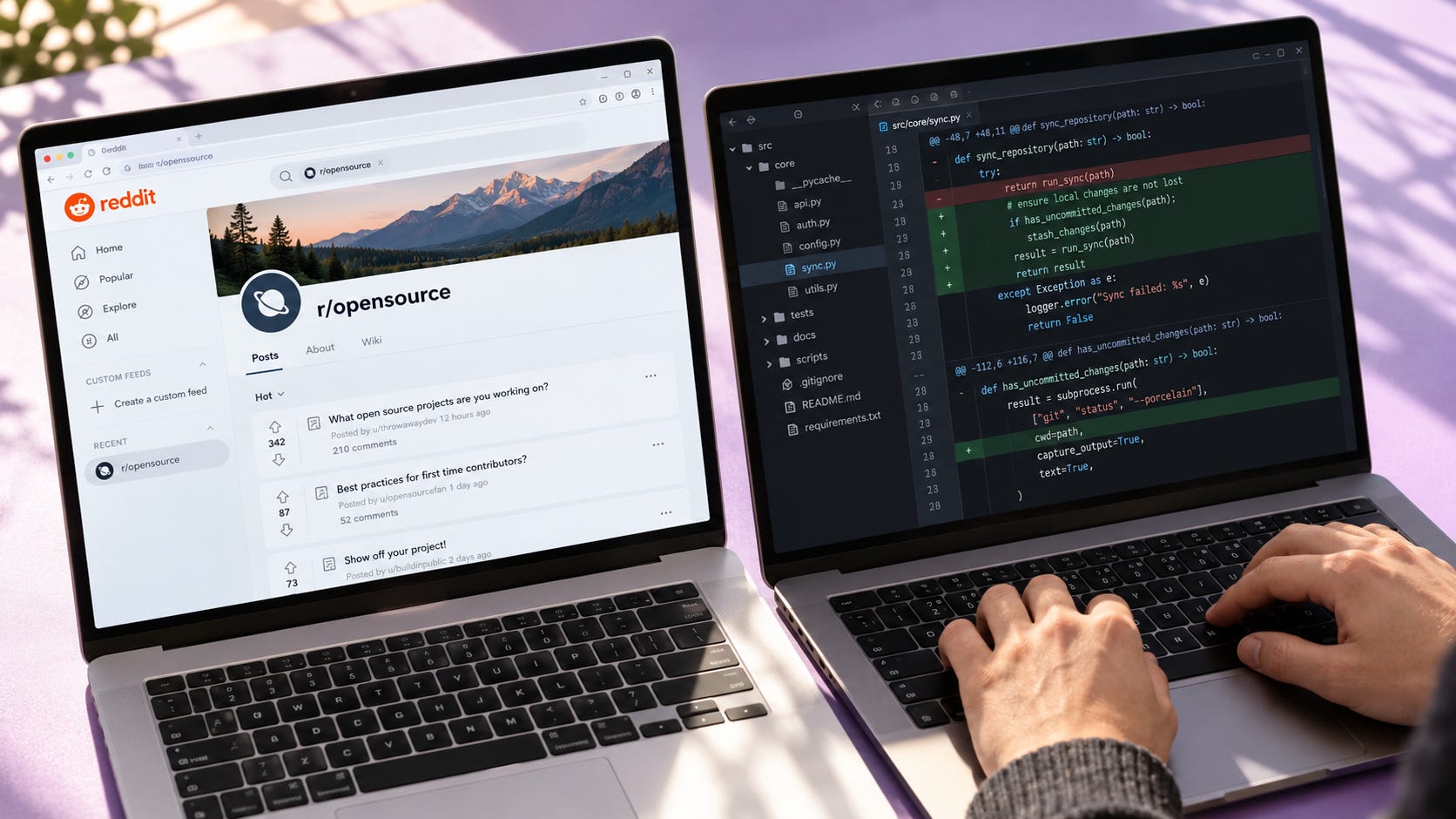
A solo developer can maintain useful open-source software for years and still fail the new posting rules at Reddit’s r/opensource. The community’s October 24, 2026 AI ban reaches beyond low-effort generated code. It adds requirements for a project’s age, contributor count, existing audience, and its creator’s ability to speak English. Legitimate developers can be turned away before anyone examines their work.
The backlash has already prompted a promise to revisit the rules. As of October 27, the gap between the sweeping announcement and the exceptions moderators say they’ll make remains unresolved. Independent maintainers face a practical problem: access to an established discovery channel now depends on criteria that have little connection to software quality.
What the r/opensource AI ban actually covers
▪ On October 24, moderator u/Wolvereness announced that projects using AI, built with AI, or intended for AI were unwelcome at r/opensource. The same post imposed eligibility requirements on projects with no AI involvement at all.
▪ Developers advertising a project were told it needed at least one year of active maintenance, multiple contributors, and an existing community. The contributor threshold was described as roughly three or more, subject to judgment. Common school-style projects were excluded, and requests for maintainers or contributors were no longer welcome. The longstanding requirement for an Open Source Initiative-approved license remained.
▪ Posters also faced an existing one-year Reddit account minimum with significant activity. Asking for an exception after a failed posting attempt could lead to a permanent ban and mute. Registered nonprofit organizations could request approval in advance for exemptions from the project and account minimums. An ordinary solo maintainer had no equivalent route through those requirements.
▪ The language provision went further. People who couldn’t speak English were told to find another community because moderators said they couldn’t distinguish an AI-written post from an AI-translated one. A developer could therefore be excluded because of the tool used to communicate, regardless of the quality of the software being discussed.
These restrictions govern participation in one subreddit. They don’t change a project’s license, remove its GitHub repository, or impose a Reddit-wide ban. But r/opensource is a discovery channel. Losing access means losing a place to introduce a project, reach potential users, and attract collaborators who might help maintain it.
Moderator discretion decides which projects get seen
The policy leaves substantial room for a moderator’s judgment. A one-year history and a contributor count are easy to measure, but neither establishes whether code is trustworthy. “Uses AI” could describe generating most of a repository, asking an assistant to review a function, adding speech recognition, or building a tool that works with local models. Those uses create different questions about quality and responsibility.
The moderator later suggested that incidental accessibility features, including automatic captions, could be allowed. On October 26, a follow-up said adjustments would be made. The moderator also said Linux would remain welcome. That clarification left smaller projects without a settled test they could apply before submitting.
An established project can receive reassurance that a newcomer has little basis to expect. Developers must anticipate whether moderators consider their work sufficiently established or obviously acceptable. That uncertainty adds another obstacle for someone who already lacks the audience and contributor base the announcement requires.
The Open Source Definition concerns license permissions, including reuse, modification, redistribution, and nondiscrimination. It sets no minimum project age, contributor headcount, or prior popularity. A private discussion forum can choose what it publishes, but its admission rules don’t determine whether software qualifies as open source. r/opensource has added participation thresholds to a software category defined on different terms.
Solo maintainers and newcomers have the least room to comply
Consider a lone maintainer who has kept a small utility secure and working for years. Requiring three contributors doesn’t improve that utility. Under the announced threshold, it makes the author ineligible to introduce it to the community. A young team faces a similar trap: it needs collaborators and users to become established, yet cannot use the forum to find them until it is already established.
The English rule compounds the problem. A developer might write clear documentation in another language and use translation to join an English-language discussion. Excluding that person because they used AI translation blocks participation before the discussion can begin. Translation errors need attention, but requesting clarification, including the original text, or using ordinary translation tools would give moderators something concrete to assess.
Objections also came from inside the moderation team. In an October 25 public response, fellow moderator Dan Brown, known as u/ssddanbrown, said he disagreed with the changes and could see no prior consultation among moderators. He credited u/Wolvereness with doing most of the difficult moderation work. Brown updated his post on October 26 to say he was leaving the team, citing the escalating dispute and stress.
Alternative communities, including r/TrueOpenSource and r/OpenSourceAIAllowed, emerged during the backlash. They offer another place to post.
A new subreddit, however, doesn’t immediately replace an established community’s audience or visibility. Developers can move their submissions more easily than they can move the people they hoped would read them.
Claims circulating about inconsistent bans and hostile treatment need individual documentation before they can support broader conclusions about enforcement. The announced requirements already provide enough reason to question the policy’s effect on independent developers.
AI spam is real, but age and headcount are poor quality tests
Brown’s account grants the strongest argument for restrictions: hastily generated projects and promotional posts consume scarce moderator time. He described one colleague doing most of that work and said AI-made submissions were pushing substantial discussion out of view. Protecting volunteer attention is a reasonable goal. A community that becomes a launch-promotion feed can lose the discussion that made it useful.
Project age and headcount remain weak substitutes for quality. A three-person team can produce a poorly tested project. One maintainer can release a carefully documented utility with reproducible tests, a clear license, and a commitment to fixing bugs. If both otherwise meet the rules, the announced contributor threshold can admit the former and exclude the latter. Having more names in a repository doesn’t establish that anyone checked the work.
Major projects already use alternatives tied to what contributors submit. The LLVM policy permits AI-assisted contributions while requiring human review, accountability, and enough understanding to answer reviewers’ questions. It allows translation or copy-editing of descriptions, but prohibits autonomous agents from posting without human approval. The contributor must do the checking before asking someone else to spend time on the submission.
The Linux kernel’s guidance requires a human to review generated code, satisfy licensing requirements, and take responsibility for the contribution. These requirements give reviewers conduct and evidence to assess. A contributor can meet them by doing the work, without first assembling a larger team or waiting for a project anniversary.
A September 2026 study of 281 AI contribution policies found that 83.3% permitted or encouraged AI-assisted code contributions. Of the policies examined, 67.3% required substantial human involvement and 43.4% explicitly assigned accountability. The sample focused on policies in popular repositories, rather than every open-source project. It shows that blanket exclusion is far from the only available response, without establishing which policy works best in every community.
Another Reddit community, r/selfhosted, offers a megathread route for projects younger than three months. Brown endorsed that lighter approach. It limits repeated launch promotion while retaining a route for newcomers to show their work. Early-stage projects have somewhere to go while they build a maintenance history.
Our guide to AI-generated pull requests recommends small, reviewed changes, proof of testing, and a responsible human who can answer questions. Those standards address the work a submission creates for someone else. They don’t require a project to become popular before it is allowed to be discovered.
More on AI-assisted software development:

Independent developers need discovery channels they can keep
▪ Keep your repository, documentation, changelog, license, and issue tracker available outside any one social forum. If you use AI, be able to explain which parts you reviewed, how you tested the result, and who will maintain it. A public history of fixes and responses to issues provides stronger evidence of responsibility than an arbitrary contributor count.
▪ Before posting to r/opensource, read the current rules instead of assuming the October 24 announcement is the final policy. Consider other relevant communities for early-stage work, respect their submission rules, and avoid repeating the same promotional message everywhere. An alternative forum is useful only if its members have a reason to engage with the project.
If you run a community, publish clear acceptance criteria and provide a route for young projects. Judge the burden a submission creates and the evidence its author supplies. Trying to infer how many tokens produced a repository gives contributors little guidance about what they must do to earn a review.

The October 26 promise of adjustments leaves a specific question open: will r/opensource replace broad eligibility tests with requirements tied to quality and human responsibility, or keep granting exceptions by reputation? Until revised rules are published and applied consistently, independent developers should keep their discovery and collaboration channels diversified. Maintain a public record of the work, and give potential users more than one place to find it.
Explore more from Popular AI:
Start here | Local AI | Builds & gear | Autonomy & policy | Fixes & guides | Popular AI podcast