


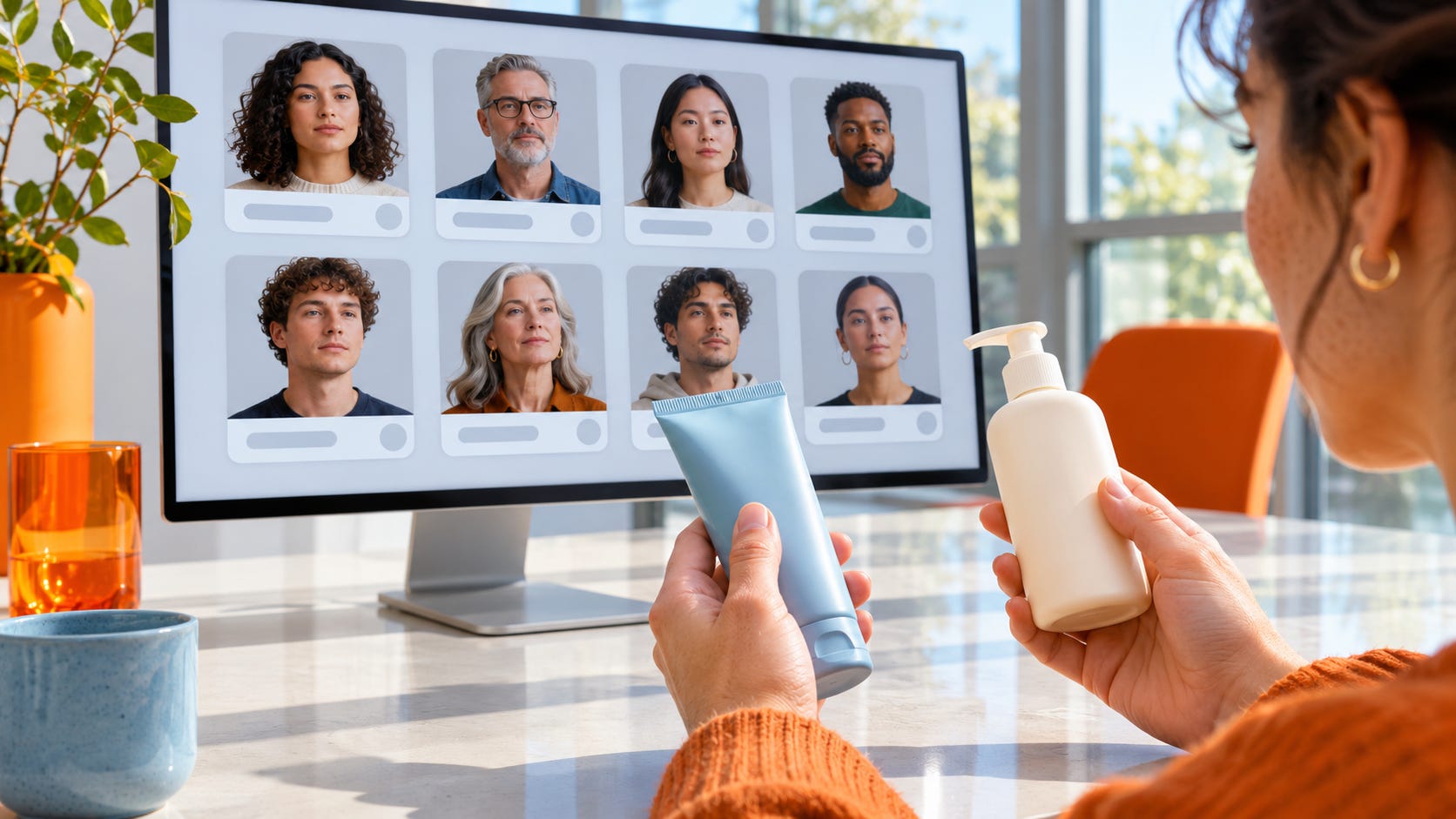
Imagine comparing ten product ideas before paying for a consumer panel. That’s the promise of synthetic consumers: AI-generated shoppers that evaluate concepts as if they were human respondents.
A study by PyMC Labs and Colgate-Palmolive, first posted on October 9, 2025, reports that an AI survey method reached roughly 90% of human survey reliability.
For a business choosing its next product, that sounds like a cheap shortcut. But the researchers compared answers to hypothetical survey questions, not actual shopping behavior. The result doesn’t mean AI predicts purchases with 90% accuracy. One of the paper’s own experiments shows how a convincing synthetic panel can still steer a business wrong.
What the Colgate study measured
Researchers started with 57 U.S. consumer surveys covering personal-care product concepts. Across them, 9,300 human respondents had rated their willingness to buy each proposed product on a five-point scale, from definitely not to definitely yes.
The team prompted GPT-4o and Gemini 2.0 Flash to impersonate respondents, supplying demographic characteristics and the same product concepts. They then compared synthetic responses with human survey distributions and with how human panels ranked the concepts.
The tests covered one broad product sector and one corporate research dataset. No one handed the AI shoppers money, put products on a store shelf, or checked whether a predicted purchase happened. The benchmark was what people said they might buy.
The trick: Let the AI explain itself before scoring it
Simply asking a chatbot for a number between one and five produced odd surveys. GPT-4o favored the middle of the scale, rarely choosing the strongest yes or no. Its distributional similarity to real respondents was just 0.26 in the image-based direct-rating setup.
The researchers instead used semantic similarity rating (SSR). An AI persona first describes its reaction in ordinary language. An embedding model compares that statement with reference sentences representing the five possible answers, then converts the similarities into a probability distribution.
Picture a hypothetical shopper reacting to premium toothpaste: “The ingredients sound appealing, but I would need a lower price.” SSR translates that sentence into weighted rating probabilities, preserving uncertainty instead of demanding one confident number.
Using SSR with GPT-4o raised distributional similarity to 0.88 in the comparable image-based setup. The system also generated longer explanations that researchers could examine for objections or selling points. Those explanations remain AI-generated hypotheses, subject to LLM bias, rather than testimony from actual customers.
The 90% number is a relative correlation, not sales accuracy
The authors repeatedly split human respondents into two groups and calculated how closely those groups ranked products. They then compared the AI-human ranking correlation with that human-human benchmark.
With images and averaged SSR reference sets, GPT-4o achieved 90.2% correlation attainment, with a Pearson correlation of 0.724 between human and synthetic average purchase-intent scores. Gemini 2.0 Flash achieved 90.6% correlation attainment in the corresponding configuration.
So 90% is a score relative to noisy human survey agreement. It measures neither the share of customers whose answer the AI guessed correctly nor the proportion of real purchases it forecast. The human concept scores were also tightly clustered, averaging around 4.0 out of 5, which makes product rankings sensitive to small changes.
The revealing experiment: Realistic averages, weaker rankings
The paper’s clearest warning comes from an experiment without demographic personas. The researchers removed information such as respondents’ ages and incomes, then generated synthetic surveys again using Gemini 2.0 Flash.
The results looked excellent at first glance. Distributional similarity reached 0.91, and the overall average purchase-intent score matched the human result. Yet for the best reference set in that comparison, correlation attainment fell to about 50%, versus around 92% with demographic information.
An AI panel can produce a chart that looks reassuringly human while losing much of its ability to tell product A from product B. Synthetic surveys therefore need two checks: whether the response distribution looks credible and whether the product rankings agree with a human benchmark.


The authors also acknowledge that their rating-reference statements were manually optimized for these 57 surveys. Performance on unfamiliar categories, differently worded concepts, or future surveys remains unproven. A method tuned on one set of questions needs to earn trust again when the products, respondents, or wording change. A realistic-looking result alone cannot establish that it will rank the next batch correctly.
Independent research gives a more mixed picture
A 2026 Nürnberg Institute for Market Decisions study found about 79% agreement between synthetic and real consumers’ brand choices in its research setup. Yet the synthetic respondents overstated positive brand attitudes and showed less variation between people. SSR improved the shape of responses without eliminating those problems.
On September 30, 2026, Pew Research Center reported that synthetic survey respondents frequently missed human results, with especially large errors for some demographic groups, in tests against U.S. public-opinion panels.


Pew used a different method and asked different questions. Its results aren’t a direct replication or rejection of Colgate’s SSR findings. They show why success on one survey dataset is insufficient evidence for replacing people across other research tasks.
Where synthetic consumers are actually useful
For small businesses, the strongest immediate use is low-cost concept screening before human testing. Ask synthetic respondents what’s confusing about a description, which benefits sound unconvincing, and what price objections might arise. Use their comments to improve the draft and design better questions for customers.
Don’t treat generated enthusiasm as demand. A simulated consumer has no household budget to protect, no competing item in a cart, and no consequence for being wrong. The Colgate study reproduced stated intent, already an imperfect proxy for purchasing.
The authors published an SSR Python implementation. If you try it, use this discipline:
Hold out fresh concepts. Define your target customer and fix the prompt, reference statements, and model settings before evaluating concepts the setup has never seen.
Check a real human sample. Compare rankings, score distributions, and subgroup errors, not merely how persuasive the AI explanations sound.
Keep the stakes proportional. Use AI to screen or rewrite ideas. For inventory commitments, pricing decisions, or ad spending, seek evidence from real customers and actual behavior.
The original pipeline used hosted language models and OpenAI’s embedding model, so sensitive concepts may pass through external services. Local AI can reduce that dependence, but replacing the study’s models requires separate validation. Popular AI’s self-hosted research guide covers related private research workflows.
More on local AI research:

Use synthetic consumers to prepare better human research
SSR addresses a real failure of direct chatbot ratings and gives entrepreneurs another way to screen ideas before paying for human research. Its strongest evidence concerns reproducing survey patterns within the tested dataset.
Use synthetic panels to decide which questions to ask next. Use people, real experiments, and sales data to decide which product deserves the money.
Explore more from Popular AI:
Start here | Local AI | Builds & gear | Autonomy & policy | Fixes & guides | Popular AI podcast
90% is impressive for comparing ideas before you spend on a panel. I’d still be careful with details, though. In my tests AI kept inventing product features it couldn’t see. A synthetic shopper might love a feature your product doesn’t have.