


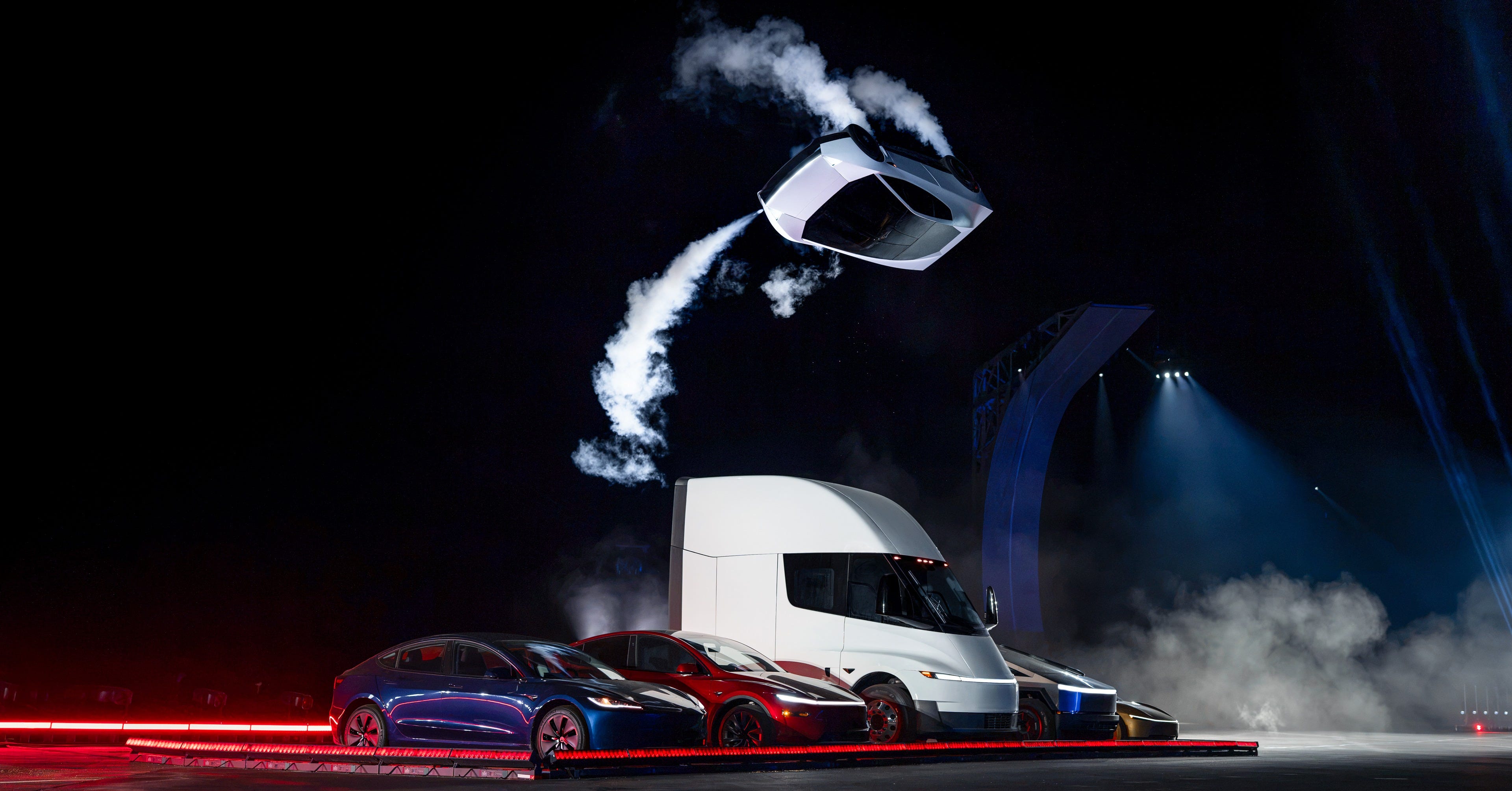
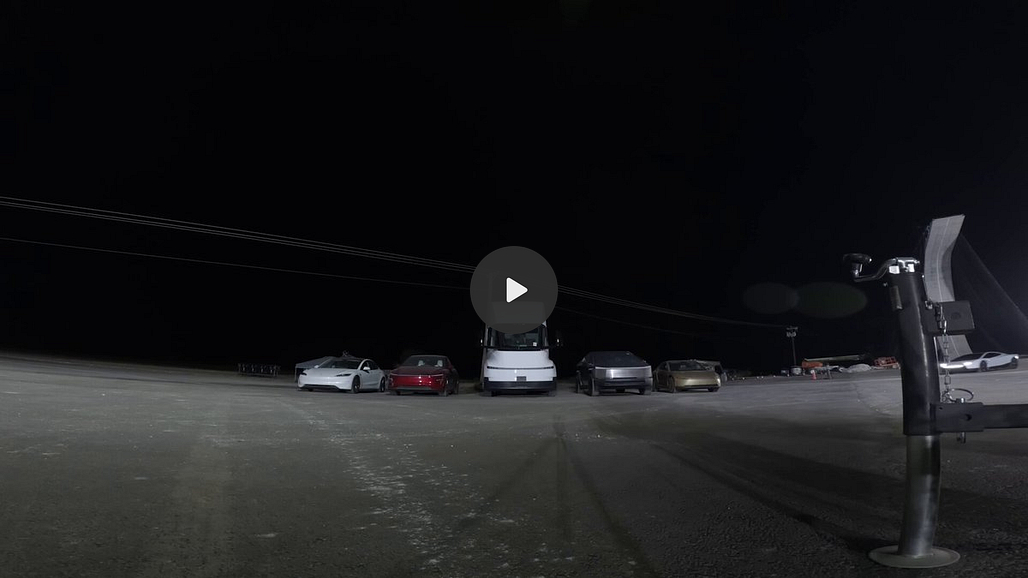
If you thought the Tesla Roadster flying video looked like AI, that suspicion was understandable. On October 15, Tesla’s new Roadster prototype really did drive upside down on a curved ramp at a SpaceX test facility in McGregor, Texas, launch into the air, twist under thruster power, and land. A second stunt sent it over a row of Tesla vehicles. The demonstration happened in front of a live audience, and Tesla streamed the event online.
That last detail matters because extraordinary video now arrives with a built-in credibility problem. Before the stunt, Elon Musk told the crowd, “We need an audience to prove that it’s not AI or SI.” The line sounded like a joke, but it described the exact verification problem viewers faced. The Roadster footage looked like the kind of synthetic clip people had already learned to distrust.
The right way to check it is not to stare harder at the pixels. The stronger evidence sits outside the clip: where it came from, who saw the event, whether other recordings match, and whether the engineering can explain what happened.

Fake flying Teslas reached the internet first
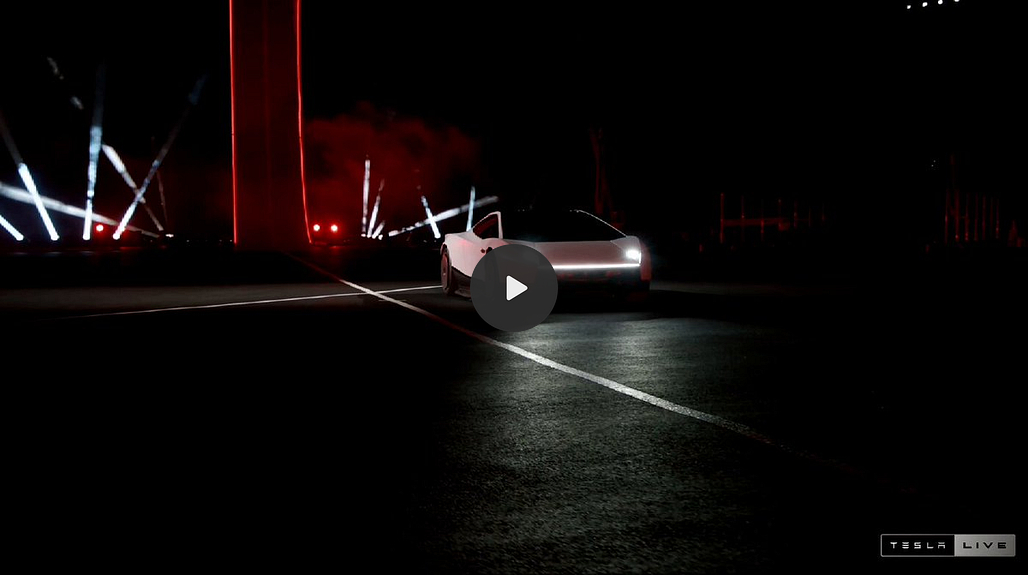
The Roadster reveal had an unusual handicap. Fake flying Teslas were already circulating before Tesla showed a real prototype leaving the ground.
In March 2026, fact-checking site Boatos documented AI-generated videos that falsely showed Musk testing Tesla-branded flying vehicles. The clips included machines taking off vertically and hovering over test areas. There was no matching Tesla announcement or real-world program behind those scenes.
The confusion started even earlier. In 2024, PolitiFact debunked viral posts claiming Musk had released a flying car. The aircraft in the images was the Jetson ONE from another manufacturer, not a Tesla.
By October 2026, the fake version of the story had already trained viewers to be suspicious of the genuine footage. That creates a nasty reversal for anyone trying to authenticate media. A real event can now resemble the synthetic copies that came before it.
Visual intuition is weak evidence in either direction. “It looks like AI” does not show that a video is synthetic. “It looks real” does not authenticate it either. Once generated video is good enough to mimic the visual surface of a real event, verification has to move beyond appearance.
What Tesla actually demonstrated
Calling the Roadster a “flying car” compresses several different pieces of engineering into one phrase.
Tesla vehicle engineering chief Lars Moravy said the prototype uses an underbody fan suction system that can generate enough force to keep the car attached while it travels around the inverted section of the ramp. Once the Roadster leaves the surface, built-in thrusters provide force for the aerial maneuver and landing. Musk described the vehicle as having altitude-control thrusters and larger rear thrusters. Independent coverage of the reveal also described the fan system and the Roadster’s different thruster configurations.
Cold-gas propulsion itself is established technology. NASA describes cold-gas systems as mechanically simple propulsion systems with no combustion, where thrust comes from expelling gaseous propellant through a nozzle. NASA also notes the tradeoff that matters here: cold-gas systems have relatively limited total impulse because the available propellant and storage capacity are finite.
That helps define what the Tesla video proves. A Roadster prototype can perform brief, controlled airborne maneuvers using its propulsion system. The footage shows a real capability under demonstration conditions.
It does not show how long the car can remain airborne, how much propellant a production vehicle will carry, how repeatable those maneuvers are, how the system behaves with passengers, or what certification and operating restrictions might apply. A successful stunt answers one engineering question while leaving the product questions open.
Tesla’s Roadster reservation page describes the single-seat Rocket version as “flight ready” with a full flight system. That is Tesla’s current positioning for the variant, not evidence that customer vehicles are ready for sustained flight.
The company’s own Roadster reservation agreement says the vehicle is still under development and that delivery timing is not guaranteed. Musk is targeting Roadster production to start in 2028.
A prototype demonstration can establish that a feature works under the conditions shown. Production readiness needs separate evidence.
How to verify an extraordinary viral video
The Roadster stunt offers a useful workflow for checking any startling clip. Pixel-level oddities can be clues, but they are a poor starting point. Reconstruct the evidence around the video first.
Find the original source. Look for the earliest complete recording instead of relying on a reposted 12-second clip. In this case, Tesla hosted the full Roadster livestream itself. For unknown viral footage, capture distinctive frames and reverse-search them. Bellingcat recommends reverse-searching video screenshots or thumbnails to find earlier uploads, recycled footage, or the original source.
Look for independent corroboration. One clip can be fabricated. A scheduled event with spectators, reporters, multiple cameras, contemporary coverage, and recordings from different positions creates a much larger body of evidence. For the Roadster, independent media covered the event in person, and the reported sequence matched Tesla’s own stream.
Compare camera angles and details. Check whether motion, lighting, sounds, landmarks, crowd reactions, and the order of events match across recordings. This is especially useful when the viral version has been cropped, re-edited, or stripped of context.
Check provenance when it exists. C2PA Content Credentials can record an asset’s origin, modifications, creator tools, and use of AI in a cryptographically bound structure. The C2PA specification explicitly warns that provenance alone cannot tell you whether content is true, accurate, or factual. Missing credentials are not proof of fakery either.
Separate the verified event from the claim attached to it. A video can be authentic while its caption exaggerates what happened. “A Roadster prototype performed brief airborne maneuvers using thrusters” is supported by the available evidence. “Tesla has a production-ready flying car that customers will soon use for sustained flight” goes well beyond what the demonstration established.
That fourth step is easy to misuse. Provenance data can strengthen an authentication case, but absence of provenance should remain neutral. Popular AI has previously examined why missing Content Credentials should not become evidence that human-made media is illegitimate.
The broader lesson is practical. Do not ask a single tool, detector, badge, or visual tell to settle the question. Build a chain of evidence.
Why the Tesla Roadster flying video is convincing evidence
A few years ago, an unbelievable video often triggered the question, “How could somebody fake this?” That is still a good question to ask, but it is no longer enough. A newer, necessary companion question is, “What evidence exists outside the video?”
For Tesla’s October 15 demonstration, that evidence is unusually strong.
▪ There is a primary livestream.
▪ There was a live audience.
▪ Independent reporters covered the event.
▪ Multiple camera views captured the same sequence.
▪ The event took place at a known test facility, and the hardware Tesla described provides a plausible mechanism for the movements seen on camera.
Taken together, that evidence is enough to establish that the stunt happened. You do not have to trust a compressed social clip on sight, and you do not have to trust Tesla merely because Tesla posted it. You can check the surrounding evidence.
The same standard should apply to the bigger product claims. The demonstration shows a Roadster prototype performing short airborne maneuvers. It does not answer endurance, repeatability, passenger operation, certification, or production-readiness questions.


That is the reasonable approach to convincing AI-era video: verify the event first, then make every attached claim earn its own evidence. The Roadster video survives that test. The broader promise of a customer-ready flying Roadster still has more to prove.
More on AI detection:

Explore more from Popular AI:
Start here | Local AI | Builds & gear | Autonomy & policy | Fixes & guides | Popular AI podcast
When you first saw the flying Tesla Roadster video, did you assume it was real or AI-generated?