


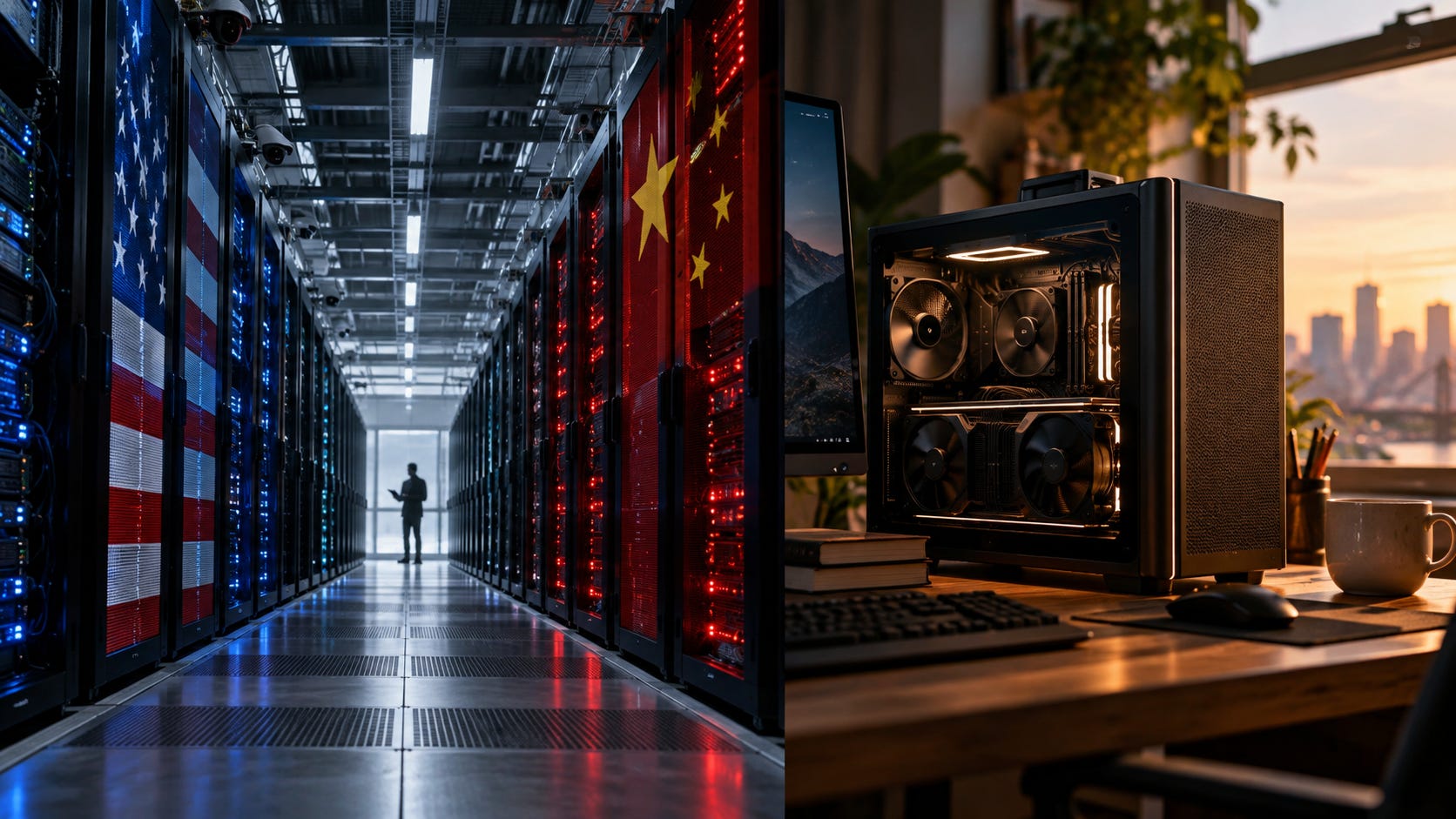
For people running local or open-weight AI, the immediate answer is simple: nothing in the public U.S.-China announcement changes what models you can run today.
The United States and China have opened a formal dialogue on advanced AI, with another exchange due by November 2026 and a bilateral communication channel for AI incidents. That creates a real diplomatic process, but the published agreement is still far from an international system for controlling AI development.
There is no shared capability threshold, licensing system, inspection regime, compute limit, model-release rule, or penalty structure. Communication between governments is comparatively easy. Controlling private AI development gets harder as enforcement moves from giant data centers to downloadable model weights and then to models already running on somebody’s own hardware.
That enforcement ladder is the useful way to read the new U.S.-China AI dialogue. The farther a rule moves downstream, the more companies, platforms, hardware vendors, developers, and users it has to reach.
Key takeaways from the U.S.-China AI dialogue
The first concrete U.S.-China AI deliverable is an incident communication channel, not a system for controlling models or users.
Governments have strong control points around advanced chips, large data centers, cloud providers, major AI labs, and public-facing AI services.
Frontier training could be regulated through compute thresholds or reporting rules, but verifying a bilateral slowdown would require definitions, telemetry, audits, or inspections that neither government has announced.
Open-weight models are much harder to control once their files are publicly distributed. Governments can regulate the original developer, major hosting platforms, and downstream uses. They cannot revoke every copy already stored elsewhere.
Local AI makes enforcement more intrusive. Restrictions that reach an offline model would generally need to act through hardware access, software distribution, law, or surveillance of what users are doing.
For ordinary users, there is no announced U.S.-China rule changing which local or open models they may run today.
What the U.S. and China actually agreed to
President Donald Trump and Chinese President Xi Jinping discussed AI during Xi’s September 23 to 25 state visit to the United States.
The U.S. account says the countries established a U.S.-China Super Intelligence Dialogue to exchange views on risks and benefits. Another exchange is due by November 2026, and the two governments plan to establish a communication channel for incidents involving what Washington is calling “super intelligence.”
China uses different language. Its Foreign Ministry said the presidents had an in-depth discussion on AI and could continue exchanging views while seeking consensus. Beijing continues to call the technology artificial intelligence rather than adopting “super intelligence” as its own term.
That wording disagreement exposes the first hard problem. Before either country could regulate “super intelligence” as a distinct category, both would need to know what falls inside it.
Is the threshold based on training compute? Autonomous behavior? Cyber capability? Recursive self-improvement? The ability to design successor models? A benchmark score? Something else?
None of those definitions appears in the public agreement. Without a shared definition, there is no obvious line telling a lab when a model crosses into the regulated category.
The talks did not appear out of nowhere. Before the summit, Treasury Secretary Scott Bessent said officials had discussed an AI incident line and risks including uncontrollable agents, non-state actors, and cyber threats.
For now, the public structure looks like an early risk-management channel. It does not look like an AI arms-control treaty.
An AI incident channel is the easiest place to start
A government-to-government incident channel requires very little control over private citizens.
Washington and Beijing can designate contacts, decide what deserves notification, create escalation procedures, and specify what information can be shared during a serious incident. Those steps can happen at the diplomatic level without creating a licensing system for every AI developer.
The kinds of incidents under discussion could include a major model breach, an AI-assisted cyberattack with national-security implications, loss of control over a highly capable agent, or an event that one side might otherwise mistake for deliberate hostile action. The exact reporting threshold has not been published, but the mechanism itself is straightforward.
The governments do not need to inspect every GPU in the country for an incident channel to be useful.
There is also precedent for limited AI agreements focused on state behavior. In November 2024, Joe Biden and Xi Jinping agreed that humans should retain control over decisions to use nuclear weapons and called for careful management of AI in military systems.
That kind of commitment is easier to make because each government controls its own military command systems. The control point is the state itself, and the rule does not require either side to reach into every private model or home computer.
Large AI labs give governments visible control points
The next obvious target is the small group of companies operating the biggest training clusters.
A frontier lab is not hard to locate. It buys or leases enormous amounts of computing hardware, depends on large data centers, hires specialized staff, signs power and cloud contracts, moves large amounts of capital, and usually relies on identifiable semiconductor or infrastructure suppliers.
A future bilateral agreement could therefore require covered companies to report certain training runs, complete standardized safety evaluations, disclose serious incidents, maintain cybersecurity controls, or notify regulators before deploying models above an agreed capability threshold.
Some AI companies are already asking governments to consider parts of that approach. OpenAI said in September 2026 that it supports capability-based national AI safety requirements, incident reporting, international standards, and shared rules for when development should slow or stop.
Dario Amodei, Sam Altman, and Elon Musk have also backed versions of coordinated pacing or stronger safeguards, while other technology leaders and governments remain opposed or skeptical. Reuters described a widening split over coordinated slowdowns, safety testing, and international cooperation.
Turning company proposals into a U.S.-China agreement would still be difficult. Washington and Beijing would need to define which models qualify, which measurements both sides trust, what companies must reveal, and how either government can tell whether the other is complying.
A promise is easy to announce. A verifiable limit needs machinery behind it.

Compute is probably the strongest technical control point
Advanced AI compute has a physical supply chain. Model behavior can be hard to define, but chips, data centers, cloud contracts, and large clusters leave more visible traces.
The United States already uses semiconductor export rules as a policy lever. In January 2026, the Commerce Department changed its licensing policy so exports of Nvidia H200, AMD MI325X, and similar processors to approved Chinese customers could be reviewed case by case under specified security conditions.
That gives governments several potential control points in one chain: chip manufacturing, exports, large data centers, cloud-computing contracts, and access to very large clusters.
A future bilateral deal could theoretically set reporting thresholds for major training clusters or create rules for the use of exceptionally large compute installations. Such a rule would still have edge cases. Training can be distributed across infrastructure. Hardware capabilities change. A threshold that looks extraordinary today can become routine later.
Even so, compute gives regulators something physical to count and organizations they can identify. That is a much cleaner enforcement problem than trying to call back a model file after the file has already spread.
Model-weight controls work best before public release
The United States has already tested this problem in policy.
In January 2025, the Commerce Department adopted an AI diffusion rule that controlled certain advanced closed model weights while excluding models whose weights were widely available.
The Trump administration later rescinded the broader AI Diffusion Rule before its compliance requirements took effect.
The policy did not survive, but it illustrates the enforcement difference unusually well.
A closed frontier model can remain behind a company’s servers. The government can regulate the company, employees, cloud provider, export activity, or access to the weights. There is still a central organization with custody of the system.
An open-weight model behaves differently after release. Its files can be copied to Hugging Face, mirrors, torrents, research servers, corporate storage, home NAS boxes, laptops, and private GPU workstations within hours. Once enough independent copies exist, “remove the model” stops being a clean technical instruction.


That is why hosted, open-weight, and local AI should not be treated as interchangeable. Popular AI’s guide to open-source and open-weight LLMs explains how downloadable weights differ from models that remain under a provider’s control.
The key enforcement moment comes before broad distribution. After that, governments can still regulate conduct around the model, but they lose the simplest switch.
More on AI privacy:

Open weights do not put users outside the law
Open weights remove one obvious control point. They do not make developers, hosts, companies, or users immune from law.
A government could regulate the original developer before release. It could impose liability rules, restrict exports, require evaluations, regulate commercial hosting, pressure repositories, control procurement, restrict particular applications, or prohibit specified conduct involving a model.
China already provides an example of provider-level enforcement. Its rules for generative AI services apply to services offered to the Chinese public, require provider compliance, allow regulatory inspection, and exclude research or development that does not provide such services to the domestic public.
That gives regulators a recognizable target. The service provider has a name, infrastructure, users, and obligations. If the provider violates the rules, authorities have an entity they can inspect or order to suspend service.
The problem gets harder when the model is no longer being delivered as a service.
Local AI moves enforcement toward the user
Suppose a model has been downloaded onto a workstation, disconnected from the internet, and loaded with llama.cpp or another local runtime.
There is no API provider to rate-limit it. There is no hosted account to suspend. There is no central server where the weights can be replaced. There is no remote moderation layer that has to approve the prompt.
A government can still prohibit particular uses. It can control the supply of some hardware. It can regulate businesses distributing the model. It can pursue people who use the system for conduct that is independently illegal.
What it cannot do as easily is modify, withdraw, or revoke software that already sits on privately controlled storage.
To reach that layer directly, regulation has to move farther downstream toward hardware access, software distribution, operating systems, or the user’s conduct. That is a larger enforcement footprint than regulating a handful of frontier labs.
China’s own policy documents show the tension. Its Global AI Governance Action Plan calls for cross-border open-source communities and open sharing while also proposing safety guidelines, compliance systems, risk testing, and traceability measures.
Both countries may want stronger safeguards around the most capable systems while still benefiting from research and software distribution built around copying code and model files. Open models make that tradeoff impossible to ignore.
Repository controls would reduce access, not erase copies
Governments looking for another control point could focus on where models are distributed.
Repositories, cloud hosts, app stores, commercial inference services, package systems, and other major intermediaries are easier to regulate than a file sitting offline on private storage. Rules aimed at those services can reduce availability substantially.
They cannot erase copies that already escaped into mirrors and private collections.
That leaves model repositories as strategic infrastructure for local AI. Popular AI’s analysis of NVIDIA’s planned Hugging Face acquisition argues that users with critical workflows should mirror the specific models, licenses, model cards, and supporting files their work depends on.
A policy aimed at one repository is platform regulation. A policy intended to control the model after widespread distribution would need to reach much farther.
That is the point where regulation starts moving from an identifiable intermediary toward software possession and private computing.
More on AI repository controls

A real development slowdown would need serious verification
The most ambitious version of U.S.-China AI cooperation would be a coordinated slowdown of frontier development.
It would also create the heaviest verification burden.
A credible agreement would need answers to questions such as:
What level of training compute triggers the rule?
Does fine-tuning count?
Are open models treated differently?
Does a distributed training run count as one system?
How are privately developed models measured?
Who verifies reported compute?
Can inspectors examine data centers?
Do cloud providers have to report customers?
What happens when a company or state laboratory refuses?
Those questions decide who gets monitored and what evidence counts as compliance.
A bilateral training cap without trusted verification could leave each side limiting compliant companies while worrying that the other side is continuing in secret. The agreement would need more than a shared aspiration. It would need definitions, reporting rules, technical measurements, audit rights, or some other verification mechanism both governments accept.
No such system has been announced.
That is why incident reporting and military-risk communication are more plausible early targets than an enforceable ceiling on general AI development.
Upstream controls are easier to enforce and easier for big companies to absorb
Rules focused on enormous training clusters, the largest frontier systems, military deployment, or serious incident reporting keep the number of regulated entities relatively small.
Governments get identifiable counterparties. Large AI companies already have legal, security, and compliance teams. Ordinary people running smaller local models may barely notice.
There is a market-structure cost, though. Heavy certification, auditing, cybersecurity, and reporting requirements are much easier for a trillion-dollar platform or hyperscaler to absorb than for a small model developer.
That does not settle whether a requirement is justified. It changes who can afford to comply.
Any future U.S.-China AI rule should therefore be read in two ways at once. First, ask whether the control point is technically enforceable. Then ask which companies or users bear the compliance burden.
Downstream controls spread the compliance burden outward
Once governments try to control already-distributed models, enforcement spreads across more layers.
Repository operators can face distribution rules. Cloud companies can receive monitoring duties. Developers can face licensing or reporting requirements. Hardware vendors can become policy enforcement points. Users can face restrictions on possession or use.
A rule originally aimed at frontier-AI risk can then reach open-source developers, researchers, creators, small companies, and hobbyists whose systems are far removed from the few models that motivated the policy.
Popular AI’s broader guide to AI regulation and policy uses the same practical test: identify what a rule controls, who enforces it, what happens when somebody refuses, and who can afford compliance.
That test is especially useful here because “AI safety” does not tell you how a rule will work. The enforcement mechanism does.
More on AI regulation:

Agent controls may be easier than model controls
There is another direction Washington and Beijing could take.
Instead of trying to control the model file itself, governments could focus on what high-risk AI systems are allowed to do. That could include rules around autonomous cyber operations, financial transactions, access to dangerous laboratory systems, military targeting, or agent permissions.
This approach has a technical advantage. A model file can be copied repeatedly. An agent still needs credentials, tools, network access, memory, an execution environment, and permission to act.
Those are control points.
Recent AI security failures have also shown why permissions outside the model are important. Popular AI’s analysis of OpenAI’s agent-memory security failures explains why persistent model state should not be allowed to grant itself authority over tools or later actions.
If both governments want technical safeguards that can be inspected without trying to control every copy of every model, agent permissions and high-impact actions are a more practical target. They focus on access and execution rather than possession of a file.
More on AI agent controls:

Sensible controls can still expand into a permission system
The risk comes from definitions and compliance infrastructure that expand over time.
A rule built for an exceptionally capable frontier system can become easier to apply to ordinary models once the reporting and certification machinery exists.
A voluntary evaluation can become a procurement requirement. A reporting standard can become a licensing condition. A repository rule can become identity verification for model downloads. A cloud reporting requirement can become monitoring of who trains what. An incident definition can expand until routine research triggers mandatory notification.
Ignore the label. Inspect the mechanism behind it.


Which systems are covered? Who has to report? Who can inspect? What data must be collected? What happens when somebody refuses? Does the rule stop at a frontier lab, or does it reach repositories, hardware, and end users?
Those details will determine whether the U.S.-China AI dialogue stays focused on exceptional systems or grows into a broader permission structure.
What local and open-model users should do now
For now, there is no announced bilateral rule requiring ordinary users to change their local AI setup.
The sensible preparation is boring, which is usually a good sign.
▪ Keep copies of the open-weight models and runtimes your important workflows depend on. Keep licenses and model cards with them. Avoid making one repository your only source. Use portable formats. Separate important workflows from any one cloud API where practical.
▪ Businesses working with frontier APIs should also keep a fallback provider or local option where the workload permits it. That is useful operational resilience even if the U.S.-China talks never produce a rule that affects those services.
And watch the definitions.
If the November talks produce language around “super intelligence,” frontier systems, compute thresholds, incident reporting, model weights, or autonomous agents, the definition of the covered system will tell you more than another general promise to cooperate. The next thing to inspect is the enforcement layer attached to that definition.
What remains uncertain as of September 28, 2026
The two governments have announced a dialogue and an incident communication channel. They have not published a binding bilateral AI agreement.
▪ There is no public joint definition of “super intelligence.” There is no announced model capability threshold. There is no bilateral compute cap. There is no shared inspection regime.
▪ There is also no announced restriction on open-weight releases or ordinary local inference, and no disclosed penalty structure.
The next exchange is expected by November 2026. That is the point where the diplomatic announcement could begin turning into a more specific policy proposal, if either side publishes definitions, reporting duties, technical thresholds, or enforcement terms.
Until then, claims that the dialogue already amounts to a system for controlling models or users run ahead of the public agreement.
The real test is whether U.S.-China AI controls stay upstream
The United States and China have more control over advanced AI than the borderless-software argument sometimes suggests.
Advanced chips come from factories. Huge training runs use identifiable infrastructure. Major labs have offices, employees, cloud contracts, data centers, and executives. Public AI services have servers that regulators can reach. Military systems belong to governments.
Those are strong control points.
Open weights change the equation after release. Once a capable model is copied widely and can run on privately controlled hardware, regulators lose the cleanest switch. Controlling it then requires pressure on repositories, hosting, hardware, developers, or users themselves.
That is why the new U.S.-China AI dialogue will be most credible if it starts where both governments can actually identify the actor and verify behavior: serious incidents, military risks, frontier labs, and genuinely exceptional compute.
If later rounds move toward ordinary downloadable models or local inference, read the enforcement mechanism before the headline. A rule that stops at a frontier data center is one kind of AI policy. A rule that follows a model onto private hardware is something much broader.
That is where diplomacy between two governments starts becoming a rule about what everyone else is allowed to run.
Explore more from Popular AI:
Start here | Local AI | Builds & gear | Autonomy & policy | Fixes & guides | Popular AI podcast
Where would you draw the line between useful U.S.-China AI coordination and a framework that gives governments too much control over AI development and access?
Useful reality check. Once capable models run locally, control shifts from weights to compute and distribution. That's also why local and regional inference capacity matters so much for anyone who wants to keep their options open, whatever the two governments agree.