


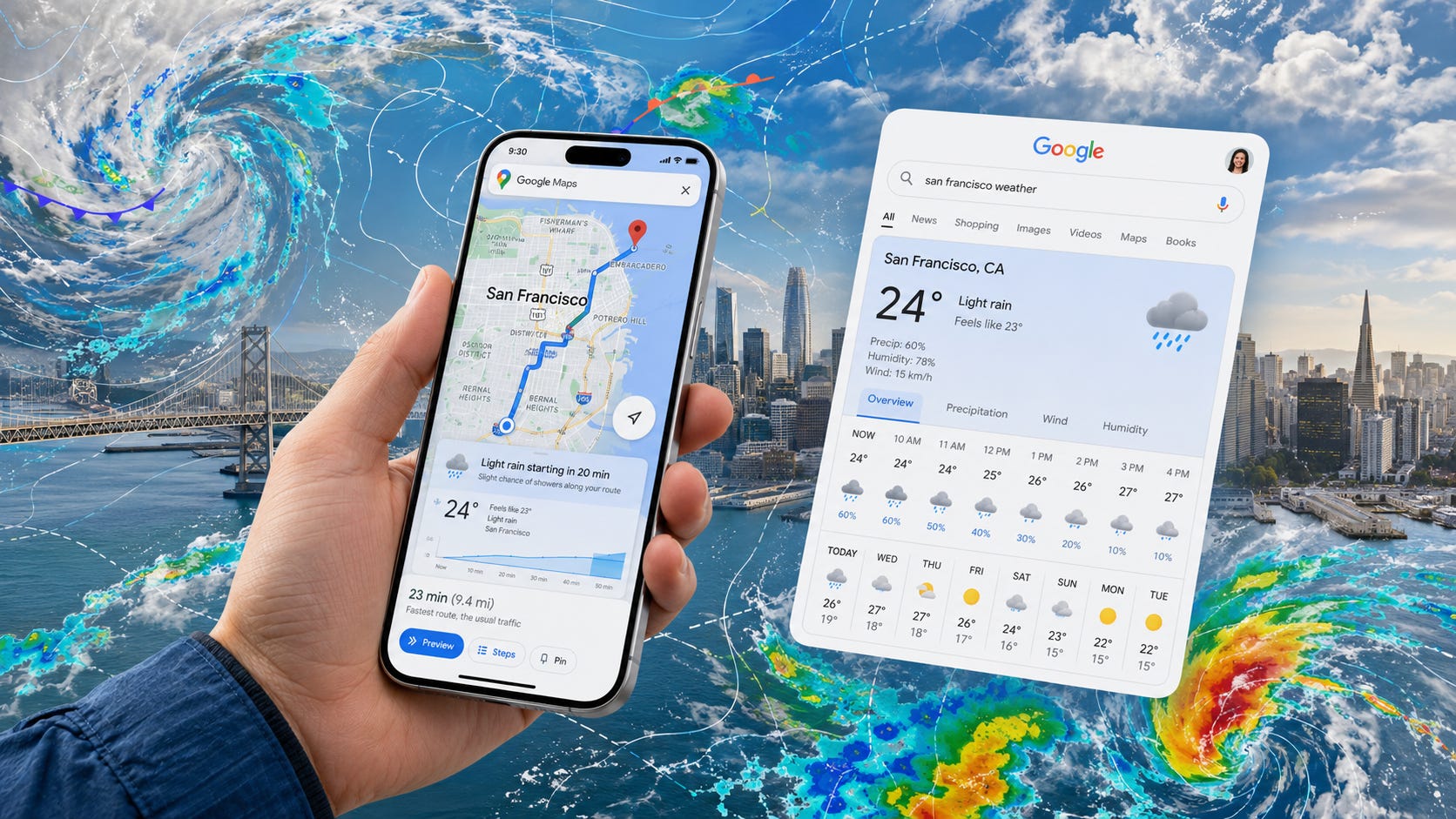
Google has put a new AI weather model between billions of users and one of the most ordinary decisions they make every day: what the weather is going to do next.
WeatherNext 3 began powering weather experiences in Google Search, the Gemini app, Google Maps, Google Maps Platform and Google Earth Engine on September 3, 2026. Google says the model can produce more localized forecasts every hour and substantially improve precipitation prediction.

That does not mean Gemini is guessing tomorrow’s weather from whatever it remembers from training. WeatherNext 3 is a specialized forecasting system built specifically for weather.
The useful rule is straightforward. Trust Google weather for ordinary planning when the forecast looks plausible. Treat it as one input when local conditions are tricky. For severe weather, warnings, evacuation decisions and other safety-critical situations, go to the official meteorological authority.
Google draws essentially the same boundary for WeatherNext 3.
Key takeaways
WeatherNext 3 is a specialized probabilistic weather model rather than a general-purpose language model improvising a forecast.
Google says WeatherNext 3 now contributes to weather experiences in Search, Gemini, Maps, Google Maps Platform and Google Earth Engine.
It can initialize a new forecast every hour using live geostationary satellite observations, compared with 6-hour cycles for WeatherNext 2.
WeatherNext 3 reaches roughly 5 km resolution for some station-targeted surface variables and about 10 km for many gridded surface variables.
Independent testing from Brightband found WeatherNext 3 leading its global medium-range benchmark during much of August.
Better model accuracy still does not turn a Google forecast into an official warning. Google explicitly tells WeatherNext users to defer to emergency authorities for severe-weather alerts.
What Google actually released with WeatherNext 3
Google DeepMind and Google Research announced WeatherNext 3 on September 3.
WeatherNext 3 is a machine-learning forecasting model designed to predict the evolving state of the atmosphere. It combines live geostationary satellite mosaics with ECMWF atmospheric analysis data, and Google says it was trained using weather-station observations, NASA precipitation data and other observational datasets.
That shift matters.
Earlier AI weather systems often learned heavily from the output of traditional numerical weather prediction systems. WeatherNext 3 moves closer to ingesting the world as it is directly observed. Live satellite imagery can enter the model as an input, which lets Google initialize a fresh WeatherNext 3 forecast every hour.
The model also operates at several resolutions depending on the forecast variable. Google says station-targeted temperature and dew-point forecasts can reach roughly 5 km resolution. Many gridded surface variables are produced at about 10 km, while upper-atmosphere fields operate at about 25 km.
WeatherNext 2 largely worked on a 25 km grid with 6-hour forecast cycles. For some surface variables, that makes WeatherNext 3 roughly five times sharper spatially.
That additional detail can matter around coastlines, valleys, mountains, cities and localized precipitation. A forecast that smooths a large geographic area into a single prediction can hide meaningful differences between nearby locations.
Higher resolution does not guarantee the model gets every neighborhood right. It does give the forecasting system a better chance of representing local features that would have been blurred on a coarser grid.
WeatherNext 3 and Gemini play different roles
There are several different kinds of AI weather hiding behind the same phone screen.
WeatherNext 3 is the forecasting model. It takes weather-related observations and atmospheric data and predicts future atmospheric conditions.
Gemini is a general-purpose AI interface. Google says WeatherNext 3 now helps power weather experiences inside the Gemini app, but the underlying forecast is coming from a dedicated weather forecasting system rather than Gemini simply generating a weather prediction from its language-model knowledge.
Pixel Weather adds another layer.
Google’s support documentation says its Weather Brief feature generates an AI-written summary of a forecast on supported Pixel devices. That summary is separate from the numerical weather prediction underneath it. Google also says the AI-generated Weather Brief does not appear when alerts for extreme or dangerous weather events are present. The alert is displayed at the top of the page instead.
This distinction is worth remembering whenever an AI assistant tells you what the weather will do.
There are three separate stages that can affect what you ultimately see:
The forecast model predicts atmospheric conditions such as rain or temperature.
The Google weather system decides which forecast information to display for your location and situation.
A generative AI system may explain that forecast in conversational language.
A mistake at any one of those stages can produce a bad answer even when the other parts of the system are working correctly.
That also means a strange Gemini response does not automatically prove WeatherNext 3 made a bad atmospheric prediction. The forecasting model, product logic, location handling and conversational explanation are related, but they are not the same thing.
Google weather is still a forecasting system, not one model
WeatherNext 3 should not be interpreted as meaning every temperature, precipitation value or weather display in every Google product now comes exclusively from one neural network.
Google says its broader weather forecasting system uses models and observations from organizations including NOAA, the National Weather Service, ECMWF, Environment Canada, the Met Office and other agencies.
Google also operates a separate nowcasting system for short-term precipitation in supported regions. That system uses radar and numerical weather prediction data and is designed for the much shorter forecasting window where knowing whether rain is approaching in the next few hours can matter more than a multiday outlook.
WeatherNext 3 therefore joins a wider forecasting stack.
That is probably a good thing.
Weather forecasting has long benefited from comparing observations, different models, ensembles, radar, satellite data, specialized systems and human expertise rather than treating one model run as sacred.
It also means a bad result in Pixel Weather, Search or another Google product does not automatically prove that WeatherNext 3 itself produced the bad number. A location problem, stale observation, display decision or another part of the forecasting stack can create a result that looks like a model failure to the person holding the phone.
For users, the distinction may feel academic when the displayed weather is wrong. It still matters when evaluating whether WeatherNext 3 itself represents a technical improvement.
What WeatherNext 3 accuracy actually means
There is good reason to take the improvement seriously, although Google’s headline accuracy numbers need some translation.
Google’s benchmark results report up to a 50% reduction in the Brier score and CRPS precipitation-error metrics compared with numerical weather prediction baselines when forecasts were evaluated against NASA IMERG observations.
That is considerably more precise than saying the rain forecast is simply 50% more accurate.
A 50% reduction in a particular statistical error score does not mean Google will get tomorrow’s rain right 50% more often on your street. Brier score and CRPS are measures used to evaluate probabilistic forecast quality. They tell researchers something meaningful about how forecasts perform across evaluations, but they do not translate directly into a universal percentage improvement for every individual user and location.
Google’s consumer announcement uses simpler language. It says people planning a day or more ahead may see up to 50% more accurate precipitation forecasts, with larger improvements in areas where forecasts have historically been less reliable.
That is an appealing consumer message, but the qualification matters. It is an “up to” figure, it concerns precipitation forecasting, and the underlying technical results are based on specific evaluation metrics and observational comparisons.
There is also independent evidence that WeatherNext 3 is competitive.
Weather forecasting company Brightband operates Operational WeatherBench, a live comparison of AI and physics-based global forecasting models. Brightband described WeatherNext 3 as the new leader on its medium-range benchmark at launch.
During August, WeatherNext 3 recorded the lowest global 2-meter-temperature error among the compared models on 26 of 30 days, according to Brightband.


That is impressive evidence for a newly deployed model. It is still a global medium-range evaluation. It does not answer whether Google’s forecast for your backyard was correct at 4:15 p.m. on a particular Tuesday.
A model can be the best global forecasting model on average and still be wrong where you are standing.
Why a strong global model can still miss your local weather
Weather is unusually unforgiving of averages.
A forecast grid can represent conditions across a few kilometers remarkably well while still missing what happens on one hill, one valley floor, one beach or one neighborhood.
Local elevation, urban surfaces, coastlines, vegetation, thunderstorms, lake effects, wind direction and gaps between observation stations can all create conditions that differ from the regional estimate.
Google acknowledges some of those limitations in its weather documentation. It notes that weather information may be unavailable where there is no nearby weather station. More broadly, forecasts remain predictions of an atmosphere that cannot be perfectly measured or modeled.
There is also a history of user frustration with Google’s consumer weather products.
Pixel users have posted anecdotal reports of current-location weather differing sharply from the conditions they were actually experiencing. In one case, Pixel Weather showed 28°C and a heavy thunderstorm for the user’s current location while their saved home location and direct observation showed 10°C and clear conditions.
Other users have reported large temperature differences and forecasts that did not match local observations.
Those Reddit posts are anecdotes. They do not establish the overall accuracy of Google’s forecasting system, and they should not be treated as evidence that WeatherNext 3 performs poorly.
They do illustrate the practical problem Google has to solve.
A global benchmark victory is not much comfort to somebody standing in sunshine while the phone insists there is a thunderstorm. Consumers judge weather products by what happens where they are, not by global aggregate scores.
WeatherNext 3’s hourly satellite initialization and higher spatial resolution address some of the technical factors behind local misses. Whether Google’s consumer weather products now feel substantially better will require real-world use across many regions and weather regimes.
There is another wrinkle for Pixel owners.
Google specifically said WeatherNext 2 upgraded Pixel Weather in 2025. The WeatherNext 3 launch announcement names Search, Gemini, Maps, Google Maps Platform and Google Earth Engine, but it does not explicitly name Pixel Weather.
That omission does not prove Pixel Weather is excluded. It also does not justify claiming that every Pixel Weather forecast has already moved to WeatherNext 3.
Until Google clarifies that rollout, the safer wording is that WeatherNext 3 is powering the Google products explicitly named in the launch announcement.
When you can reasonably trust Google WeatherNext 3
For ordinary decisions, using Google’s forecast as your primary quick reference is reasonable.
That includes deciding whether to bring an umbrella, planning an outdoor lunch, choosing which day to mow the lawn, packing for a weekend trip, checking expected temperatures along a drive or deciding whether an afternoon activity is likely to get rained out.
These are exactly the kinds of decisions where a faster, higher-resolution global forecasting model can be useful.
The consequences of a miss are also limited. If the forecast misses a shower, you get wet. If the temperature is a few degrees different from the prediction, you may have packed the wrong jacket.
WeatherNext 3 becomes particularly interesting when planning a day or several days ahead. Google’s biggest advertised precipitation improvements concern planning a day or more in advance rather than minute-by-minute hyperlocal rain detection.
For that kind of ordinary planning, a sensible interpretation is:
“This is probably Google’s best estimate of what the weather will do.”
A less sensible interpretation would be:
“Google says there is an 18% chance of rain, so there is a precisely measured 18% chance that rain will fall on my house.”
Weather forecasts are probabilistic estimates of an atmosphere that cannot be perfectly observed or predicted.
AI does not remove that uncertainty. Better AI can produce a better estimate of the uncertainty and a more skillful forecast, but the answer remains a forecast.
That is the right mental model for WeatherNext 3 accuracy.
When you should cross-check another weather source
Start checking another forecast when the consequence of being wrong becomes annoying, expensive or difficult to reverse.
If you are planning a long hike, sailing, flying a drone, organizing an outdoor wedding, running an outdoor business event, driving through mountain weather or making agricultural decisions, comparing more than one source is cheap insurance.
The goal is not to find whichever forecast tells you what you want to hear. It is to see whether independent forecasts and observations broadly agree, especially when conditions are uncertain or highly local.
Cross-checking also makes sense when Google’s display disagrees with what you can plainly observe.
If your phone says 28°C and thunderstorms while you are standing under clear skies at 10°C, trusting the screen simply because the underlying system uses a sophisticated AI model would be irrational.
Check the location. Check how recent the information is. Look at radar or satellite information where appropriate. Compare the result with an official local weather source.
Google’s Pixel support guidance recommends enabling location permission to improve the weather information shown for your location. A location problem can resemble a forecasting failure because the product may be displaying an entirely reasonable forecast for the wrong place.
For very short-term precipitation, Google’s separate nowcast can also be more relevant than a medium-range WeatherNext forecast where the nowcast is available.
The important point is that “Which weather model is best?” and “Which weather information should I look at right now?” are sometimes different questions.
When Google weather should stop being your primary source
The trust boundary changes once weather can seriously injure or kill somebody.
Google’s WeatherNext developer guidance says the model’s predictions are informational and are not official severe-weather warnings. Google tells users to defer to official alerts from emergency authorities.
That is the right policy.
If a tornado, flash flood, hurricane, extreme heat event, severe thunderstorm, winter storm, dangerous coastal event or fire-weather emergency threatens your area, use the authority responsible for issuing official warnings where you live.
In the United States, the National Weather Service provides official alerts, forecasts, forecast maps and radar. An NWS watch generally means hazardous weather is possible and conditions warrant preparation and attention. A warning means dangerous conditions are occurring, imminent or sufficiently likely that protective action may be required.


Do not wait for Gemini to confirm a tornado warning before taking shelter.
Do not use a Maps weather card to decide whether an evacuation order is serious.
Do not dismiss an official flash-flood warning because Google’s precipitation forecast looks mild.
A forecasting model and an emergency-warning system perform different jobs.
WeatherNext can help produce better forecasts. That does not replace the institution that decides when available evidence is strong enough to issue a public warning, coordinate safety messaging or tell people to act.
Google has already demonstrated that relationship through its work with the U.S. National Hurricane Center on earlier WeatherNext models. AI-generated weather scenarios can become another tool available to trained forecasters. The human and institutional warning process remains downstream of the model.
That distinction is fundamental to deciding when WeatherNext 3 deserves trust.
Better AI weather still cannot eliminate uncertainty
WeatherNext 3 is an interesting example of AI becoming useful in a way that looks very different from the familiar chatbot framing.
This is machine learning applied to a specialized scientific problem with structured inputs, measurable outputs, decades of observational data, continuous evaluation and benchmarks against competing forecasting systems.
Its failures can be measured in degrees, millimeters, kilometers, wind speeds, probabilities and forecast errors.
That is a very different proposition from asking a general-purpose chatbot a question whose answer it may or may not know.
WeatherNext 3 can outperform older forecasting systems and still be wrong.
A forecast can be statistically excellent across the globe and still miss your valley.
A five-day precipitation forecast can improve dramatically without becoming an appropriate substitute for a tornado warning issued shortly before impact.
A higher-resolution model can represent local terrain more clearly without making every street-level temperature prediction perfect.
Hourly initialization can pull in fresh satellite observations without making the atmosphere completely predictable.
Those statements are compatible with each other. Improved accuracy and persistent uncertainty are not contradictory.
That should make people more comfortable using AI-generated weather forecasts without becoming careless about them.
The sensible response to better forecasting AI is neither blind faith nor reflexive distrust. It is matching the tool to the decision.
WeatherNext 3 accuracy comes with a clear trust boundary
▪ For everyday weather planning, WeatherNext 3 looks credible enough to use as a primary Google forecast source, and the evidence presented so far points to a meaningful technical improvement.
The hourly satellite inputs, finer surface resolution, observational training, stronger precipitation metrics and independent Brightband results all point in the same direction.
That does not mean every Google weather result will suddenly become correct.
▪ Give the forecast less trust when conditions are highly local or rapidly changing. Cross-check it when the cost of being wrong is significant. Be particularly skeptical when the weather shown on your screen conflicts dramatically with your location or with what you can directly observe.
▪ When the weather becomes dangerous, change tools entirely.
Use the official warning authority for your location and act on its alerts rather than waiting for confirmation from Gemini, Search, Maps or another consumer weather interface.
That boundary would still make sense if the next WeatherNext model became substantially more accurate.
A forecast predicts what might happen. An official warning communicates that the people and systems responsible for public safety believe the threat warrants attention or action.
Better AI can improve the forecasting job considerably. It does not make the warning system obsolete.
Explore more from Popular AI:
Start here | Local AI | Builds & gear | Autonomy & policy | Fixes & guides | Popular AI podcast
Would you trust Google WeatherNext 3 for an important outdoor plan, or do you still cross-check another weather source?