


Spotify has now taken a step I warned about when writing about how AI provenance can become a creator permission system: an informational label has become an input into deciding who gets an audience.
Starting in mid-September, Spotify says profiles classified as AI Personas will be excluded by default from all editorial and algorithmic recommendations. Their music can remain on Spotify. People can search for it and follow these artists. But Spotify will stop introducing them to new listeners through the recommendation machinery on which independent musicians increasingly depend. Spotify also says it will not rely on voluntary disclosure alone. It will review profiles and apply the badge itself.
Spotify’s separate AI Credits system does not carry such a penalty. At least, not yet. The company explicitly says disclosing AI use in vocals, instrumentation or production will not downrank the song. The new distribution penalty attaches to the artificial artist identity.
That still leaves an obvious question.
Why?
More on AI provenance:

Spotify says listeners dislike discovering that an apparently human artist was actually an AI-generated persona. Fine. Put a label on it. Problem solved.
None of this explains why the music itself should disappear from discovery algorithms.
Deezer has gone considerably further. It detects fully AI-generated music and automatically removes it from algorithmic recommendations and editorial playlists. Yet Deezer’s own 9,000-person Ipsos survey produced a wonderfully inconvenient result: 97 percent of participants failed to distinguish fully AI-generated music from human music in a blind test. Eighty percent wanted AI music labeled and 73 percent wanted to know when platforms were recommending it. Those numbers can justify more transparency, but they do not show that listeners dislike music without it.
That gets to the absurdity I have been discussing in my articles on AI labeling under the EU AI Act. If people need a label before they know they are supposed to dislike something, the label is doing something other than quality control.
There is plenty of terrible AI music. Anyone can ask Suno for a song, accept the first generation, auto-generate lyrics that barely make sense and flood the Internet with uncanny garbage.
But we already have perfectly functional ways to deal with music nobody wants to hear.
Spotify has spent years building systems that learn from listening, skipping, saving, searching and other behavior. Its own explanation of recommendations says those signals shape what listeners receive. Spotify also has a spam system specifically aimed at mass uploading, duplicates, SEO manipulation and other abuse.
If everybody skips a song after seven seconds, fine. Let the algorithm bury it. If someone manipulates streams, demonetize him. If an account uploads ten thousand near-identical tracks to game royalties, treat it as spam.
None of those problems requires deciding that a song becomes less worthy of discovery because artificial intelligence touched it.
Sadly, AI derangement syndrome is escaping the confines of wannabe artists’ social media feeds and making it into the offices of corporate policymakers. I personally expect content platforms to continue drawing arbitrary lines in the sand regarding what is essentially creators’ personal choice regarding which creative tools they may or may not use.
And they will almost certainly be shooting themselves in the foot by doing so.
AI music has some promising things going for it, and it becomes considerably more interesting once you stop looking at it as a way to manufacture low effort mass-produced slop.
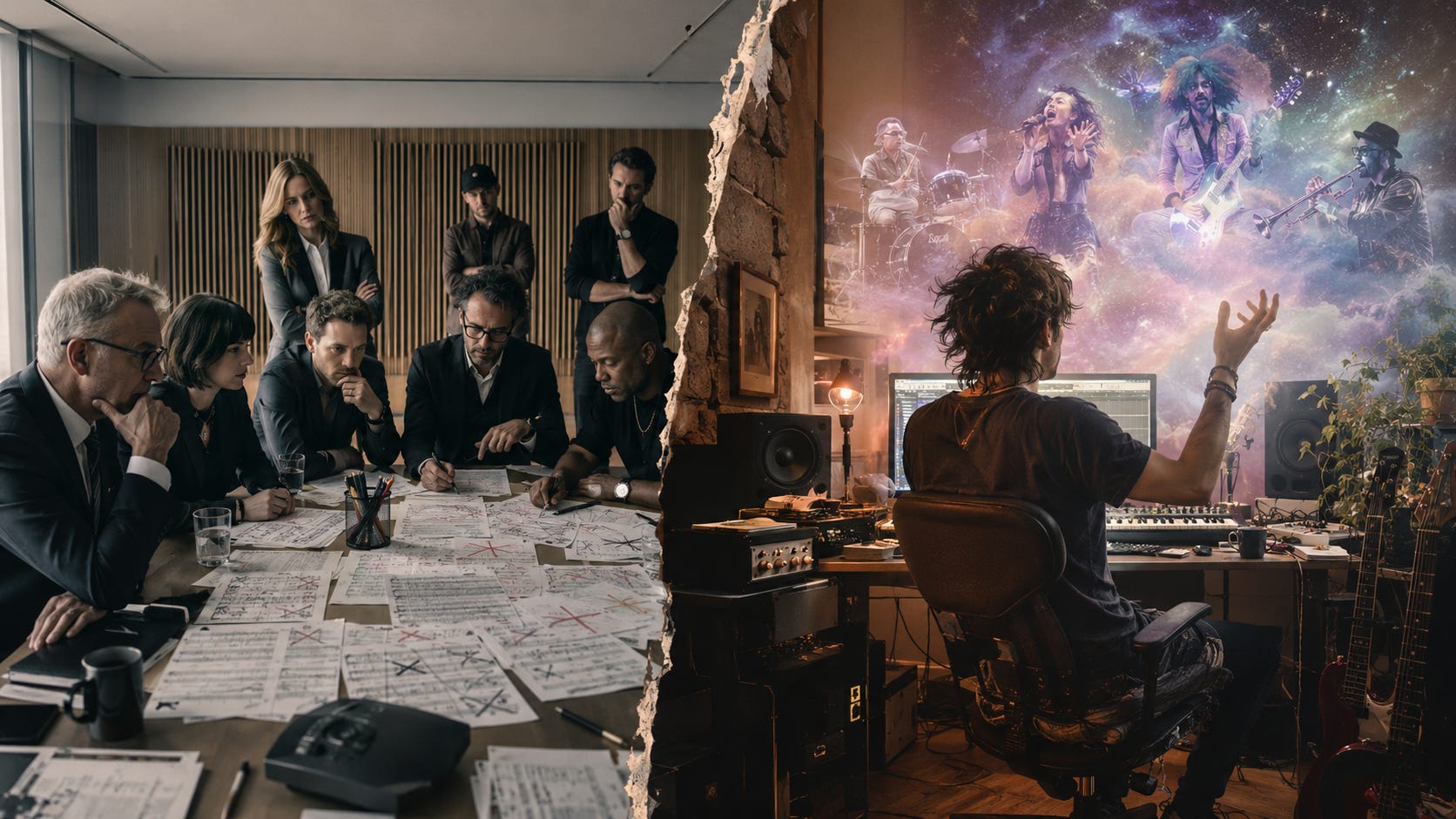
I personally have played in several bands and can testify that the romantic image of conventional music production bears little resemblance to what actually happens between an idea and a finished recording. A song leaves one person’s head and immediately enters negotiations.
The guitarist wants to play a riff that showcases his skills at the cost of making the song incoherent. The drummer wants to play fills that belong elsewhere. The singer cannot perform the melody you imagined. Somebody thinks the lyrics are embarrassing. Somebody else wants something more commercial. And that’s before money even enters the picture. Then come budgets, producers, schedules, managers, labels, touring considerations and the permanent fear that one politically disastrous sentence can turn a career into radioactive waste.
Sometimes those compromises improve a song. More often than not, however, they simply move it away from the original vision.
Generative music removes a shocking number of those veto points.

Suno’s current Pro plan starts at $8 per month when billed annually and includes its advanced models and commercial-use rights for newly generated songs. One person can now experiment with arrangements, voices and instrumentation at a scale that once required studio time, musicians and a serious budget.

Granted, production capacity does not give someone taste or talent. As I argued in “The terrible rise of human slop”, AI is very good at destroying production barriers, but it cannot magically improve creative judgment.
Regardless, there are genuine market signals we can look at. Here are some things people are already doing with that freedom.
▪ Xania Monet currently has around 428,000 monthly Spotify listeners. The human behind the project, poet Telisha “Nikki” Jones, writes the lyrics and uses Suno to turn them into R&B recordings. “How Was I Supposed to Know?” became the first known AI-based act to enter a Billboard radio airplay chart. The project even attracted a reported multimillion-dollar record deal. Whatever one thinks of the production method, hundreds of thousands of listeners are choosing the result.
▪ Breaking Rust has around 846,000 monthly Spotify listeners, while Cain Walker has more than 600,000. Breaking Rust’s “Walk My Walk” reached No. 1 on Billboard’s Country Digital Song Sales chart. Their catalogs lean into outlaw-country themes of defiance, work, freedom, pain and refusing to bend. People did not need a lecture on synthetic authenticity before listening to them. They heard songs they liked, and that was all it took.
▪ The Velvet Sundown built an entire imaginary psychedelic-rock band around AI and currently attracts roughly 126,000 monthly listeners. The project openly describes itself as synthetic and human-directed. It is almost a perfect test case for Spotify’s new rule. Once everybody knows the musicians are fictional, what consumer harm are listeners protected from by keeping the songs out of recommendations?
Then there is Hard Archive, a deliberately ridiculous faux-vinyl project built around fake historical recordings, taboo comedy, memes and material so politically incorrect that I have difficulty imagining the average major-label brand department allowing half of it into a meeting. Its Spotify page currently shows roughly 14,000 monthly listeners, while YouTube shows more than 83,000 subscribers and 14 million channel views this summer. Its whole appeal comes from making things conventional entertainment institutions would either sanitize or refuse to make.
That kind of creative independence is the side of AI music its critics rarely want to discuss.
And Spotify itself obviously has no principled objection to generative AI. The company has been working with Sony, Universal, Warner, Merlin and Believe on “artist-first” AI products. It has also announced licensing arrangements for AI-powered fan covers and remixes that route compensation back through participating rightsholders.
AI is therefore quite welcome when it arrives wrapped in licensing agreements, established rights holders and an approved commercial structure.
The independent synthetic artist gets a badge and a discovery wall.
That is precisely how digital provenance becomes creator gatekeeping. The database begins by telling you how something was made. Soon the same field determines whether it can be recommended, monetized, verified or treated as authentic.
Then comes the reverse problem. Spotify now has a “Verified by Spotify” system built around authentic human identity, while AI Personas receive the opposite signal. Once platforms start awarding economic advantages to provable humanity, musicians who never touched AI acquire a new problem of their own: how do you prove a negative?
I have already written about the emerging world in which “human-made” may need paperwork. Missing provenance proves very little. Detectors make mistakes. Audio gets compressed, mastered, processed and transformed. Yet once “verified human” becomes commercially preferable, suspicion alone can force creators to document how they create.
This is the strange destination toward which the authenticity crusade is heading.
More on AI gatekeeping:


Personally, AI music has ruined a lot of traditionally produced music for me.
Whenever I hear a famous band now, I find myself imagining the invisible PR committee behind the recording. The producer deciding which riff makes it into the final mix. The label deciding what fits the brand. The manager thinking about touring partners whose delicate sensibilities cannot be offended. The publicist thinking about headlines. The lawyers making sure nobody says anything risky. The musicians themselves compromising until everybody can tolerate the result.
Then I hear some lunatic on the Internet use AI to resurrect a nonexistent 1970s band and make it sing something no record executive on Earth would ever approve.
Which one contains the purer expression of creative intention?
Increasingly, I suspect that AI may end up producing some of the least mass-manufactured music on the market. One person can follow an idea wherever it goes, without a label smoothing off the edges, a producer chasing a format, lawyers removing dangerous lines or five band members negotiating the song into mediocrity.
Traditional music can be entirely human-made and still have almost no individual human vision left in it. AI music can be synthetic from beginning to end and still express one person’s taste, humor, anger and imagination with remarkable fidelity.
Maybe the real slop was the music industry all along.
Explore more from Popular AI:
Start here | Local AI | Builds & gear | Autonomy & policy | Fixes & guides | Popular AI podcast
If an AI-generated song is good enough that listeners genuinely want to hear it, should Spotify and other music platforms treat it differently in recommendations simply because of how it was made?