


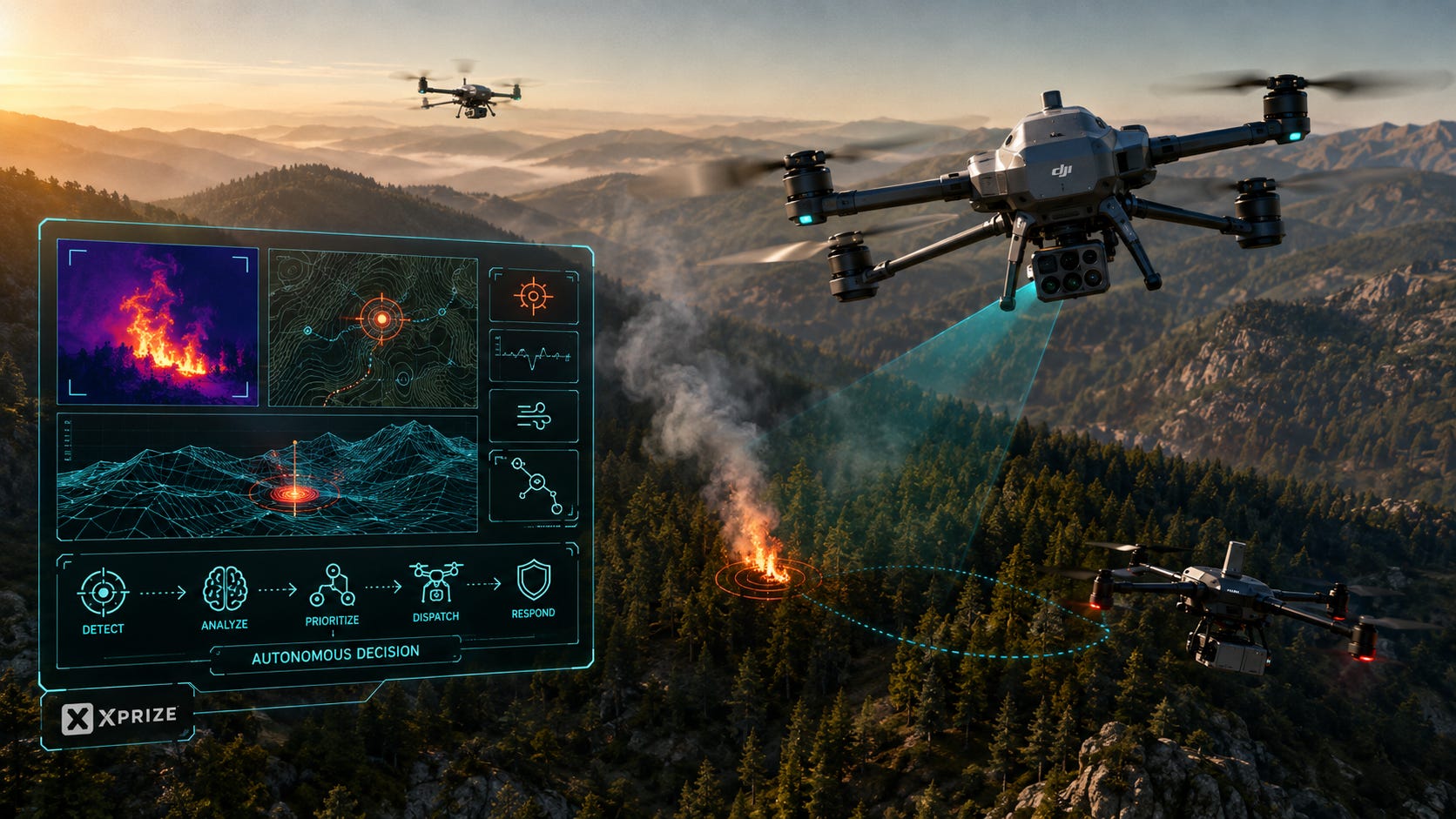
Most “AI agent” demos leave one awkward question hanging: did the thing actually accomplish anything?
Autonomous wildfire response is harder to fudge. In June 2026, teams in the XPRIZE Wildfire competition put integrated AI, sensor, robotics, and drone systems through field testing near Nenana, Alaska. The systems had to detect a fire, decide whether it was real, locate it, deploy aircraft, and suppress it without a human making the decisions along the way. XPRIZE says the Alaska trials evaluated speed, accuracy, autonomy, and suppression effectiveness under realistic field conditions.
The important word is tested.
XPRIZE has set an unusually unforgiving final target. Teams in its Autonomous Wildfire Response track must autonomously detect and suppress a high-risk fire inside a 1,000-square-kilometer test area within ten minutes while leaving decoy fires untouched.
That gives autonomous AI something most agent benchmarks still lack: an objective you can watch fail.


AI wildfire drones: key takeaways
XPRIZE ran large-scale autonomous wildfire response testing in Alaska in June 2026, with systems combining AI, sensors, autonomous aircraft, communications, and suppression hardware.
The competition’s ultimate benchmark is unusually concrete: find the correct fire, suppress it within ten minutes across a 1,000 km² area, and ignore decoys.
The June testing is evidence that these systems have moved beyond slide decks, but XPRIZE has not yet published a final scorecard showing that a team has satisfied the full grand-prize requirement.
Drone payload and response time are tightly linked. Once a wildfire becomes large, a relatively small autonomous aircraft stops being an extinguisher and becomes another tool supporting human crews.
Aviation approval, airspace coordination, communications, weather, terrain, and safe operation around crewed aircraft may be as important to deployment as the AI itself.
What XPRIZE actually tested in Alaska
Official testing was set to begin June 15 near Nenana, about an hour southwest of Fairbanks. The teams were challenged to monitor a vast area for eight hours and rapidly detect, locate, and suppress as many as three controlled incipient-stage fires without human intervention.
The June field roster consisted of three teams: Anduril, AURA Foresight, and Dryad. They attacked the same problem with very different system designs.
Anduril built a layered setup around persistent ground sensing, autonomous aerial surveillance, thermal imaging, computer vision, Lattice Fire software, and Ghost-X aircraft that could be autonomously tasked after an ignition was validated. Its system combined ground and aerial sensors so that detection, verification, location, and suppression could happen as parts of one coordinated pipeline.
AURA Foresight used AI-assisted camera sites, commercially available DJI aircraft, thermal sensors, laser range finding, digital elevation models, and coordinated drone swarms. Its system first estimated the location of a possible ignition, sent an aircraft to investigate, then used software to distinguish a real fire from a decoy before coordinating the suppression response.
Dryad pushed detection earlier. Its approach used solar-powered ground sensors to detect combustion gases during the smoldering phase, before flames necessarily produced the visual cues a conventional camera might rely on. An observation drone could then verify and geolocate the ignition before a suppression drone responded.
That variety matters because “AI firefighting drone” sounds like a clever quadcopter with a fire extinguisher strapped underneath.


The actual systems look more like distributed machines.
Sensors watch continuously. Software decides whether an alert is credible. An aircraft verifies it. Positioning software determines where the fire actually is. Another aircraft carries suppressant. Communications links keep the pieces coordinated. Sensors can continue watching afterward to determine whether the response worked or whether the fire is still active.
The AI is one component of that loop. The useful unit is the whole system.
Why wildfire suppression is a better autonomy benchmark
Popular AI has already covered the move toward embodied AI systems built to perceive, reason about, and act beyond a chat window. Wildfire suppression shows why physical autonomy needs a much harder standard.
You cannot grade this with vibes.
A wildfire-response system has several questions to answer:
Did it notice the fire?
Did it reject the decoys?
Did it locate the actual ignition accurately?
Did it send the right aircraft?
Did the aircraft reach the target safely?
Did the suppressant hit the fire?
Was the fire actually extinguished?
Did all of that happen quickly enough to change the outcome?
Those questions expose the weakness of many AI demonstrations. A system can look impressive while succeeding only at the easiest visible step.
A detector that spots smoke has not completed a suppression mission. A drone that can fly autonomously has not proved it can identify the correct target. A suppression aircraft that drops water accurately has not demonstrated that the full system can notice an unknown ignition, verify it, route a vehicle, avoid decoys, and complete the attack before the fire grows past the payload’s useful range.
The XPRIZE benchmark collapses those separate capabilities into one end-to-end result. That is much closer to how useful autonomy should be evaluated.
An autonomous coding agent can produce a plausible patch that later fails a test. A research agent can generate a polished report whose sources do not survive inspection. A physical response system faces a less forgiving evaluator.
The fire is either found or it is missed. The decoy is either rejected or attacked. The aircraft reaches the target or does not. Suppressant lands where it should or it does not. The ignition is controlled within the required window or it keeps growing.
Reality provides the score.
Related:

Alaska proved field capability, not the full prize claim
There is still a large gap between XPRIZE conducted autonomous wildfire field testing and autonomous drones can now reliably extinguish wildfires at scale.
The first statement is well supported. The second remains premature.
The Alaska finals show that autonomous detection, verification, navigation, and suppression hardware can be integrated and operated in realistic outdoor conditions. That is meaningful progress because it forces the software to deal with actual terrain, weather, communications, aircraft behavior, imperfect sensing, and physical payload delivery rather than a simulated environment.
But the public XPRIZE material does not provide the detailed timing and scoring needed to conclude that a team has already satisfied the complete 1,000 km², ten-minute grand-prize requirement. The competition page still says final winners will be announced in 2026, and it does not identify an Autonomous Wildfire Response winner as of August 14.
One finalist has published more detail about its own performance. Dryad says its Alaska system demonstrated autonomous detection and suppression, with its sensors triggering a drone response that located and attacked a small fire without human involvement. The company also says its Silvaguard Suppression Drone can deploy up to 100 liters of suppressant onto an ignition point.
That is useful evidence of technical progress, but it is still a competitor describing its own system. It is different from a published XPRIZE scorecard showing a final pass, the timing of every stage, decoy performance, false-positive behavior, or a winner against the full benchmark.
For now, the strongest conclusion is narrower and more defensible: end-to-end autonomous wildfire suppression has reached credible field trials.
Whether it has passed the entire test remains the more demanding question.
Early detection matters more than the drone spectacle
The basic physics are brutal.
A drone does not need to defeat a mature wildfire for this idea to be useful. It needs to arrive before a small ignition becomes one.
XPRIZE’s description of Dryad’s system makes that constraint clear. Its ground sensors try to detect a fire during the smoldering stage. An observation drone then verifies and locates the ignition. Only after that does a suppression drone respond. The sequence works because the fire is still small enough for an aircraft-sized payload to matter.
That may be the real product hiding inside the flashy “AI drone extinguishes wildfire” headline.
The breakthrough is the compression of time between ignition and suppressant reaching the ignition point.
That time matters at every step. Detection has to happen early enough to preserve a useful response window. Verification has to be fast enough that the system does not spend its advantage staring at a false alarm. Geolocation has to be accurate enough for the suppression aircraft to avoid wasting time searching. The aircraft then has to reach the correct location with a payload that is still large enough relative to the fire.
This framing also makes the payload problem easier to understand. A small autonomous aircraft is potentially valuable when the fire is small. Its advantage shrinks as the fire grows. Eventually the aircraft stops being an extinguisher and becomes another sensing, mapping, or support tool for a much larger human response.
There is already a separate real-world experiment heading in that direction. Aspen Fire Protection District is becoming an early customer for autonomous suppression drones from Seneca. Aspen Public Radio reported that the aircraft carry a limited amount of suppressant, and Fire Chief Jake Andersen described their value in terms of reaching small fires in remote places much faster than ground crews might be able to reach them.
That is exactly where autonomous response makes the most sense.
The ideal success story may look almost boring. A sensor notices the beginning of a fire. Software validates the alert. An aircraft reaches the ignition before the situation becomes visually dramatic. Suppressant lands. The system verifies that the fire is out. A potentially major incident never develops far enough to require the spectacular footage people associate with wildfire response.
If autonomous suppression works, its sweet spot is probably the fire that never becomes a disaster.
Wildfire drones already have a role. Full autonomy changes the loop
Fire agencies do not need to be convinced that drones can help.
The FAA already describes UAS as useful for situational awareness, hotspot detection, persistent monitoring, perimeter mapping, infrastructure assessment, ignition support, and nighttime wildfire operations. Those are meaningful capabilities, but they do not automatically amount to autonomous suppression.
What XPRIZE is pushing toward is more consequential.
A conventional drone operation can still depend on people at every important decision point. A human crew may decide where to send the aircraft, interpret the imagery, determine whether a heat source is dangerous, request another asset, approve a suppression action, and decide what happens next.
The autonomous systems being tested try to close more of that loop themselves.
Sense.
Classify.
Verify.
Navigate.
Suppress.
Check the result.
The importance is not that each individual step is unprecedented. The importance is that the handoffs between them become part of one machine-directed response chain.
That creates harder failure modes.
A false positive wastes aircraft time and suppressant. A false negative leaves a fire growing. A bad coordinate sends the response to the wrong place. A communications failure can break the sequence in the middle. A weak classifier can mistake a decoy for the real target. A poor route or navigation decision can delay the aircraft long enough that a once-manageable ignition outgrows the available payload.
There is also a safety problem that ordinary software-agent benchmarks barely have to confront. A bad autonomous decision can put an aircraft into airspace where firefighters, helicopters, tankers, or other drones may already be working.
Making the model smarter is therefore only one part of the engineering challenge. The entire system has to behave safely when sensing is uncertain, when connectivity is imperfect, when conditions change, and when a mission cannot proceed exactly as planned.
That is the difference between an AI feature and an autonomous response system.
Payload, weather, communications, and regulation still set the ceiling
The hardest constraints around autonomous wildfire suppression do not disappear because AI is involved. In several cases, better AI simply reaches the point where aviation, physics, communications, and incident coordination become the limiting factors.
▪ Payload. Suppression aircraft can only carry so much. That creates a race between fire growth and response time. More payload generally means a larger aircraft, which can bring higher cost, more power demand, more complicated logistics, and more demanding operating requirements.
This is why ultra-early detection is tied so tightly to autonomous suppression. If the system needs a tanker-sized payload by the time it arrives, the autonomy problem has already lost to the fire problem.
The payload limit also changes what success should mean. A small aircraft does not have to replace a large tanker or helicopter. It has to arrive while a relatively small payload is still relevant. The value comes from being early enough to change the scale of the incident.
▪ Weather and terrain. XPRIZE chose Alaska because the site offered changing weather, long distances, rugged terrain, and a large, sparsely developed operating area. Teams had to detect incipient fires, avoid false positives, dispatch suppression systems, and operate safely under those conditions.
Those conditions do not affect every sensor or aircraft in the same way. Smoke can obstruct ordinary cameras. Terrain can block lines of sight. Forest canopy can hide heat sources. Wind and weather constrain aircraft. Long distances make response time more demanding and can expose communications weaknesses.
That helps explain why the finalist systems were layered. A single detector can fail for reasons that have nothing to do with its headline accuracy. Combining ground sensors, thermal imaging, aerial surveillance, cameras, software verification, and different communications methods gives the overall system more ways to keep functioning when one signal becomes unreliable.
▪ Communications. Autonomous does not mean disconnected.
Ground sensors, camera towers, aircraft, positioning systems, operators, and emergency services still need reliable ways to exchange information. Some finalist systems use mesh networks. Others combine commercial communications hardware with centralized software platforms. In either case, remote wildfire country is exactly where assuming perfect connectivity becomes dangerous.
A credible system needs a defined behavior when a link disappears halfway through a mission. Does the aircraft continue? Does it return? Can it still verify the fire? Can another part of the network take over? Can the system distinguish a temporary communications loss from a larger mission failure?
Those questions are operational, but they are also central to autonomy. A system that works only while every network connection behaves perfectly is not ready for the environment it is supposed to protect.
▪ Aviation rules. This may be the least glamorous bottleneck and one of the largest.
The FAA already has mechanisms for integrating drones into wildfire operations, including emergency airspace coordination. But ordinary U.S. drone rules do not automatically permit every mission an autonomous wildfire network would want to perform.
FAA Part 107 waiver guidance explicitly covers cases such as flying a small UAS beyond visual line of sight and flying multiple small UAS with one remote pilot. Both can matter if an autonomous network is expected to patrol large territory or coordinate several aircraft.
Weight creates another threshold. The FAA states that Part 107 applies only to drones weighing less than 55 pounds at takeoff, with heavier aircraft potentially requiring an exemption under Section 44807 or another applicable path.
Then there is the wildfire itself. Active incidents can involve helicopters, airtankers, temporary flight restrictions, and tightly managed fire traffic areas. An autonomous suppression fleet cannot become a new collision hazard while trying to solve the original emergency.
That is why the Alaska finals’ connection to the University of Alaska Fairbanks and ACUASI matters. The tests were conducted in an environment built to support advanced unmanned-aircraft operations, rather than pretending that software autonomy alone solves the airspace problem.
Deployment at scale requires permission to operate safely at scale.
What would prove autonomous wildfire suppression works?
A slick video of a drone dropping water on a controlled flame is not enough.
Neither is an AI detector spotting smoke in a curated camera feed.
The convincing evidence would look much closer to the XPRIZE benchmark: repeated tests over meaningful territory, unknown ignition locations, decoys, changing environmental conditions, autonomous confirmation, reliable navigation, actual suppression, and hard timing data.
Then do it again.
And again.
False positives matter because a system that launches every time sunlight or dust looks like smoke will waste aircraft cycles, suppressant, and attention. False negatives matter even more because a missed ignition can keep growing while the system reports nothing unusual.
Response time matters as a chain, not as a single flattering number.
A system that detects a fire in 30 seconds but needs 14 minutes to put suppressant on it has missed a ten-minute objective. A system that reaches the general area in five minutes but spends several more trying to find the precise ignition has a different failure. A system that arrives quickly and attacks a decoy has failed in a more obvious way.
Suppression effectiveness also has to be measured after the drop. Hitting the target is not the same as extinguishing the fire. A credible test needs to know whether the ignition actually went out, whether it reignited, and whether the system correctly recognized the result.
Human intervention should be reported clearly too. If a person had to confirm the target, reroute the aircraft, restart a failed communications link, approve the suppression step, or correct the mission, that matters when the claim being tested is end-to-end autonomy.
The point is not to demand perfection from an early field trial. The point is to make the failure boundaries visible.
That is what makes XPRIZE Wildfire unusually interesting as an AI benchmark. A competitor cannot hide a missed fire behind eloquent text output. It cannot turn a bad route into a better answer with a second prompt. It cannot claim success because a judge liked the demo.
The technology has to complete the chain in the physical world.
Why autonomous wildfire drones will still need firefighters
Replacement is the wrong benchmark.
Even successful autonomous suppression systems are best understood as machines for the first few minutes of an incident.
They can watch places continuously that people cannot. They can investigate remote terrain without first putting a crew in a truck or helicopter. They can launch into missions where speed matters more than payload. They can check a suspicious heat signature before somebody commits larger resources. If the fire is still tiny, they may be able to attack it directly.
That can be extremely useful without turning the drone into a robotic fire department.
Once a fire grows beyond the suppression capacity of a small aircraft, the job changes. Human incident commanders, aircraft, engines, hand crews, heavy equipment, evacuation systems, and logistics still have to manage a complex emergency. The problem becomes larger than rapid detection and an initial suppressant drop.
Autonomous systems may still help at that stage. The FAA’s existing wildfire-drone use cases already include mapping, persistent monitoring, hotspot detection, situational awareness, and other support missions. Those jobs remain valuable even when direct autonomous suppression is no longer enough.
The important distinction is timing.
An autonomous system could be most valuable precisely because it acts before the familiar wildfire-response machinery is fully mobilized. It can turn a remote ignition into a target within minutes rather than a developing incident waiting for somebody to notice, verify, travel, and attack it.
That does not diminish firefighters. It changes what they are asked to respond to.
A technology does not need to replace the fire department to earn a place in wildfire operations.
Stopping one fire while it is still small is enough.
The real test for AI wildfire drones comes after Alaska
There is something refreshing about an autonomous-AI project that can lose in public.
The wildfire is either detected or it is not. The decoy is either ignored or it is not. The aircraft arrives or it does not. The suppressant hits the target or it does not. The fire goes out within the deadline or it keeps burning.
That is a stronger standard for autonomy than a polished demo where the system builder also controls the framing, the examples, and the definition of success.
The Alaska trials show that autonomous wildfire response has reached a stage where serious teams can attempt the full detection-to-suppression loop outdoors. Sensors, AI software, communications, aircraft, thermal imaging, positioning, and suppression hardware are being integrated into systems that can operate in the field rather than existing only as diagrams or isolated prototypes.
They do not yet prove that the problem has been solved at operational scale.
That distinction matters because the interesting claim is not that a drone can carry suppressant. It is not that computer vision can spot smoke. It is not that an autonomous aircraft can fly to coordinates.
The meaningful claim is that one system can notice the right ignition, reject the wrong one, locate the fire, choose and route an aircraft, deliver suppression, verify the result, and do all of it fast enough to change what happens next.
That is a measurable job.
If a team eventually meets the full 1,000 km², ten-minute requirement reliably, the result will be more than an impressive AI demonstration. It will show that autonomous AI can take responsibility for a physical response loop where the objective, the clock, and the failure state are all visible.
For AI agents, that may be the most important part of the wildfire experiment.
There is nowhere to hide when the answer is still burning.
Explore more from Popular AI:
Start here | Local AI | Builds & gear | Autonomy & policy | Fixes & guides | Popular AI podcast
Would you trust an autonomous AI wildfire drone to detect and suppress a fire without human approval, or should a human always stay in the loop?