


If you use Claude for writing, coding, research, or business, Anthropic’s IPO filing answers a question that sits behind every interaction: who controls the company setting Claude’s rules? The proposed structure gives its seven co-founders 50.1% of voting power on general shareholder matters through a single special share. A separate trust gets to elect most of the board. Public investors would be able to buy into Anthropic without gaining ordinary control over its direction.
The arrangement could protect long-term research from demands for faster financial returns. It also concentrates authority in a small group whose judgments on AI safety, access, and acceptable uses may shape Claude for years. Buying shares and paying for a subscription would leave those decisions largely in the same hands.
What Anthropic filed on October 26
Anthropic filed its preliminary S-1 registration statement on October 26, 2026, proposing a Nasdaq listing under the ticker ANT. The filing describes a proposed offering. Its price, final share count, and timing were not settled in the initial prospectus, and the filing does not establish that the IPO is complete.


Anthropic is already a Delaware public benefit corporation. Its stated purpose is the responsible development and maintenance of advanced AI for humanity’s long-term benefit. The company says this structure requires directors to balance shareholders’ financial interests, the interests of people affected by its actions, and that public purpose. The IPO would retain that status while adding a special founders’ voting vehicle alongside the existing Long-Term Benefit Trust (LTBT).
Shareholder voting control and board-election control are split between two groups. Ordinary IPO buyers would not acquire either form of control. An individual founder would not personally hold all the powers described in the prospectus, either.
Anthropic’s five share classes, explained
The proposed capital structure separates economic ownership from voting rights. Some shares carry a financial stake. Others exist chiefly to assign governing powers.
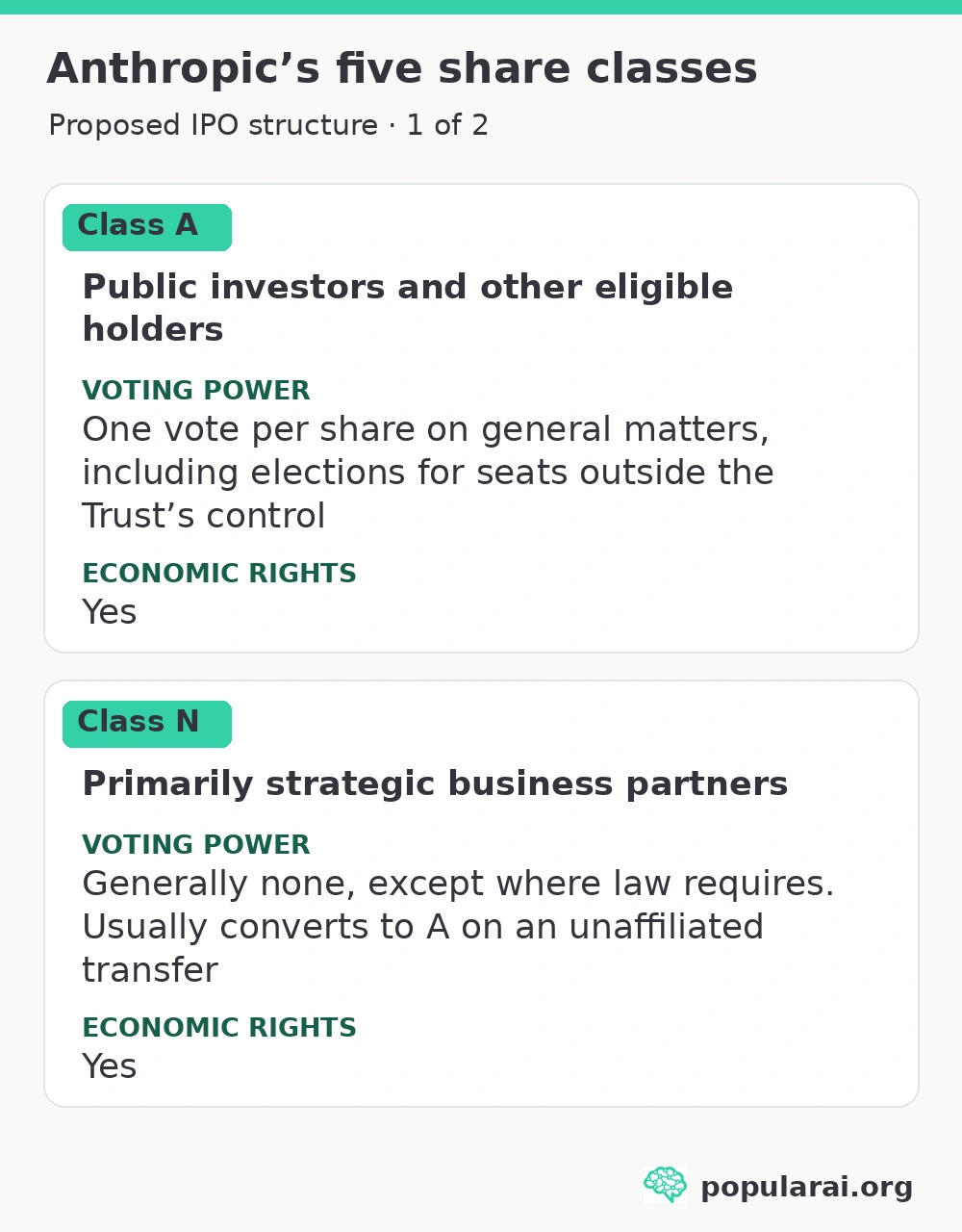
Two shares stand out. The sole Class F share gives the Founder LLC a voting majority even if it owns far less than half of Anthropic’s economic value. Issuing additional Class A stock does not dilute that general-vote percentage while Class F remains in force. Selling more stock to the public would therefore not, by itself, erode the founders’ majority.
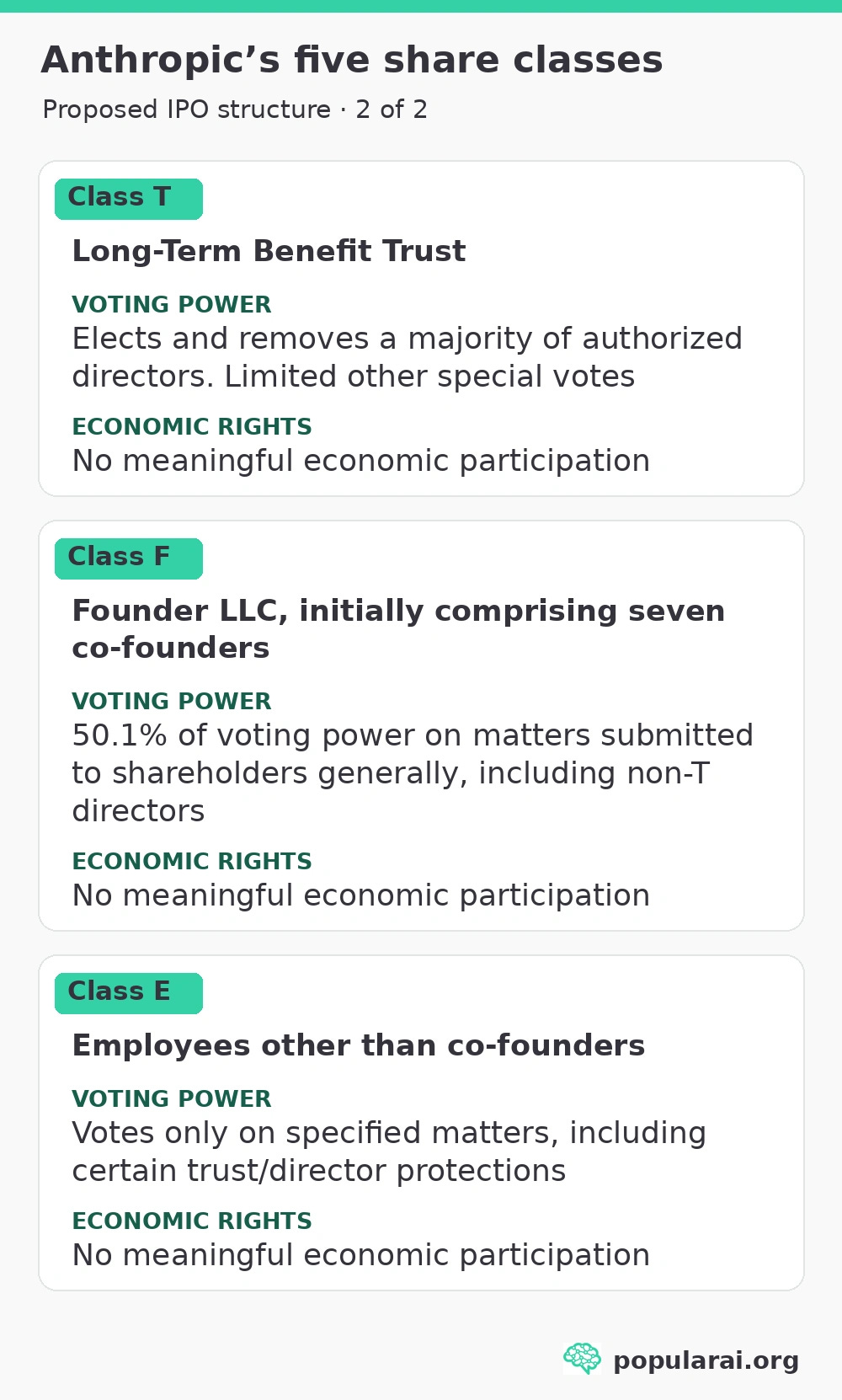
The sole Class T share works differently. It lets the LTBT choose most directors, without carrying 50.1% of ordinary shareholder votes. Adding the two powers together as though they were percentages of the same vote would misrepresent the structure. One governs general shareholder decisions. The other reserves control over most board seats.
The control chain from shareholders to Claude
The LTBT and Founder LLC would collectively be able to elect every director. The trust selects the majority. The founders’ voting vehicle normally determines elections for the remaining seats and the outcome of general shareholder resolutions. The board oversees the company and supervises management. Executives and staff then decide how Claude is built, trained, deployed, priced, and moderated through the company’s decision-making processes.


Trustees do not personally approve each Claude refusal, content-filter adjustment, or API restriction. The S-1 explicitly denies the trust and its trustees authority over day-to-day management or strategy setting. Their influence runs mainly through their choice of directors and the advice they provide. Following that chain avoids attributing a product decision to someone whose formal power is to help choose the people overseeing it.
The founders also act as a group. The Class F share belongs to an LLC whose initial members are Dario Amodei, Daniela Amodei, Tom Brown, Jack Clark, Jared Kaplan, Sam McCandlish, and Christopher Olah. If a majority of the continuing founders cannot agree on how to vote it, the filing generally provides for its votes to follow the Class A voting proportions, subject to quorum requirements. The 50.1% figure should not be mistaken for personal voting control by the CEO.
The trust is designed to have financially disinterested trustees. Anthropic says they hold no equity, do not share in profits, and select new trustees in consultation with the company. Those arrangements may reduce incentives to maximize the next quarter’s share price. Trustees still are not elected representatives of Claude users or the general public. Financial independence answers one accountability question, while leaving the question of whom they represent unresolved.


Can public shareholders change Anthropic’s AI policies?
Usually, they could not force a change by winning a shareholder vote. Anthropic warns that Class A holders generally cannot determine shareholder-vote outcomes or director elections, regardless of how they vote, except in specified circumstances such as founder disagreement.
The structure deliberately protects against unwanted takeovers and investor campaigns to replace directors. It also removes an ordinary route for holding company leadership accountable. Public shareholders could sell, criticize management, exercise applicable legal rights, and influence the market’s willingness to finance Anthropic. They would not ordinarily be able to vote out the trust’s director slate. Owning stock would give them financial exposure without comparable governing power.
Anthropic expects to qualify as a Nasdaq controlled company and use an exemption allowing a nominating and governance committee that is not entirely independent, as Reuters reported on October 27. That leaves another consequential choice about future directors closer to current leadership.
The founders’ advantage has conditions. The Class F sunset provisions start a 450-day transition after fewer than three qualifying continuing founders remain for 90 consecutive days, with other termination provisions also applying. There is no fixed calendar expiration. The trust’s board-election role has separate amendment and termination conditions, so the end of Class F would not automatically end the trust’s authority.
How corporate control reaches Claude’s restrictions
Claude’s behavior already reflects company decisions made above the level of individual users. Anthropic’s October 8 Usage Policy update outlined revised rules for deceptive campaigns, surveillance, weapons-related applications, high-risk automated decisions, and abusive interactions with Claude. The revision is scheduled to take effect on November 12, 2026.
The announcement also shows that restrictions can loosen. Anthropic said it removed a blanket prohibition on personalized campaign targeting while retaining bans on deceptive election activity and misuse of personal data. Neither Claude subscribers nor a public shareholder majority had to approve those changes. The company set the terms on which people could use its service.
Enforcement has practical consequences. Anthropic can warn, suspend, or terminate accounts over policy violations. For January through June 2026, it reported 11.4 million banned accounts, 398,000 appeals, and 42,000 appeal overturns. Those figures document the scale of enforcement. They do not establish whether any individual decision was justified.
The IPO structure provides no evidence that trustees or founders directed a particular moderation decision. It shows where corporate authority is concentrated when users, employees, or shareholders dispute such decisions. A board chosen chiefly by the trust could defend legitimate safety limits against revenue pressure. Its insulation from ordinary shareholder votes could also make contested rules harder to change. The governing documents assign powers, but cannot tell us how their holders will exercise them.
Popular AI’s guide to LLM bias and AI censorship explains how post-training and product policies affect what a hosted model says. Corporate control sits above those technical choices, determining who can oversee the people making them.


Keep Claude useful without making it irreplaceable
Nobody needs to abandon a productive Claude workflow because of a proposed IPO. Avoid making the vendor’s policy choices an irreplaceable dependency.
▪ Keep prompts, source documents, agent instructions, code, and finished outputs in formats you can access outside Claude. For software built around its API, isolate provider-specific calls so switching models does not require rebuilding the application. Read current usage rules before committing to high-risk or regulated deployments. Have a manual path when an account is paused or a requested capability is unavailable.

▪ For confidential or politically sensitive work, consider a second hosted model or a local fallback. Popular AI’s local AI guide covers the tradeoff: local models can reduce exposure to centralized account and inference controls, but bring hardware costs, setup work, model limitations, and maintenance responsibilities. A fallback should preserve access to the work you need, rather than simply add another tool to the same vulnerable workflow.
Under the proposed IPO structure, the founders would control general shareholder votes, the benefit trust would choose most directors, and management would operate Claude. Public ownership would leave that chain of authority largely intact. Keep using Claude where it earns its place, and keep your work portable enough to continue if the people controlling it change the rules.
More on this subject:


Explore more from Popular AI:
Start here | Local AI | Builds & gear | Autonomy & policy | Fixes & guides | Popular AI podcast