


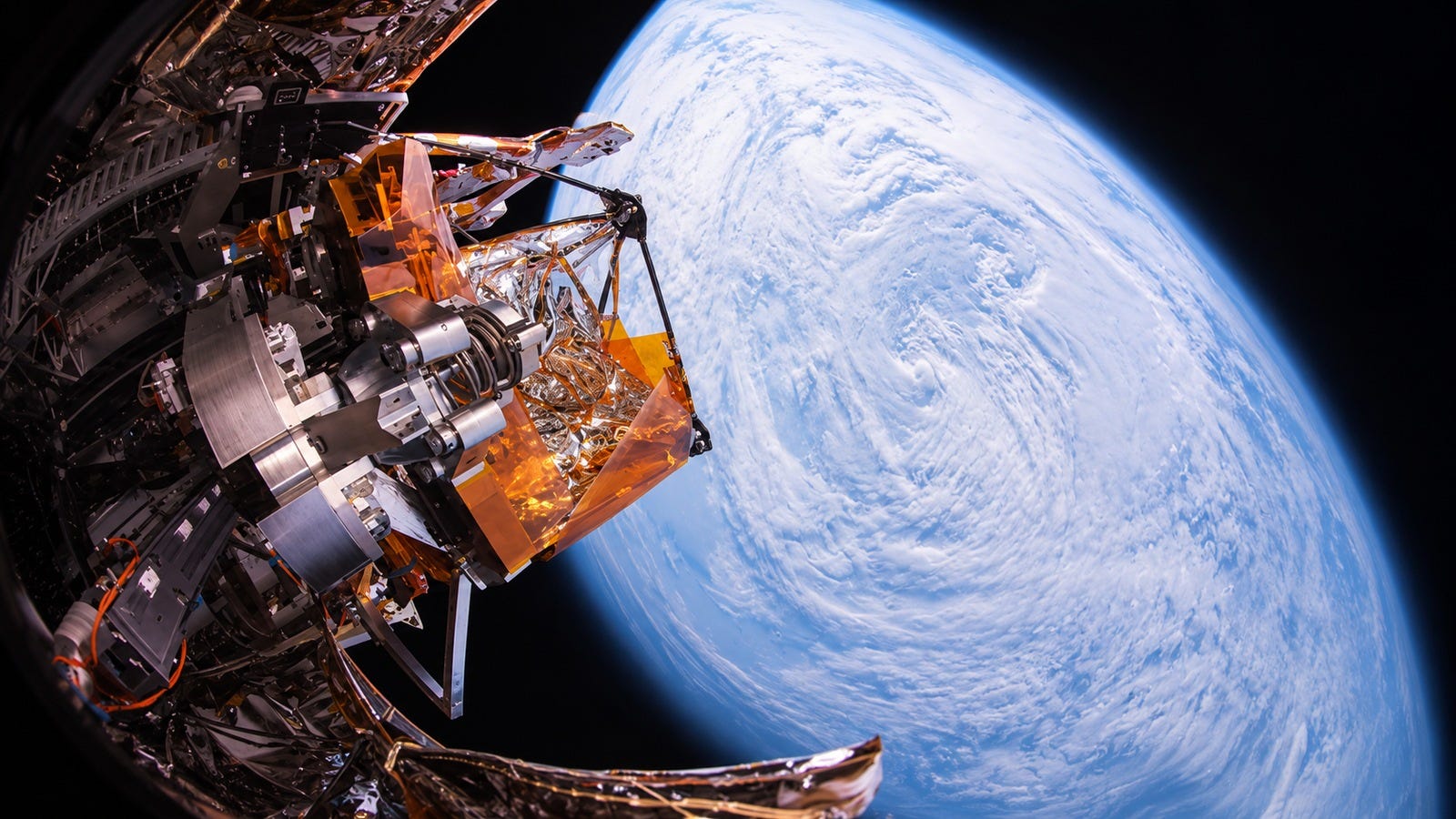
Caltech’s ASTRA robot assembled part of a space antenna from loose components without an astronaut handling the pieces. On November 5, Caltech announced that ASTRA had built a third truss bay in orbit. The first two bays were already assembled at launch. The proposed reflector needs 11.
The new bay shows that a robot can make the necessary connections in space. Getting it built still took repeated work on Earth. When the assembly sequence ran into trouble, engineers had to figure out what went wrong and send a workaround back to the spacecraft.

What ASTRA built in orbit
ASTRA stands for Autonomous In-Space Tensioned Reflector Assembly. Caltech developed the experiment with DARPA funding. The roughly cubic-meter payload launched on March 30, 2026, on SpaceX’s Transporter-16 mission aboard Momentus’s Vigoride 7 spacecraft.
The target was a 1.4-meter-diameter reflector antenna. Its shape would come from a truss built in repeating sections, called bays, that support a lightweight reflective surface. Each bay uses composite-fiber tubes and aluminum joints, stored in dispensers until the robot needs them.
The gantry robot moves along three straight axes. It picks up the tubes and joints, positions them on an assembly plate, and connects them there. The assembly plate gives each loose part a place to go. The robot can build the same shape on that plate each time, then push the finished section out to clear the work area.
In orbit, the team first released the launch restraints and pushed the two prebuilt bays out of the assembly box. That made room for the robot to build the third from individual parts. The design calls for the robot to attach perforated Kapton film to the truss before pushing each completed bay out of the box and making room for the next one. Caltech’s orbital photos show the partial structure. A finished 11-bay reflector and its radio performance remain unverified. Caltech’s lab demonstration shows how the assembly sequence works on Earth.
How autonomous was the construction?
The robot handled the physical assembly. Engineers Charles Sommer, Alan Truong, and Tara Venkatadri sent commands through Vigoride and checked the results against photos from orbit. When a step failed or produced an unexpected result, the team worked out what to try next.
They kept a flight spare, a twin of the orbital hardware, in a Caltech lab. If the images pointed to a mechanical problem, the team could reproduce it on the ground and test a workaround before sending revised commands to the spacecraft. An unexpected fault could take several trips through that loop. With the flight hardware out of reach, the pictures were the team’s way to check whether a command had done what they expected before they moved on to the next step.
The team had seven or eight chances a day to contact ASTRA, each lasting about 15 minutes. Engineers had to fit new commands and checks into those windows. That helps explain how a short sequence of assembly moves translated into months of mission operations.
DARPA’s program manager said the demonstration used straightforward robotics and no advanced algorithms. ASTRA’s hardware was built to carry out a prescribed sequence. Its operators still diagnosed unfamiliar faults and decided how to resume the build. Other uses of autonomy put software in charge of different decisions, from interpreting a robot’s surroundings and helping plan its movements to letting a language model operate scientific instruments.
More on AI in robotics:


Why the planned antenna remains unfinished
The November 5 announcement accounted for three of the 11 bays: two built on Earth and one built in orbit. That left eight to go. Caltech reported unexpected problems and limited operating time, and the team considered it unlikely that the full truss would be ready before the mission ends in December 2026.


On November 12, Momentus reported further progress on the modular build. The update gave no new bay count or completion date for the antenna. For now, the third bay is the last one the project has publicly identified as assembled. The proposed 11-bay reflector is still the design target.
The public reports give no typical build time per bay or success rate over consecutive builds. A single successful assembly shows that the mechanism works in orbit. Estimating how long a larger build would take requires both numbers, especially if a fault can stall the next bay while the team on Earth tests a fix.
Could this lead to giant space telescopes?
A launch vehicle’s fairing limits the size of any structure that has to go up in one piece, even if it can fold for launch. Another option is to send up larger sections separately and join them in orbit. ASTRA takes the idea down to the component level. Pack the pieces tightly for launch, then use a machine to connect them where the structure will operate.
That approach could suit large radio antennas, telescope supports, and solar arrays. DARPA’s NOM4D program aims at structures hundreds of meters or even kilometers across. At those sizes, a builder would need enough materials and power, a way to maintain alignment as the structure grows, and fault recovery that keeps the work moving. Precision telescope mirrors bring their own requirements beyond those of an antenna truss. A truss can hold a large surface, but telescope optics also have to keep that surface aligned and shaped precisely enough to produce a usable image.
What ASTRA needs to prove next
The next test is sustained assembly. Can a robot build several bays in sequence with fewer calls to the ground team? Those runs would give engineers a way to tell which parts of the build repeat reliably and which still need handholding. Then comes the test of the structure itself. Measuring the shape of a finished reflector and testing its radio performance would show whether the assembled hardware can do the job it was built for.
Explore more from Popular AI:
Start here | Local AI | Builds & gear | Autonomy & policy | Fixes & guides | Popular AI podcast
Could Caltech's ASTRA robot be the beginning of large-scale autonomous space construction, or does this experiment reveal just how far space robotics still has to go?