




EU AI Act labeling requirements begin applying on August 2, 2026. They will affect generative-AI providers, professional creators, publishers and businesses that produce certain synthetic images, audio, video and public-interest text.
The law may be less sweeping than some descriptions suggest. It does not require a visible disclaimer on every photograph touched by an AI tool. It does not make every unlabeled AI meme a crime. The Artificial Intelligence Act itself also recognizes standard editing, private personal use, human-reviewed text and evidently creative work.
Yet the underlying problems remain serious. Article 50 creates a new legal duty based on how media was made and which tools were used in its creation, even where the output is lawful, accurate and harmless. Meanwhile, comparable media manipulation performed by a ghostwriter, CGI artist, studio musician, photographer or human retoucher remains free from any equivalent labeling requirements.
The AI Act treats AI involvement in and of itself as suspect and seems very uninterested in combating actual deception.
More on EU AI regulation:

Key takeaways
Visible labeling is limited mainly to deepfakes and certain public-interest text. Ordinary AI assistance does not automatically require a public warning.
Providers and users have different duties. Generative-AI companies must make synthetic outputs machine-detectable. Professional deployers must visibly disclose certain deepfakes and unreviewed public-interest text.
The AI Act does not automatically criminalize failure to label. Article 50 violations can attract administrative fines, but the regulation does not turn every creator into a criminal defendant.
Old content does not need retroactive labels when it was generated and already published before August 2, 2026.
AI labels are not neutral. Research shows that they can reduce trust, perceived accuracy and engagement even when the underlying material is true.
The burden will not fall evenly. Large publishers can hire compliance staff or replace AI with conventional production. Independent creators and small businesses are more likely to absorb the label, the paperwork and the reputational discount.
What changes on August 2, 2026
Article 50 of the EU Artificial Intelligence Act becomes legally binding. It contains four transparency regimes:
People must be informed when they are interacting with certain AI systems.
Providers of generative systems must make synthetic outputs machine-readable and detectable.
People exposed to emotion-recognition or biometric-categorization systems must be informed.
Professional deployers must disclose certain “deepfakes” and certain AI-generated or manipulated public-interest text.
The AI Act’s content rules are the part most likely to affect creators and publishers.
The European Commission states that Article 50 covers the marking and detection of synthetic content by providers, plus visible labeling by deployers of “deepfakes” and certain text publications.
As defined in the AI Act, a provider is the company making or supplying the generative system. A deployer is a person or organization using the system under its authority for professional purposes.
The average person using AI for a purely personal, nonprofessional activity is excluded from the Act’s definition of a deployer while a freelancer, business, publisher, agency or monetized creator will have a harder time relying on that exclusion.
What providers must do
Providers of systems that generate synthetic text, images, audio or video must design their outputs so they are:
Marked in a machine-readable format.
Detectable as artificially generated or manipulated.
Marked using solutions that are effective, interoperable, robust and reliable as far as technically feasible.
This is mainly a product-design obligation. It falls on companies supplying image generators, audio generators, video models and text systems.
Thankfully, the law contains reasonable exceptions for functionality that users themselves might not even recognize as AI-powered. Provider-side marking does not apply to the extent that the system merely performs an assistive function for standard editing or does not substantially alter the input or its meaning.
That means basic correction is not supposed to be treated as synthetic fabrication. Noise reduction, exposure adjustment, and routine cleanup may fall outside the marking obligation. Generating a missing person, replacing a building, or fabricating a photorealistic event is a different matter. Where exactly the line between the two is drawn is, as usual, unclear. Vagueness, after all, is an art form that the European Commission has mastered to a tee. Someone still has to decide when an edit stops being “standard” or becomes “substantial.”
And there is no shortage of ideologically and politically motivated bureaucrats in Europe who would very much like to be that special someone.
Providers of generative systems already on the EU market are receiving additional time. The Council gave final approval on June 29, 2026 to an amendment setting a December 2, 2026 deadline for existing systems. The Council’s final approval notice describes this as a shorter grace period for providers to implement transparency solutions. A Freshfields analysis of the final transparency code explains the resulting staggered timetable: deployer duties remain due on August 2, while qualifying existing provider systems receive the later date.
What professional creators and publishers must disclose
The visible disclosure duty for “deployers” is more limited than the “provider” duty.
According to the Commission’s official EU label guidance, Article 50(4) covers two main categories.
▪ “Deepfakes”
For the purposes of the AI Act, a “deepfake” is any AI-generated or AI-manipulated image, audio recording, or video that:
Resembles an existing person, object, place, entity, or event.
Would falsely appear authentic or truthful to a person.
This definition clearly extends beyond the commonly understood meaning of “deepfake”. It covers more than the inauthentic use of someone’s likeness. It may also apply to media depicting a synthetic apartment, an altered product, an invented street scene, or a fabricated event. Any realistic AI-generated media asset could potentially qualify, since the Commission’s definition expressly includes objects and places.
Any such “deepfake” must carry a clearly visible disclosure informing people that the content has been artificially generated or manipulated.
▪ “Public-interest” text
A disclosure is also required when AI-generated or AI-manipulated text is published to inform the public about a “matter of public interest.”
There is, however, a significant exception. No disclosure by the deployer is required when the text has undergone human review or editorial control and a natural or legal person accepts editorial responsibility for it.
This should protect a normal AI-assisted publishing workflow in which a human editor checks the claims, rewrites the material and accepts responsibility for its publication. Yet a simple spelling check or a ceremonial click on an approval button is unlikely to be sufficient. Publishers should be able to demonstrate that a real person reviewed the substance of the text.
That last part would make any sensible anti-authoritarian immediately ask: “Will the average person be able to prove, to the satisfaction of the enforcing bureaucracy, that the text has undergone human review or editorial control? Or is this yet another provision designed to surreptitiously target small content creators, independent publications and private individuals who do not usually have specialized editors or human reviewers on their payroll?”
What the rules do not require
Several claims circulating about Article 50 go further than the law.
▪ It does not require every AI-assisted edit to carry a warning
The Act expressly recognizes standard editing and insubstantial alterations. The “deepfake” disclosure also depends on false apparent authenticity.
Removing sensor dust from a photograph is not equivalent to adding a person who was never there.
Researchers examining the Act’s treatment of digital photography have reached a similar concern. Kristof Meding and Christoph Sorge argue that the definition of a deepfake remains insufficiently specified, particularly where modern cameras and editing tools combine authentic capture with computationally generated elements.

The difficulty is that the final interpretive line is still being drawn. Industry groups have warned that an expansive interpretation could make the disclosure system self-defeating. CCIA Europe argued that labeling everything from spell-checked emails to filtered photographs would create user fatigue and cause AI labels to “lose all meaning.”


As of July 13, 2026, the Commission’s website still points to its May 2026 draft guidelines, while its FAQ says the final version is being completed before August 2. Those draft Article 50 guidelines are practical guidance rather than settled case law.
Creators are being asked to prepare for binding obligations while some of the most practical scope questions remain under vague “guidance” rather than settled case law.
▪ It does not require a visible label on every AI-generated image
A professional deployer’s duty to apply a visible label arises when the image, audio, or video qualifies as a “deepfake.”
A plainly fantastical cartoon that no reasonable viewer could mistake for reality may not meet that definition. A photorealistic image of a real politician committing a fabricated act probably would. Again, the distinction is open to interpretation. Would a satirical meme depicting a corrupt politician burning a pile of cash be judged a realistic “deepfake,” or as an artistic representation requiring no label? Judging by EU precedent, that boundary will likely remain vaguely defined and be drawn differently depending on the subject and publishers’ political leanings.
Provider-side machine-readable marking is broader in scope, but it is a separate obligation imposed upstream on the system provider.
▪ It does not apply retroactively to already published content
The Commission states that AI-generated or manipulated outputs that were generated and already made available before August 2, 2026 do not require retrospective marking or labeling.
Reuploading, materially editing or republishing an older asset after the application date may create a new factual question. Publishers should keep creation and publication records for older material.
It does not automatically create a criminal offense
Failure to comply with Article 50 is an infringement of a regulatory obligation. By itself, it does not create a criminal conviction or a general crime of “unlabeled AI use.”
Under Article 99, breaches of Article 50 can be subject to administrative fines of up to €15 million or, for an undertaking, up to 3 percent of worldwide annual turnover. The Act also requires penalties to be proportionate and takes the position of smaller businesses into account. A recent legal summary of the August obligations confirms that Article 50 sits within this administrative-fine tier. The same Article 50 compliance briefing warns against assuming that every transparency deadline was postponed.
Member states may (read: will) create additional procedures, remedies or related domestic offenses. Those would have to be examined under the relevant national law.
Regardless of how member states will choose to implement it, article 50 creates legal exposure for failing to disclose a production technique.
The consumer-protection argument is severely lacking
The official narrative holds that synthetic media can facilitate deception, manipulation, fraud, and misinformation and that, consequently, a sweeping AI crackdown is necessary. Europe’s overwhelmingly state-subsidized media are all too eager to repeat this view until every television viewer parrots it in support of far-reaching information regulation.
Now, nobody will deny that these can be real problems. A fake recording used to impersonate a bank employee, a fabricated political announcement, or a photorealistic image falsely depicting someone committing a crime can cause direct harm.
The question is why the legal trigger should be the involvement of AI rather than the harmful act itself.
European law already prohibits misleading commercial practices. The Commission describes the Unfair Commercial Practices Directive as the overarching EU framework governing unfair business-to-consumer practices. Influencers who receive money, products, or other benefits are already expected to disclose their advertising relationships. The Commission’s Influencer Legal Hub likewise states that brand partnerships, free products, and affiliate marketing must be disclosed. Fraud, impersonation, privacy violations, defamation, unlawful political advertising, and non-consensual intimate imagery may trigger other EU or national laws, depending on the circumstances.
Granted, not every conceivable harm involving synthetic media was already perfectly covered. Someone, somewhere, will probably always find a deceptive practice that exploits a legal loophole. Yet none of that is a valid argument for Article 50, which does something entirely different.
It creates a legally binding provenance obligation that applies regardless of whether anyone can prove consumer harm, reputational injury, or fraudulent intent.
A truthful AI-generated news summary without sufficiently demonstrable human review must be labelled because of a tool used in its production process. Meanwhile, a misleading paragraph drafted by a human ghostwriter, or even a 100% AI-generated text by a publisher with a designated editor on payroll, will escape any legal obligation to inform readers.
A harmless, photorealistic image of an AI-furnished room may require disclosure. A misleading image of that same room created through Photoshop compositing or conventional CGI will not require a label.
The Act is therefore only nominally concerned with deception. Strip away the justificatory rhetoric, and it is really about establishing a mandatory, official distinction between “suspicious” AI-generated content and “authentic” traditionally produced content.
AI is being treated as uniquely suspicious
That implied distinction is especially problematic. After all, media was never reliably authentic, even before generative AI existed.
Photographs have always been selected, cropped, staged, retouched, and captioned. Television uses editing, reenactments, makeup, lighting, voiceovers, stock footage, and CGI. Music credits frequently conceal from audiences the actual division of labor among songwriters and studio musicians. Public figures use speechwriters. Brands hire photographers, actors, illustrators, and agencies to manufacture the appearance of spontaneity.
None of these practices automatically make the resulting work “false.” They do, however, show why “human-made” is a weak proxy for authenticity.
Article 50 nevertheless creates a special, unique provenance regime for AI-generated content.
Consider two visually identical advertisements:
A small retailer uses an AI image tool to generate a photorealistic background around a real product.
A large retailer hires a photographer, set designer, compositor, and CGI studio to create the same fictional scene.
The final impression on the consumer may be identical. Yet the first workflow can trigger an AI label, while the second does not fall within Article 50 because it was produced without an AI system.
In practice, the real distinction will be between the means used and who has access to them, rather than the harm caused to consumers.
European retailers have now raised this distinction with the Commission. EuroCommerce has argued that non-deceptive AI-generated advertisements should not be classified as deepfakes merely because AI was used, warning that excessive labeling could dilute the value of warnings attached to genuinely deceptive material.


The same problem arises in music. A creator who uses an AI-generated voice to make a recording appear to feature a real singer is likely creating a “deepfake” and should disclose it. A record label that hires a soundalike vocalist, songwriter, session band, and production team can create a similarly manufactured performance without being legally required to disclose anything at all.
Crackdowns like the AI Act are all too eager to skip over the simple fact that AI use does not intrinsically make content “deceptive“ and human labor does not automatically make it authentic.
The label itself can damage truthful content
The Commission ironically describes labeling as a way to support trust. That assumes the label functions as neutral information.
Research suggests otherwise.
A 2024 experiment published in PNAS Nexus found that an “AI-generated” label reduced perceived trustworthiness and sharing intentions even when headlines were true or had actually been written by humans. The study’s results on skepticism toward AI-labeled headlines found that an overall more negative perception occurred regardless of a headline’s truth or actual origin.
A 2026 study of social media content found that “AI-generated” and “AI-enhanced” labels reduced affective and behavioral engagement, with the strongest decline for content labeled fully AI-generated. Its social-media engagement findings also suggest that the effect varies by content type and disclosure timing.
Luckily for us AI enthusiasts, the evidence is not uniform across every context. Another 2026 persuasion study found that labeling photorealistic content as AI generated may reduce its persuasiveness. Yet the researchers all but lose their minds over the finding that labeling factual, information-heavy messages as AI-generated did not significantly reduce their persuasive effects.
It is worth noting that this more recent wave of AI trust research is often conducted from an explicitly institutional perspective in which AI-generated information, increasingly used as shorthand for any content created without explicit establishment approval, is treated as inherently problematic and as something that should be perceived as less trustworthy:
“Given current levels of trust in AI content, these results imply that, while authorship labels would likely enhance transparency, they are unlikely to substantially affect the persuasiveness of the labeled content, highlighting the need for alternative strategies to address challenges posed by AI-generated information.“
Notice that the actual veracity of the information does not even begin to play a role in whether institutions and their researchers consider it problematic. The focus is solely on the fact that widely accessible tools are being used to synthesize and present information. This criterion, to anyone assessing it honestly, simply boils down to who gets to present information, rather than the information itself.
Regardless of whether AI labels truly make AI-generated or AI-assisted content less persuasive across the board, it is undeniable that they are at least intended to have that effect.
For a small publisher, artist or retailer, an official badge may be interpreted as:
Fake.
Automated.
Low effort.
Untrustworthy.
Cheap.
Inauthentic.
“AI slop.”
That reputational effect is not an accidental side issue. The label changes the audience’s evaluation before it assesses the content itself.
A rule that imposes that cost only on one production method is more than consumer protection. It is also a market intervention in favor of established players.

Why large publishers can absorb the rule more easily
The Commission’s voluntary Code of Practice on Transparency of AI-Generated Content gives signatories a recognized compliance framework. The Commission’s code overview says signatories can rely on its measures to demonstrate compliance following a positive assessment.
Non-signatories remain free to use other methods, but the Commission warns that they may face more requests for information and may need to explain how their alternative measures satisfy Article 50.
That structure creates a familiar compliance split.
A major publisher can:
Employ legal and compliance staff.
Build an AI-content inventory.
Record editorial reviews.
Integrate provenance metadata.
Modify publishing systems to preserve labels.
Negotiate contractual promises from vendors.
Replace AI work with conventional production where the label is commercially damaging.
An independent creator may be using a mixture of tools like ChatGPT, Photoshop, Canva, Suno, an image generator and several social platforms. Each tool can add or remove metadata differently. A platform may compress the file. A content-management system may strip credentials. A profile avatar may appear in contexts where the biography and caption are invisible.
The creator still carries responsibility for the final disclosure when Article 50 applies.
A legal rule can be formally equal while imposing very unequal costs and enabling very unequal enforcement.
Sadly, this is anything but new to those familiar with regulatory modus operandi. The same compliance dynamic emerged in our earlier analysis of who benefits when AI regulation becomes a professionalized industry. AI regulation is increasingly becoming a cash-and-control contest in which costly, complex compliance regimes serve as competitive moats that protect industry incumbents.
More on AI regulation:

The human-review exemption may become an incumbent privilege
The public-interest text exemption looks sensible. A publisher should not have to label every article merely because an editor used AI during research or drafting.
The practical question is what evidence proves “meaningful human review.“
A large newsroom can establish:
Named editors.
Approval records.
Version histories.
Fact-checking procedures.
Written AI policies.
Retained source files.
Legal review for sensitive stories.
A solo publisher may perform equally serious review but have fewer records to prove it later.
The law does not formally reserve the exemption for major media companies. Regardless, the evidentiary and compliance structure still favors organizations that already operate large, costly bureaucratic publishing systems.
There is also a simple workaround available to wealthy producers. They can replace an AI step with paid human labor.
A publisher who uses an AI image generator may be forced to use an “AI slop” label. A publisher who pays a CGI studio to create the same fictitious visual avoids the AI-specific duty. A musician who distributes a synthetic voice may be forced to disclose AI usage. A record company that pays an uncredited human studio singer avoids Article 50 even when the audience receives substantially the same final product.
A rule like this doesn’t target deception. It is a disguised production-method tax that wealthier, more established organizations can route around and that conveniently saddles smaller, independent competitors with a well-documented commercial disadvantage.
The law does not create a general authenticity standard
Government and corporate communication illustrate the gap.
During the coronavirus crisis, the Dutch government acknowledged using 60 influencers in its “Alleen Samen” campaign, both paid and unpaid. The Dutch parliamentary answer on influencer use says the commissioned material covered coronavirus rules, testing, travel, vaccination and youth well-being. It listed payments of approximately €75,000 for ten influencers, €151,742 for StukTV and €70,998 for TikTok content, but only a small minority of these messages was explicitly communicated as a paid advertisement in practice.
This demonstrates the broader point that a message can be:
Written by a government communications team.
Delivered by a familiar influencer.
Financed through public money.
Designed to appear native to a social feed.
Intended to change behavior.
None of that requires an Article 50 provenance label when no AI system created the content. The relevant disclosure requirements come from sponsorship and advertising rules, not from a general law requiring every post to reveal its production chain.
The AI Act does not require public institutions, broadcasters or corporations to disclose ghostwriters, behavioral consultants, staged scenes, human retouching, commissioned opinions or conventional CGI.
It uniquely singles out AI.
Popular AI has previously examined similar AI Act asymmetries in our earlier analysis of prohibited AI practices and government exemptions, which revealed similar uneven rules for private and institutional actors.
More on the EU AI Act:

Real-world examples for creators and businesses
The following scenarios show why implementation will be difficult.
▪ Removing dust, noise or unwanted artifacts
A correction that does not materially alter the depicted scene will usually fit more comfortably within standard editing or insubstantial alteration.
Removing sensor dust, correcting exposure or eliminating compression artifacts should not normally turn a photograph into a “deepfake.“
Removing an inconvenient person, building, product defect or physical feature can change the meaning of the scene. A realistic result may qualify as “AI-manipulated“ content that falsely appears authentic.
In other words: under current guidelines, the same generative AI tool can create different disclosure requirements, depending on how the tool is used. What changed and how the result appears to a viewer matter.
▪ Using an AI-generated social media avatar
A stylized cartoon avatar that is plainly fictional is less likely to qualify as a “deepfake“ because it does not falsely appear to be an authentic person.
A photorealistic invented spokesperson, or a heavily altered image resembling a real person, creates more risk.
The Commission’s code expects disclosure no later than the viewer’s first exposure. Its preferred approach is to embed the icon in the content or use an equivalent interface overlay that remains visible when possible.
For an avatar that appears beside comments, search results, and reposts, a disclosure included only in the profile biography may not be visible when a user first encounters it. A conservative approach would be to place a small disclosure within the avatar itself or in a persistent adjacent interface field, with fuller information provided in the biography. However, applying this approach broadly could turn online interfaces into a cluttered mess.
Consider how annoying cookie notices already are. Now imagine a similar nuisance informing you that every other image you see online has been enhanced by AI.
▪ Publishing an AI-generated celebrity meme
An obviously absurd cartoon involving a public person may fall outside the “deepfake“ definition because it cannot reasonably appear authentic.
A photorealistic image falsely showing a celebrity at a real event is more likely to qualify.
Article 50 provides a more flexible regime for content that is evidently artistic, creative, satirical, or fictional. The disclosure must still be appropriate, but it should not unreasonably interfere with the enjoyment of the work. However, good luck determining what your appointed bureaucrats will regard as “evidently artistic.”
The law’s distinction between obvious satire and apparently authentic manipulation will inevitably produce judgment calls.
▪ Publishing an AI-furnished property image
The Commission specifically lists an authentic photograph of an empty apartment furnished with AI as an example of partially AI-modified content. Its EU icon examples place that scenario alongside face swaps and other partly modified media.
This makes sense where the image could mislead a buyer or renter about what exists.
It also reveals the medium problem. Manual virtual staging or conventional CGI can create the same impression without triggering Article 50’s AI label, although consumer-protection law may still prohibit material deception.
▪ Releasing music made with Suno or another generator
A generic AI-generated instrumental is not automatically equivalent to impersonating an existing performer.
A song that uses a cloned voice and appears to be performed by a real singer is much more likely to meet the definition of a “deepfake.”
The Commission’s guidance on icons lists fully AI-composed music and art as possible examples of creative works, while noting that artistic and creative works may be subject to more limited disclosure requirements. Creators should document whether the output imitates a real performer, whether it is presented as an authentic recording, and how the disclosure is displayed when the work is distributed.
Under the guidelines as currently published, it would be inaccurate to claim that every Suno track automatically requires the same visible warning.
▪ Publishing an AI-assisted article
A publisher can use AI for outlines, restructuring, language editing or a first draft without necessarily placing an AI warning on the final article.
For public-interest text, the crucial protection is meaningful human review combined with accepted editorial responsibility.
Keep records showing:
Who reviewed the article.
What sources were checked.
What substantive changes were made.
Who approved publication.
Who accepts responsibility for the final text.
The law rewards having an auditable editorial process, whether the publisher has 1,000 employees or one.
▪ Creating the same effect through CGI
Article 50 is triggered usage of by AI systems and tools only. A comparable effect produced with conventional digital compositing does not become AI-generated content.
Other laws may still apply when the result is defamatory, fraudulent or commercially misleading.
That is the central inconsistency. Two equally deceptive images can receive different provenance treatment because one used a regulated production tool and the other did not.
How labels are supposed to appear
The EU’s official icons are optional. The underlying disclosure is mandatory when Article 50 applies.
The Commission currently offers three main variants:
A basic AI icon.
A “fully AI-generated” icon.
A “partially AI-modified” icon.
Under the official display guidance, a label should generally:
Be clear and distinguishable at first exposure.
Avoid being hidden by overlays.
Be embedded into the content or supplied through an equivalent interface mechanism.
Remain visible when content is downloaded or reshared where practicable.
Use plain language.
Be accessible to assistive technology where possible.
The voluntary code supplies more detailed measures. Following it can make compliance easier to demonstrate, but using an EU icon does not by itself prove compliance.
This leaves awkward format questions.
Where does a creator put an icon on a ten-pixel profile thumbnail? How should an audible disclosure work in a looping sound effect? What happens when a platform strips metadata? Who is responsible when a compliant original is downloaded, cropped and reposted by someone else?
The law turns publishing details that were once minor or irrelevant into compliance questions and potential legal headaches.
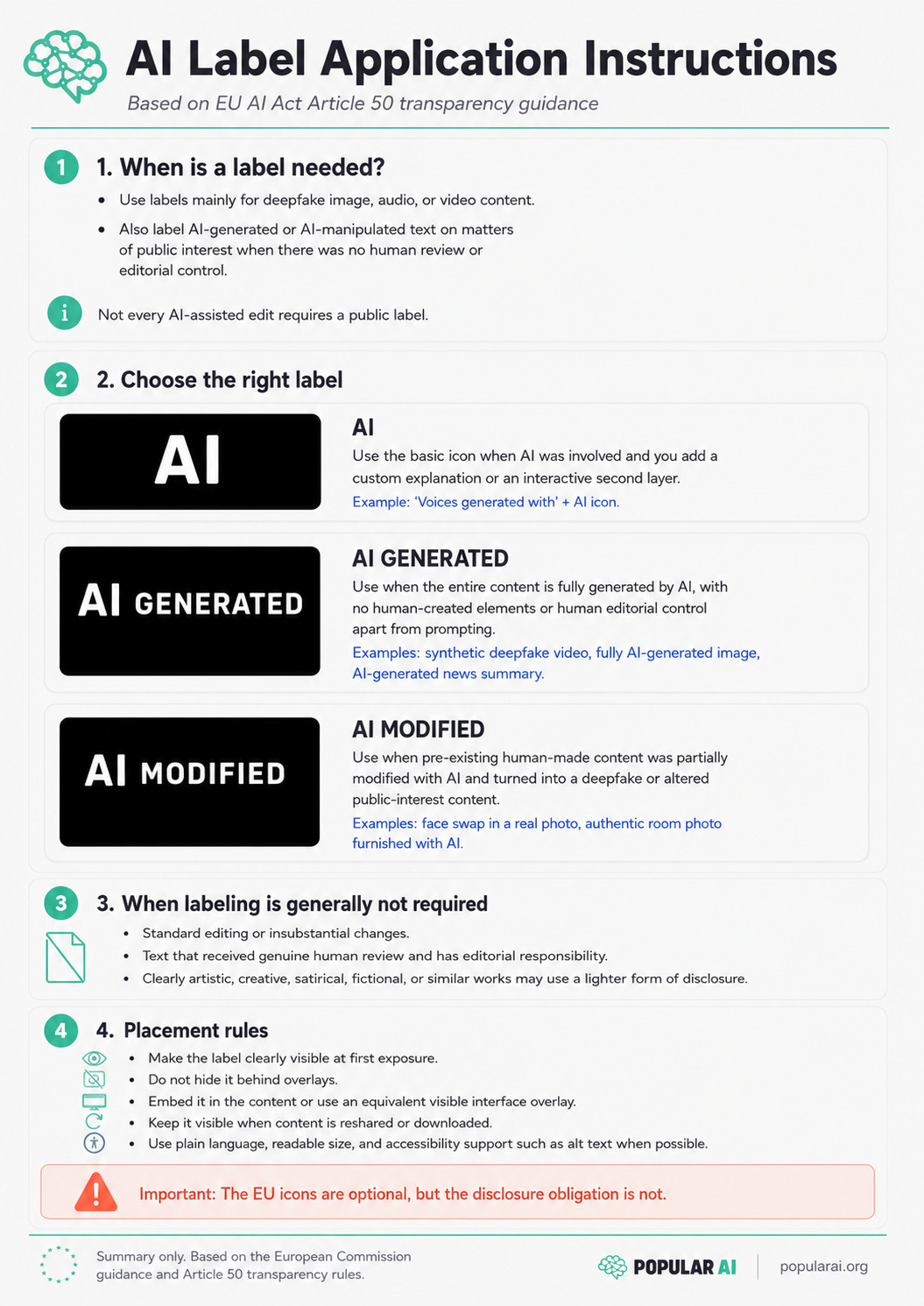
A practical Article 50 checklist
Creators, publishers and small businesses operating in the EU should prepare now.
1. Inventory every generative tool
Record which tools create or modify:
Text.
Images.
Audio.
Video.
Avatars.
Product photographs.
Advertising.
Articles.
Music.
Social posts.
Separate internal uses from material that reaches the public.
2. Identify your legal role
Ask whether you are:
A provider supplying an AI system.
A professional deployer using another company’s system.
Both.
A private person acting purely outside professional activity.
Do not assume that being a solo creator means personal use. Monetization, client work and business promotion point toward professional deployment.
3. Classify each public asset
For images, audio and video, ask:
Does it resemble a real person, object, place, entity or event?
Could an ordinary viewer mistake it for authentic material?
Was the change substantive?
Is it evidently fictional, satirical or creative?
For text, ask:
Is it meant to inform the public about a public-interest matter?
Did a human meaningfully review it?
Has someone accepted editorial responsibility?
4. Preserve provenance data
Where a provider adds Content Credentials, metadata or another machine-readable mark, avoid stripping it unnecessarily.
Keep:
Original files.
Exported versions.
Creation dates.
Tool and model information.
Edit histories.
Screenshots of settings.
Publication dates.
This is especially useful when relying on the pre-August 2026 exclusion for older content.
5. Create a reusable disclosure system
Prepare disclosures for each format:
Persistent image icon.
Video opening disclosure.
Recurring video indicator where appropriate.
Audible audio disclosure.
Article header or byline note.
Profile-biography explanation.
Accessible alt text.
Use language that tells the truth without making broader claims than necessary. “AI-modified background” conveys more information than a generic warning that the whole work is “AI-generated.”
6. Document human editorial review
For public-interest text, record the reviewer, sources checked, material edits and final approval.
The exemption depends on real editorial responsibility, not the mere presence of a human somewhere in the workflow.
7. Review platform behavior
Test whether Instagram, YouTube, TikTok, X, Substack, WordPress and other publishing systems preserve:
Embedded credentials.
Visible labels.
Alt text.
Captions.
Downloaded disclosures.
Do not assume that a compliant source file remains compliant after platform processing.
8. Monitor the final Commission guidelines
The final guidelines are expected before August 2, 2026. They may materially affect interpretations of standard editing, public-interest text, deployer status and practical labeling. The Commission’s Article 50 draft-guidance page should remain on every compliance watchlist.
This article reflects the law and published guidance available on July 13, 2026.
Who gains from this system
The most immediate beneficiaries are compliance consultants, provenance-technology vendors, large platforms able to build detection systems, publishers with established review and recordkeeping procedures, production companies that can substitute conventional labor for AI, and incumbents able to treat regulatory overhead as a routine operating expense.
Those most disadvantaged are independent creators, freelancers, small publishers, local retailers, small advertising agencies, artists experimenting with mixed workflows, businesses without in-house legal staff, and creators publishing across platforms that handle metadata inconsistently.
Considering the real-world consequences of this regulation, it really does look like yet another EU crackdown on the free flow of information. Compliance costs and the stigma attached to disclosure labels will be easier for established companies to absorb, while smaller publishers and independent content creators will be burdened with largely useless administrative work.
These smaller operators will also face greater legal risk if they fail to meet the same compliance standards that billion-dollar media corporations can afford to implement. The regulation could make participation on character-limited social media platforms especially difficult, since creators may be forced to sacrifice a significant portion of their character allowance to AI disclosures.
It is also worth asking whether the people complaining about AI-generated images will actually be more satisfied when their feeds are additionally cluttered with unattractive disclosure labels and layers of provenance information.
The European Union says it wants to promote innovation while reducing administrative burdens. Yet the current system appears to benefit select generative AI providers that join an approved compliance structure, while independent alternatives and users may be subjected to case-by-case scrutiny, vague standards that are likely to be applied unevenly, and repeated requests for additional information.
As it stands, the EU AI Act’s supposedly neutral transparency rules look less like impartial regulation and more like a competitive advantage for a small, select group of players in the information and media sector.
A better rule would target deception
A defensible synthetic-media law should ask questions such as:
Does the content materially misrepresent a real person, product, place or event?
Is it likely to deceive a reasonable viewer?
Is the deception relevant to a purchase, vote, reputation, consent or legal decision?
Was the publisher reckless or intentional?
Did anyone suffer or face a concrete risk of harm?
Would the same conduct be lawful if performed with CGI, editing, impersonation or human labor?
The technology used can matter as evidence of ill intent, but it should not automatically determine the legal category. A fake bank call should be illegal because it is fraud, whether the voice came from AI, an impersonator, or a recording.
A fabricated sexual image should be prohibited because it violates consent and dignity, whether it was produced by a diffusion model or manual compositing. Popular AI’s analysis of the UK’s targeted intimate-deepfake law shows how legislation can begin with a specific harm rather than a general suspicion of AI production. Its examination of the law’s protections and detection risks also shows why targeted prohibitions still require careful scrutiny of enforcement methods.
A truthful article should be judged by its claims, evidence, and editorial responsibility. The software used to help draft it does not determine whether it is misleading.
More on AI deepfake regulations:

FAQ
Do I need to label every image edited with AI?
No. Standard editing and changes that do not substantially alter the input or its meaning are recognized exceptions to the provider marking rule. A professional deployer needs a visible disclosure when the result qualifies as a deepfake.
Materially adding, removing or changing real-world elements creates more risk than correcting exposure, noise or artifacts.
Does an AI-generated business avatar need a label?
A photorealistic avatar that appears to be a real person may qualify, particularly when used professionally. A clearly fictional or stylized character is less likely to meet the deepfake definition.
For an in-scope avatar, the safest disclosure is one that accompanies the image at first exposure rather than appearing only on a profile page that viewers may never open.
Must old AI-generated posts be updated?
No, provided the output was generated and already made available before August 2, 2026. The Commission’s transparency-code FAQ says those outputs do not need retrospective labels.
Keep records of original creation and publication dates.
Is failure to label AI content a crime?
Not automatically. Article 50 is enforced through the AI Act’s administrative compliance regime. Violations can attract major fines, but that is different from creating a general criminal offense.
Separate national laws may apply to fraud, defamation, intimate imagery or other conduct.
Does a human editor eliminate the label requirement for articles?
For public-interest text, the deployer disclosure does not apply when the material has undergone human review or editorial control and a person or organization assumes editorial responsibility.
The review should be substantive and documented.
Must a private person label an AI meme?
A person acting solely in a personal, nonprofessional capacity is excluded from the definition of deployer. The AI system provider may still have machine-readable marking duties.
A professional creator, publisher or business using the same content may be treated differently.
Do all Suno songs need visible AI labels?
The law does not clearly support treating every generic AI-generated track identically. A recording that falsely appears to feature a real performer is a much clearer deepfake case.
Creative works receive a flexible disclosure regime, and the final Commission guidelines may further clarify how synthetic music is treated.
Can the disclosure appear only in a caption?
That may not always satisfy the recommended approach. The Commission’s code favors disclosure at first exposure, embedded in the content or delivered through an equivalent interface layer.
A caption that disappears when the file is downloaded or reshared may be less reliable.
Why the EU AI Act may produce more clutter than truth
The EU AI Act’s labeling requirement is, at least nominally, more limited than its most alarmist interpretations suggest.
It does not appear to require the visible labeling of every instance of AI involvement. It excludes purely personal use, recognizes standard editing practices, protects meaningfully reviewed public-interest text, and allows flexibility for obviously creative works. Failure to comply is not automatically a criminal offense.
That does not make the policy benign.
Article 50 creates a new legal distinction between AI-assisted media and functionally similar media produced using older methods. It attaches warning signals to one production process while leaving ghostwriting, conventional CGI, commissioned influence, manual compositing, and other forms of manufactured media outside its provenance regime.
The rule will be easiest for organizations that can hire compliance staff, maintain audit trails, and replace AI with paid human production, or at least become very good at creating the appearance of doing so. The same rule may force small publishers and businesses to choose among reduced efficiency, legal uncertainty, and an official label that some consumers will interpret as meaning “fake.”
The use of AI does not prove that content is inauthentic. The absence of AI does not prove that content is real.
A law that confuses those two questions will produce plenty of labels, but it will most certainly not produce more truth.
Explore more from Popular AI:
Start here | Local AI | Fixes & guides | Builds & gear | Popular AI podcast
Should AI-generated content be labeled because of how it was made, or only when it could genuinely deceive someone?