


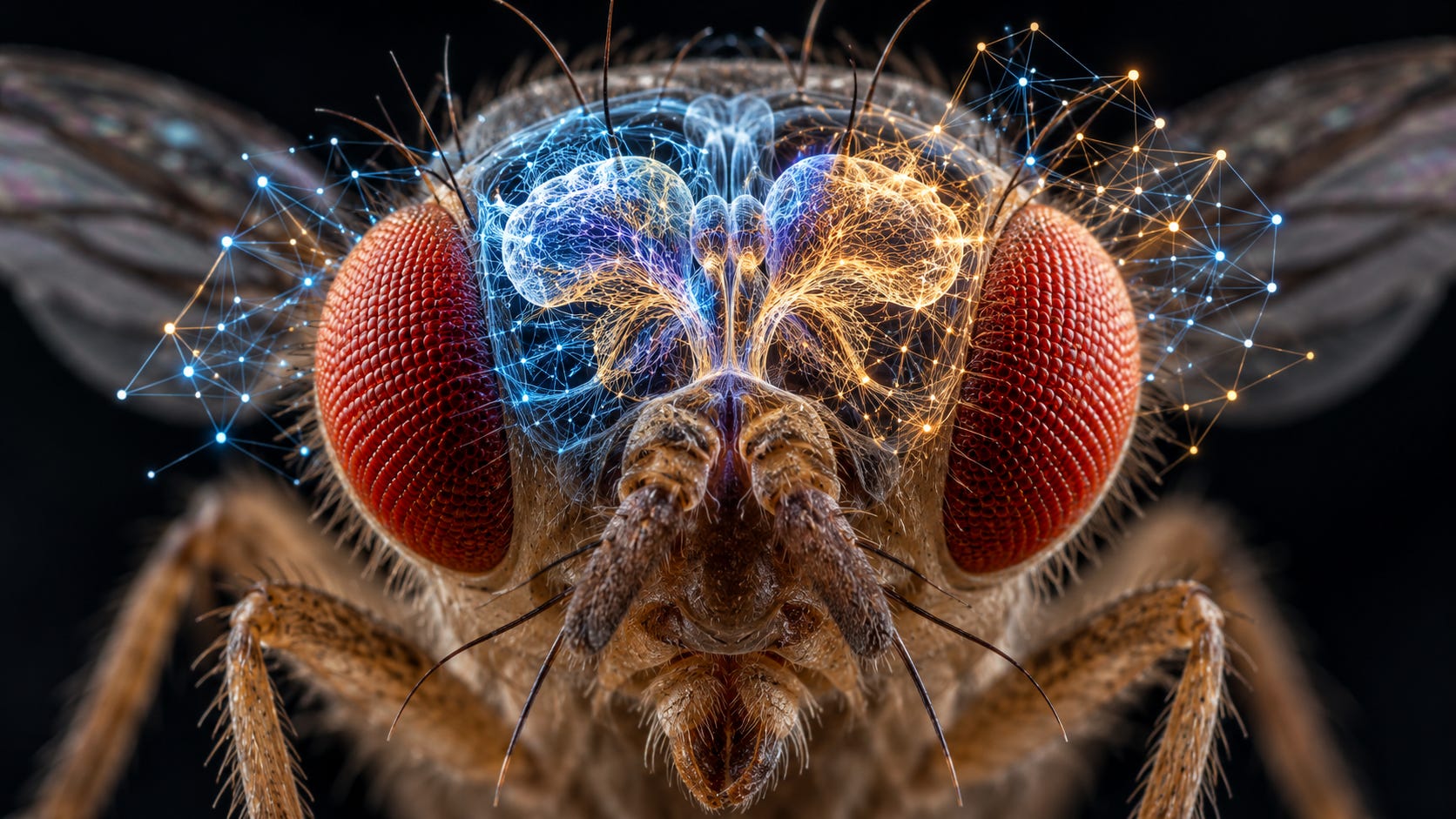
The viral fruit fly brain AI story sounds like an extremely online joke: researchers map a fly’s nervous system, publish the data, and developers quickly have it playing Doom and Minecraft, swinging at Beat Saber blocks, parallel parking, trading Bitcoin, and doing whatever else somebody can wire to a neural output.
But the meme is real, and the experiment underneath it is even more interesting.
Researchers used AI and large-scale computing to help reconstruct the complete central nervous system of an adult male fruit fly at synaptic resolution. They then released the MaleCNS connectome openly. The resulting dataset gives AI builders access to a biological neural architecture containing about 166,700 neurons and their measured connections, ready to be turned into computational networks, modified, benchmarked, damaged, rewired, and compared with artificial designs.


Doom is the fun part. The harder question is whether evolution has already discovered useful network structures that AI researchers can exploit.
Key takeaways
MaleCNS is an openly available wiring map of the complete male fruit fly central nervous system, including the brain, optic lobes, and ventral nerve cord. The finished Cell paper reports 166,700 neurons and 11,710 neuron types.
AI helped create the connectome. Google says AI and computing helped reconstruct the neural map from microscopy and classify more than 166,000 neurons. Human experts then proofread and annotated the reconstruction.
The downloadable connectome is biological network architecture, not a ready-made trained AI model. Developers still choose neuron dynamics, inputs, outputs, learning rules, and the interfaces that connect the measured wiring to an outside task.
The viral Doom, Minecraft, Beat Saber, and Bitcoin projects do use the fly connectome in different ways, but the interface between the fly wiring and the task is engineered by the developer. Those projects span games, driving, trading, and other experiments, so the wrapper around the connectome changes what each demo actually demonstrates.
The serious AI comparisons have started. An October 2026 preprint found that MaleCNS topology beat degree-preserving rewired controls on two artificial cognitive tasks, while another study found no consistent advantage from real fly wiring for a hashing task. Biology may contain useful architectural biases. It has not casually demolished the transformer.
What researchers actually released
The project comes from HHMI Janelia, Google Research, the University of Cambridge, and the MRC Laboratory of Molecular Biology. MaleCNS v1.0 was released on June 8, 2026, and the completed research paper appeared in Cell on September 3, 2026. The paper brought the project much wider attention, followed by a burst of online experiments.
The result is a connectome, a reconstruction of which neurons connect to which other neurons.
For an AI programmer, a useful mental model is an enormous directed graph. Neurons become nodes. Synaptic relationships become edges. Connection strength can be derived from measured synaptic contacts. The project also provides cell classifications, predicted neurotransmitters, neuron geometry, and other annotations.
That combination makes MaleCNS unusually hackable.
The official download page offers the full connection graph as a 1.1 GB file, plus a 13 MB annotation file, a 42 MB neurotransmitter file, skeletons, and a 12.7 GB synapse-point table. The project also exposes the connectome through neuPrint for interactive and programmatic queries. The dataset is licensed under CC BY.
You can therefore download the wiring of an actual animal nervous system and start writing software around it.
That remains a rather unusual sentence.
AI was involved before anybody made the fly play Doom
The internet version of this story can make the process sound as though scientists scanned a fly, pressed a button, and received fly_brain.exe.
The real pipeline has several layers.
Researchers imaged the nervous system at enormous resolution using electron microscopy. Automated systems helped reconstruct neuronal structures from the resulting image data. Human experts then proofread, classified, and annotated the reconstruction rather than treating machine output as finished biology.
AI therefore enters the story before any viral demo. Machine learning helped convert a massive microscopy dataset into structured neural data that scientists could inspect and use.
It enters again when developers take that structural data and choose equations that make neurons fire, propagate signals, and interact inside software.
Now a third layer has appeared. Researchers are asking whether the fly’s evolved wiring can act as the architecture of an artificial network trained on tasks no fruit fly ever encountered.
That is the part AI researchers should watch.
How a wiring diagram becomes a working brain simulation
MaleCNS tells you a great deal about anatomy. It does not specify every equation required to simulate a living nervous system.
A developer still has to decide how simulated neurons accumulate input, when they fire, how synapse counts become computational weights, how excitatory and inhibitory effects work, whether connections can change, what sensory neurons receive from an outside environment, and which neural activity becomes an action.
Those choices can dominate the behavior of the finished system.
One established approach is the leaky integrate-and-fire model, a relatively simple form of spiking neural network. Before MaleCNS became an internet celebrity, researchers had already used this approach with an earlier fruit fly connectome. A 2024 Nature paper built a whole-brain computational fly model from neural connectivity and neurotransmitter identity. The model predicted parts of feeding and grooming circuitry, and researchers tested some of those predictions experimentally in real flies.
So running a connectome as a computational model is serious neuroscience. The viral 2026 demos did not invent that idea.
What changed with MaleCNS is the scale, completeness, accessibility, and number of programmers willing to attach the network to a new problem and see what happens.
Yes, people really are putting the fly into everything
The September wave moved quickly. Developers connected MaleCNS-derived simulations to Minecraft, Doom, Beat Saber, driving, Bitcoin trading, and increasingly strange experiments.
The word playing needs some qualification because these projects are interface experiments as much as brain simulations.

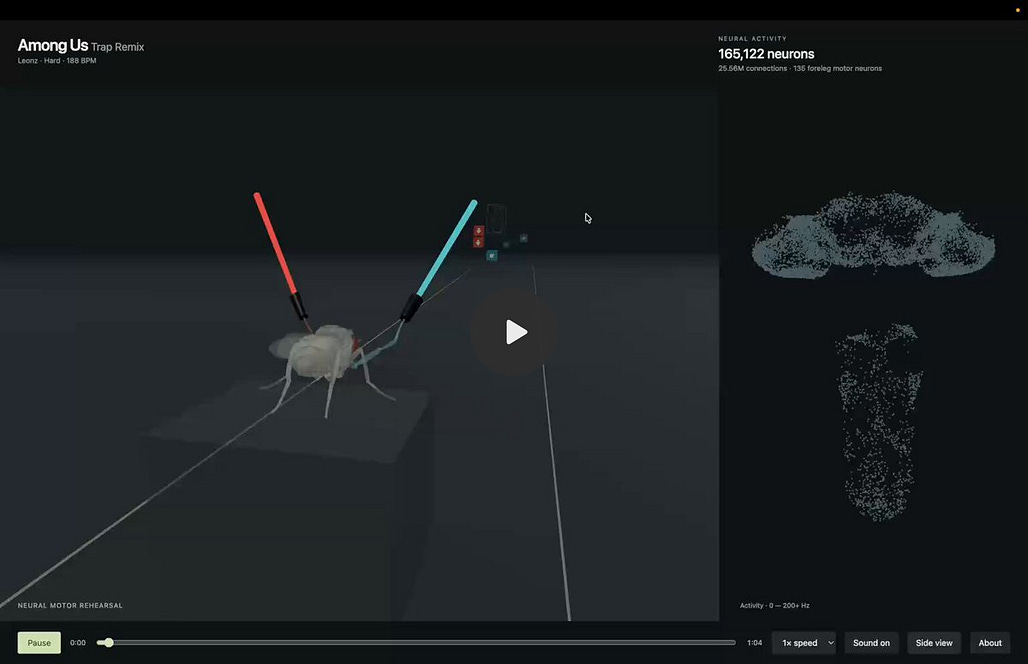
Take DoomFly. Its developer uses the MaleCNS wiring to run the neural simulation, but the eye mapping, neural dynamics, threat inputs, and game controller are explicit engineering choices. Visual information has to be converted into stimulation of selected fly neurons. Activity then propagates through the network. Other neural populations have to be translated into Doom controls.
That boundary between measured biology and designed software is central to interpreting the demo.
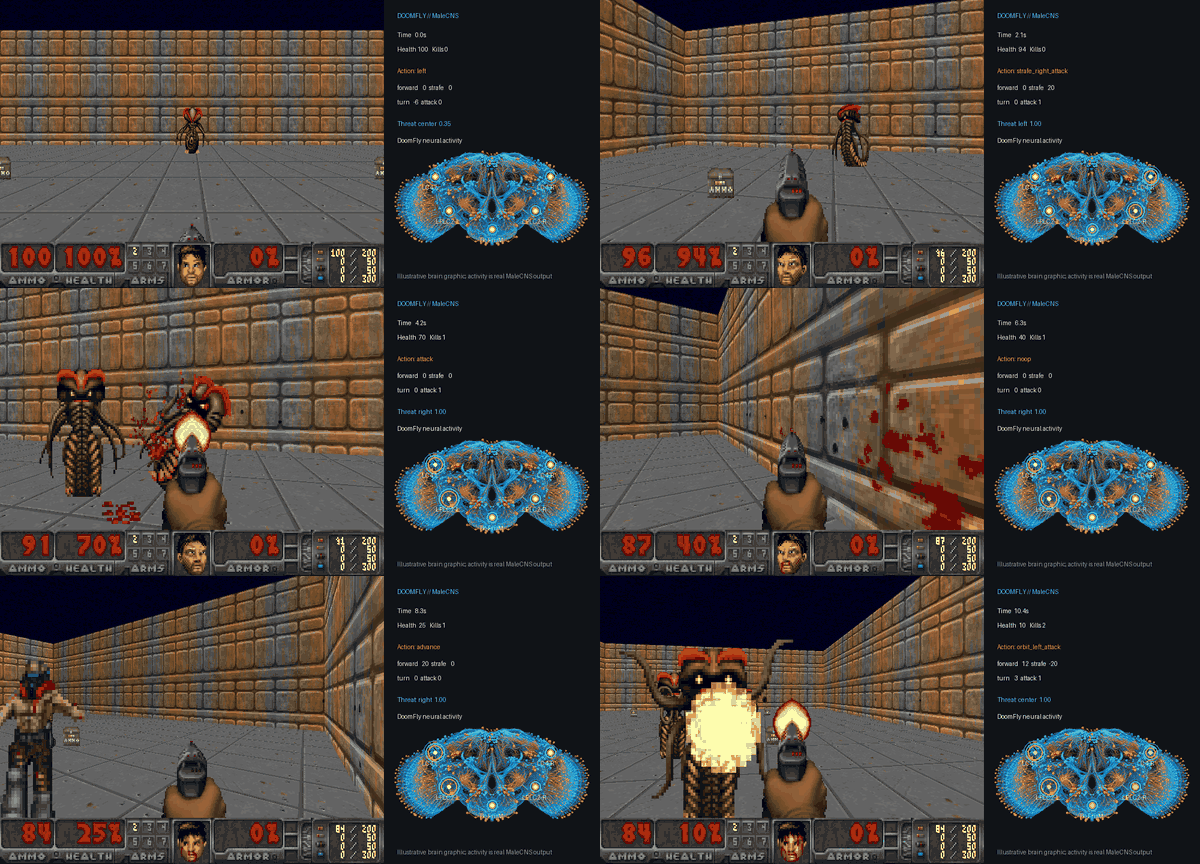
The connectome becomes a computational substrate between perception and action, but the developer decides how perception enters and how action leaves. Change those mappings and you can produce a different system while still using the same underlying MaleCNS graph.
A century of fruit fly neuroscience has therefore reached the inevitable endpoint: somebody gave the fly a Coinbase integration.
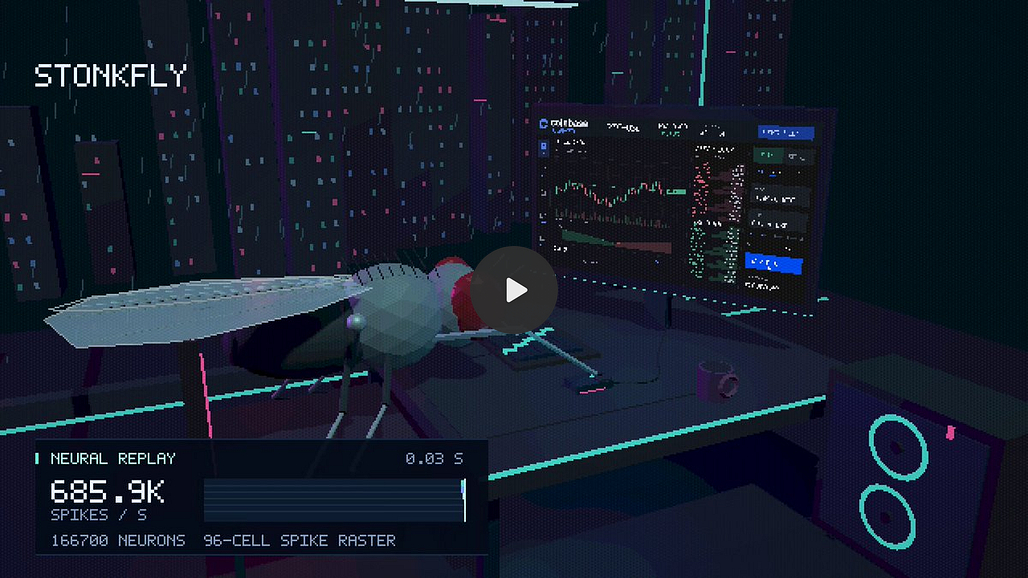
Stonkfly feeds visual representations of market charts into simulated photoreceptors, propagates activity through a MaleCNS-based network, and converts selected neural activity into buy, sell, or hold decisions. Positive and negative outcomes can stimulate dopamine-related populations under an experimental plasticity rule. Its documentation is careful about the result: profitable learning has not been demonstrated.
That caveat is more informative than the trading screenshot. The experiment is interesting because programmers can place a real biological wiring topology inside a completely alien sensorimotor loop, then inspect what the network does.
The fly has not secretly become a portfolio manager.

The big AI question is whether the fly’s wiring helps
The cleanest experiment is simple in principle.
Take the same artificial task, training procedure, input mapping, output mapping, number of neurons, and number of connections. Then replace the biological wiring with a randomized network that preserves important low-level statistics.
If the randomized network performs just as well, the surrounding software probably deserves most of the credit.
If the biological network repeatedly wins, the topology itself may be contributing something useful.
That gives researchers a precise AI question: did evolution discover reusable network structure?
A community experiment called fly-connectome-lm tried using MaleCNS as a token-in, token-out language model. The initial results were humbling. A conventional transformer performed substantially better, while the frozen fly network did not beat randomized controls. Later experiments that allowed more of the connectome-derived network to train improved the result and produced an advantage over a matched random graph in that setup, although the transformer remained stronger.
That comparison tells us much more than a video of the fly surviving a game.
Then, on October 7, 2026, researchers at KAIST posted a preprint explicitly testing whether MaleCNS topology could help on artificial cognitive tasks. They fixed the fly connectome as the recurrent architecture and trained one scalar value for every anatomical edge.
On a bounded addition task, the biological graph reached 92.77% mean held-out accuracy, versus 67.93% for degree-preserving rewired networks. On a controlled grounded-language task built around a 100-word vocabulary, MaleCNS reached 61.59% on the strict evaluation, versus 44.17% for matched rewires.
The authors describe that difference as an inductive bias. In machine learning, an inductive bias is structure that makes some solutions easier for a network to learn.
That is a much more useful claim than saying a fly brain can “do language.” The task is synthetic, the vocabulary is controlled, and the network is trained for that setup. The interesting result is that preserving the measured topology helped relative to carefully rewired controls.
Copying what a fly knows may be irrelevant. Copying how evolution wired the fly could still be useful.
The controls are already producing inconvenient results
Good experiments should make the story harder, not cleaner.
Another October preprint tested a well-known “fly hashing” idea against several electron-microscopy connectomes, including MaleCNS. In those experiments, the measured biological pairing produced no consistent retrieval advantage over degree-preserving randomized wiring.
We therefore have one recent study reporting that higher-order MaleCNS structure helps on bounded addition and grounded relational language, and another finding no consistent benefit from real connectome wiring for a specific information-retrieval scheme.
Excellent. That is a research program, not a slogan.
There is no reason evolution should have optimized a fruit fly nervous system for every arbitrary computer-science benchmark. Fruit flies had more immediate problems involving food, predators, navigation, mating, and the continued existence of fruit flies.
The more likely possibility is narrower and more testable: biological networks may contain recurring computational motifs that work well under particular sparse, recurrent, sensory, memory, navigation, or continual-learning workloads.
MaleCNS turns that idea into something researchers can measure instead of merely admire.
The control every viral fly demo should face
Whenever another “fly learns X” video appears, add one question:
What happens if you replace the fly wiring with a matched rewired graph?
A good control preserves basic statistical properties such as neuron count and each neuron’s number of incoming and outgoing connections while destroying the specific biological arrangement.
Then run the same interface, training budget, input mapping, output mapping, and evaluation.
If both networks perform similarly, the surrounding software probably deserves most of the credit.
If the MaleCNS network repeatedly wins across random seeds, tasks, and alternative interfaces, you have evidence that its topology contributes something.
A September review of early viral projects found that many splashy digital-fly demos still lacked strong wiring controls. The October academic work is beginning to close that gap.
That progression is more interesting than treating every videogame clip as proof of a digital mind. The strongest result will come from a boring-looking benchmark where the biological graph keeps beating well-designed controls.
You can run the fly brain yourself
You do not necessarily need an AI workstation.
The official MaleCNS project lets you explore individual neurons and connectivity through browser-based tools or download the raw data for local analysis. The full flat connection graph is about 1.1 GB. Programmatic neuPrint access requires an account and token, while the bulk files are available from the project’s download infrastructure.
Community projects push local execution further. GFly, for example, compiles a filtered MaleCNS graph into about 21.7 MB of browser assets and runs roughly 164,740 neurons with 6.2 million connections as a leaky integrate-and-fire simulation in JavaScript. It uses no backend, API key, or inference server.
That makes MaleCNS an unusually accessible form of experimental local AI. There are no proprietary inference credits to buy and no hosted model API deciding when an experiment ends.
For the broader difference between downloadable models and hosted services, Popular AI’s open-source LLMs and local models guide covers the practical tradeoffs around running models yourself. The local AI hub covers local runtimes, hardware, privacy, APIs, and hybrid setups for more conventional AI workloads.
MaleCNS takes the same control idea somewhere stranger. Instead of downloading weights learned by a transformer, you are downloading a structure discovered by evolution and reconstructed from a dead fly.
More on local AI:


MaleCNS is not a tiny biological LLM
Treating MaleCNS as a miniature LLM creates more confusion than insight.
An LLM arrives with an architecture plus enormous numbers of learned parameters shaped by training on text. MaleCNS provides biological connectivity, anatomical labels, synaptic information, and related predictions. A computational simulation still needs chosen dynamics and an interface to whatever task the developer wants to run.
That is why two MaleCNS projects can behave completely differently while both legitimately use the same connectome.

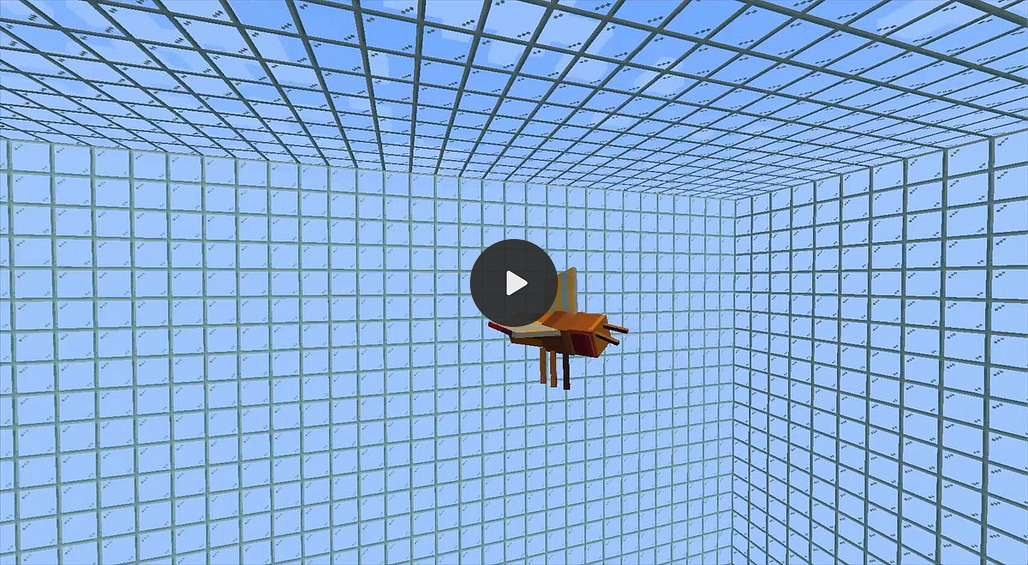

One developer can turn game frames into retinal stimulation. Another can map a price chart onto photoreceptors. A researcher can train values on anatomical edges for a language experiment. Somebody else can remove neurons, delete synapses, and study how network activity changes.
That last example is already happening. An October 13 preprint simulated pathology-like neuron and synapse damage in a 166,700-neuron MaleCNS-based integrate-and-fire model, using the connectome to study how different damage patterns changed activity.
The connectome is becoming shared computational infrastructure.
The software around it still matters enormously. Different simulations can use different firing rules, thresholds, weight mappings, signs, plasticity rules, sensors, and readouts. A result from one implementation should not automatically be treated as a property of MaleCNS itself.
That is why the best experiments keep returning to controls.
Biological architecture search is now a real experiment
AI researchers spend enormous effort designing architectures, sparsity patterns, memory mechanisms, recurrent loops, routing systems, and training tricks.
Nature has been searching the same architecture space for quite a bit longer.
That does not make every biological feature computationally optimal. Evolution optimizes organisms under constraints that GPU clusters do not share. Biological nervous systems care about energy, physical wiring distance, noisy signals, growth, damage, reproduction, and survival in real time. Transformers care rather less about being eaten.
MaleCNS still changes what researchers can test.
Instead of vaguely borrowing inspiration from biology, an experiment can import a measured topology. Researchers can train that graph on an artificial task, compare it with transformers or other artificial networks, scramble the graph while preserving degree, damage selected neurons, change interfaces, and measure which properties survive.
Performance is only one metric. Sample efficiency, energy use, robustness, memory, adaptability, and tolerance to neuron loss may reveal advantages that a simple accuracy leaderboard misses.
The critical step is attribution. If a MaleCNS-derived model does something impressive, researchers need to determine whether the useful part came from the biological topology, the chosen neuron equations, the input encoding, the output readout, the learning rule, or some interaction among them.
That sounds less dramatic than “fruit fly brain plays Doom.”
It is also how this turns into useful AI research.
What the fruit fly brain AI story actually shows
MaleCNS gave the internet something rare: an open, detailed biological neural architecture complex enough to support sophisticated animal behavior and accessible enough for ordinary programmers to experiment with.
AI helped scientists reconstruct that architecture from microscopy. Open data let developers turn the wiring into software. Viral projects then made the central research question impossible to miss: can biological topology perform useful computation outside the problems it evolved to solve?
The early answer is inconvenient in exactly the right way. Sometimes the real wiring appears to help. Sometimes randomized wiring works just as well. Conventional transformers can still beat connectome-based systems on tasks they were built for.
The next impressive MaleCNS demo is therefore not another fly attached to yet another meme-able, viral game.
It would be far more interesting to deliver a controlled experiment where the real connectome beats the same system after its wiring has been scrambled, then does it again under a different seed, interface, or task.
When that happens consistently, the meme about putting a fly brain into everything starts looking like a real architecture paper.
Explore more from Popular AI:
Start here | Local AI | Builds & gear | Autonomy & policy | Fixes & guides | Popular AI podcast
If a simulated fruit fly brain can control games and robots, what would convince you that we’re seeing real intelligence rather than clever engineering around the connectome?