


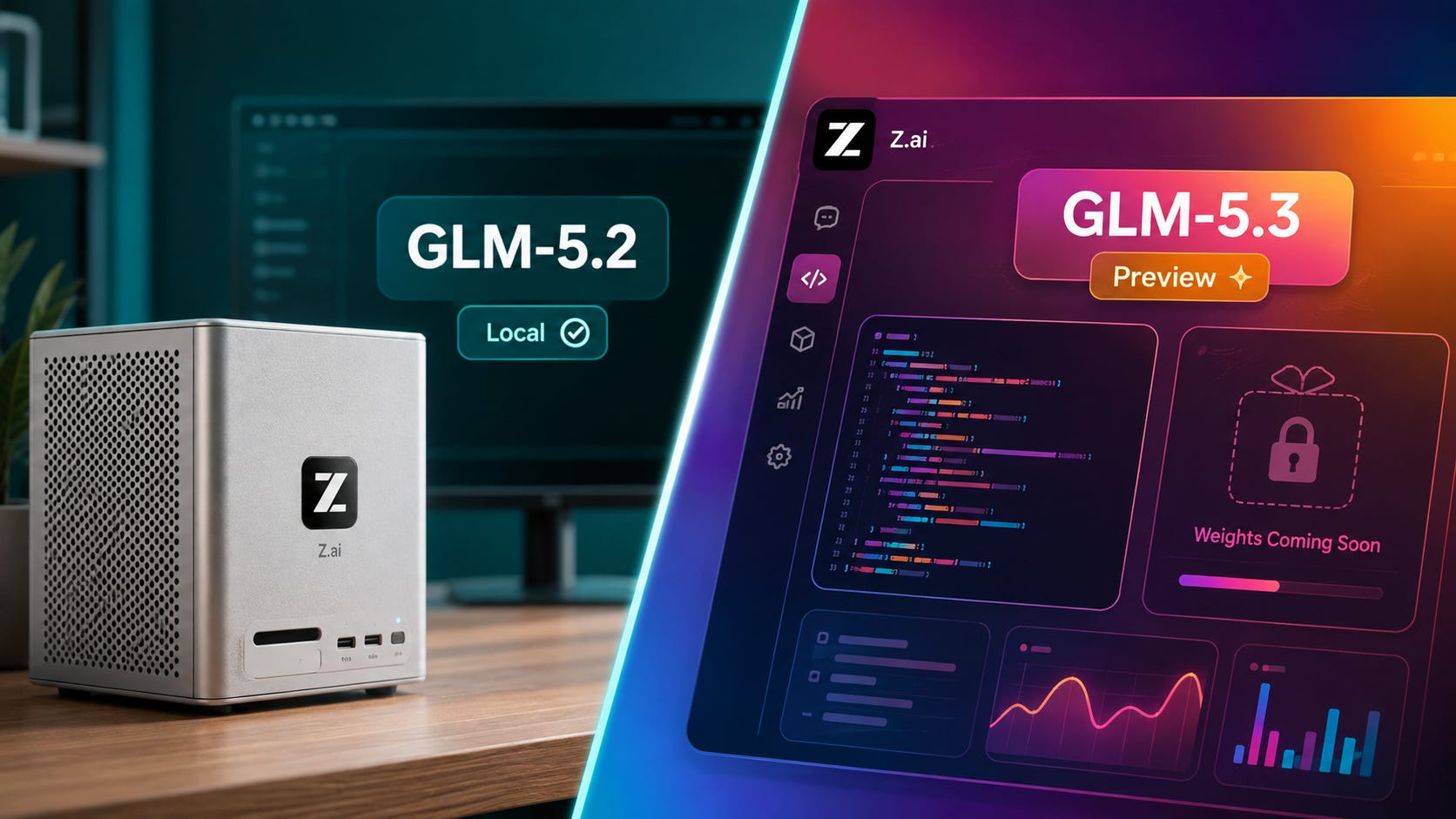
As of August 20, 2026, GLM-5.3’s weights are still unavailable for local use. Z.ai announced GLM-5.3 on August 14 and said it plans to release the weights about two weeks later, after additional security evaluation and hardening. For local AI users, the practical answer is straightforward: keep GLM-5.2 or another proven model in production, test hosted GLM-5.3 if its coding gains matter to you, and do not buy hardware for GLM-5.3 yet.
The missing weights leave too many expensive questions unanswered. There is still no GLM-5.3 model repository to inspect for downloadable file sizes, an explicit model license, official quantizations, serving recipes, or real local inference results. Z.ai says GLM-5.3 uses the same base model as GLM-5.2, which gives us a useful reference point. It still does not give local users a deployment specification.
That distinction matters because the interesting part of GLM-5.3 is already testable through hosted access, while the part that determines whether it belongs in a local AI stack is still missing. The model may be compelling as a coding-agent upgrade. It is not yet a defensible reason to rebuild a server.
Key takeaways
Keep GLM-5.2 running if your local setup already works. There is no reason to destabilize a working deployment for weights you cannot download yet.
Test hosted GLM-5.3 if coding is your priority. Z.ai reports large improvements on coding and long-horizon agent benchmarks, although those results are still developer-reported.
Do not buy GPUs for GLM-5.3 yet. The release does not provide the practical artifacts needed to calculate a sensible local build.
Expect GLM-5.3 to remain enormous. Z.ai says it uses the same base model as GLM-5.2, whose official Hugging Face page lists 753 billion parameters.
Revisit the decision when the weights arrive. That is when the license, quantizations, storage footprint, runtime compatibility, context behavior, and actual hardware requirements can be checked instead of guessed.
What Z.ai actually released
Z.ai announced GLM-5.3 as a coding and long-horizon agent upgrade built on the same base model as GLM-5.2. According to the company, every improvement comes from additional post-training rather than a new base-model pretraining run.


That makes GLM-5.3 unusually interesting even before local deployment enters the discussion. It is evidence that the behavior of a model family can change substantially without increasing the size of the base model. Z.ai says it expanded the number and diversity of reinforcement-learning environments, trained on harder long-horizon tasks, and spent more compute on that post-training process.
The result, according to Z.ai, is a model substantially better at coding, autonomous engineering work, and cybersecurity tasks. Those are meaningful targets for developers who already use GLM models for agents, because they are the kinds of workloads where a modest improvement in one-shot answers matters less than whether the model can preserve a goal through a longer sequence of tool use and code changes.
What Z.ai has not released is the part local AI users need most: the weights.
The company says the weights will be released two weeks after launch once safety evaluation and hardening are complete. That points to roughly August 28 if the schedule holds, although Z.ai did not make August 28 a guaranteed release date.


Reuters independently confirmed the staged release and reported that Z.ai plans to place some of the most sensitive cybersecurity functionality behind verified access. Reuters also emphasized that the reported security benchmark results had not been independently verified.
For local users, that staged release creates a clean separation between what can be evaluated now and what must wait. Hosted behavior can be tested. Local memory requirements, quantization quality, runner support, and real hardware performance cannot.
What actually changed from GLM-5.2
The strongest argument for testing GLM-5.3 now is coding.
Z.ai reports a 50% improvement over GLM-5.2 on its private Z.ai Code Bench. Because that benchmark is internal, outside users cannot independently reproduce the headline number today. The company also reports large improvements on named public benchmarks, which makes the pattern more useful than a single private score even though the runs still come from Z.ai.
Among the more striking changes:
Terminal-Bench 3.0: 4.6 to 28.3
DeepSWE v1.1: 46.2 to 66.9
FrontierSWE: 67.5 to 78.1
AutomationBench v1.0.6: 26.2 to 48.2
Agents’ Last Exam CLI: 23.8 to 28.5
Those are Z.ai’s runs, not independent Popular AI tests. The distinction matters because agent benchmarks are especially sensitive to the harness, time limits, context configuration, tool environment, and other evaluation choices around the model.


The cyber results attracted more attention. Z.ai reports GLM-5.3 improving from 77.2% to 84.5% on CyberGym and from 24.4% to 54.4% on ExploitBench. The latter still trails the 78% result Z.ai reported for Anthropic’s restricted Mythos 5. Reuters confirmed the reported figures while stressing that the results had not been independently verified.
The benchmark story is interesting. It still does not answer the local AI question.
A coding benchmark cannot tell you whether a particular quantization will fit your server, whether vLLM will support the release cleanly, whether AMD users will have a good path, or how many tokens per second your hardware will produce. Those are deployment questions, and the files needed to answer them are not public yet.
Can you run GLM-5.3 locally?
Not yet. Z.ai’s launch material says the GLM-5.3 weights will become publicly available about two weeks after launch. Until those files exist, there is no official local GLM-5.3 deployment to test.
We can still make one useful inference. GLM-5.3 uses the same base model as GLM-5.2, and the official GLM-5.2 repository lists that model at 753 billion parameters. GLM-5.2 also has an official FP8 release, a one-million-token context positioning, and an MIT license.
That is enough to say GLM-5.3 is unlikely to turn into an ordinary single-GPU desktop model. It is not enough to turn GLM-5.2’s known requirements into a GLM-5.3 hardware recommendation.
The actual 5.3 artifacts need to come first.
The release could arrive with different recommended precision formats, changes to serving configuration, new inference requirements, or different guidance around its post-trained behavior. Community quantizers may quickly produce GGUF, NVFP4, MXFP4, INT4, or other versions. Their quality and hardware tradeoffs cannot be evaluated before those builds exist.
License is another unanswered question. GLM-5.2 is explicitly MIT-licensed. Z.ai calls GLM-5.3 an open release and promises public weights, but the August 14 launch post does not provide a GLM-5.3 model repository with a license file.
Do not assume the GLM-5.2 license automatically carries over. Check the GLM-5.3 repository when it appears.
Why you should not buy hardware for GLM-5.3 yet
Hardware recommendations become risky when the model exists mainly as a benchmark table and a hosted endpoint.
A local deployment decision needs more than parameter count. You need to know the precision you intend to run, available quantizations, runtime overhead, KV-cache requirements, context target, tensor or expert parallelism, CPU offload options, storage needs, framework support, and the inference speed you consider acceptable.
At this model scale, small gaps in those details can completely change the practicality of a build. A machine that looks sensible from parameter count alone may become awkward once a serving stack, memory overhead, long context, or multi-node requirements enter the picture.
GLM users are already running into exactly these kinds of questions with the current family. One user in the official GLM Hugging Face community asked how to deploy GLM across two H200 nodes with eight GPUs each after hitting a pipeline-parallelism limitation. Another asked which ROCm/vLLM Docker environment works for AMD GPUs after the documented setup failed on AMD hardware.
Those reports do not prove GLM is universally difficult to run. They show why implementation details become the real problem once a model reaches this scale. GPU count alone does not guarantee that the software path you need will work cleanly.
That is why “same base model” is useful technical information and poor purchasing advice.
Popular AI’s earlier GLM-5.2 analysis reached much the same conclusion for the previous release: this family belongs much closer to serious server infrastructure than to the ordinary 24GB desktop-GPU world.
The broader local AI hardware buying guide makes the same workload-first case. If you are thinking about buying hardware specifically for GLM-5.3, wait for the weights and work backward from a deployment you can actually reproduce.
That means identifying the exact build you want to run, the runtime that supports it, the memory and storage footprint, the context you need, and the throughput you consider usable. Only then does a hardware recommendation become more than an expensive guess.
More on AI hardware for GLM-5.3:


Keep GLM-5.2 if you already run it locally
GLM-5.2 is the boring answer right now, which is exactly what you want from production infrastructure.
Its weights exist. Its MIT license exists. An official FP8 version exists. Community quantizations exist. Its deployment problems are discoverable rather than hypothetical.
If you have already done the work to get GLM-5.2 stable under vLLM, SGLang, another inference stack, or a custom multi-GPU deployment, replacing it before GLM-5.3 can even be downloaded gives you no operational benefit.
Keep the working 5.2 installation.
Then build a separate GLM-5.3 evaluation path when the new weights arrive. That lets you compare behavior without sacrificing a known-good environment before you know whether the local version is actually better for your workload.
This matters even more for production agents. A model change can affect tool use, reasoning length, output format, latency, token consumption, and how often an agent wanders away from the task. Z.ai has already changed one behavior explicitly: GLM-5.3 no longer supports disabling thinking and instead exposes low, high, and max reasoning-effort levels, with max recommended for coding.
That alone makes an in-place production swap a poor first test. A cleaner approach is to preserve the 5.2 path, run the same tasks through hosted 5.3 now, and repeat the comparison locally when the weights are available.
Hosted GLM-5.3 is worth testing now
Waiting for the weights does not mean ignoring GLM-5.3.

Z.ai says it has rolled GLM-5.3 out to all GLM Coding Plan users and supports it in ZCode and coding-agent workflows. The release also documents the glm-5.3 model identifier and the new reasoning-effort settings.
That creates a useful evaluation window before the local release. You can test whether the post-training gains matter on the exact work you care about without committing to a new server.
Take several real tasks that GLM-5.2 struggles with and run them against 5.3. Good candidates are repo-scale changes, multi-stage debugging, test-driven fixes, long-running refactors, and tasks where the agent needs to preserve a goal through many tool calls.
Do not evaluate it by asking for a clever function and admiring the first response. That tells you little about the long-horizon behavior Z.ai is emphasizing.
Measure completed work instead.
Record whether the tests pass, how often you intervene, how much code you repair afterward, how long the task takes, and whether the agent reaches the intended result. Popular AI’s AI API comparison guide explains why cost and capability should be measured per accepted task, especially for long-running agents where retries and human repair can erase an apparent advantage.
If GLM-5.3 materially beats 5.2 on your workloads, you have a concrete reason to care about the weights when they arrive.
If it does not, the benchmark gap saved you no time. That is useful information too, because it can stop a model upgrade from becoming an infrastructure project without a measurable payoff.
More on local AI versus cloud AI:

Hosted 5.3 and local 5.3 are different trust decisions
There is another reason to avoid treating hosted access as a substitute for the eventual weights.
ZCode is a hosted product. Its current privacy policy says user content can include text, files, images, audio, video, and code, while the Optimization Program is off by default and requires an active opt-in before that content is used for product or model training and optimization.
Z.ai gives API customers a different data arrangement. Its current API Data Processing Addendum says customer and end-user content is processed in real time and is not saved on its servers, while other customer data can be temporarily stored where required to provide the service or comply with law.
Those are distinct hosted data-handling arrangements. They are more useful than pretending every GLM workflow has the same privacy model.
For sensitive repositories, local inference will still offer a fundamentally different control point once the weights arrive. You can control storage, logs, network access, model version, serving software, and whether the system remains connected to an external provider at all.
That control comes with the infrastructure burden. You are responsible for the runtime, hardware, updates, access controls, logging, and the operational decisions that a hosted provider otherwise absorbs.
The distinction between downloadable weights, local inference, licensing, and genuine control is covered in Popular AI’s broader guide to open-source LLMs for local AI and private use.
For developers deciding whether to test GLM-5.3 before the weights arrive, the practical question is therefore twofold. First, does hosted 5.3 actually improve your work? Second, if it does, is that improvement valuable enough to justify the local infrastructure once the artifacts exist?
More on open-source LLMs:

Who should use GLM-5.3 now
▪ Test hosted GLM-5.3 now if you are a developer already using GLM-5.2 for coding agents. You have the clearest comparison workload and can find out whether the post-training improvements survive contact with your repositories.
▪ Keep GLM-5.2 if you need local production inference. You can actually download, license, quantize, serve, and troubleshoot it today. That makes it the safer operational choice while 5.3 remains hosted-only.
▪ Wait if you are planning hardware around GLM-5.3. The information needed to make a defensible purchase does not exist yet. Parameter count is a clue. It is not a bill of materials.
▪ Wait if you require fully local or offline processing. Hosted access cannot satisfy that requirement regardless of model quality. The local decision begins when the weights and license can be inspected.
▪ Be particularly cautious if you are planning a large multi-GPU or AMD deployment. Existing GLM community questions already show that runtime and parallelism support can determine whether an otherwise suitable machine is useful at all.
This division is more practical than asking whether GLM-5.3 is simply “better.” It may already be better for a hosted coding workflow and still be the wrong choice for a local production system today.
What to check when the GLM-5.3 weights arrive
The next meaningful update to this page should focus much less on benchmark scores and much more on files.
The release becomes actionable for local AI when we can verify the model repository, license, model configuration, full-precision and reduced-precision sizes, official serving instructions, supported vLLM and SGLang versions, quantizations, VRAM and system-RAM requirements, storage footprint, AMD support, multi-node behavior, and performance on real hardware.
Those details will answer the questions that a hosted benchmark cannot. They will show whether local 5.3 can be served with existing GLM infrastructure, whether a new runtime path is required, whether community builds reduce memory far enough to change the audience for the model, and whether the performance remains usable after compression.
The biggest question will be whether community quantizations preserve enough of GLM-5.3’s post-training gains to make upgrading worthwhile.
That cannot be answered from the hosted model.
Quantization is especially important here because the attraction of GLM-5.3 is improved behavior from the same base-model foundation. If aggressive compression disproportionately damages the agent behavior that distinguishes 5.3 from 5.2, a smaller file will not automatically make it a better local model.
This is also the point where local hardware advice can become concrete. Once real quantization data exists, readers can compare the model’s memory demands with the hardware they already own and decide whether a server-class deployment, a heavily quantized experiment, or continued hosted use makes the most sense.
Until then, the responsible approach is to collect evidence on model quality without pretending the local deployment details are known.
GLM-5.3 is worth testing now, but the hardware can wait
Do not wait for GLM-5.3 by putting your current local setup on hold. Keep using GLM-5.2.
Test hosted 5.3 now if its coding improvements could save you real work. That gives you evidence from your own repositories without committing to new infrastructure.
Keep the comparison controlled. Give both models the same repo state, task, success criteria, and time budget. Measure whether the work is accepted, how much intervention it takes, and whether the result is better enough to justify another deployment path.
Do not buy GPUs, redesign a server, or abandon a stable GLM-5.2 deployment because Z.ai published stronger benchmark numbers.
GLM-5.3 becomes a local AI buying decision when the weights, license, quantizations, runner support, and real hardware results exist. Until then, the model is worth evaluating through the access that exists today.
The benchmark is interesting. The hardware invoice can wait.
FAQ
Are the GLM-5.3 weights available?
No. As of August 20, 2026, Z.ai says the weights will become publicly available about two weeks after the August 14 launch, following additional security evaluation and hardening.
When will GLM-5.3 weights be released?
Z.ai said two weeks after launch. That points to roughly August 28, 2026 if the schedule holds, but the company has not guaranteed that exact date.
Should I use GLM-5.2 or GLM-5.3?
Use GLM-5.2 if you need downloadable weights and a proven local deployment today. Test hosted GLM-5.3 if you want to evaluate Z.ai’s claimed coding improvements before the local release. The cleaner comparison is to keep 5.2 stable while evaluating 5.3 separately.
How much VRAM will GLM-5.3 need?
There is no verified GLM-5.3 local VRAM recommendation yet. Z.ai says it uses the same base model as GLM-5.2, whose official repository lists 753 billion parameters, so the full model remains in the server-class category. Wait for the actual 5.3 artifacts and quantizations before sizing hardware.
Will GLM-5.3 use the MIT license?
That has not been confirmed in a public GLM-5.3 model repository as of August 20. GLM-5.2 uses MIT, but users should check the actual GLM-5.3 license when its weights appear rather than assuming the terms will be identical.
Is GLM-5.3 better than GLM-5.2 for coding?
Z.ai’s benchmarks say yes, sometimes by a large margin. Those results are developer-reported. Test both models on the same repositories and acceptance criteria before changing a production workflow.
Explore more from Popular AI:
Start here | Local AI | Builds & gear | Autonomy & policy | Fixes & guides | Popular AI podcast
Are you waiting for GLM-5.3 weights, or sticking with GLM-5.2 until the local AI deployment picture is clearer?