


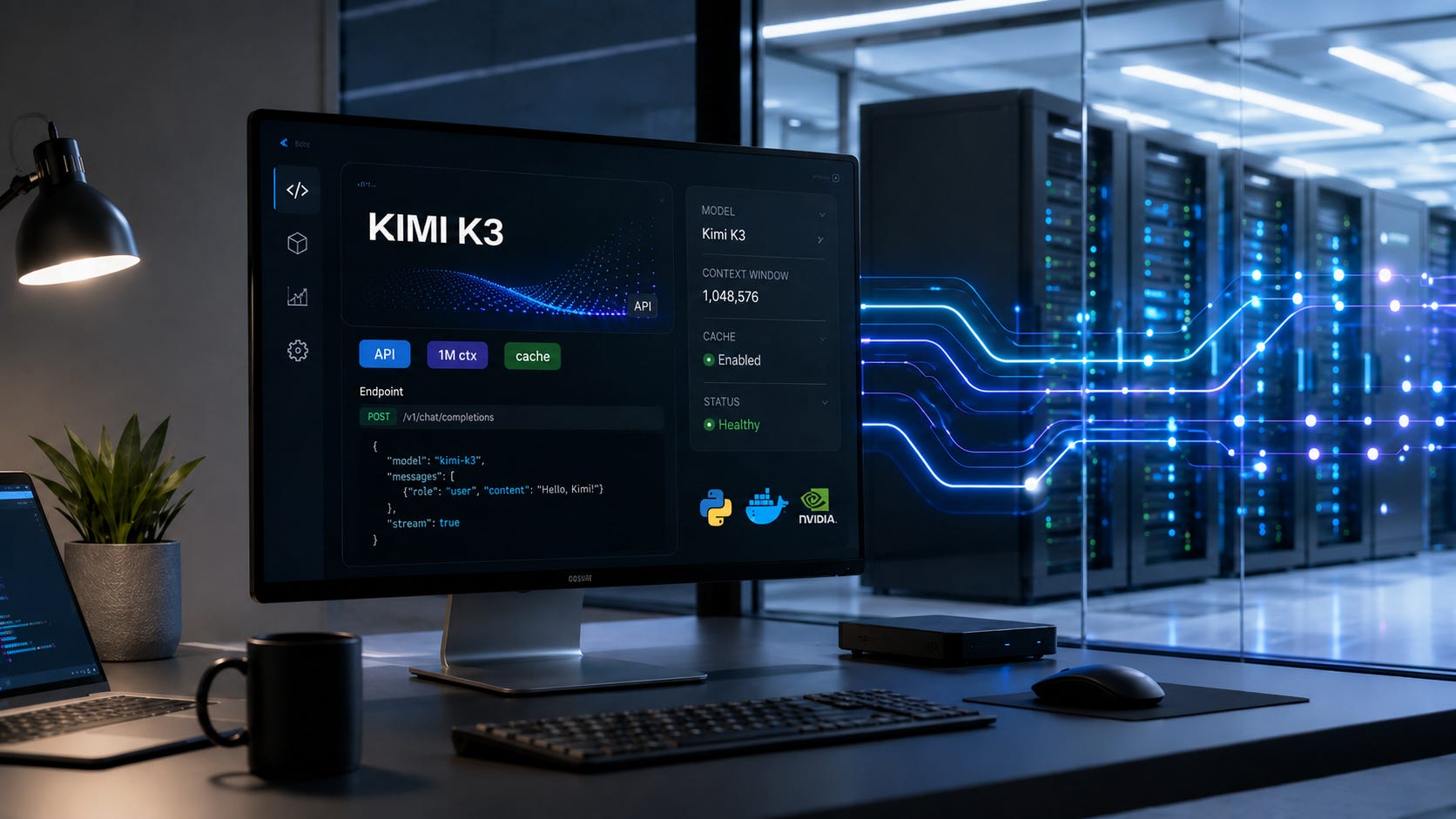
Kimi K3 is the kind of open-weight model that makes a 24GB GPU look like a rounding error. Moonshot AI’s new mixture-of-experts model has 2.8 trillion total parameters, native vision, and a one-million-token context window. It is already available through hosted Kimi products and the company’s API, with the full weights promised by July 27, 2026.
That does not mean you should prepare a desktop download.
For nearly every developer, the practical route is to test Kimi K3 through the API. Local AI users should wait for smaller descendants, distillations, reduced-expert variants, or aggressive community conversions. Renting enough tightly connected hardware to serve the complete model makes sense only for research labs, inference companies, infrastructure teams, and large organizations evaluating a serious private deployment.
Kimi K3 matters because it pushes open-weight AI toward the frontier. It also exposes an increasingly important distinction. A model can offer downloadable weights while remaining completely impractical for personal hardware.
More on local AI models:

Kimi K3 for local AI: key takeaways
Quick verdict: You almost certainly cannot run the full Kimi K3 model on a normal local AI PC, workstation, or home server.
Model scale: Kimi K3 has 2.8 trillion total parameters, 896 experts, 16 experts selected per token, native visual input, and a one-million-token context window.
Hardware reality: Moonshot recommends supernode configurations with 64 or more accelerators, which places K3 in data-center territory rather than the consumer GPU market.
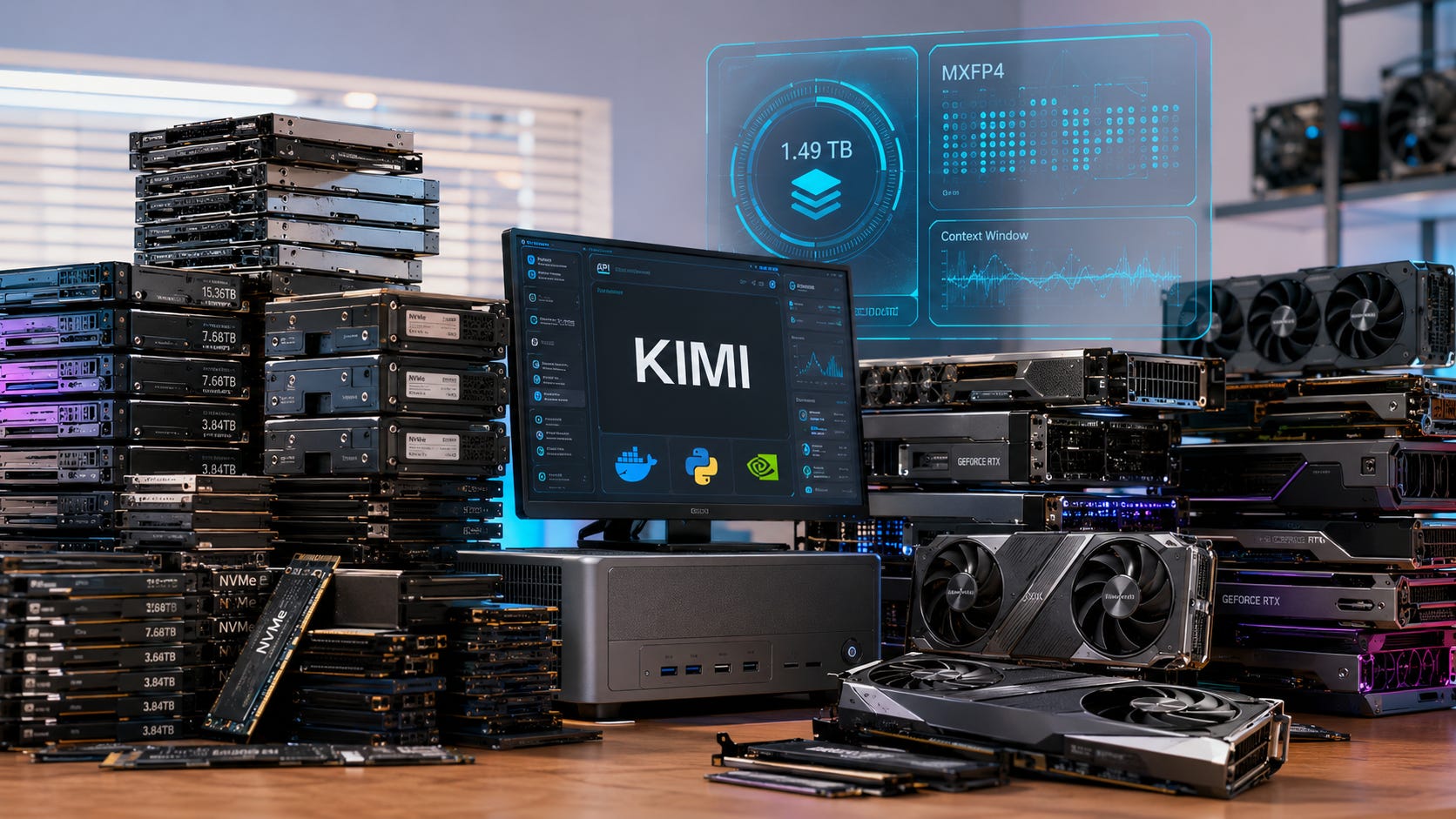
Storage estimate: MXFP4 parameter values and block scales alone work out to roughly 1.49TB, before checkpoint indexes, configuration files, runtime overhead, caches, and conversion workspace.
Best option for most readers: Use the API to evaluate K3 now, or wait for smaller K3-derived models that target realistic 24GB, 48GB, 96GB, or 128GB memory tiers.
What Moonshot released with Kimi K3
Moonshot AI announced Kimi K3 on July 16, 2026. The company describes it as a 2.8-trillion-parameter model for coding, research, knowledge work, visual reasoning, and long-running agent tasks. K3 is available through Kimi’s web service, Kimi Work, Kimi Code, and the Kimi API. Moonshot says the full model weights will be released by July 27.
The headline architectural details are unusually ambitious:
2.8 trillion total parameters
896 mixture-of-experts specialists
16 experts selected per token
A one-million-token context window
Native text and visual input
Kimi Delta Attention
Attention Residuals
MXFP4 weights and MXFP8 activations
Quantization-aware training beginning during supervised fine-tuning
Moonshot says Kimi Delta Attention and Attention Residuals help K3 achieve an approximate 2.5-fold improvement in scaling efficiency compared with K2. The company also says Stable LatentMoE activates 16 of 896 experts and recommends deployment on supernodes with at least 64 accelerators. Those claims appear in the official Kimi K3 architecture and deployment notes, while the full technical report is still pending.
The careful description for K3 is currently planned open-weight model. As of July 24, the weights have not been released and Moonshot has not published the final license. Commercial use, redistribution, modification, and derivative-model rules therefore remain unconfirmed.
Calling K3 fully open source before the license and supporting code arrive would go beyond the available evidence. The weights may become accessible, but the exact rights attached to them will determine how open the release is in practice.


What changed from Kimi K2
The original Kimi K2 used one trillion total parameters and 32 billion activated parameters. K3 raises the total parameter count to 2.8 trillion while making expert routing much sparser. The Kimi K2 technical page lists 384 experts with eight selected per token, compared with K3’s 896 experts and 16 selected per token.
K3 therefore selects roughly 1.8 percent of its expert pool for each token. Multiplying 2.8 trillion by 16 divided by 896 gives a simplistic selected share near 50 billion parameters. That is not a reliable active-parameter specification because the full model also contains shared layers, attention components, routers, embeddings, and other structures. It is still useful as a rough illustration of how sparse the routing has become.
This sparsity explains why K3 can require much less computation per token than a dense 2.8-trillion-parameter model. The system does not execute every expert for every token.
The compromise is storage and communication. Sparse activation lowers arithmetic demand, but it does not erase the unused experts from the checkpoint. The serving system must keep the broader expert pool available because routing decisions can change from token to token and request to request.
Kimi K3 benchmarks look strong, but the footnotes matter
Kimi K3 has attracted particular attention for coding. Tom’s Hardware reported that it reached 1,679 points and ranked first in Arena’s Frontend Code evaluation. The report also highlights K3’s unusual model scale and the gap between open-weight access and practical deployment.
Independent evaluator Artificial Analysis gives Kimi K3 an Intelligence Index score of 57. Its current measurements show about 62 output tokens per second and a time to first token of 1.99 seconds through Kimi’s API. The evaluator describes the output speed as below average for comparable models, while the first-token latency is better than its comparison median.


Those results are strong enough to justify testing. They do not prove that K3 is universally better than every Claude, GPT, Gemini, GLM, or smaller open-weight model.
Moonshot’s own benchmark footnotes reveal several comparability problems. K3 was generally evaluated at maximum reasoning effort. Different models sometimes used different coding-agent harnesses. Some Claude Fable 5 runs encountered fallback behavior. Several results came from Moonshot’s internal evaluations. Some GPU tasks were recalibrated for H20 hardware instead of the benchmark’s usual setup. Moonshot also warns that K3 may become excessively proactive and make unexpected decisions when instructions are ambiguous.
The right response is controlled testing on the work you actually do. Use the same repository snapshot, task description, test suite, time budget, tool permissions, and output constraints across models. Measure accepted changes, test pass rate, retries, tool mistakes, destructive edits, latency, and cleanup time.
Artificial Analysis’ coding evaluation provides one independent starting point for that comparison:

These things matter because agent reliability is a better battleground than chat-style benchmark performance. A model that scores well on a frontend leaderboard can still ignore project conventions, make unnecessary edits, or lose coherence during a long tool-driven session.
A second Tom’s Hardware analysis of K3’s benchmark and infrastructure story reinforces the basic point. The model deserves attention, but its benchmark position and deployment practicality are separate questions.
More on agent reliability:

Can you run Kimi K3 locally?
Almost certainly not on anything that would normally be described as a local AI PC.
A downloadable checkpoint can still be impractical for individual deployment. Kimi K3 is an unusually clear demonstration because the weight format is already compressed, the total parameter count is enormous, and Moonshot’s own serving recommendation starts at 64 accelerators.
A high-end gaming GPU does not solve this. A multi-GPU workstation does not solve it. Even an expensive 96GB professional GPU belongs to a much smaller memory class, as the analysis of the RTX PRO 6000 Blackwell for local AI makes clear.
The issue is not a missing community launcher or a clever command-line flag. It is the physical scale of the model.
More on the RTX PRO 6000 for local AI:

The Kimi K3 checkpoint could require around 1.49TB
Moonshot says K3 uses MXFP4 weights. Under the Open Compute Project’s MX specification, MXFP4 uses four bits for each FP4 element, an eight-bit E8M0 scale, and a scaling block size of 32 elements. That produces an effective storage requirement of about 4.25 bits per parameter before other metadata.
For 2.8 trillion parameters:
2.8 trillion × 4.25 bits ÷ 8
≈ 1.49 trillion bytes
≈ 1.35 TiB
This is a lower-bound estimate for parameter values and their block scales. It does not include every tokenizer file, configuration file, tensor index, duplicated download, temporary extraction, conversion output, runtime cache, log, or filesystem overhead.
A machine used only to retain the checkpoint would need more than the nominal 1.49TB estimate. A realistic experimentation system would want at least a 2TB drive for one copy. A 4TB or larger fast NVMe workspace would be more sensible for downloading, extracting, validating, converting, quantizing, and retaining several versions.
Higher-precision conversions make the storage problem worse:
Eight bits per parameter: about 2.8TB
BF16 or FP16: about 5.6TB
These figures are arithmetic estimates rather than published checkpoint sizes. The actual release could package tensors differently and may include additional components. The important point remains unchanged. K3’s native format is already aggressively compressed, so there is no easy precision switch that turns the full model into a workload that fits an RTX 5090.
Sparse experts do not remove the memory requirement
The most common misunderstanding sounds reasonable at first:
K3 activates only 16 experts, so the system should need memory for only those experts.
The router can select different experts for different tokens. A serving system therefore needs fast access to the full expert pool. It cannot assume the same 16 experts will remain active across every request.
Loading experts from a consumer SSD whenever routing changes would make inference painfully slow. Even fast desktop NVMe storage offers far less bandwidth and much higher latency than accelerator memory and the interconnects used in large AI servers.
The vLLM project summarizes the serving challenge clearly:

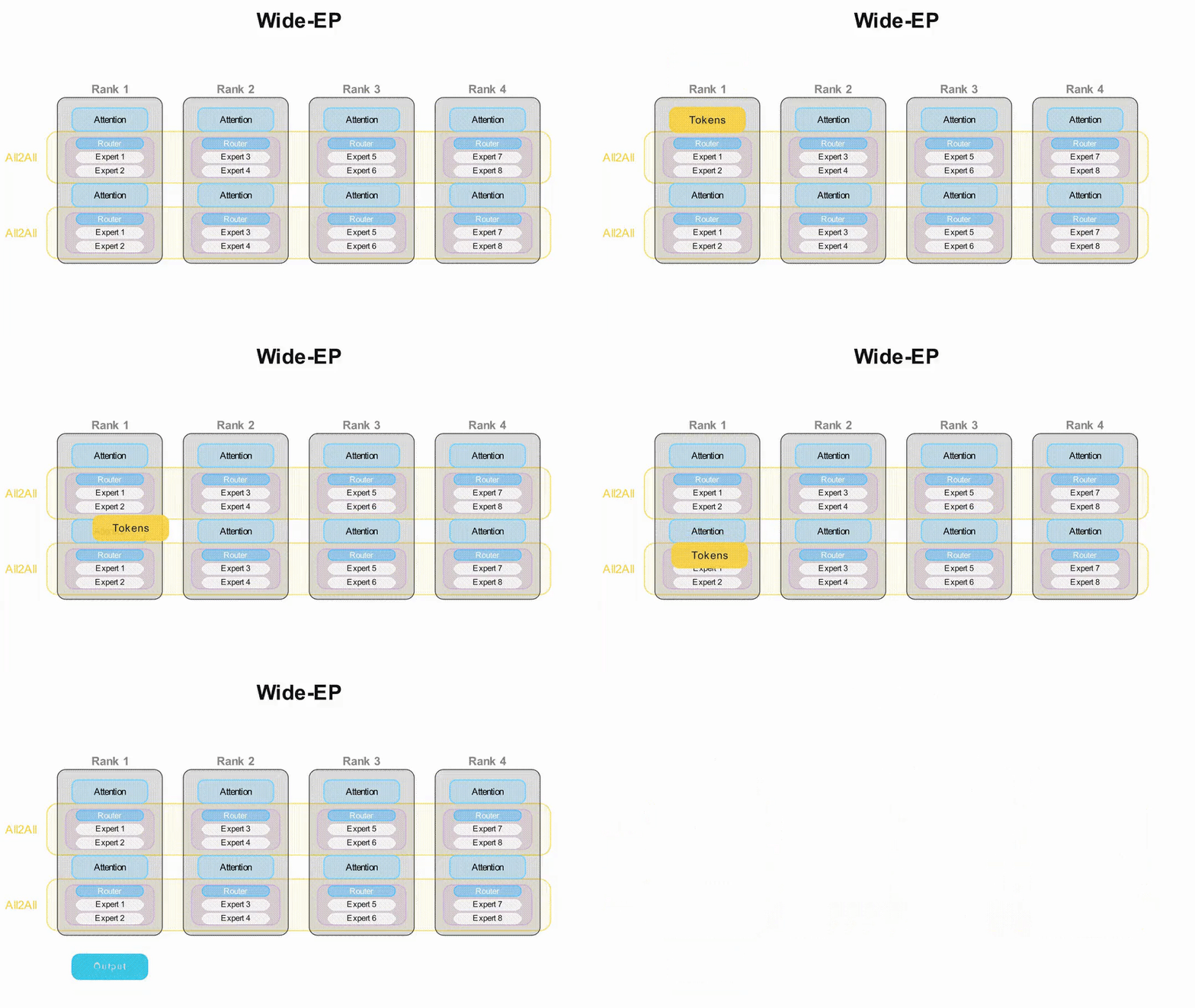
The model’s expert weights normally need to be distributed across accelerator memory or another extremely high-bandwidth tier. Routed token data then moves between devices so the selected experts can process it.
The vLLM documentation on expert parallelism describes expert layers being sharded across expert-parallel ranks. Its multi-node guidance also covers communication backends, networking, node roles, and expert load balancing.
That is data-center engineering. It is not the same problem as splitting a 70-billion-parameter GGUF file across two gaming GPUs.
Consumer runners can spill model layers into system RAM, but performance often collapses when the working set crosses slower memory tiers. Popular AI’s guide to why Ollama and llama.cpp crawl when models spill into RAM explains the same bandwidth problem at a far smaller scale.
More on VRAM versus RAM for local AI:

Moonshot recommends 64 or more accelerators
Moonshot’s deployment recommendation is unusually direct. Kimi K3 should run on supernode configurations with 64 or more accelerators.
That guidance is about communication efficiency as well as capacity. With hundreds of experts spread across many devices, the system needs a high-bandwidth, low-latency interconnect to route token data without turning every inference step into a networking delay. (Kimi)
An illustrative H100 configuration shows the scale. A single NVIDIA DGX H100 contains eight H100 GPUs with 640GB of aggregate GPU memory. NVIDIA also lists 900GB/s GPU-to-GPU bandwidth, up to 400Gbps cluster networking, and 2TB of system RAM for the DGX H100.
A 64-H100 deployment would represent eight such nodes and roughly 5.12TB of aggregate HBM. That illustration does not mean Moonshot requires H100 specifically. It shows what a 64-accelerator cluster looks like in familiar hardware terms.
NVIDIA’s DGX H100 tour helps put the scale of one eight-GPU node into perspective:
Such a deployment requires:
Eight high-end GPU server nodes in this H100 example
High-speed InfiniBand or comparable networking
Substantial local and shared storage
Large amounts of system memory
Cluster orchestration and monitoring
Expert-parallel serving software
Data-center power, cooling, and redundancy
Engineers who can diagnose distributed inference failures
This is not a matter of finding a consumer motherboard with more PCIe slots. It is an infrastructure project.
Before buying any local hardware around a model this large, read the broader analysis of whether local AI hardware is worth buying in 2026. K3 is a poor baseline for a personal purchase because it sits several tiers above even expensive workstation deployments.
More on buying hardware for local AI:

Renting enough GPUs is expensive too
Cloud access removes the capital purchase, but it does not make a 64-GPU deployment cheap.
As a rough lower-bound illustration, Lambda lists H100 SXM instances at $3.99 per GPU-hour. Multiplying that public rate by 64 GPUs gives:
64 × $3.99 = $255.36 per hour
One uninterrupted day at that simple rate would cost $6,128.64.
That comparison is intentionally rough. Ordinary cloud instances are not automatically equivalent to the tightly connected 64-accelerator supernode Moonshot recommends. A production K3 cluster may need a different topology, networking contract, storage layer, image, runtime, reservation, and support arrangement.
The public pricing table is therefore useful as a cost floor, not as a complete K3 deployment quote. A short rental could still make sense for a company evaluating serving feasibility, quantization, or model quality. It does not make sense for someone who wants a private coding chatbot on weekends.
The one-million-token context window adds another trap
A one-million-token context window sounds ideal for enormous repositories, document collections, research archives, and long-running agent sessions.
It does not mean every deployment should enable one million tokens by default.
Long context raises prefill compute, latency, memory demand, and cache-management complexity. Moonshot developed Kimi Delta Attention and a specialized prefill-cache implementation partly to make this context length commercially serviceable.
Local users already encounter this problem with much smaller models. A model that fits comfortably at 16,000 tokens can become sluggish or run out of memory when the context setting is pushed dramatically higher. Popular AI’s local model guide by VRAM tier explains why fitting the model weights and fitting the desired context are separate questions.
The context number should also match the task. Feeding an entire repository into one prompt can increase cost and distract the model with irrelevant files. Retrieval, repository maps, selective file loading, and context compression may produce better results than brute-force prompting.
With K3, both model fit and context fit operate on a scale far beyond consumer hardware.
More on choosing the right model for your VRAM:

Who should use the Kimi K3 API
The API is the sensible option for nearly everyone who wants to judge the model rather than build its infrastructure.
Moonshot currently lists the following prices in the official Kimi K3 announcement:
Cache-hit input: $0.30 per million tokens
Uncached input: $3 per million tokens
Output: $15 per million tokens
Those prices can change, so teams should confirm the current platform terms before budgeting. As of July 24, 2026, they offer a far more accessible evaluation path than renting dozens of accelerators.
▪ Developers comparing coding agents should test K3 on a disposable repository, branch, container, or worktree. Moonshot’s warning about excessive proactiveness makes tight permissions and reproducible tasks especially important.
▪ Startups evaluating model economics can use the API to measure quality, token consumption, latency, retries, cache-hit behavior, and human cleanup time before making any infrastructure commitment.
▪ Researchers and creators working with long documents can test the one-million-token context window without building a multi-node serving stack.
▪ Small businesses can use consumption-based access when workloads are intermittent. Paying for tokens is likely to be far cheaper than operating an accelerator cluster that spends most of the day idle.
The API still creates platform dependency. Availability, pricing, moderation, rate limits, model updates, and account access remain under Moonshot’s control. Open weights may eventually provide an exit route for organizations with enough resources, but the existence of that route does not make it affordable.
Who should wait for smaller K3 models
Most local AI enthusiasts should wait. The useful releases are likely to be smaller or more specialized descendants:
A distilled K3 coding model
A smaller dense model trained from K3 outputs
A reduced-expert model
A community quantization with measured quality tradeoffs
A K3-derived model for 24GB, 48GB, 96GB, or 128GB memory tiers
An official smaller variant from Moonshot
A private hosted option that does not require a 64-GPU commitment
These releases would not preserve all of K3’s capability. They may preserve the parts that matter for a specific workflow.
That is usually the better local AI trade. A focused model that fits your machine can be more valuable than a benchmark leader that exists only as a terabyte-scale download. Popular AI’s analysis of why specialized AI models can beat benchmark kings in real workflows applies directly to K3.
Our recent GLM-5.2 local AI analysis offers a useful comparison. Even a much smaller server-class mixture-of-experts model can remain impractical for ordinary desktops. K3 extends that hardware problem to a far more extreme scale.
For readers choosing among models that actually fit consumer hardware, the 8GB, 12GB, and 24GB VRAM guide is a more useful starting point than designing a machine around full K3.
Related articles:

Who should rent a Kimi K3 cluster
Rent high-memory, tightly interconnected hardware only when the deployment itself is part of the experiment.
Good candidates include inference providers preparing commercial K3 hosting, universities studying quantization and sparsity, large companies evaluating private deployment, researchers measuring expert routing, serving-framework maintainers adding KDA or AttnRes support, benchmark organizations validating Moonshot’s claims, and teams developing smaller derivatives.
Even those groups should wait for the weights, final license, technical report, checksums, tokenizer, configuration files, and recommended runtime versions.
Serving software support matters as much as hardware. The vLLM expert-parallel deployment documentation shows the operational pieces involved in sharding experts, configuring multi-node communication, and balancing expert loads. K3 may also require architecture-specific changes that are unavailable before release.
Renting first and discovering that the serving stack cannot load the architecture is an expensive way to read release notes.
Kimi K3 license, privacy, and control
The planned weight release could give qualified organizations more control over inference, fine-tuning, data location, model availability, and internal security.
The final license still matters. Open-weight licenses can limit commercial use, redistribution, certain industries, derivative models, or high-volume services. As of July 24, K3’s final license has not been published.
Hosted Kimi should not be confused with local processing.
Kimi’s consumer privacy policy says user content can include prompts, audio, images, videos, and files. It says this information may be processed to provide and improve the service, including training and optimizing models.
Kimi’s terms allow users to request an opt-out from model-improvement use, with the stated method of contacting the company by email. The same terms allow Moonshot to suspend, restrict, or terminate access and to modify, suspend, or discontinue parts of the service.
The privacy policy’s description of user-content processing means users should avoid uploading secrets, credentials, sensitive client files, regulated data, or confidential repositories without first reviewing the applicable terms and organizational controls.
The Kimi terms of service also reinforce the basic hosted-service tradeoff. Access depends on an account and a provider-controlled platform. The open-weight release may offer an alternative for large operators, while ordinary users will still experience K3 mainly as a hosted service.
What Kimi K3 means for local AI
Kimi K3 is good news for local AI even though the full model is a poor local deployment target.
Publishing weights lets researchers inspect the architecture, build serving support, test quantization, create derivative models, and challenge claims that would otherwise remain hidden behind an API.
It also creates competitive pressure. Closed providers must compete with a model that organizations may eventually host without paying the original developer for every token.
Open-weight AI is now splitting into two practical tiers:
Personal local AI, where one person runs a useful model on a desktop, workstation, mini PC, or home server.
Independent infrastructure AI, where an organization controls the weights but still needs a data-center cluster.
Kimi K3 belongs firmly in the second tier.
That still offers more control than API-only access. It is not ownership that most individuals can exercise directly. The weights may be downloadable, yet the capability remains operationally concentrated among organizations with large budgets and distributed-systems expertise.
This distinction will shape future open-model debates. Parameter access, practical deployability, licensing freedom, runtime support, and affordable hardware are separate dimensions. A release can score well on one and poorly on another.
Kimi K3 local deployment FAQ
Is Kimi K3 open source?
Moonshot has promised to release the full Kimi K3 weights by July 27, 2026. As of July 24, the weights and final license are unavailable. “Planned open-weight model” is the most accurate description until the license, code, and release package can be inspected.
How much storage will Kimi K3 need?
The MXFP4 format specification supports a lower-bound estimate of about 1.49TB for 2.8 trillion parameter values and block scales. The actual download may be larger after indexes, metadata, configuration files, and other components are included. A serious conversion workspace would likely need at least 4TB of fast storage.
How much VRAM does Kimi K3 need?
Moonshot has not published a simple minimum-VRAM figure. It recommends supernode configurations with 64 or more accelerators. For scale, the NVIDIA DGX H100 and H200 user guide lists 640GB of aggregate GPU memory in an eight-H100 DGX system, so a 64-H100 illustration reaches 5.12TB across eight nodes. That is an illustration, not an official K3 minimum. (NVIDIA Docs)
Can an RTX 5090 run Kimi K3?
No practical full-model deployment fits on one RTX 5090. A single consumer GPU is orders of magnitude below the storage, accelerator-memory, and interconnect scale implied by K3’s checkpoint and Moonshot’s 64-accelerator guidance. Even several 24GB or 32GB gaming GPUs would not create a usable complete-model setup.
Could Kimi K3 run from system RAM?
A future community project might attempt CPU or hybrid inference on a server with terabytes of RAM. It would still require enormous memory capacity, bandwidth, storage, architecture support, and patience. Treat that possibility as a distributed-systems experiment rather than a practical personal assistant.
How much would a 64-GPU Kimi K3 rental cost?
Using Lambda’s listed H100 rate as a rough floor, 64 GPUs at $3.99 per GPU-hour equals $255.36 per hour or $6,128.64 per day. A real K3 supernode may cost more because it needs the correct network topology, storage, runtime, and availability arrangement. (Lambda)
How much does the Kimi K3 API cost?
As of July 24, 2026, Moonshot lists K3 at $0.30 per million cache-hit input tokens, $3 per million uncached input tokens, and $15 per million output tokens. Artificial Analysis independently lists the same Kimi K3 API prices, along with a current Intelligence Index score of 57 and output speed near 62 tokens per second. (Artificial Analysis)
Is hosted Kimi K3 private?
Hosted Kimi is not the same as local processing. The service’s privacy policy says user content may be used to provide and improve the service, including model training and optimization. Its terms provide an email-based opt-out for model-improvement and research use. Review the current policies before submitting private code, confidential files, personal data, or trade secrets.
Kimi K3 is open-weight infrastructure, not a desktop model
Kimi K3 matters because it pushes frontier-scale open-weight AI into territory previously dominated by closed labs. It does not turn frontier AI into a desktop download.
Use the API when the goal is to test K3’s coding, research, vision, or agent capabilities. Wait for smaller derivatives when the goal is a useful model on hardware you personally control. Rent a full cluster only when you are evaluating K3 as infrastructure rather than as an application.
The most practical local model is often the one shaped around your workload, not the model with the largest checkpoint or strongest headline score. That is why the argument for specialized AI models over benchmark kings remains relevant here.
Open weights create the right to try. They do not guarantee that trying will be affordable, fast, or local.
Explore more from Popular AI:
Start here | Local AI | Fixes & guides | Builds & gear | Popular AI podcast
How much hardware would you realistically dedicate to running Kimi K3 locally, and when does using the API become the smarter choice?