


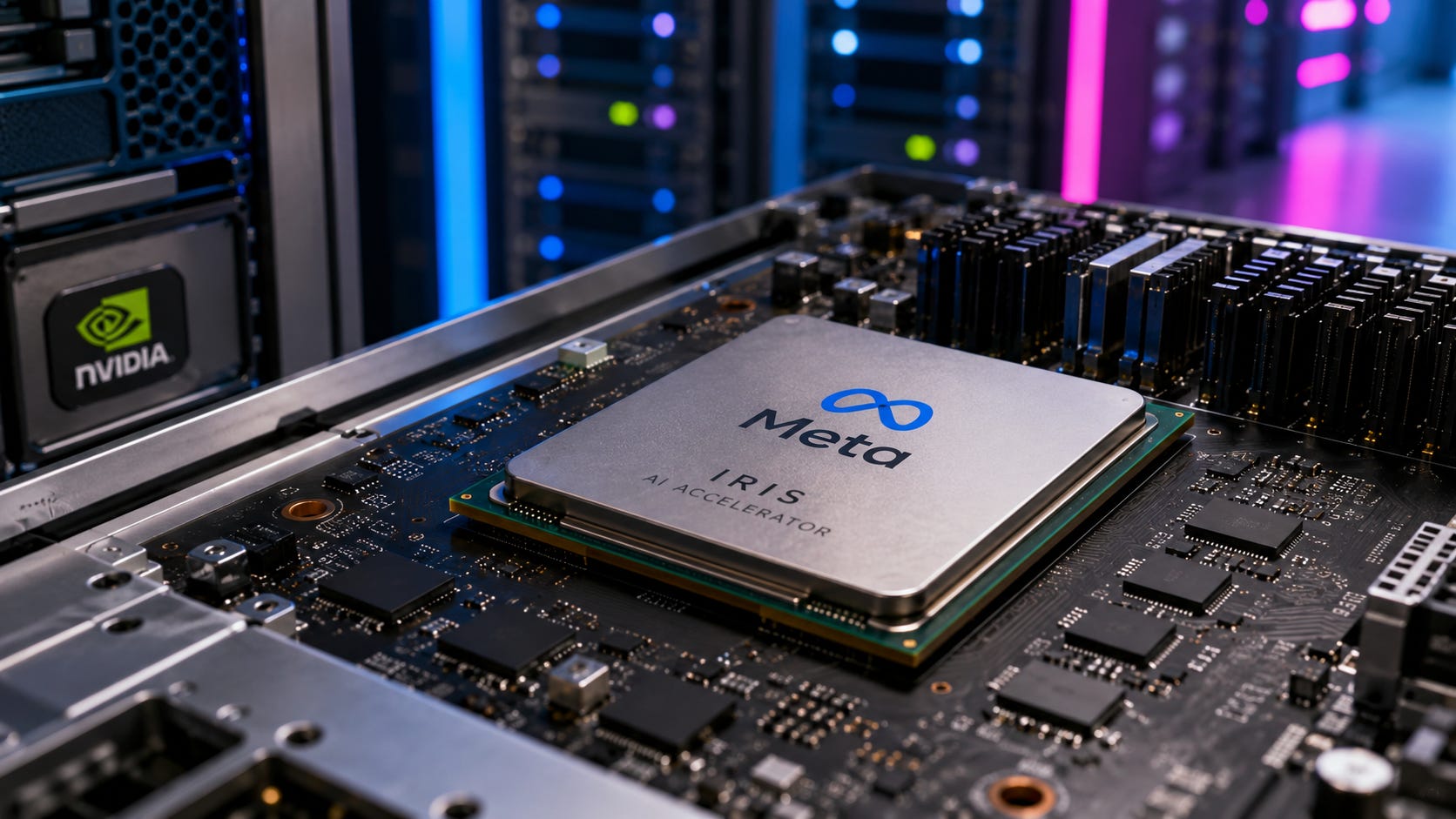
Meta’s Iris AI chip is not something you can buy for a local AI workstation. That is exactly why it matters.
Meta plans to begin manufacturing an internal AI chip code-named Iris in September 2026 as part of a plan to lift its computing power to 14 gigawatts in 2027. The data-center chip sits inside Meta’s MTIA program, is being designed in-house with Broadcom’s help, and will be manufactured by TSMC.
The immediate story is obvious: Meta wants more control over the silicon that powers Facebook, Instagram, recommendations, generative AI, and future AI agents.
The larger story is more important for everyone else. Big Tech is trying to climb out from under the same dependency problem ordinary AI users already feel at a smaller scale.
Cloud AI is powerful until the bill changes. API access is convenient until a rate limit, account issue, policy shift, or product rewrite breaks your workflow. Nvidia GPUs are the default choice until every major customer wants the same accelerators at the same time. Local hardware is expensive until the subscription bill, privacy risk, or latency problem makes ownership look rational.
Iris will not make a used RTX 3090 24GB faster. It will not help an RTX 4090 fit a model that needs more than 24GB of VRAM. It will not turn a laptop NPU into a serious local LLM box.
But it does show where the AI market is heading. Compute control is becoming strategy.
What Meta Iris actually is
The cleanest way to understand Iris is to ignore the consumer GPU frame. This is not a graphics card, a workstation accelerator, or a chip Meta plans to sell to hobbyists.
Reuters describes Iris as a Meta data-center AI chip under the Meta Training and Inference Accelerators program. The report says Meta tailored it for its own needs, is working with Broadcom on design, and plans to use TSMC for manufacturing.
That matters because Meta’s problem is not “can we run one model once?” Meta’s problem is serving AI features to billions of users at acceptable cost, latency, and reliability.
Meta’s own MTIA roadmap fills in the technical shape. In March 2026, Meta said it was developing and deploying four MTIA generations, MTIA 300, 400, 450, and 500, across 2026 and 2027. The company said MTIA 300 targets ranking and recommendation training, while MTIA 400, 450, and 500 are aimed mainly at generative AI inference production.
That split is the key. Training gets most of the public attention because it is expensive, dramatic, and easy to tie to frontier model races. Inference is where AI becomes a permanent business expense. Every prompt, recommendation, agent action, image request, and coding loop has to be served again and again.
That is why Meta’s Iris push matters even if consumers never touch the chip. The question is not whether Iris replaces Nvidia tomorrow. The question is whether Meta can use custom silicon to lower internal inference cost, reduce supplier dependence, and tune hardware for its own workloads.
The specs that matter for AI
Meta has not published a consumer-style Iris spec sheet. There is no public, verified VRAM figure, workstation compatibility list, board price, wattage number, or independent local AI benchmark.
What Meta has published is more useful for understanding the direction.
Meta says MTIA 450 is optimized for GenAI inference, doubles high-bandwidth memory bandwidth compared with MTIA 400, and introduces low-precision data types co-designed for inference workloads. The same Meta AI post says MTIA 500 increases HBM bandwidth by another 50% over MTIA 450 and adds more low-precision data-type work.
That tells you where the pressure is: memory bandwidth, low-precision inference, rack-scale deployment, software co-design, and total cost of ownership.
For local AI buyers, the lesson is familiar. Speed matters, but fit comes first. When a model does not fit in memory, every workaround hurts. You quantize harder, shorten context, offload to CPU, split across GPUs, shrink the model, or return to the cloud.
A 2026 paper on consumer-grade LLM inference calls this the “VRAM Wall” for 70B-plus models. The authors describe the tradeoff on discrete GPUs as aggressive quantization that can degrade model quality, or CPU offloading through PCIe that can sharply reduce throughput.
That is the same problem at two scales. Meta is trying to solve it with custom data-center silicon, HBM bandwidth, and software tuned to its own workloads. Local users solve it by buying enough VRAM, enough unified memory, or enough patience.
Why Iris is a market signal for local AI
Iris does not directly change what you can run at home. It will not make an RTX 3060 run a 70B model with long context. It will not make ComfyUI need less memory. It will not turn a thin AI PC into a frontier model box.
The change is the signal.
Meta is showing, through spending and chip design, that AI capability is too important to leave fully in another company’s hands. Reuters quoted an internal memo saying adopting the latest GPUs at Meta scale has been “a heavy lift” and has cost the company time. The same report says Meta’s custom silicon approach is likely to lower compute costs and give the company more independence from suppliers such as Nvidia and AMD.
That should sound familiar to anyone building a local fallback.
A local AI box is not a miniature Meta data center, but the logic is related. Cloud AI is convenient until pricing, rate limits, policy, or account access gets in the way. Local AI is weaker in some tasks, yet it gives you a baseline that does not disappear when a vendor changes terms. Hardware ownership is painful up front, but more predictable once the box is built. Memory capacity is often more important than benchmark theater.
Meta is moving from “buy the best external accelerators” toward “own more of the stack.” Local AI users are asking the smaller version of the same question: how much useful AI capability should live on hardware you control?
Nvidia is still the center of gravity
Iris does not mean Nvidia is finished. That would be the shallow read.
Nvidia remains the center of the AI buildout. The company reported $81.6 billion in total revenue for the quarter ended April 26, 2026, with Data Center revenue at $75.2 billion.
Meta also keeps buying Nvidia and AMD GPUs. Reuters says Iris is meant to augment the large quantities of GPUs Meta purchases from Nvidia and AMD, rather than replace them outright.
The reason is software as much as silicon. Nvidia’s CUDA ecosystem remains a huge advantage because so much AI software assumes it, supports it first, or performs best on it. Nvidia’s own CUDA Toolkit documentation is built around installation guides, programming guides, compilers, libraries, profiling tools, samples, API references, compatibility notes, and release notes.
AMD has improved, and ROCm can run PyTorch workloads, but the official PyTorch on ROCm documentation still leans on specific setup paths such as tested Docker images, compatibility guidance, and ROCm-specific installation choices.
For local users, this is why Nvidia keeps winning even when AMD offers attractive raw specs. The question is rarely which card looks best on a spec sheet. The practical question is which card lets Ollama, LM Studio, llama.cpp, vLLM, ComfyUI, PyTorch, and your other tools work without turning every install into a driver project.
That is also why a mature Nvidia GPU can beat a theoretically interesting alternative for many local AI buyers. The stack matters. The chip alone is never the whole product.
The real control lever is the hardware stack
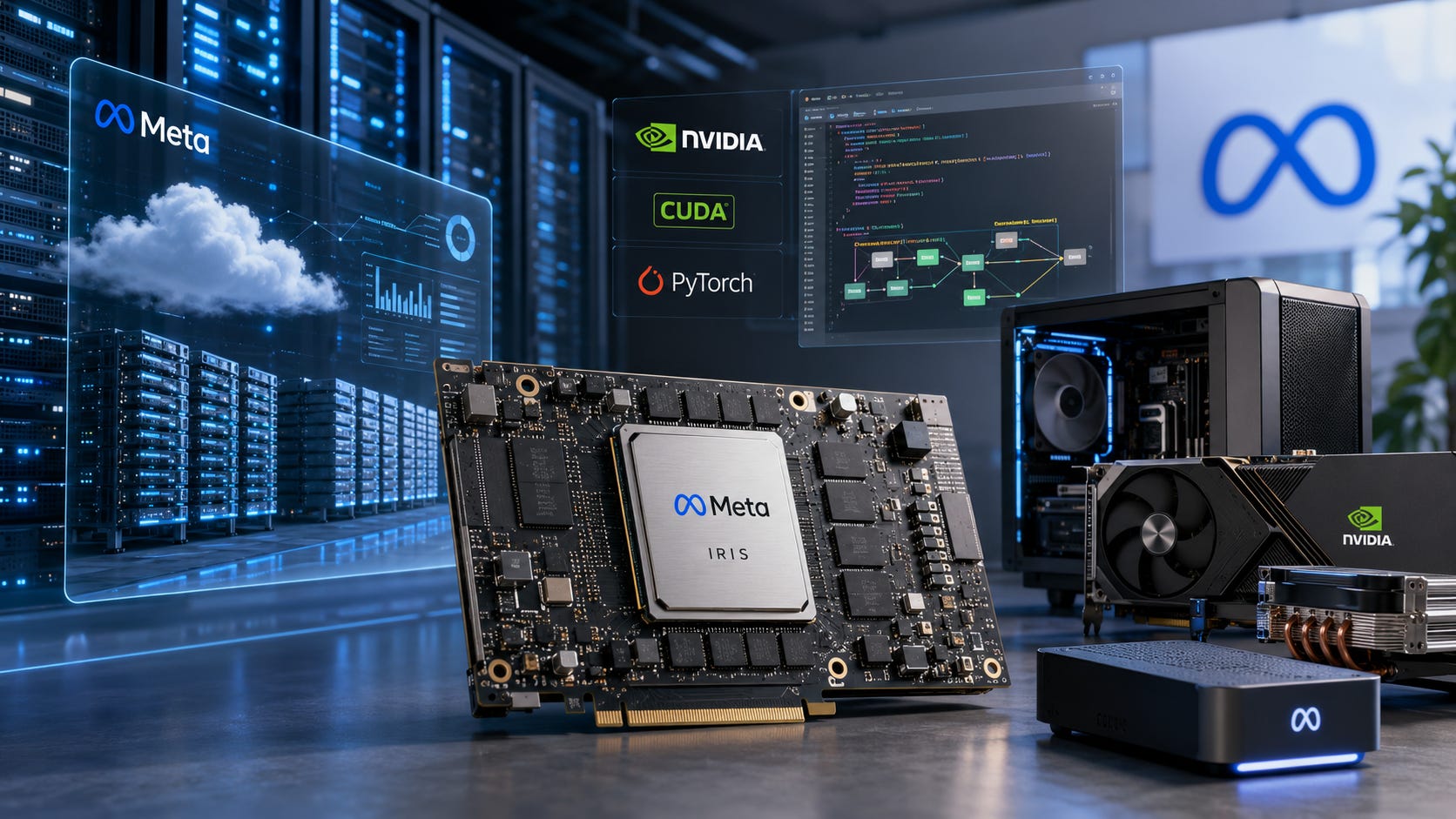
The control lever here is not one chip. It is stack ownership.
Meta’s MTIA strategy touches chip design, advanced packaging, networking, rack infrastructure, software, kernels, workload placement, and deployment cadence. Meta’s April 2026 Broadcom announcement says the partnership covers chip design, advanced packaging, and networking, with a commitment exceeding 1 gigawatt as the first phase of a sustained multi-gigawatt rollout.
Meta’s KernelEvolve post shows why the software layer matters. Meta says its accelerator fleet spans Nvidia GPUs, AMD GPUs, and MTIA silicon, each with different memory architectures and hierarchies, instruction sets, and execution models. A kernel that runs well on one platform may perform poorly or fail on another.
That is the moat. The company that owns the workload, model architecture, software stack, deployment pipeline, and hardware roadmap can tune all of them together.
For users, the parallel is simple: do not judge AI hardware only by peak TOPS, CUDA cores, tensor cores, or marketing slides. Judge it by the working stack.
Does Ollama, LM Studio, llama.cpp, vLLM, ComfyUI, PyTorch, or your tool of choice actually support it? Does the model fit in memory? Does it run on your operating system without strange workarounds? Does the driver stack survive updates? Can you export your models, workflows, and data? Can you keep working if an API or account goes down?
Those questions matter more than a single synthetic benchmark. A local AI machine is useful only when the whole workflow works.
What Iris means for API pricing and agent costs
Custom silicon should eventually push some inference costs down. That does not guarantee lower user prices.
A provider can use cheaper inference to cut prices, widen margins, offer larger context windows, subsidize agents, bundle AI into existing products, or serve more requests at the same price. Users benefit when competition, product strategy, or open alternatives force the savings through.
This is where Meta’s broader AI strategy matters. MarketWatch linked Meta’s custom-chip progress with the launch of Muse Spark 1.1, describing investor optimism around agentic coding and AI monetization.
Coding agents are especially sensitive to inference cost. A chat prompt can be cheap. An agent that reads files, calls tools, retries failures, runs tests, edits code, and loops for minutes can burn far more tokens and compute. If Meta can serve those workloads on cheaper internal infrastructure, it can pressure other providers on price or bundle more AI into its own products.
There is a catch. Cheaper cloud inference still runs through someone else’s account, policy, logging, rate limits, and product roadmap. Lower prices reduce one pain point. They do not give you control.
That is why Iris is relevant to local AI even though it is a data-center chip. It makes clear that the companies selling AI access are trying to lower their own dependency risk. Users should think about their dependency risk too.
What local AI buyers should do now
Do not buy hardware, just because Meta has an AI chip.
Buy hardware because your workflow needs a local fallback.
For most readers, the decision still falls into four practical lanes: used 24GB Nvidia, premium 24GB Nvidia, 32GB flagship Nvidia, or a memory-first unified-memory machine. Each path has a different reason to exist.
Disclosure: This post includes Amazon affiliate links. If you buy through them, Popular AI may earn a small commission at no extra cost to you.
Best value: used RTX 3090 24GB
A used RTX 3090 remains the value reference point because Nvidia lists the RTX 3090 with 24GB of GDDR6X memory.

It is not efficient by 2026 standards. It can run hot. Used cards need careful inspection. Power supplies, case airflow, seller history, and return policy matter. Still, 24GB changes what you can run locally.
Buy this class of card if you want a first serious local LLM or ComfyUI machine and you care more about model fit than new-card shine. Popular AI’s guide to the best budget local LLM PC in 2026 is the right next step if the goal is a practical 24GB build instead of a showcase machine. The same guide is useful for parts planning before you shop used cards.
More on budget local AI builds:

The RTX 3090 is also the most honest lesson in local AI buying. It is old enough to feel unglamorous, but the memory still matters. Many buyers learn fast that a newer 12GB or 16GB GPU can feel worse for local LLM work than an older 24GB card when model fit is the constraint.
Best mature high-end option: RTX 4090 24GB
The RTX 4090 is the mature premium option for buyers who want 24GB of Nvidia support with much more speed and efficiency than the 3090. Nvidia lists the RTX 4090 with 24GB of GDDR6X memory, 16,384 CUDA cores, and fourth-generation Tensor Cores.

The 4090 is faster and more efficient than the 3090, but it does not solve the memory ceiling if your problem is model fit. A workload that fails because 24GB is not enough will usually fail on both cards.
Buy the 4090 if 24GB is enough and daily speed matters. For image generation, mixed creator work, frequent local inference, and CUDA-heavy tools, it remains a strong premium card when pricing is sane.
Do not buy it because you assume “faster” always means “better for LLMs.” Faster helps after the model fits. Before that, memory is the gate.
Specialist choice: RTX 5090 32GB
The RTX 5090 is the specialist choice for buyers who can use more headroom and are willing to pay flagship money. Nvidia describes the RTX 5090 as a Blackwell GPU with 32GB of GDDR7 memory.

The extra memory matters. It gives more room than 24GB cards for larger quantized models, longer context, heavier image workflows, and some local agent setups. But it is still not a magic solution for every 70B-plus workload, and early flagship pricing can be hard to justify.
Buy it only if the jump from 24GB to 32GB changes a job you actually do often. That might mean a specific model, a specific context length, a specific ComfyUI workflow, or a specific local coding setup.
For casual experiments, the RTX 5090 can be overkill. For heavy daily local AI work where 24GB is constantly tight, it can be the first consumer GeForce card that feels like a meaningful memory step.
Memory-first alternative: unified-memory machines
Unified-memory systems deserve more attention because large local models are often memory-bound.
The Silicon Showdown paper argues that Apple’s unified memory architecture can avoid some discrete-GPU bottlenecks for large quantized models, while Nvidia discrete GPUs retain advantages in compute density and low-latency workflows. The paper frames the choice as a tradeoff between compute density and memory capacity, moderated by ecosystem friction.
That does not mean every local AI buyer should switch to Apple Silicon or an AMD unified-memory mini PC. It means the old “GPU speed wins everything” rule is incomplete. For larger local LLMs, memory capacity and bandwidth can matter more than raw compute.
Our M4 Max versus Ryzen AI Max+ 395 local AI guide is a recommended next read if you are considering a high-memory compact machine instead of a discrete GPU tower. It is also worth checking out if your main question is how much unified memory changes local model fit.
More on AI mini computers:

The right choice depends on the workload. Nvidia is usually the safer path for maximum tool compatibility. Unified memory can be more interesting when fitting a larger quantized model matters more than peak throughput. A dual-GPU tower can be powerful, but it brings power, heat, noise, space, and software complexity.
What to skip
Skip any AI PC purchase where the seller leads with NPU marketing and hides the memory story.
A small on-device NPU can be useful for specific apps. It is not the same class of hardware as a serious local LLM workstation. For local LLMs, ComfyUI, private RAG, coding models, and long-running workflows, the questions are still memory, software support, thermals, storage, power, and upgrade path.
Also skip the fantasy that one purchase solves everything. A 24GB GPU is useful. A 32GB GPU helps some jobs. Dual GPUs can be powerful. A 128GB unified-memory machine opens different doors. Every option still has tradeoffs.
That is why our RTX 5090 vs RTX 4090 vs RTX 3090 local AI comparison is the practical buying companion to this infrastructure story. Our GPU comparison guide is especially useful if you already know you want Nvidia but cannot decide which memory tier makes sense.
More on choosing the right GPU:

For deeper planning, Popular AI also has guides on choosing the right local LLM for 8GB, 12GB, and 24GB VRAM, whether 4x or 8x RTX 3090 local AI servers still make sense, and whether local AI hardware is worth buying in 2026.
More on local AI hardware:

How Iris compares to the local AI problem
Meta is fighting the data-center version of a constraint ordinary users see at home.
At Meta scale, the constraints are supplier dependence, rack deployment speed, memory bandwidth, custom kernels, power, networking, and total cost of ownership.
At home, the constraints are VRAM, RAM, drivers, thermals, noise, electricity, software support, storage, and whether your tool still works after an update.
The numbers are different. The shape of the problem is similar.
A paper on AIvailable, a software-defined LLM-as-a-service architecture, argues that many inference systems assume homogeneous, resource-rich hardware, which is unrealistic for constrained environments. The proposed approach focuses on heterogeneous and legacy GPU nodes, including Nvidia and AMD devices, with VRAM-aware allocation.
That is the world many local AI users live in. Most setups are mixed, budget-limited, repurposed, imperfect, and built around what the owner can actually afford. Not everyone has a clean rack of current-generation accelerators. Many people have one used GPU, an old workstation, a Mac with lots of memory, or a machine that has to double as a gaming PC.
The good news is that local AI does not need to beat Meta’s data centers. It only needs to give you enough private, repeatable capability that you are not helpless when hosted AI becomes expensive, filtered, rate-limited, or unavailable.
Further reading
For build-specific decisions, start with our budget local LLM PC guide, our M4 Max vs Ryzen AI Max+ 395 guide, and our RTX 3090 vs RTX 4090 vs RTX 5090 comparison. Those are better buying tools once you already understand the larger compute-control lesson behind Iris.
FAQ
Can I buy Meta’s Iris AI chip?
No. Iris is a Meta data-center chip, not a consumer GPU or workstation card. Reuters describes Iris as an internal chip under Meta’s MTIA program, designed with Broadcom’s help and manufactured by TSMC.
Does Iris mean Meta is leaving Nvidia?
No. Reuters says Iris is intended to augment the large number of GPUs Meta buys from Nvidia and AMD. The goal is to reduce dependence and cost, not immediately replace every external accelerator.
Why should local AI users care about Meta’s custom chip?
Because it shows that AI compute cost and hardware control are now strategic issues. If Meta wants more control over its compute stack, ordinary users should also think about how much capability they want on hardware they own.
Will custom chips make AI APIs cheaper?
They can lower a provider’s inference cost, but users only benefit if competition or product strategy passes those savings along. Providers can also keep the savings as margin, expand features, or bundle AI into existing products.
What matters most when buying local AI hardware?
Memory comes first. For local LLMs and image workflows, VRAM or unified memory usually decides what fits. Speed matters after the model fits. For many buyers, that is why a used RTX 3090 can still make more sense than a newer lower-memory card.
Is Nvidia still the safest local AI choice?
For most local AI users, yes. Nvidia’s CUDA ecosystem remains the easiest path for many tools, especially when the goal is to spend time using AI rather than debugging hardware support. AMD, Apple Silicon, and other paths can make sense, but the software stack matters as much as the chip.
The local AI takeaway from Meta Iris
Meta’s Iris chip is a warning label on the AI market: even the richest platforms do not want to depend blindly on Nvidia forever.
For local AI users, the answer is not to chase hyperscaler hardware. The useful move is to copy the principle at human scale.
Keep using cloud AI when it is faster, cheaper, or better. Build local capability where privacy, repeatability, account risk, latency, or monthly cost matter. Buy hardware based on model fit first, software support second, and speed third.
For most buyers in 2026, that means a used RTX 3090 if value matters, an RTX 4090 if mature 24GB speed matters, an RTX 5090 if 32GB changes the job, or a high-memory unified-memory machine if your priority is fitting larger quantized LLMs locally.
Meta is building Iris because control over compute is becoming strategic. Local AI users should take the hint.
Explore more from Popular AI:
Start here | Local AI | Builds & gear | Autonomy & policy | Fixes & guides | Popular AI podcast
Does Meta’s Iris AI chip make you more optimistic about cheaper cloud AI, or more determined to own local AI hardware?