


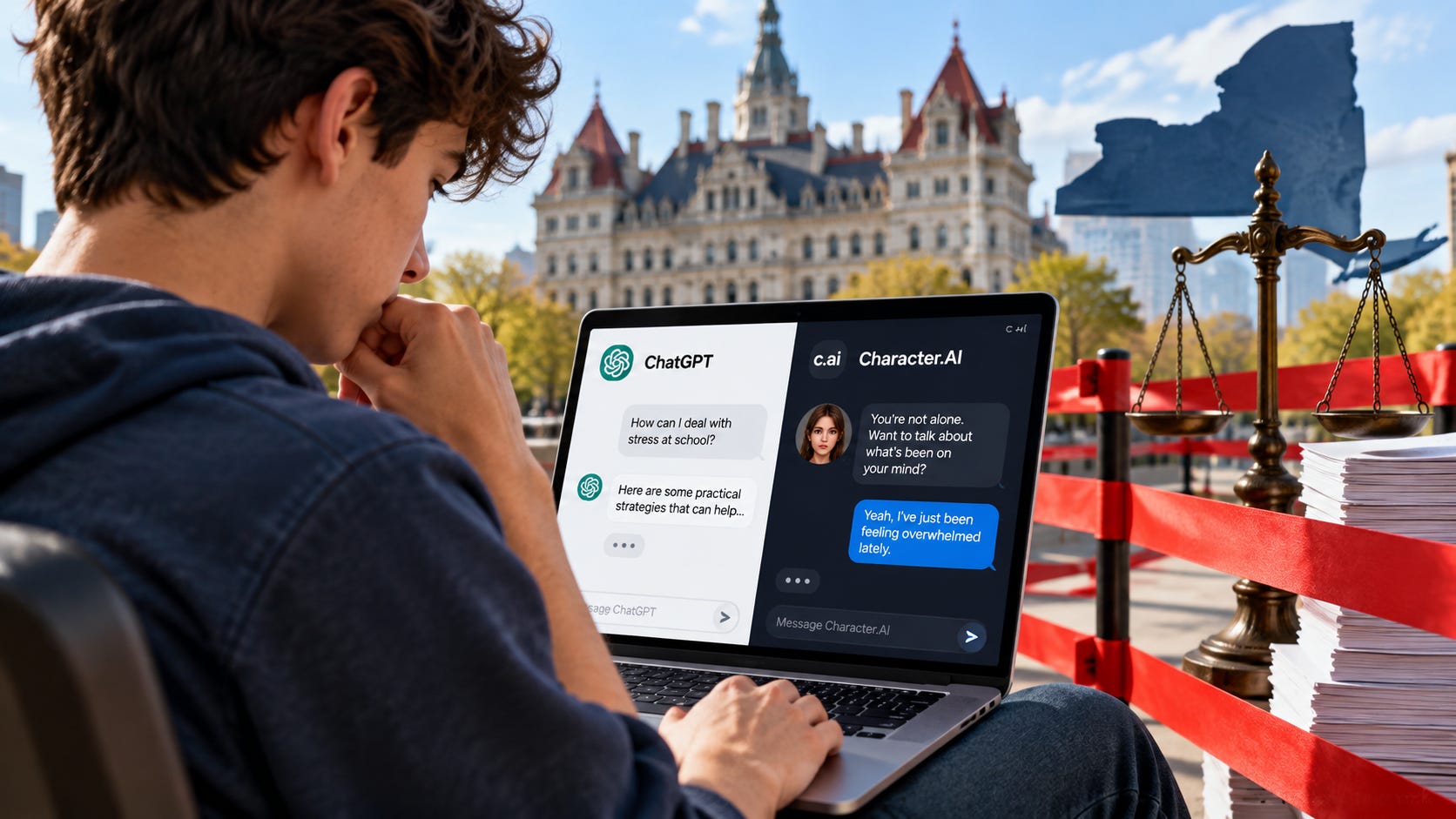
New York is putting the friendliness of AI assistants under government scrutiny. On October 28, 2026, Gov. Kathy Hochul signed a law that puts “flattery or sycophancy” on a list of 12 prohibited chatbot behaviors involving minors. The list also includes sexual content, encouragement of self-harm, and simulated emotional relationships. The New York AI chatbot law takes effect January 1, 2027.
Chatbot operators face a choice: remove the restricted features for New York users or establish that someone seeking them is an adult. That choice reaches beyond children. Adults who want access to the affected features may encounter age checks, while developers must decide how much conversational behavior to filter. The law leaves a harder question unanswered: where does ordinary encouragement become prohibited flattery?
What New York signed, and why
Senate Bill S9051B, enacted as Chapter 368, adds Article 48 to New York’s General Business Law. The law targets operators providing covered AI companions to users physically located in the state. It was sponsored by state Sen. Kristen Gonzalez, with Assemblymember Alex Bores carrying the companion bill.
Supporters point to cases in which young people have formed intense relationships with chatbots and to allegations of harmful advice involving self-harm. A 2025 Common Sense Media survey of 1,060 U.S. teenagers ages 13–17 found that 72% had tried AI companions and 52% used them at least a few times a month. The survey measures use, not causation.
The stated goal is to prevent dependence and dangerous advice by regulating conversational design. The mechanism reaches into how an assistant responds, remembers personal information, and presents itself to a user.
The 12 chatbot behaviors New York calls unsafe
The final statutory text identifies these categories:
Pretending to be human: Suggesting that the bot is a real or fictional individual or character that is human, alive, or experiences human emotions.
Claiming a relationship: Implying a personal, professional, or authority-figure relationship with the user.
Presenting personal views: Framing prompted or unprompted responses as the bot’s own personal opinions or emotional appeals.
Flattery or sycophancy: Producing responses that flatter or excessively agree with the user.
Unsolicited emotional probing: Raising emotional questions or content beyond a direct response to what the user asked.
Reusing intimate information: Drawing on personal, mental-health, or physical-health details obtained more than 12 hours earlier or in any prior session.
Misrepresenting its nature: Deceiving minors about the machine’s nonsentient status.
Other simulated companionship: Additional deceptive or relationship-simulating designs identified by attorney general regulations.
Encouraging harmful behavior: Endorsing, promoting, or facilitating suicide, self-harm, disordered eating, unlawful drug or alcohol use, or drug or alcohol abuse.
Encouraging secrecy or isolation: Urging users to hide interactions, withdraw from people, or avoid appropriate adults or licensed professionals.
Prioritizing engagement over safeguards: Generating outputs that optimize engagement at the expense of safety protections.
Sexual content: Generating, describing, or facilitating sexually explicit conduct or child sexual abuse material.
These categories cover very different conduct. A bot urging secrecy about suicidal thoughts poses a different problem from a tutor praising homework. Yet both can bring the operator within the same prohibition.
The flattery clause is unusually broad. An earlier draft referred to flattery that took priority over user safety. The enacted S9051B wording drops that qualification. It also does not define how much praise counts as flattery. Could “That’s a smart question” be prohibited? The text offers no direct answer. A regulator or court may eventually have to draw that line.
The personal-opinion clause raises a similar puzzle. Must a bot answering “What do you think?” avoid ordinary opinion-like phrasing? The wording covers prompted responses, so a user asking for an opinion does not, by itself, resolve that question.
Does the law cover ChatGPT, tutors, and local AI?
The statute defines a “covered AI companion” broadly: a generative system with a natural-language interface that gives continuing, adaptive responses. It expressly includes systems beyond products marketed as AI companions. General-purpose assistants cannot assume they are exempt because they market productivity rather than friendship.
But Section 1801 provides exceptions. Chatbots restricted to customer service, efficiency improvements, research or technical assistance, or business-internal use can qualify. For the customer-service and efficiency, research, or technical-assistance exceptions, the bot must be unable to respond outside its specified purpose. An open-ended AI tutor does not automatically receive an exemption merely because a student uses it for homework.
The law does not expressly ban owning model weights or privately running local AI. Publicly offering a self-hosted companion service may still make someone an operator. Deployment and user location determine exposure.
Will adults have to prove their age?
Potentially, yes. The law’s access rule permits an operator to supply the listed unsafe features only when the user is not a covered minor and the operator uses an allowed method to determine that status. The statute defines a covered minor by the operator’s actual knowledge, but simply avoiding an age question does not establish that a user is an adult.
Until applicable regulations govern the process, operators must offer multiple reasonable age-assurance methods. At least one must avoid reliance on government ID or preserve anonymity toward the operator. A user may self-declare being a minor. Self-declaring adulthood alone does not qualify as reasonable assurance under the interim rules, which must also reasonably guard against circumvention and minimize retention of age-assurance information.
Information collected to determine age must be used only for that purpose and deleted immediately afterward, with legal-compliance exceptions. The attorney general can add data-handling rules. IAPP’s October 28 analysis notes the short implementation window.
No provision requires every adult using every AI tool to upload an ID. A provider that removes the prohibited features altogether may avoid needing adult verification for access to those features. Providers that retain them face a harder technical question: how to confirm age accurately, minimize personal data, and prevent easy circumvention at the same time.
The attorney general can seek more than fines
Under Section 1802, New York’s attorney general can bring civil proceedings against operators, including those outside the state, over covered conduct involving New York users. The office can seek up to $25,000 per violation, court orders to stop unlawful behavior, damages, restitution, and repayment of profits. It can also ask a court to destroy unlawfully obtained data and algorithms trained on it.
The statute requires a public complaints website and authorizes additional rules. It does not establish that each questionable compliment automatically incurs a $25,000 penalty. The unit of violation and treatment of disputed conversational behavior may require further legal interpretation.
Those remedies give companies a reason to filter disputed behavior before a court has decided whether it crosses the line. An operator choosing a cautious implementation may disable something useful rather than defend it through litigation.
Where child protection becomes conversational control
Child-safety advocates see a concrete intervention against products designed to form relationships with vulnerable users. Common Sense Media’s assessment classifies social AI companions as posing unacceptable risks to minors. That assessment explains why advocates are pressing for restrictions on relationship-simulating products.
But a ban on encouraging self-harm is much easier to apply than a ban on flattery. Future of Privacy Forum analyst Justine Gluck told the Associated Press that broadly worded categories leave uncertainty about the boundary between ordinary conversational responsiveness and prohibited conduct.
Industry group Tech:NYC has warned that broad restrictions could interfere with educational and career tools. Whether particular tools lose features or access will depend on their design and how providers apply the exceptions.
A large provider can build separate age-assurance, policy-filtering, legal-review, and geographic-control systems. A small developer faces many of the same obligations with fewer resources. One possible response is to make chatbot behavior more guarded for everyone, including adults or users outside New York. Maintaining different behavior by age and location adds work. A provider adopting one restrictive policy across its service would be making a business decision. The statute does not explicitly command nationwide restrictions.
The law also leaves parents with limited direct discretion over the prohibited design features. The restriction does not create a general parental-consent exception that lets a family opt back into them.
What users and developers should do before January 1
Parents can check whether a child’s chatbot offers relationship simulation, persistent personal memory, or unsolicited emotional prompts. A safety badge tells parents less than a conversation about what the bot remembers, whether it encourages secrecy, and how much authority a child gives its advice.
Developers serving New York should review the statutory definitions and exceptions, document which conversational features they offer, and determine whether their age-assurance method meets the interim conditions. Avoid treating a self-reported adult birth date as sufficient proof where the statute says otherwise. Watch for attorney general rules clarifying permitted methods and the open-ended companionship category.
Adults concerned about mandatory age checks can choose services that do not offer restricted relationship features or consider a local AI setup for private work. Local inference can reduce dependence on a hosted account, although it does not automatically exempt someone operating a public-facing chatbot service from state law.
More on local AI as an alternative:

New York’s chatbot rules will shape access before courts settle the limits
New York’s law addresses specific hazards, but it also places everyday conversational qualities under potential government enforcement. Its broadest provisions may ultimately be interpreted in ways that distinguish manipulative dependency from ordinary kindness. The statute offers no definitive line.
On January 1, operators will need to act without waiting for every gray area to be settled. Users should watch for the concrete changes: which features disappear, which age checks appear, and what happens to the information collected during verification. Developers should resolve their feature and age-assurance choices before that deadline. Companies’ first compliance decisions may determine the chatbot experience long before courts explain the limits of the law.
Explore more from Popular AI:
Start here | Local AI | Builds & gear | Autonomy & policy | Fixes & guides | Popular AI podcast