


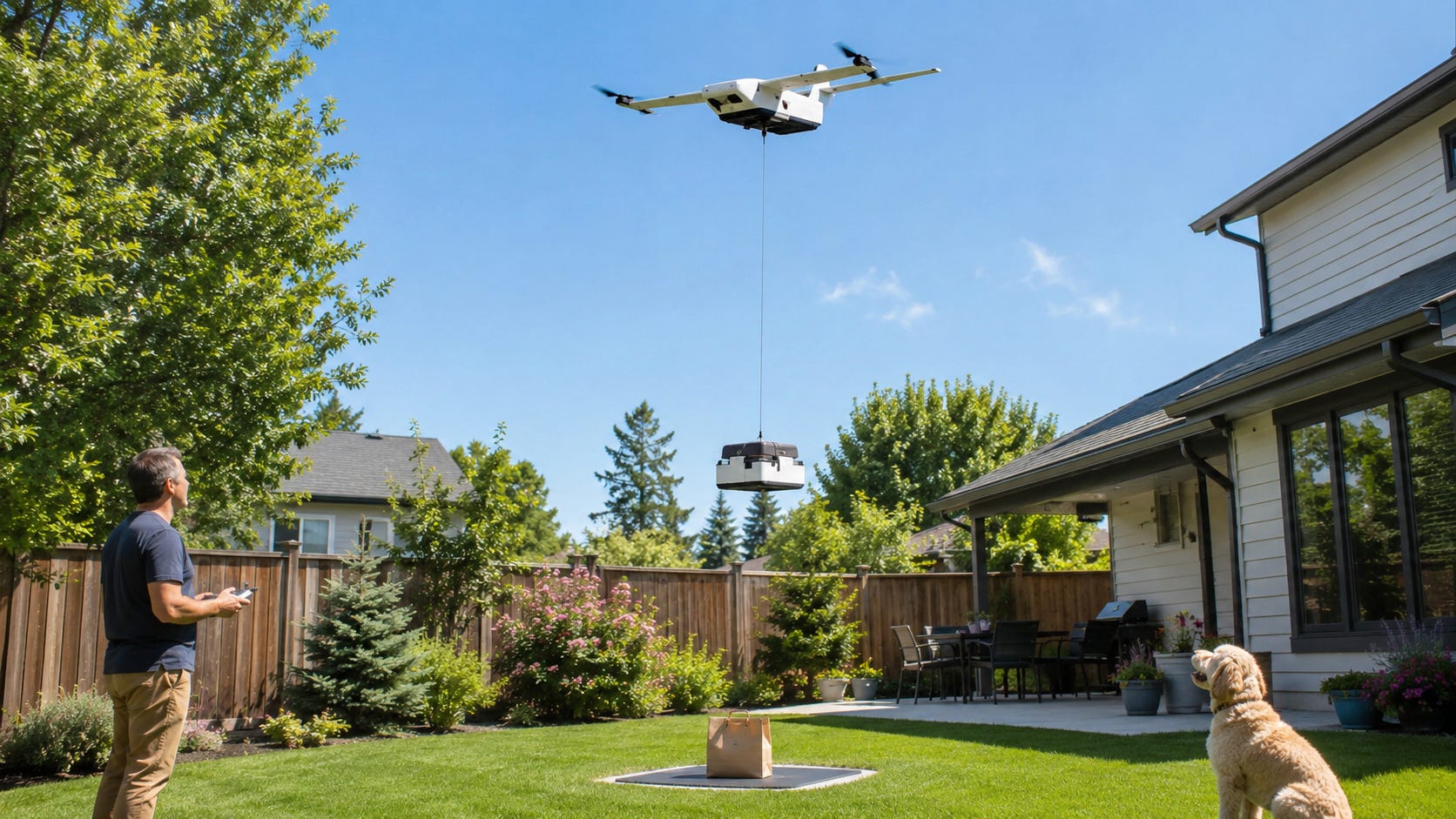
Uber and Zipline have set an enormous target: one million autonomous drone deliveries per day by the end of 2029, with the first Uber Eats deliveries scheduled to begin later in 2026.
The aircraft is no longer the most interesting part of that plan. Zipline already has years of autonomous flight behind it. The harder test begins at the destination, where a clean GPS coordinate turns into somebody’s actual yard, driveway, apartment complex, patio, parking lot or shared courtyard.
That is where Uber Zipline drone delivery stops looking like an aviation demonstration and starts behaving like a household service. A delivery network that works at small scale can choose favorable locations, predictable routes and customers who are willing to tolerate novelty. A network aiming for one million daily deliveries has to survive ordinary residential messiness.
The decisive questions are therefore less cinematic than autonomous flight itself. Can the system complete deliveries without intervention? Can it reject unsafe drop zones gracefully? How often does weather force a fallback to road delivery? Does repeated neighborhood traffic become annoying? Can apartments and shared spaces be served without adding so much friction that a courier would have been easier?
Those questions will determine whether Uber Eats drone delivery becomes infrastructure or remains an impressive option available only when conditions are unusually friendly.
Key takeaways
Uber and Zipline plan to begin Uber Eats drone deliveries in existing Zipline markets in 2026, then expand into dozens of U.S. cities, with a target of one million deliveries per day by the end of 2029.
Zipline’s Platform 2 avoids landing the main aircraft. The drone stays up to roughly 300 feet above the destination while a smaller autonomous delivery unit descends on a tether and evaluates the delivery site.
Zipline has substantial real-world operating experience. The August 17 joint announcement says the company has completed more than 2.7 million deliveries and flown more than 135 million autonomous miles. Those are company-reported figures.
That record does not answer the Uber-scale questions yet. Public data does not disclose the residential delivery success rate, human intervention rate, weather uptime, abort rate or all-in cost per successful unattended order.
The best proof will be boring operational data. If drone delivery is becoming infrastructure, Uber and Zipline should eventually publish the same kinds of reliability numbers people expect from other infrastructure.
Uber is turning Zipline into a much bigger autonomy test
On August 17, 2026, Uber and Zipline announced a strategic partnership that will put Zipline deliveries directly inside Uber Eats. Uber is also making an undisclosed strategic investment in the drone company.
The service is supposed to begin in Zipline’s existing U.S. markets before expanding into dozens of additional cities. The headline goal is one million drone deliveries every day by the end of 2029. That target changes the interesting question.


Zipline does not need to prove that autonomous drones can carry useful things. It has been doing that commercially for years. The company says it operates on four continents and has accumulated extensive autonomous mileage. In July 2026, Zipline said roughly 70 percent of its flights were taking place in the United States.
The new question is whether autonomous delivery can survive Uber-scale variability.
One customer has an open lawn. Another has a fenced backyard. Another has a driveway full of cars. Another lives in a building with no useful private outdoor drop point. Another has tree cover, children playing outside or a dog that is very interested in whatever has just descended from the sky.
At limited scale, a delivery network can concentrate on addresses that fit the technology. At mass-market scale, edge cases become a significant share of the workload. A system can no longer treat inconvenient destinations as rare exceptions if millions of people are supposed to use it routinely.
That makes this a useful follow-up to Popular AI’s recent look at autonomous wildfire drones operating in the physical world. In both cases, the meaningful AI problem continues after perception and navigation appear to work. The system still has to complete the physical job reliably, under changing conditions, with a clear definition of success and a safe way to handle failure.
Uber’s scale also changes what counts as an acceptable failure rate. A small pilot can absorb an awkward destination, a manual intervention or a canceled flight as a learning event. A consumer marketplace cannot treat those outcomes as curiosities. Every intervention has a labor cost. Every fallback can add delay. Every failed delivery can become a support interaction and a disappointed customer.
The million-delivery target therefore turns Zipline into more than a drone supplier. It turns Platform 2 into a test of whether end-to-end physical autonomy can be predictable enough to disappear into a mainstream logistics network.

More on physical AI:

Zipline designed Platform 2 around the last 300 feet
Most people’s mental image of drone delivery is a quadcopter descending into the yard with a package underneath it.
Zipline took a different approach.
Its Platform 2 aircraft remains high overhead during delivery. Zipline says the aircraft can hover up to roughly 300 feet above the ground. The FAA’s environmental review of Zipline’s proposed Dallas-Fort Worth operations describes typical delivery altitude at about 330 feet above ground level.
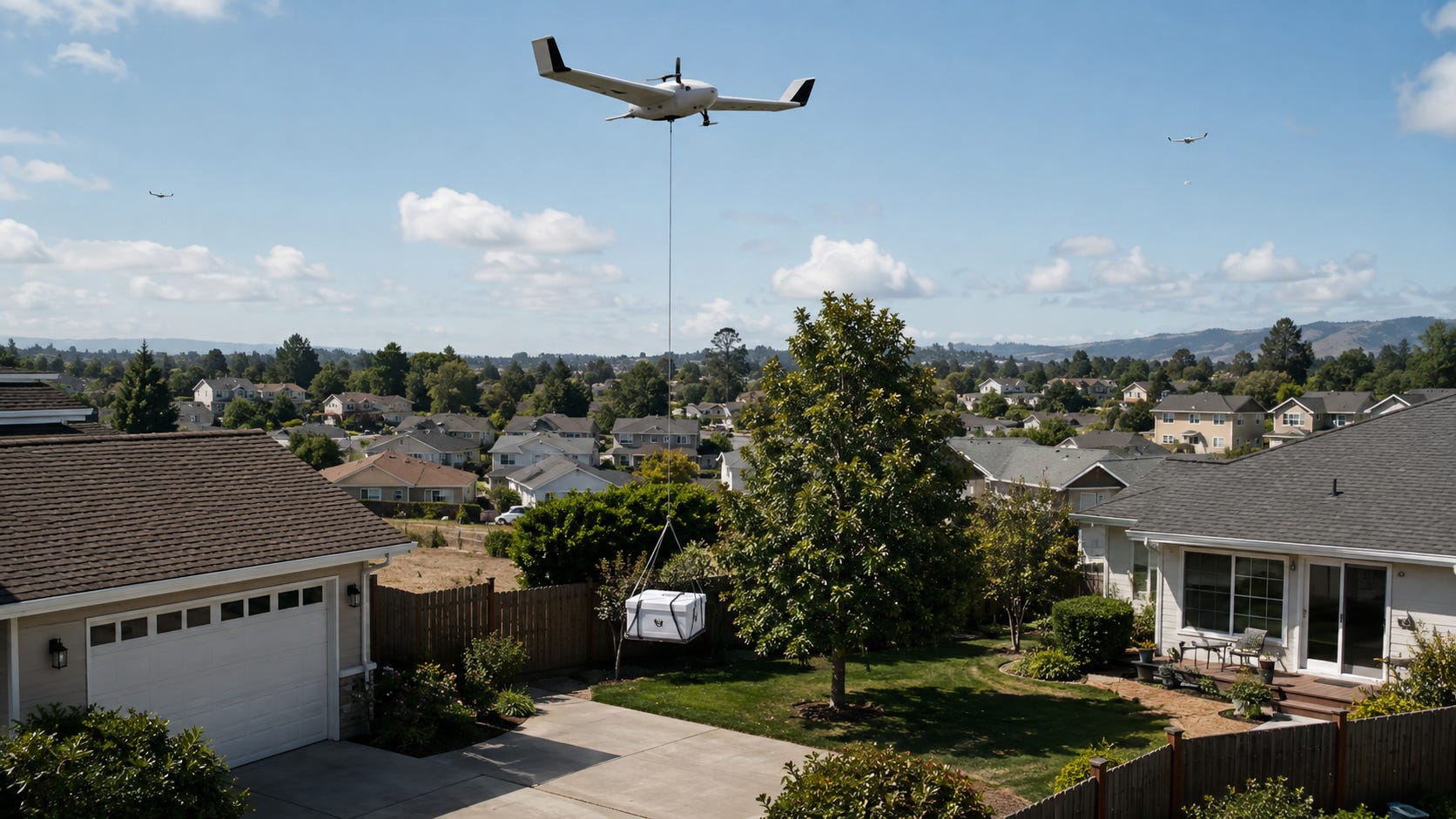
The main aircraft therefore does not need to squeeze between trees, fences, roofs, patio furniture and parked cars. Instead, it opens its payload bay and lowers a smaller autonomous unit, called the Droid in FAA documents, down a winch line.
The important part is what happens next. The FAA says that during descent, the Droid automatically controls its lateral position, evaluates the delivery site and continues only if the area is clear. The same review lists residential yards, driveways, parking lots and common areas as modeled delivery points.
That architecture is a clever answer to the backyard problem. It keeps the larger, louder and more safety-critical flying machine far above people and obstacles. The difficult final approach is delegated to a much smaller device that can move precisely near the ground.
The design also separates two autonomy problems that would otherwise be fused together. The aircraft has to navigate the airspace and arrive over the correct destination. The Droid then has to judge whether the exact ground location is usable. A successful route therefore does not automatically become a successful delivery.
That distinction matters because residential delivery sites change constantly. A driveway that was empty at breakfast may be occupied at dinner. A backyard may contain toys, furniture or people. A shared lawn may be clear one day and crowded the next. A household service needs to evaluate the destination as it exists when the package arrives.
Zipline says Platform 2 can deliver to front yards, backyards and public locations. Its current North Texas operation offers evidence that the concept is already being used beyond controlled demonstrations. In Rowlett, the company says it delivers thousands of orders a day and can deliver to front yards, backyards, patios and public locations.
That is meaningful evidence. It shows that Platform 2 is serving actual food and retail demand in residential environments.
What the public record still lacks is the statistical detail needed to judge how often the process works across the full mess of American housing. We do not know what percentage of requested residential drop points are accepted on the first attempt, how often the Droid rejects a site, how often an operator has to intervene, or how frequently a customer needs a different delivery mode.
Those numbers are much less exciting than a video of a package descending neatly into a yard. They are also more useful for judging whether the system can scale.
The backyard problem is really a reliability problem
A spectacular drone demo can succeed nine times out of ten and still look impressive. A household delivery service has a much narrower margin for visible failure.
When someone orders dinner, “the autonomy usually figured it out” is not a useful service guarantee. The meal either appears where expected, or somebody has to solve the failure. That somebody might be a remote operator, a restaurant employee, an Uber support agent, a courier or the customer.
This is why delivery completion rate matters more than another clean demonstration.
Zipline says Platform 2 uses onboard autonomy and perception. The FAA describes software-generated routes that account for weather risk, wind direction, population density, terrain, obstructions, airspace restrictions and other aircraft. The aircraft also automatically deconflict with one another and follow predetermined operating rules.
That is serious autonomy, but the word “autonomous” needs to be interpreted carefully.
The FAA documentation describes a Remote Pilot in Command who can terminate a flight if necessary. Restaurants and retailers still prepare orders and load them into the system. Aircraft and docks still require maintenance. Regulatory operations still require people. Customer support still exists when an order does not go as planned.
“Autonomous delivery” therefore describes the automated flight and delivery process. It does not imply a logistics network with no humans anywhere in the loop.
For Uber’s target, the important number is how rarely those humans need to rescue an ordinary delivery. If the aircraft handles routine flights automatically but difficult destinations frequently require operator decisions, the system may still be technically autonomous while remaining labor-intensive at marketplace scale.
The same applies to site rejection. A safe system should refuse a bad delivery point. That is a feature, not a flaw. Yet the business impact depends on what happens next. If a rejected drop zone automatically triggers a sensible alternative that the customer accepts, the failure may be nearly invisible. If it leads to a canceled dinner order, a phone call or a second delivery by car, the operational cost is much higher.
The most important residential metric is therefore broader than precision. It is successful unattended completion: launched orders that arrive at the intended usable location without a person having to solve a problem.
That single metric would tell us far more about the maturity of autonomous drone delivery than cumulative miles alone.
Weather needs an uptime number
Zipline has spent years dealing with weather, starting with medical delivery operations where grounding an aircraft could delay something more important than a cheeseburger.
The company says Platform 2 has been tested in rain, wind, storms, cold and other difficult conditions. Zipline has also described a weather system that uses aircraft-generated data to improve flight decisions, including real-time wind, temperature and pressure information gathered by its drones.
The FAA’s DFW analysis is more operationally useful. It says daily flight volume would vary with weather conditions and describes route planning that considers weather risk and wind.
Those statements can coexist. An aircraft can be capable of flying in unpleasant weather while still delaying or canceling missions when conditions exceed an operational limit. That is normal aviation behavior.
The consumer question is therefore not whether Zipline can produce footage of a drone flying in rain. The useful metric is weather uptime.
Among otherwise eligible drone orders, what percentage remain deliverable during the rain, wind, heat, thunderstorms and rapidly changing conditions customers actually experience? How often does an order begin as a drone delivery and end up assigned to a car because conditions changed? How much extra time does that fallback add?
Those numbers matter more at Uber scale because a broad marketplace will expose the system to weather patterns across many cities at once. A network can be technically capable in each market while still suffering meaningful aggregate downtime if local operating limits are crossed often enough.
Weather also interacts with customer expectations. A medical logistics network can prioritize safety and urgency with carefully managed workflows. Uber Eats is a consumer marketplace where people expect the delivery estimate to mean something. If a weather fallback is common, Uber needs to recognize that before it promises a drone delivery experience.
A strong system would make weather limitations almost invisible by deciding early which mode is appropriate. A weak system would discover the problem after the customer has already committed to the order.
That is why weather uptime belongs next to delivery success rate, rather than in a marketing claim about all-weather capability.
Noise looks better on paper, but scale changes the question
Zipline has clearly treated noise as an engineering problem. Its two-part architecture keeps the larger aircraft hundreds of feet above the customer, and the company says its systems have continued getting quieter through aircraft design, software changes and routing decisions.
There is also unusually useful public regulatory evidence.
The FAA’s December 2025 environmental assessment modeled a potentially large Dallas-Fort Worth network with as many as 75 sites and up to 400 daily deliveries from each site. Under the project’s modeled assumptions and required setbacks, the FAA concluded that the proposed action would not create a significant noise impact.
For en-route operations, the FAA modeled a single point exposed to 400 delivery and return flights, 800 flights total, and calculated day-night average exposure no higher than 50.3 dBA.
That is encouraging evidence, but it does not settle the consumer question.
Day-night average sound level is designed to evaluate accumulated environmental exposure. A resident experiences an individual delivery differently. The more practical question is how noticeable one delivery is while someone is sitting in a backyard, working near an open window or talking on a patio. Then comes the scale question: how does that experience change when several nearby households start ordering too?
The distinction between average exposure and perceived annoyance matters because repetitive sounds can attract attention even when they remain below a regulatory significance threshold. A flight path that is unobtrusive at low volume could feel different when demand becomes concentrated around dinner time.
A million deliveries per day makes that worth measuring directly.
Uber and Zipline should eventually report real-world sound exposure by distance, repeated-flight frequency in high-demand neighborhoods and complaint rates per thousand deliveries. Complaint data would be especially useful because it captures what engineering measurements alone cannot: whether people actually find the service disruptive after the novelty wears off.
The FAA model finding no significant environmental noise impact is useful evidence. Long-term neighborhood acceptance would be stronger evidence of product fit.
For mass-market drone delivery, quiet enough for approval and quiet enough to disappear into everyday life are related standards, but they are not identical.
Apartments may be harder than backyards
Suburban yards are the friendly version of this challenge.
A detached home often gives the system some private outdoor space to work with. Even when a preferred spot is blocked, the customer may have a driveway, side yard, front walk or patio that can serve as an alternative.
Dense housing can remove that flexibility.
A high-rise or apartment complex can separate a customer’s GPS coordinate from any delivery point that person controls. A courtyard may serve dozens of homes. A sidewalk may be busy. A roof may be inaccessible. A balcony may be unsuitable or unreachable. A designated drop zone may exist, but using it could require the customer to leave the apartment and travel through the building.
Zipline describes Platform 2 as suitable for dense environments. Its broader deployments also include delivery to homes, office buildings, hotels and public spaces. In its Rwanda expansion announcement, the company said Platform 2 is intended for dense urban environments and is already used for deliveries to homes, office buildings, hotels and public spaces in the United States.
That suggests a practical answer: drone delivery does not need to reach every front door. It can reach a safe, approved pickup location associated with the destination.
The business question then becomes how much friction that adds.
A suburban customer walking ten feet into the yard is receiving something close to doorstep convenience. An apartment resident taking an elevator downstairs to retrieve food from a designated drone zone is receiving a different service. It may still be fast and useful, but the comparison with a human courier changes.
That difference matters because Uber is not building a drone-only network. The company describes a hybrid delivery network combining couriers, sidewalk robots and drones so different orders can use different transportation modes.
That gives Uber an important escape hatch. Zipline does not have to solve every building. It has to solve enough addresses reliably that Uber can route the rest elsewhere without undermining the economics or confusing the customer.
This may be the partnership’s biggest structural advantage. A standalone drone service needs its own coverage map to be compelling. Uber can potentially treat the drone as one option inside a larger dispatch system.
If the destination is a good fit, use a drone. If the building is awkward, the weather is poor or the order does not suit the aircraft, use another mode.
That sounds simple, but it creates another autonomy challenge. Uber has to know which mode is likely to succeed before the customer discovers the answer the hard way.
The missing metrics will decide whether drone delivery can scale
The one-million-a-day target will become much easier to judge once Uber and Zipline disclose operational metrics rather than cumulative mileage.
The first metric should be successful unattended-delivery rate. It should show the percentage of launched residential missions that put the order at the intended usable delivery point without requiring customer or operator intervention. That denominator matters because counting only completed drops can hide difficult addresses that were rejected earlier.
Abort and fallback rate should show how many selected drone deliveries are canceled before launch, aborted in flight, returned to origin or reassigned to road delivery. These outcomes are operationally different, but all of them matter to a marketplace promising speed and convenience.
Human intervention rate should distinguish routine remote supervision from situations where a person had to make a decision the autonomous system could not safely complete. A drone can fly itself for nearly an entire mission while still requiring enough exceptions to make the service expensive.
Drop accuracy and site-rejection rate should be reported together. Accuracy tells us how precisely packages reach accepted targets. Rejection rate tells us how often the system decides a requested destination cannot be used. A system that posts perfect placement after filtering out difficult sites is solving a narrower problem than the accuracy number implies.
Weather uptime should measure the share of otherwise valid orders the system can complete across actual operating conditions. The result should be tied to customer experience, including how often a drone order falls back to another delivery mode and how much delay that creates.
Damage and incident rates should cover the package, customer property, aircraft and people, with a useful denominator such as incidents per 100,000 completed deliveries. A mature infrastructure system should make safety performance legible without requiring readers to interpret cumulative mileage as a proxy.
Noise complaints per delivery would add the human side of the acoustics story. Regulatory models can estimate environmental exposure. Complaint rates can show whether repeated operations remain acceptable once the service is ordinary rather than novel.
Performance by housing type would reveal where the architecture works best. Detached homes, townhouses, apartment complexes, dense mixed-use areas and designated public pickup points are different delivery environments. Combining them into one completion rate could hide meaningful differences.
Then there is the biggest number: cost per completed order.
The useful figure is not aircraft energy cost or a theoretical cost at full utilization. It is the all-in cost after aircraft, docks, charging, maintenance, software, regulatory operations, remote supervision, failed flights, repositioning, depreciation and any ground delivery required when the drone cannot finish the job.
That number decides whether autonomous drone delivery becomes infrastructure or remains a technically impressive premium feature.
The million-delivery target is therefore an economics test wrapped around a reliability test. High completion rates matter because failures create labor and delay. Strong weather uptime matters because fallback capacity costs money. Good site selection matters because an unsuitable address can waste both aircraft time and customer patience.
At scale, the operational details become the business model.
Zipline has already passed the first test
It would be easy to treat the million-deliveries-per-day goal as another futuristic corporate promise. Zipline deserves more credit than that framing gives it.
The company has already crossed the point where autonomous delivery exists mainly as a demonstration. Its current U.S. operations include real restaurant and retail orders. Its aircraft have accumulated extensive autonomous mileage. Its residential architecture is deployed. The FAA has reviewed a proposed Dallas-Fort Worth operating footprint far larger than a handful of novelty flights.
The technology is real.


The unresolved question is whether its failure rate becomes boring enough for consumers to stop thinking about the technology.
That is a much tougher standard because ordinary delivery is judged against habits people already understand. A courier can walk around a parked car. A driver can call from the gate. A person can notice that the obvious entrance is closed and try another one. An autonomous system needs its own safe, repeatable version of that flexibility.
For drone delivery, maturity means your burrito arrives when the yard is inconvenient. It means the system recognizes when the yard is too inconvenient and fails gracefully. It means weather delays are rare enough to be tolerable. It means your neighbors eventually stop looking up every time one passes.
It also means Uber can predict when a drone is the right delivery vehicle before the customer discovers that it was not.
This is why cumulative autonomous miles, impressive as they are, cannot answer the final consumer question. Those miles prove that Zipline knows how to operate autonomous aircraft at meaningful scale. Uber’s target asks whether the entire delivery transaction can become equally routine.
That includes the last few feet, the fallback path and the economics of every exception.
Why Uber Zipline drone delivery will be won on the ground
Zipline’s aircraft can already fly. That is increasingly the least interesting fact about them.
Uber’s million-deliveries-per-day target turns residential drone delivery into an end-to-end autonomy benchmark. The aircraft has to reach the right destination. The delivery system has to understand the site as it exists at that moment. The package has to reach a usable spot. The system has to recognize bad conditions. Failures have to be handled without turning every edge case into a phone call, a remote rescue or a second delivery by car.
Zipline’s architecture is unusually well designed for that problem because the main aircraft stays high above the backyard and gives the difficult final descent to a smaller autonomous device. That decision removes much of the obstacle-avoidance burden from the larger aircraft and lets the system evaluate the drop point close to the ground.
Now Uber and Zipline have to prove that the architecture survives scale.
The most persuasive evidence will look boring: high unattended-completion rates, low intervention and abort rates, strong weather uptime, low complaint rates, predictable performance across different housing types and an all-in delivery cost that makes sense.
If those numbers arrive and hold up across dozens of cities, one million daily drone deliveries will stop sounding like a science-fiction milestone and start looking like a logistics target.
Until then, the backyard remains the place where the hardest test begins.
Explore more from Popular AI:
Start here | Local AI | Builds & gear | Autonomy & policy | Fixes & guides | Popular AI podcast
Would you trust an autonomous drone to deliver dinner to your yard, or does the last 300 feet still need a human?