


The strange part about an AI-guided cyborg cockroach is not that researchers can steer it. Scientists have been electrically guiding insects for years.
The interesting part is what happens when the computer stops trying so hard.
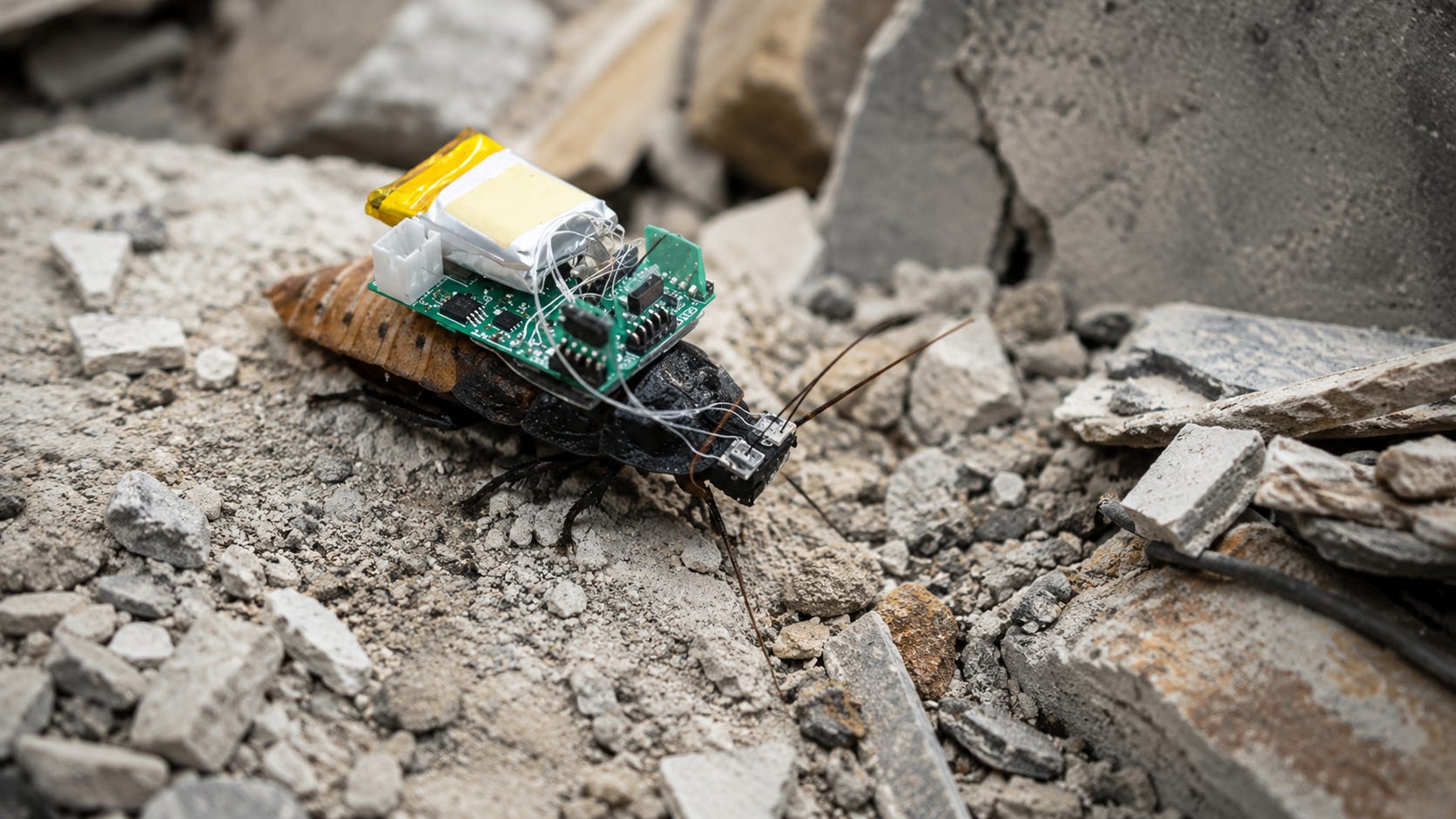
Researchers at the University of Osaka and Universitas Diponegoro have added real-time AI terrain recognition to a cyborg cockroach. The system can distinguish flat ground, ascents, descents, and holes, then change how it stimulates the insect depending on what it is crossing.
The result is counterintuitive. On difficult terrain, better control can mean issuing fewer steering corrections and allowing the cockroach to use the climbing behavior biology already gave it.
That makes this more than a story about remote-controlling an insect with AI. It is a useful example of physical AI built around a simple principle: let the computer decide what actually needs control, then get out of the way when the body already knows what to do.
Key takeaways
The new cyborg cockroach uses a small multilayer perceptron to classify terrain as flat ground, ascent, descent, or hole.
The classifier reached 92% accuracy in an offline evaluation. That is terrain-classification accuracy, not a 92% navigation or rescue success rate.
Terrain-aware control reduced traversal time, total navigation time, travel distance, and electrical stimulation compared with less context-aware navigation.
The breakthrough is partly restraint. Steering during a climb can interfere with the cockroach’s natural movement.
The study does not prove cyborg cockroaches outperform miniature conventional robots in real rubble.
Cyborg cockroaches have already reached an actual disaster zone through a separate Singaporean project, although there is no public evidence that one has located a survivor.
The problem was too much control
Cockroaches are exceptionally good at doing cockroach things.
They can scramble through clutter, climb over objects, squeeze through confined areas, cope with uneven surfaces, follow walls, and recover from awkward body positions without requiring a robotics engineer to program every leg movement.
That is the basic appeal of a biohybrid robot. Instead of building an insect-scale locomotion system from motors, joints, actuators, power electronics, control software, and sensors, researchers attach electronics to an animal whose locomotion already works.
The Osaka group had already demonstrated biohybrid navigation through sand, rocks, walls, and other obstacles. In the underlying Soft Robotics work, the navigation system incorporated free walking, wall-following, obstacle avoidance, and natural climbing behavior rather than continuously commanding every movement.
That approach matters because the insect is not a passive chassis. It is already sensing, balancing, climbing, and responding to contact with the environment.
Climbing exposed the weakness in a controller that lacks enough context.
A terrain-blind navigation system knows where it wants the cockroach to go. When the insect turns away from the desired heading while negotiating an obstacle, the controller can interpret that deviation as an error.
So it corrects it.
That sounds sensible until the cockroach is halfway up something.
The insect may need to change its orientation, reposition its legs, hesitate, or move temporarily away from the target direction as part of a successful climb. A navigation system that keeps correcting those movements can effectively fight the body it is supposed to be using.
The more useful controller starts with a different question: what kind of terrain is the cockroach on right now?
That one change turns navigation from constant correction into context-dependent intervention.
What the AI cyborg cockroach actually does
There is no giant language model riding around on the cockroach.
The researchers use a multilayer perceptron, or MLP, that classifies onboard sensor data into four terrain states: flat surface, ascent, descent, or hole.
The system reported 92% accuracy during offline classifier evaluation.
That number deserves care because it is easy to inflate into a much broader claim than the study supports. It does not mean the cyborg completed 92% of disaster missions, found 92% of victims, or navigated real rubble correctly 92% of the time. It measures one component of the system: how accurately the model classified terrain in the researchers’ offline evaluation.
Once the terrain is recognized, the control strategy changes.
On flat ground, stimulation of the antennae can be used primarily for steering. During ascents and hole traversal, stimulation of the cerci at the rear of the insect is prioritized to encourage forward movement. During descent, the controller can suppress that forward stimulation to reduce the risk of rolling over.
The important part is not merely that different terrain classes trigger different commands. It is that a terrain label can also justify withholding a command.
During a climb, repeatedly steering the insect back toward a target heading can interrupt a useful natural movement. Terrain awareness gives the controller a reason to stop treating every deviation as a navigation error.
The experimental results in Device report reductions in obstacle and hole traversal time, total navigation time, travel distance, and stimulation effort when terrain-aware control is used.
The machine is adding perception and arbitration.
The cockroach is still supplying most of the hard locomotion.
That division is the core engineering idea. The AI does not need to synthesize the animal’s gait or calculate every foot placement. It needs enough awareness to decide when electronic intervention will help and when it is more likely to interfere.
The cockroach is part of the control system
That division of labor is what makes this more interesting than a novelty headline about remote-controlled bugs.
A conventional robot designer tries to build a machine whose mechanics and software jointly solve the terrain problem. A biohybrid system can treat the animal’s body and nervous system as an existing package of locomotion capabilities.
The computer does not need to recreate every reaction that lets a cockroach handle uneven terrain. It can use the insect’s existing responses as part of the overall system.
That changes what good control looks like.
If the body can already solve a local movement problem, sending more commands may reduce performance rather than improve it. The controller’s job becomes choosing the right level of intervention.
This resembles the larger shift toward embodied and physical AI, where models have to perceive and act through physical systems. The unusual part here is that the hardware platform arrived through biology rather than a factory.
That has an important consequence for how intelligence should be measured.
A controller that issues more commands is not necessarily smarter. If the physical system can already solve part of the problem, intelligence may appear as better delegation.
Sense the terrain. Pick the goal. Intervene when necessary. Leave working biology alone when possible.
The AI is valuable because it helps decide where the boundary between those responsibilities should sit.
More on physical AI:

Are cyborg cockroaches actually better than tiny robots?
The new study does not answer that question with a head-to-head test.
There is no equivalent miniature mechanical robot traversing the same course beside the cockroach. Claims that cyborg insects have now “beaten robots” would therefore outrun the evidence.
What the research demonstrates is why the approach is attractive.
The Device paper points to climbing, movement through clutter, stability on uneven terrain, and low biological energy consumption as useful properties of the insect platform. Earlier Osaka research framed the engineering shortcut even more plainly: attaching electronics to an insect avoids having to reproduce all of its locomotion machinery artificially.
That can be especially valuable at very small scales, where batteries, motors, joints, sensors, communications hardware, payload capacity, and mechanical robustness all compete for limited space and weight.
Mechanical robots retain obvious advantages of their own. They can be manufactured to specification, tested repeatedly under standardized conditions, and operated without turning a living animal into part of the machine.
So the useful conclusion is narrower than “cockroaches are better robots.”
Cyborg insects offer a way to outsource difficult locomotion to biology. AI becomes valuable when it helps the electronic half cooperate with the biological half.
Whether that combination ultimately beats a purpose-built robot depends on the mission. This study does not settle that comparison, especially in the rubble, communications conditions, and operational uncertainty of a real disaster site.
Search and rescue is no longer purely hypothetical
There is an important wrinkle in the usual “maybe one day these could search collapsed buildings” pitch.
Cyborg cockroaches have already gone to an actual earthquake zone.


After the March 28, 2025 earthquake in Myanmar, Singapore’s Home Team Science and Technology Agency says its engineers deployed 10 cyborg cockroaches with Singapore Civil Defence Force rescuers.
HTX says the insects were equipped with infrared cameras and sensors and helped rescuers search for signs of life in damaged areas of Naypyitaw. The team conducted five deployments covering 12 sites.
Singapore’s Nanyang Technological University separately describes the operation as the first real-world humanitarian deployment of its cyborg-insect technology.
That does not mean the Osaka controller described in the new Device paper has already operated in Myanmar. These are separate research efforts with different systems.
It also does not prove a cyborg cockroach has successfully found a trapped person. HTX’s public account describes the insects assisting the search for signs of life, but it does not publicly attribute a survivor detection or rescue to one.
That distinction is important because field deployment and field success are different thresholds.
The technology has crossed the line from laboratory curiosity into humanitarian field experimentation. The harder question is whether cyborg insects can deliver repeatable mission results, useful localization, reliable communications, and actionable detections under disaster conditions.
As with autonomous wildfire-response systems, physical AI eventually faces a harsher benchmark than an impressive demonstration. A component can work. A prototype can navigate. A field trial can happen. The full system still has to complete the actual job.
More on AI in the field:

What this study still does not prove
The new Osaka work is a navigation advance, not a finished rescue system.
The experiments used 10 adult male Madagascar hissing cockroaches measuring roughly 6 to 7 cm long. They were tested in a controlled experimental environment.
A real collapsed building introduces problems that a terrain classifier alone does not solve.
Dust can interfere with sensors. Rubble can shift. Communications can disappear behind concrete and steel. Water, fire, heat, sharp materials, and inaccessible voids introduce additional failure modes. Rescuers also need useful localization. Detecting a possible person is much less valuable if nobody knows where the insect found them.
Those are system-level problems, and recognizing an ascent or a hole does not automatically solve them.
Then there is the question of scale. A useful search system might need many insects moving through different voids while software maps where they have been, prevents wasted duplication, maintains communications, and tells rescuers which detections deserve attention.

Singapore’s project is already moving in that direction. NTU reported that a four-insect swarm covered more than 80% of an obstacle-filled test area in 10.5 minutes during laboratory testing.
That result is promising, but it is still a laboratory measure. It does not turn the individual cockroach into a complete rescue product.
The individual insect is only one component.
The harder product is the search system around it: deployment, coordination, sensing, mapping, communications, interpretation, and a way to turn detections into useful decisions for human rescuers.
There is also an animal-welfare question
Calling these systems “cyborgs” can make the underlying mechanism sound more mechanical than it is.
They are living animals.
In the new Osaka study, researchers anesthetized the cockroaches with carbon dioxide and surgically implanted fine electrodes into the antennae and cerci, with another electrode attached at the thorax. The insects were allowed at least 24 hours to recover before experiments, according to the Device study’s experimental methods.
Whether potential rescue benefits justify that intervention is an ethical question the navigation study does not settle.
The engineering trend is interesting because researchers are also investigating ways to guide insects with less invasive methods.
A separate paper from Morishima and colleagues, published on August 26, tested ultraviolet-light stimulation as a non-invasive steering method. Electrical stimulation produced faster navigation in that experiment, while UV-induced turning responses remained more stable across repeated trials.
That produces another engineering tradeoff rather than a neat solution.
Stronger direct control may be faster. Less invasive control may preserve more natural sensory pathways and avoid implanted steering electrodes.
The comparison also reinforces the broader theme running through the terrain-recognition work. More control is not automatically the same thing as better control. The value depends on how the intervention changes the behavior of the living system carrying the electronics.
Why restraint may be the real breakthrough in physical AI
Physical AI is often presented as a race to put increasingly capable models inside machines.
The AI cyborg cockroach suggests another path.
The computer does not need to replace everything the physical system can already do. It needs enough perception to recognize the situation, enough intelligence to choose an appropriate intervention, and enough restraint to leave a competent physical system alone.
For this particular robot, biological locomotion is already included.
That changes the optimization target. The goal is not maximum command authority over every movement. It is a productive partnership between a controller that can recognize context and a body that already knows how to climb, balance, squeeze, and recover.
The 92% classifier figure is useful, but it is not the most interesting part of the study. The more important result is what terrain recognition allows the controller to do with that information.
Sometimes it steers.
Sometimes it encourages forward movement.
Sometimes it suppresses stimulation.
And sometimes the smartest move is to stop interfering.
That is why the most interesting result from an AI-controlled cockroach is not stronger remote control. It is a controller that can recognize when its own correction is becoming the problem.
The cockroach already knows how to climb.
The AI is learning when to let it.
Explore more from Popular AI:
Start here | Local AI | Builds & gear | Autonomy & policy | Fixes & guides | Popular AI podcast
Would you trust AI-guided cyborg cockroaches in a real search-and-rescue mission, or does the biohybrid approach go too far?