



If an AI coding agent can read your repo, run commands, edit files, call cloud models, log telemetry, and lose access because of provider policy, it is no longer a harmless productivity plug-in.
That is the deeper lesson from the reported Alibaba Claude Code ban. The story is not only about Alibaba, Anthropic, China, or one coding tool. It is about a bigger shift in software development. AI coding agents are becoming remote infrastructure with account rules, telemetry defaults, enterprise controls, jurisdiction limits, and policy enforcement built into the workflow.
The practical question for developers is simple: should Claude Code, Codex, Qoder, ZCode, Gemini CLI, or local agents be allowed near private repositories?
The answer depends on what the agent can see, where the model runs, who controls access, what telemetry leaves the machine, which account is being used, and what happens when a vendor, employer, cloud partner, or regulator changes the rules.
More on AI coding agents:

Key takeaways on the Alibaba Claude Code ban
Reuters reported on July 3, 2026 that Alibaba banned employees from using Claude Code at work after scrutiny over features that could help identify China-linked users. Reuters attributed the order to a person familiar with it and said Alibaba directed employees toward its own Qoder platform.
The main control lever is hosted access to the coding stack. Claude Code may run on a developer’s machine, but it still depends on Anthropic model access, account rules, supported-region policy, telemetry design, enterprise settings, and vendor-side enforcement.
The report is not proof that Claude Code is malicious. Anthropic’s own Claude Code data usage docs say the tool logs operational metrics without code or file paths, and that telemetry can be disabled with
DISABLE_TELEMETRY. The risk is broader: hosted coding agents create more points where access rules, telemetry defaults, and platform policy can shape development work.
Developers should treat coding agents as semi-trusted infrastructure, not autocomplete. A coding agent can inspect project context, propose edits, run shell commands, install dependencies, follow repo instructions, and touch secrets if the environment allows it.
The safer workflow is tiered. Use hosted agents for public or low-risk work, enterprise-hosted agents for sensitive company code, and local or self-hosted agents for repositories where privacy, jurisdiction, account risk, or resilience matters more than frontier-model quality.
The real decision is not Claude Code versus Qoder versus Codex in the abstract. It is which agent gets access to which repo, under which account, in which jurisdiction, with which fallback.
What happened at Alibaba
Reuters reported that Alibaba banned employees from using Anthropic’s Claude Code at work after the tool came under scrutiny for features that can help identify users linked to China. The same report said the order came amid a broader dispute after Anthropic accused Alibaba of illicitly extracting Claude model capabilities through distillation, a claim Alibaba had not publicly commented on at the time of the report. Reuters also said Alibaba employees were being told to use Qoder, the company’s own coding platform.
The reported ban is not happening in isolation. Anthropic has a published supported countries and regions policy and says that, where legally permitted, it reserves the right not to provide products or services to entities whose majority ownership traces to nations outside its supported regions.
Anthropic also tightened its position in a September 4, 2025 update on sales restrictions for unsupported regions. In that update, the company said its terms prohibit use in certain regions and described companies from China and other unsupported regions accessing services through subsidiaries as a risk it wanted to address.
That context matters because the Alibaba report is really about control. A coding agent can look like a local dev tool. Yet the account, model access, model routing, telemetry design, enterprise policy, and eligibility rules often live elsewhere.
What actually triggered the concern
Reuters reported that developers had identified mechanisms in Claude Code that inspected environment signals such as timezone and proxy-related information. It also reported that an Anthropic employee described the feature as a March experiment aimed at preventing unauthorized resale and model distillation. That Reuters account supports a narrower conclusion than the phrase “backdoor” suggests.
The public evidence does not prove that Claude Code is a malicious tool. It does show that Anthropic has policy reasons to detect restricted access, and that a coding agent embedded in developer workflows creates a technical place where those rules can be enforced.
For developers, the important question is less dramatic and more practical: what signals can the tool collect, what signals can the provider use, what can be disabled, what cannot be disabled, and what happens if the account or organization is no longer eligible?
The control lever is hosted model access
The control lever is hosted model access tied to a local development agent.
Claude Code is a command-line development tool, but its value depends on Anthropic-controlled model access. Anthropic’s Claude Code data usage page says Claude Code connects from user machines to Anthropic for operational metrics such as latency, reliability, and usage patterns, while excluding code and file paths from that logging. The same page says telemetry can be disabled with DISABLE_TELEMETRY, and that Sentry error reporting can be disabled separately with DISABLE_ERROR_REPORTING.
That is the bargain with many modern coding agents. The agent may sit in the terminal. The intelligence, authentication, billing, model routing, policy enforcement, telemetry defaults, and rate limits often sit with a hosted provider.
The practical control points include account eligibility, supported-region policy, provider terms, enterprise allowlists, blocklists, telemetry defaults, error reporting, cloud model access, API keys, token budgets, repo permissions, local shell permissions, environment variables, and employer compliance rules.
A normal IDE plugin suggests code. A coding agent can act. It can inspect a repository, modify files, run tests, install packages, call tools, and recover from errors. Microsoft’s Claude Code for Foundry documentation describes Claude Code as an agentic coding tool that reads codebases, edits files, runs commands, and integrates with development tools. Microsoft frames Foundry configuration as a way to run Claude Code on Azure infrastructure while keeping data inside an enterprise compliance boundary.
That is the enterprise version of the lesson. Serious teams are already asking where the agent runs, which boundary contains it, which identity system governs it, and who can audit or block it.
What the ban means for developers
For solo developers, the lesson is not “never use Claude Code.” Claude Code remains a powerful agentic coding tool because it can reason across a real project and operate inside the terminal. The lesson is that convenience now comes with a control layer. If your account, region, payment method, employer, repo content, or usage pattern trips a policy, your workflow can change even when your code has not.
For enterprise developers, the Alibaba report turns AI coding into a procurement and compliance question. A tool that looks like a personal productivity boost can become restricted software once it touches company code, private infrastructure, customer data, regulated workloads, or supply chains with national-security sensitivity.
For open-source maintainers, the risk looks different. Public repos reduce privacy exposure, but they do not remove supply-chain and security risk. AGENTS.md has become a common format for giving coding agents repository instructions, and the project says it is used by more than 60,000 open-source projects. That makes agent-readable repo context a new part of software maintenance.
For local AI users, the news strengthens the case for a fallback. Local coding agents are usually weaker than frontier hosted agents, especially for large refactors, deep debugging, and messy multi-file changes. But a local workflow can keep private code away from a third-party model account. We have already covered practical fallback paths such as an independent AI dev stack with Claude Code and local models.
The stated goal may be legitimate, but the mechanism still matters
Anthropic’s stated position is that unsupported-region restrictions are about legal, regulatory, and security risk. In its September 2025 update, the company said entities controlled from unsupported regions could face legal obligations that create national-security concerns, and it singled out distillation as one way restricted entities could use Claude to advance their own AI systems. Anthropic described those restrictions in its unsupported-region policy update.
That goal may be sincere. The mechanism still matters.
The mechanism is not a law passed by a legislature. It is a platform rule enforced through accounts, ownership rules, traffic analysis, cloud access, product behavior, and terms of service. That is why developers outside China should still pay attention. The same architecture that can enforce a China restriction can enforce other restrictions later.
A model provider can change supported regions. An employer can ban a tool. A cloud partner can require a different deployment path. A compliance team can move developers from one coding agent to another. A platform can alter telemetry, billing, usage limits, model availability, account rules, or content policy.
If the agent is part of your daily development loop, these are not abstract policy changes. They become build-system risk.
Why coding agents are riskier than chatbots
A chatbot can be risky if you paste secrets into it. A coding agent can be risky even when you think you are only asking it to help with setup.
Coding agents operate across several surfaces at once: the repo, the terminal, the shell environment, dependency installers, local files, Git history, issue text, logs, API keys, cloud credentials, CI scripts, package scripts, MCP tools, and agent instruction files.
That is why the security model must be stricter than “do I trust the model’s answer?”
Mozilla’s 0DIN team demonstrated the issue with a proof of concept in which a normal-looking GitHub repository could lead Claude Code into executing a payload fetched through DNS. The 0DIN report said the malicious payload was not present in the repository and was instead pulled at runtime from a DNS TXT record, making it invisible to ordinary file review before execution.
That is not only a Claude Code problem. It is a class problem for agents that try to be useful by running setup commands, fixing errors, trusting project instructions, and following package-level hints. An agent does not need malicious intent to create damage. It only needs enough tool access and too much trust in the context around it.
Reliability is still uneven
The engineering quality of coding agents is improving fast, but the stack is still fragile.
A March 2026 empirical study of Claude Code, Codex, and Gemini CLI examined more than 3,800 publicly reported bugs in their GitHub repositories. The authors found that more than 67% of the bugs were functionality-related, 36.9% were rooted in API, integration, or configuration errors, and common symptoms included API errors, terminal problems, and command failures. The study framed those findings as engineering pitfalls in AI coding tools.
That does not mean coding agents are useless. It means the agent stack is still fragile in the places developers care about most: invocation, configuration, tool execution, command flow, and integration with real projects.
Microsoft’s early-2026 rollout study shows why companies still tolerate that fragility. The paper studied tens of thousands of Microsoft engineers using Claude Code and GitHub Copilot CLI, and reported that adopters merged roughly 24% more pull requests than they otherwise would have, while noting that merged PRs are only a proxy for output value. That finding came from Microsoft’s study of command-line AI coding agent adoption.
The same paper says the analysis window ended before an internal announcement that most Claude Code licenses would be discontinued and affected engineers would be moved to Copilot CLI. That detail in the HTML version of the Microsoft rollout paper is the entire story in miniature. Coding agents can be useful enough to spread, expensive enough to control, and policy-dependent enough to disappear from a team’s workflow.
The tool choice is now geopolitical
Alibaba’s reported move is part of a broader split in AI coding infrastructure.
On one side, U.S. model providers are restricting access by region, ownership, risk category, and enterprise terms. On the other, Chinese AI companies are pushing domestic and open models into coding workflows. Reuters reported that Chinese cloud and AI firms have shifted toward domestic and open-source models such as DeepSeek, Alibaba’s Qwen, Moonshot, and Zhipu as U.S. providers try to prevent unauthorized access, resale, and distillation. That broader shift was part of Reuters’ Alibaba Claude Code report.
Z.ai is now pushing directly into the coding-agent market. Business Insider reported on July 2, 2026 that Z.ai released ZCode, an AI coding harness that competes with Cursor and GitHub Copilot and connects to multiple models. The report said ZCode’s Lite plan was on sale for $16.20 per month and its Max plan for $144 per month.
ZCode’s official page describes the product as an official harness for GLM-5.2 and lists GLM Coding Lite at $16.20 per month during the displayed promotion. Z.ai’s documentation also says new users can connect models through trial quota or GLM Coding plans inside ZCode’s model configuration flow.
Alibaba has its own Qoder stack. Alibaba Cloud’s documentation describes Qoder as an agentic coding platform with a desktop IDE, CLI, and JetBrains plugin, and says it can connect to Alibaba Cloud Model Studio through pay-as-you-go, Coding Plan, or Token Plan access. Qoder’s Cloud Agents docs describe a fully managed runtime for AI agents that runs tasks in cloud sandboxes with configurable environments, tools, and sessions.
That does not make Chinese coding agents automatically safer. It means the trust question moves. With Claude Code, a Chinese company may worry about U.S. provider detection and restrictions. With Qoder or ZCode, a U.S. or European company may worry about vendor jurisdiction, data handling, compliance boundaries, model routing, and future access risk.
The model provider changed. The control problem did not vanish.
Claude Code, Codex, Qoder, ZCode, Gemini CLI, or local agents?
The right tool depends on the repo, the account, and the organization’s risk tolerance.
Use Claude Code when capability matters and the repo is low to medium sensitivity
Claude Code is still a strong choice for real development work, especially when the repo is already allowed under your company’s AI policy and the model provider’s terms. Use it for code reading, tests, small refactors, docs, prototypes, migration planning, and debugging where the productivity gain is worth the hosted-model dependency.
Do not use it blindly on repos that contain customer data, credentials, regulated code, trade secrets, unreleased product strategy, security-sensitive systems, or jurisdiction-sensitive material unless your organization has approved the deployment path.
Use enterprise-hosted Claude Code or Copilot-style tooling when compliance matters
For larger companies, the better question is not whether the tool is good. It is whether the tool can run inside a boundary the company can govern.
Microsoft’s Foundry docs frame Claude Code on Azure around private networking, role-based access control, enterprise-grade security, compliance boundaries, and cost management.
That is where enterprise AI coding is moving: central authorization, central logging, central cost controls, approved model routing, and clear deployment boundaries.
Use Codex if your team is already standardized on OpenAI
OpenAI’s Codex CLI repository describes Codex CLI as a coding agent that runs locally on the user’s computer, with sign-in through ChatGPT plans or setup through an API key.
That makes Codex attractive if your team is already standardized on OpenAI, ChatGPT, GitHub, or a workflow where OpenAI-controlled tooling is easier to approve. The tradeoff is similar to Claude Code. The agent runs locally, but model access and account status still depend on a hosted provider.
Use Gemini CLI when open-source client code and Google access matter
Google’s Gemini CLI repository describes Gemini CLI as an open-source terminal agent with Gemini access, file operations, shell commands, web fetching, MCP support, and an Apache 2.0 license.
That can be useful if you want a visible client stack, Google account access, and a terminal-first agent. But unless you configure a different backend, the model path still runs through Google.
Use Qoder or ZCode when the model ecosystem and pricing fit the risk profile
Qoder and ZCode make sense for developers or teams that want to test the Chinese coding-agent ecosystem, GLM-based workflows, or lower-cost coding plans. Z.ai’s GLM-5.2 and ZCode push the market toward cheaper and more open coding-model infrastructure. Popular AI has already covered why GLM-5.2 is worth testing for open coding agents, while warning that serious local use still runs into hardware and serving constraints.
The caution is obvious: do not switch from one jurisdiction problem to another without reading the terms, data policy, model-routing path, telemetry defaults, and enterprise controls.
More on GLM-5.2 for AI coding agents:

Use Aider or local agents when control matters more than peak model quality
Aider’s docs say it can connect to most LLMs and can work with local models through Ollama or OpenAI-compatible local APIs. That makes Aider a better fallback for developers who want a git-centered coding workflow while keeping model access local or private.
Local coding agents are not magic. They are usually weaker on large, messy, multi-file tasks. But they are the right tool for private scripts, small repos, documentation updates, local refactors, test scaffolding, and sensitive code exploration where cloud upload is the wrong default.
A safer repo policy for AI coding agents
The practical move is to classify repos before picking an agent.
Tier 1: public and disposable code
Use hosted agents freely, but still review diffs and commands. This tier includes throwaway prototypes, open-source examples, tutorials, documentation sandboxes, and personal experiments with no secrets.
Recommended tools: Claude Code, Codex, Gemini CLI, ZCode, Qoder, Aider.
Tier 2: private but low-risk code
Use hosted agents if the repo has no credentials, no customer data, no unreleased strategy, and no regulated material. Keep secrets out of the environment. Run the agent in a clean workspace. Review commands before execution.
Recommended tools: Claude Code or Codex for capability, with Aider or a local agent as a fallback.
Tier 3: company code with business value
Use only approved agents. Prefer enterprise deployment, private networking, central logging, policy controls, and cost tracking. Do not let individual developers route sensitive company code through personal accounts.
Recommended tools: enterprise-hosted Claude Code, GitHub Copilot, approved Codex deployment, approved Qoder enterprise path, or local agents connected to internal model hosting.
Tier 4: regulated, customer, security, or jurisdiction-sensitive code
Do not use consumer hosted agents. Use enterprise-controlled deployments, self-hosted models, or local tools. Keep repo access, logs, prompts, outputs, and tool execution inside a boundary your organization controls.
Recommended tools: self-hosted coding model, approved enterprise cloud, Aider with a local or private model endpoint, or strictly sandboxed local agents.
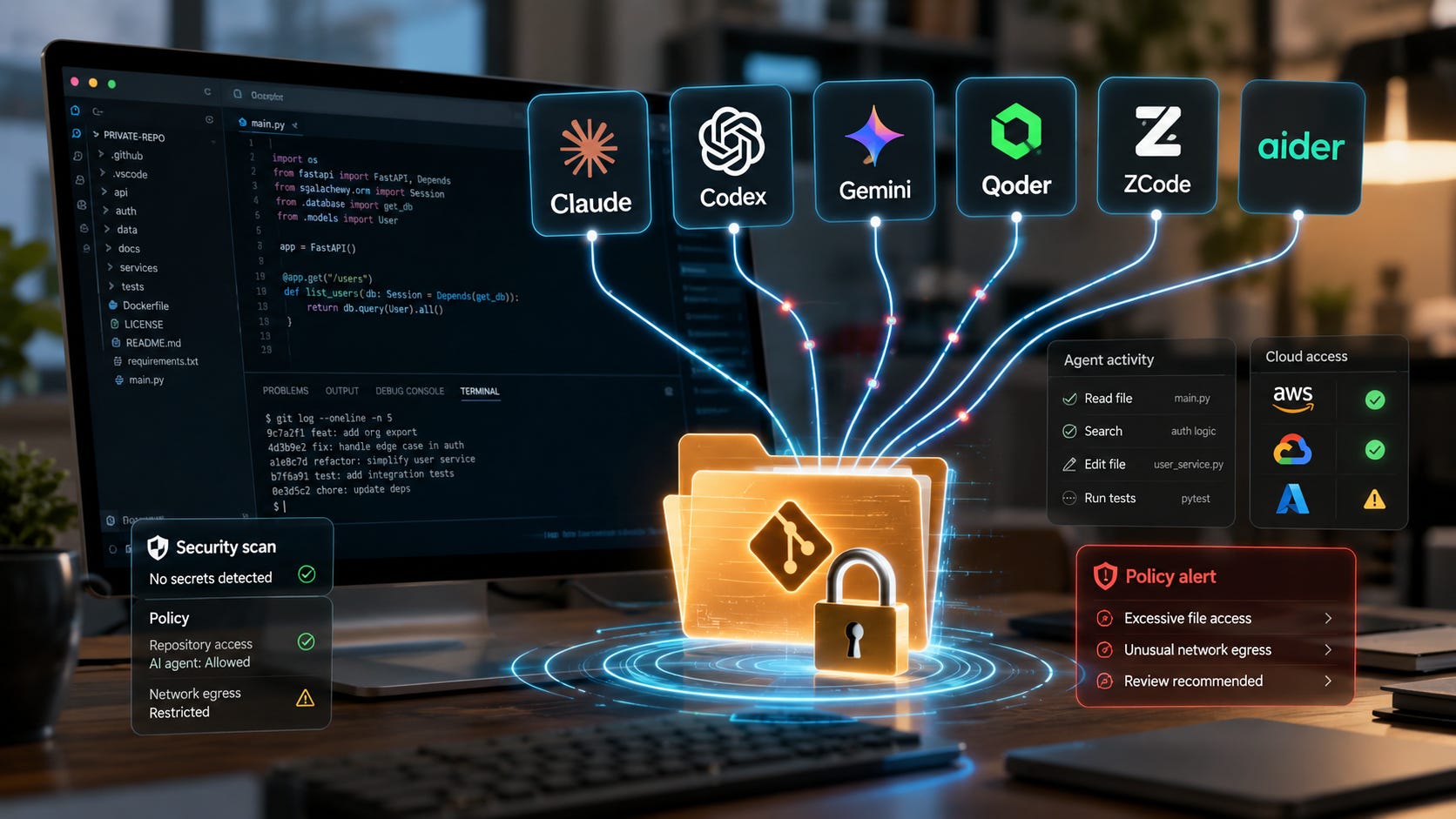
Guardrails developers should add now
Before letting any coding agent touch a repo, set a few hard rules.
Run agents inside a clean workspace, container, VM, or low-privilege user account when possible. Never expose long-lived cloud credentials through the shell environment. Use .env.example files instead of real .env files. Require human approval before package installs, shell scripts, database migrations, and network calls.
Start with read-only planning before edit mode. Keep git clean before every agent run. Review every diff before commit. Add an AGENTS.md file that tells agents how to test, what not to touch, where secrets are stored, and which commands are forbidden. Disable nonessential telemetry where the tool supports it. Keep a local fallback for private tasks and outage days.
Also, do not install coding agents from ads, shared chats, screenshots, Discord messages, random GitHub clones, or pasted terminal commands.
That last point is already a live threat. One of our recent articles covered Claude Code install scams where attackers used legitimate-looking claude.ai shared links and Google Ads to push fake install commands. The safer pattern is to start from official setup docs and verify the package name before running anything in Terminal.
More on Claude Code install exploits:

What could be abused later
The Alibaba case points to a broader precedent: coding agents give platforms a new place to enforce rules inside developer workflows.
The same mechanisms could be used for legitimate security controls. They could also enable broader lockouts or surveillance-like enforcement. A vendor could restrict access by region, ownership, payment method, project type, output category, repo content, employer policy, or risk score. An employer could mandate one agent because it controls the billing and logs. A state could pressure local providers to detect disallowed use. A cloud provider could require traffic to pass through approved infrastructure.
None of that requires the coding agent to be bad. It only requires the agent to be useful enough that developers depend on it.
That is why the fallback matters. Rented intelligence is valuable. It is still rented.
The Alibaba Claude Code ban is a repo-security warning
Use hosted coding agents, but stop treating them like harmless editor extensions.
Claude Code, Codex, Gemini CLI, Qoder, and ZCode can all be useful. The safer decision is to match the agent to the repo’s sensitivity. Public code and prototypes can use the strongest hosted tool available. Private business code needs approved accounts, clear telemetry settings, strict secret handling, and enterprise controls. Regulated or jurisdiction-sensitive repos need a local, self-hosted, or tightly governed path.
The reported Alibaba ban is not only a China story. It is a preview of how AI coding tools will be controlled everywhere: through accounts, regions, model access, telemetry, cloud boundaries, employer policy, and cost.
If a coding agent can touch your repo, it belongs in your security model.
FAQ
Did Reuters prove Claude Code has a backdoor?
No. Reuters reported that Alibaba banned Claude Code at work after scrutiny over features that can help identify China-linked users. The public evidence supports a policy-enforcement and telemetry concern, not a proven malicious backdoor. Reuters’ report also attributed the ban to a person familiar with the order.
Does Claude Code send my code to Anthropic through telemetry?
Anthropic’s Claude Code data usage docs say operational metrics do not include code or file paths. The same docs say the
/feedbackcommand can send conversation history, including code, if the user submits it and chooses how much history to include.
Can I disable Claude Code telemetry?
Anthropic says Claude Code telemetry can be disabled with the
DISABLE_TELEMETRYenvironment variable, and error reporting can be disabled withDISABLE_ERROR_REPORTING.
Are local coding agents safer?
They can be safer for privacy because repo contents do not need to go to a hosted model account. They are not automatically safe. A local file-writing agent can still make bad edits, run dangerous commands, or expose secrets if you give it too much access.
Is Qoder safer than Claude Code?
Not automatically. Qoder may be a better fit for Alibaba or teams aligned with Alibaba Cloud, but it still introduces vendor, cloud, account, telemetry, and jurisdiction questions. Alibaba Cloud’s docs describe Qoder as an agentic coding platform that can connect to Alibaba Cloud Model Studio plans, while Qoder Cloud Agents run tasks in managed cloud sandboxes.
Should developers stop using AI coding agents on private repos?
No. They should stop using them casually. Private repos need classification, approved accounts, secret handling, command approval, clean git state, telemetry review, and a fallback path.
Explore more from Popular AI:
Start here | Local AI | Fixes & guides | Builds & gear | Popular AI podcast
Would you let Claude Code, Codex, or another AI coding agent access your private repos today, or is that already too much trust?