


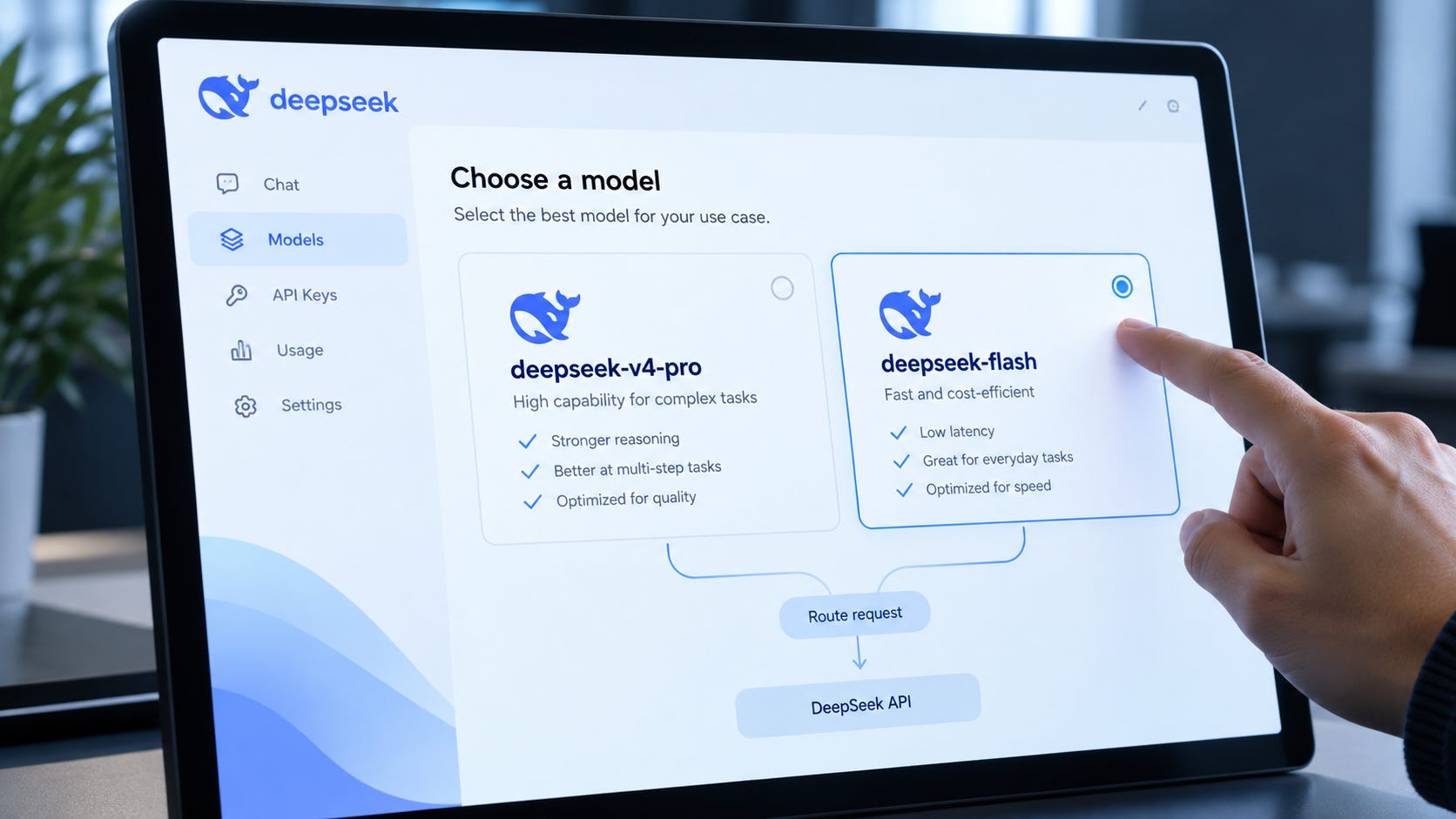
DeepSeek just removed the deadline hanging over V4 Pro users.
The company originally said that beginning September 14, 2026, requests to deepseek-v4-pro would be routed to V4.1-Flash until V4.1-Pro arrived. Then it reversed course. A September 11 revision replaced the forced-migration notice with language saying V4 Pro would continue after September 14 with unchanged billing, citing user demand.
That changes the decision. V4 Pro users no longer need to plan around an automatic model swap. They can ask the more useful question: Is V4.1-Flash actually better for my application?
For coding agents, high-volume API jobs and multimodal workflows, V4.1-Flash deserves an immediate production test. For applications that depend on deep explanations, long-context reasoning or behavior already validated on V4 Pro, there is no good reason to switch blindly. DeepSeek’s own benchmark results show a much more workload-dependent comparison than a simple “new model wins” story.
DeepSeek V4 Pro vs V4.1 Flash: key takeaways
DeepSeek withdrew the planned September 14 forced replacement of V4 Pro.
deepseek-v4-procontinues operating instead of automatically routing to Flash.
V4.1-Flash is much cheaper on the September 10 launch rate card, adds native image input, and targets faster, more efficient agent and multimodal workloads.
DeepSeek’s own results still put V4 Pro ahead on several reasoning, knowledge and long-context tests. Flash is not a universal upgrade.
Early user reports are similarly workload-dependent. One single-run coding comparison reported 38% lower wall time and 43% fewer total tokens, while other users reported weaker depth for studying and explanation-heavy work.
The safest migration strategy is to replay real production requests through both models and compare accepted results, retries, latency, token use and human repair.
For new Flash integrations, DeepSeek says to use the canonical
deepseek-flashAPI ID rather than building around the retired V4 Flash names.
DeepSeek reversed the September 14 V4 Pro cutoff
DeepSeek’s September 10 V4.1-Flash launch announcement was unusually explicit. It said the older V4 Flash and V4 Flash Vision Exp models were retired, with their legacy IDs temporarily routing to V4.1-Flash. It also said that all deepseek-v4-pro requests would begin routing to V4.1-Flash at 04:00 UTC on September 14.
That second part is now obsolete.
The tracked pricing-page revision shows that on September 11 DeepSeek replaced the retirement language with a statement that V4 Pro API service would continue after September 14 and keep its existing billing. The reversal matters because model routing is not a cosmetic change. A stable API identifier can still produce different behavior when the provider changes the model behind it.
There is also a documentation wrinkle. DeepSeek’s September 10 launch article still contains the original forced-routing announcement. That is why searches can still surface an official-looking instruction that says V4 Pro will be replaced. The later pricing-page revision changed that plan.
For production users, the reversal is useful even if V4.1-Flash turns out to be excellent. You can validate Flash on your own schedule rather than discovering that an existing model ID silently started serving a different model.
Test V4.1-Flash, but do not migrate on benchmark scores alone
V4.1-Flash should probably enter your evaluation suite now. It should not automatically replace V4 Pro.
If your workload is coding, tool-heavy agents, repetitive automation, high-volume inference or image-aware processing, Flash has enough technical and economic advantages to justify serious testing. If V4 Pro already passes your production acceptance tests and failures are expensive, keep it in place while Flash proves itself.
API models are components, not sports teams. A higher benchmark score tells you very little about whether a model preserves your JSON schema, chooses the correct tool on turn 37, notices the important clause in a long document, or writes code your tests accept.
Popular AI’s broader AI API comparison guide focuses on cost per accepted task rather than raw token price. That is the right frame here. Flash can be dramatically cheaper per token and still be the wrong model if it creates enough retries, partial completions or human cleanup.
The inverse is also true. A more expensive V4 Pro request can be cheaper in practice if it reliably completes a task that Flash repeatedly fumbles. Production economics start after the benchmark chart ends.
More on AI tokenomics:

Why V4.1-Flash is tempting for agents and high-volume API work
V4.1-Flash is a substantial architecture change, not a minor V4 refresh.


Its cache design is also aimed directly at long-context and agent workloads. DeepSeek says the global KV cache footprint is roughly one quarter of V4 Flash’s, while persistent KV storage falls to roughly one eighth. For agents that repeatedly reuse long context, those changes can affect both serving cost and throughput.
Then there is price. On the September 10 launch-day rate card, V4.1-Flash was listed at $0.15 per million uncached input tokens and $0.60 per million output tokens off-peak, compared with $0.66 and $1.98 for V4 Pro. Peak rates were twice the off-peak rates in that launch pricing structure.
That gives the launch version of Flash roughly a 4.4x advantage on uncached input and a 3.3x advantage on output before cache behavior enters the calculation. At agent scale, where one job can burn through millions of tokens, that difference is large enough to justify a migration test even when V4 Pro is working fine.
Flash also adds native image understanding. If your workflow needs screenshots, diagrams, photographed documents or other image inputs, the model removes the need to stay on a separate experimental vision route.
Price alone still does not decide the migration. A model that is three times cheaper per output token but needs twice as many retries can lose much of that advantage. The unit to watch is the finished task you can actually use.
DeepSeek’s benchmarks do not show a universal V4 Pro replacement
DeepSeek’s launch language says V4.1-Flash surpassed V4 Pro across performance, cost, speed and total time. Its published evaluation tables tell a more workload-specific story.
At maximum reasoning effort, V4.1-Flash scores 90.6 on Terminal-Bench 2.1 versus V4 Pro’s 87.9. On DeepSWE v1.1, Flash reaches 74.2 versus 62.7. Flash also leads V4 Pro in DeepSeek’s published results on Terminal-Bench 3.0, CyberGym, SEC-Bench Pro, HLE with tools, AutomationBench and Agent’s Last Exam.
That is a strong result for coding and agentic work. It fits the product pitch.
The same tables also contain clear V4 Pro wins. On GPQA Diamond, V4 Pro scores 92.4 while V4.1-Flash scores 90.9. On the text-only HLE comparison, Pro records 42.7 while Flash gets 39.1. DeepSeek’s base-model results also put Pro ahead on SimpleQA Verified, MultiLoKo, BBH and LongBench-V2.
Those losses do not make Flash a bad model. They show why “Flash beat Pro” is too broad to be a migration rule. A model can be the better terminal agent and still be worse for a research explanation, long-context synthesis task or knowledge-heavy workflow.
If your application resembles Terminal-Bench, those agent scores are highly relevant. If it resembles a document analyst that must explain a complex source in detail, a different part of the evaluation set may deserve more weight.
Early users are seeing the same workload split
Community reports are anecdotal, but they can reveal failure modes that benchmark summaries hide.
One r/DeepSeek user described V4.1-Flash as fast but much weaker for studying and detailed explanations. Other commenters in the same discussion pushed back and reported good results for coding, research and problem solving. That disagreement is useful because it points to task sensitivity rather than a clean winner.
Another user ran V4.1-Flash and V4 Flash Vision Exp against the same coding assignment. In that single run, V4.1-Flash completed in 18 minutes 49 seconds versus 30 minutes 11 seconds and consumed 11.59 million tokens instead of 20.31 million.
The result looks impressive until you inspect the completion state. The V4.1-Flash run still showed one task in progress and another pending when the comparison was captured, while the older Vision Exp run had completed all 11 tasks. The author explicitly called it a quick test rather than a controlled benchmark.
That caveat is the migration problem in miniature. Faster and cheaper is valuable. The job still has to finish correctly.
Replay your real workload before switching
A useful V4 Pro versus V4.1-Flash test does not need a benchmark lab. It needs requests that resemble the work you actually pay the API to perform.
Start with a representative production sample. For a small application, 50 to 100 cases may already expose obvious differences. Larger deployments should build a regression set around important task categories, expensive failures and known weak spots.
Keep prompts, tool definitions, system instructions and acceptance criteria as consistent as the APIs allow. DeepSeek exposes thinking-mode and reasoning-effort controls, so comparing one model at maximum effort against another at a cheaper setting mostly tells you that you configured them differently.
Measure the parts that can change the decision:
Task success: Did the final result pass your validator, unit tests or human acceptance criteria?
Structured output: Does valid JSON stay valid? Are required fields present? How often do you need a retry?
Tool use: Does the model select the right tool, provide valid arguments and recover from failed calls?
Code quality: Run the tests. Count regressions and human fixes instead of judging snippets by appearance.
Reasoning and explanation depth: Include cases where completeness, nuance or teaching quality changes whether the answer is useful.
Latency and tokens: Record time to first token, total runtime, input tokens, output tokens, cached tokens and retries.
Vision: If screenshots, diagrams or documents are part of the workflow, test them directly because native image input is one of Flash’s concrete advantages.
Then calculate the number that affects your budget: cost per accepted result.
The cheaper model wins only when it remains cheaper after failed attempts, extra turns, retries and cleanup. If Flash costs less per token but causes more repair work, the savings can disappear quickly. If it matches or beats Pro’s acceptance rate, the lower token cost becomes much more compelling.
For a low-risk rollout, route a small share of eligible traffic to Flash first and keep V4 Pro as the fallback. Watch failure reasons, not only aggregate pass rate. A five-point gain can hide a new failure mode that matters to one customer or one high-value workflow. Expand the Flash share only after the errors you care about stay within your existing tolerance. That gives you a reversible migration instead of a launch-day bet.
Use deepseek-flash for new Flash integrations
DeepSeek now tells new V4.1-Flash integrations to use:
deepseek-flashThe older deepseek-v4-flash and deepseek-v4-flash-vision-exp identifiers are compatibility routes whose original models have been retired. They temporarily point to V4.1-Flash.
There is little reason to create new technical debt around retired model names. More importantly, do not spread the selected model ID through application code. Put it in configuration so a model change is a deployment change, not a rewrite.
Keep prompts, tests and business logic outside provider-specific dashboards where practical. A model should be a replaceable dependency with a clear interface and a regression suite behind it.
DeepSeek’s reversal is a mild version of the dependency problem in Popular AI’s analysis of OpenAI’s planned Cursor cutoff and model portability. This time users gained an option instead of losing one. The same control point exists either way. The provider decides what an API identifier serves and how long a model remains available.
More on AI model portability:

V4.1-Flash is open weight, but it is not a casual local model
DeepSeek has released V4.1-Flash weights under the MIT license on Hugging Face, with support paths for vLLM and SGLang. That gives organizations another deployment option if they want more control over where inference runs.


Do not read “8B active parameters” as “8B local model.”
The published model has a 552B backbone plus additional Engram conditional-memory parameters. The current vLLM deployment recipe classifies the setup as advanced and lists H200, GB200, GB300 and MI350X hardware among its verified targets. This is datacenter territory, not a normal gaming-PC download.

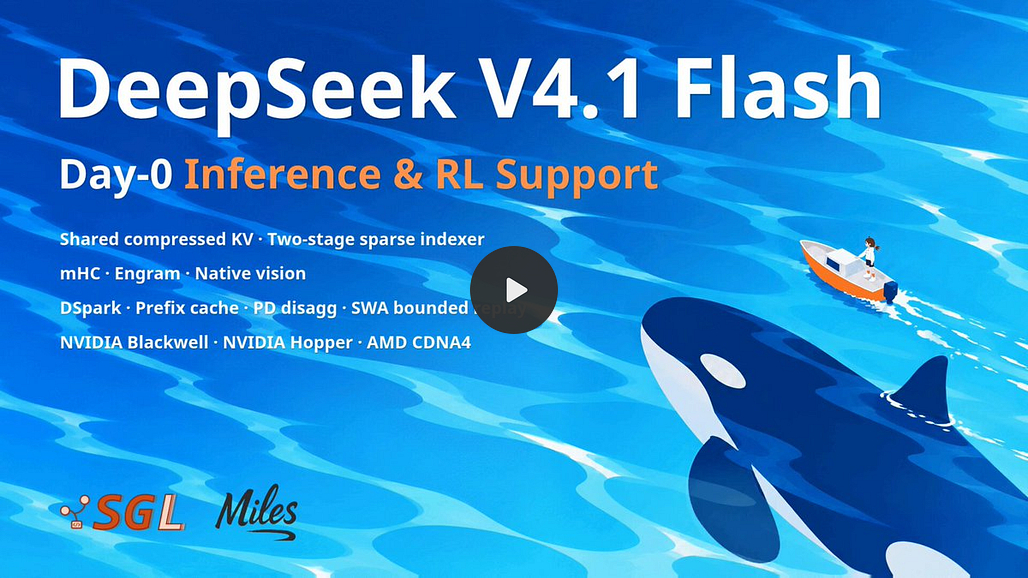
For most individual developers, the hosted API will remain much easier than self-hosting the full model. Teams considering local alternatives should separate two questions: whether V4.1-Flash can be self-hosted, and whether they actually need this specific 552B model to build a useful fallback.
Popular AI’s local AI guide covers the hardware, privacy and API tradeoffs, while its open-source LLM guide explains how open weights, licenses and hardware fit affect local deployment. A smaller local model may be a much more realistic fallback even if it cannot reproduce V4.1-Flash performance.
More on open-weight AI coding:


Staying on V4 Pro has a price
DeepSeek’s reversal preserves choice, but that choice still has an operating cost.
V4 Pro was substantially more expensive than V4.1-Flash on the September 10 launch rate card, and it does not provide Flash’s native image input. For high-volume agent workloads, those differences become difficult to ignore if Flash produces equivalent or better accepted results.
“We already trust Pro” is a valid reason to delay a migration. It is not a reason to stop testing.
If Flash passes the same tests, completes agent jobs faster and cuts token cost sharply, continuing to pay Pro rates out of habit makes little sense.
If Flash fails tasks that Pro handles reliably, the higher price is buying something real: fewer bad outputs, less repair work or more consistent behavior.
That is why a selective migration can be better than an all-or-nothing switch. Coding and image-heavy jobs may move first. Research, teaching or high-risk long-context tasks may stay on Pro. A router can make that decision per workload once the eval data supports it.
Who should switch to V4.1-Flash now?
▪ Start migrating now if your workload is dominated by coding agents, terminal work, tool use, high-volume automation or image input, especially when outputs are easy to verify automatically. Flash’s agent benchmarks, native vision and lower launch pricing make those workloads the clearest candidates.
▪ Run both in parallel first if your application mixes coding with research, explanation, long documents, analysis or customer-facing prose. Flash may win some categories while Pro remains better in others. Parallel replay gives you evidence without forcing a risky cutover.
▪ Stay on V4 Pro for now if you already have a validated production workflow where behavioral consistency is worth more than token savings and your own evaluation has not shown that Flash can replace it. The September 11 reversal gives you room to make that call deliberately.
And if your application cannot tolerate a vendor changing or withdrawing a model, put more effort into fallback design than into arguing over which DeepSeek model wins this week. A tested provider or model fallback protects you from more than one release cycle.
FAQ
Is DeepSeek V4 Pro still available after September 14, 2026?
Yes. DeepSeek’s revised pricing-page notice says V4 Pro API service will continue after September 14 with unchanged billing. The company had previously announced that
deepseek-v4-prowould route to V4.1-Flash, but the September 11 revision withdrew that forced migration.
Is V4.1-Flash better than V4 Pro?
For some workloads, yes. DeepSeek’s published results show strong gains on several coding and agent benchmarks, while V4 Pro remains ahead on several reasoning, knowledge and long-context tests. Test the workload you intend to run instead of treating the aggregate launch claim as a production guarantee.
What model ID should new V4.1-Flash integrations use?
Use
deepseek-flash. DeepSeek says the previous V4 Flash and V4 Flash Vision Exp models are retired and their legacy identifiers temporarily route to V4.1-Flash.
Is V4.1-Flash cheaper than V4 Pro?
On DeepSeek’s September 10 launch rate card, yes. V4.1-Flash was listed well below V4 Pro for uncached input and output tokens. Your real cost still depends on cache behavior, traffic timing, token use, retries and whether the result passes your acceptance criteria.
Can DeepSeek V4.1-Flash run locally?
The weights are available under an MIT license, but the full model is enormous. Current vLLM serving guidance targets datacenter accelerators rather than ordinary gaming GPUs. For most individual developers, the API is far easier than self-hosting the complete model.
The safer DeepSeek migration is selective, measured and reversible
DeepSeek’s reversal is the best outcome for V4 Pro users because it turns a forced migration into a controlled experiment.
Run that experiment.
▪ V4.1-Flash has a strong case for coding agents, automation, multimodal work and high-volume jobs where lower token prices compound quickly. DeepSeek’s own agent benchmarks give plenty of reason to test it, and early coding reports suggest the speed and token savings can be substantial.
▪ Those signals are not enough to assume Flash is better at every task. DeepSeek’s own results leave V4 Pro ahead in several reasoning, knowledge and long-context comparisons. Community reports also show that response depth can vary sharply by use case.
Keep V4 Pro running while you replay representative production jobs through deepseek-flash. Measure successful outputs, tool behavior, code tests, explanation quality, latency, tokens, retries and human repair. Move the workloads where Flash actually wins.
The model name should not make the production decision for you. Neither should the benchmark average. Your acceptance tests should.
Explore more from Popular AI:
Start here | Local AI | Builds & gear | Autonomy & policy | Fixes & guides | Popular AI podcast