


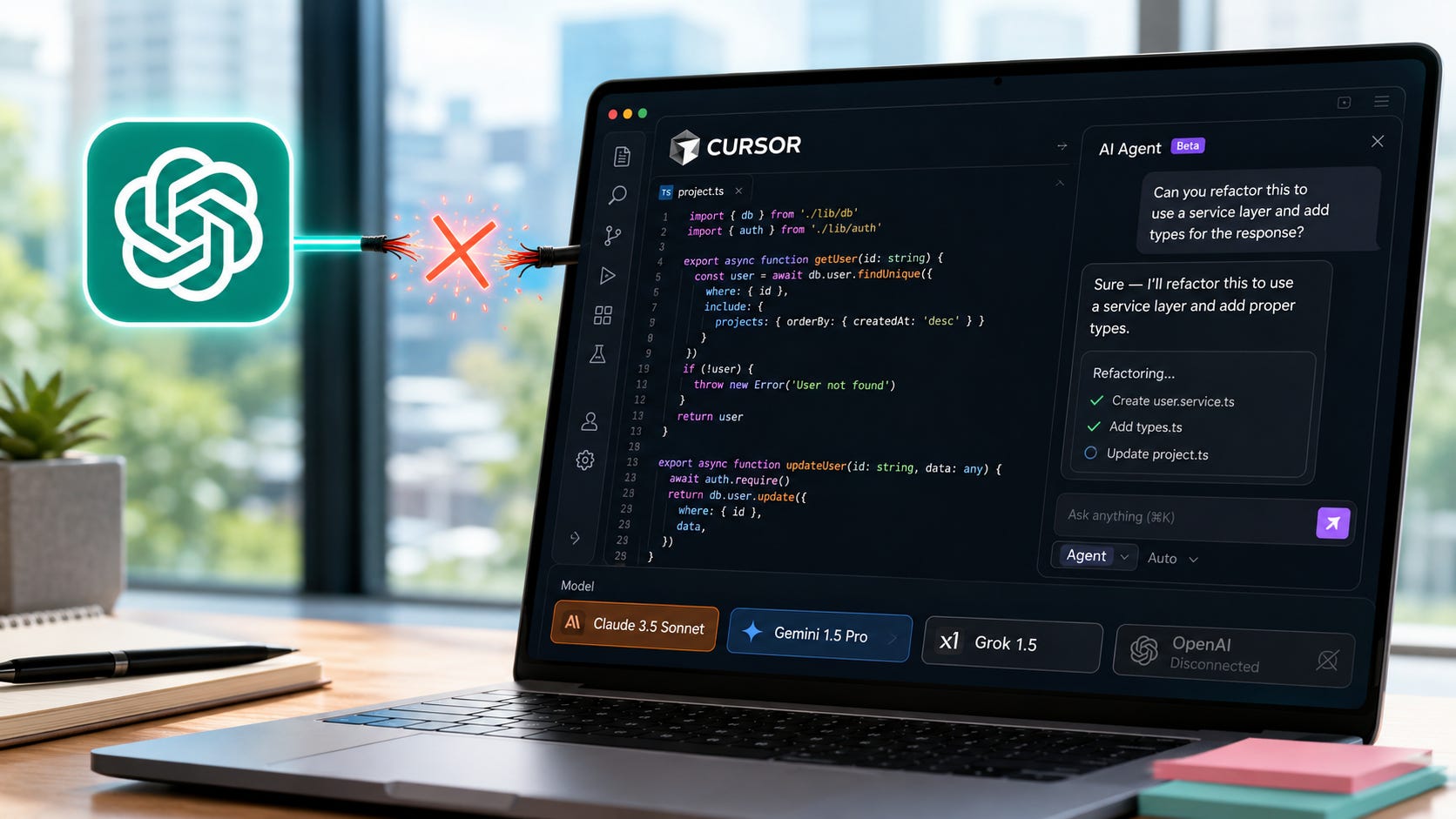
OpenAI plans to end its direct model-supply agreement with Cursor after SpaceX acquired the coding platform. The proposed cutoff date is November 12, 2026. That sounds like a Cursor problem, but the more useful lesson is about AI coding dependency.
If your prompts, project rules, tools, tests, memory, and agent workflows only function while one model provider remains available through one platform, you do not really have a portable coding stack. You have a chain of dependencies whose weakest links are controlled by other companies.
The good news is that Cursor is already more portable than the headline suggests. OpenAI models do not necessarily vanish from the Cursor application if the direct commercial agreement ends. The bad news is that several of Cursor’s most convenient features depend on model access routed through Cursor itself, which means a personal API key cannot reproduce the entire experience.
The OpenAI-Cursor dispute is therefore a useful stress test. It shows which parts of an AI coding workflow belong to you, which parts are rented, and which parts can break when a vendor relationship changes.
Key takeaways
OpenAI announced on August 28 that it intends to end the contract supplying models directly to Cursor, with November 12, 2026 as the proposed cutoff. OpenAI says a change-of-control clause in its agreement gives it a limited cancellation window after SpaceX’s acquisition.
OpenAI models are not necessarily disappearing from the Cursor application. Developers can still use supported OpenAI models through their own API keys or run the Codex IDE extension inside Cursor.
That fallback is incomplete. Cursor’s bring-your-own-OpenAI-key path does not cover Cursor Tab, Auto routing, Cloud or Background Agents, Automations, Cursor CLI, or Cursor’s API and SDK.
Repository files such as
AGENTS.md, tests, evals, prompts, and ordinary source code are much easier to preserve across providers than account-level memory or platform-specific automation.
MCP improves tool portability because several coding agents support the protocol, but the client configuration still differs between Cursor, Claude Code, Gemini CLI, and OpenCode.
The safest coding stack treats GPT, Claude, Gemini, Grok, and local models as replaceable execution engines. Your durable workflow should live somewhere else.
What happened between OpenAI and Cursor
On August 28, OpenAI said it had notified SpaceX that it intends to wind down the contract through which OpenAI supplies models to Cursor. OpenAI proposed November 12, 2026 as the shutoff date and said it was giving the maximum notice allowed under the agreement. The company also said its Cursor contract contains a limited cancellation window after a change of control, that it does not believe it can be confident SpaceX will comply with its terms based on previous disputes involving Musk-controlled companies, and that it will not provide future models to Cursor through the existing agreement. Those points are OpenAI’s stated rationale for ending the direct Cursor supply arrangement, rather than an independent finding about SpaceX’s conduct.

The trigger was Cursor’s acquisition by SpaceX. Cursor said the transaction officially completed on August 14 and would give the company access to SpaceX computing infrastructure for building stronger models. Cursor also pointed to Grok 4.6 as an early example of what the combined companies could build together.

The dispute looks dramatic because OpenAI is one of the most important model providers in the coding market, but the immediate operational damage to Cursor may be smaller than the headline implies. Cursor co-founder Michael Truell said OpenAI models account for roughly 5% of Cursor user traffic and that the companies were still talking.

That does not make the dispute unimportant. It makes the architectural lesson easier to see because Cursor has enough alternative model access to absorb a supplier problem that could be much more damaging for a smaller AI product.
The real control lever is upstream model access
Cursor does not own OpenAI’s models.
It can build the editor, agent interface, repository indexing, orchestration, pricing system, MCP integrations, rules system, routing logic, and developer experience around those models. OpenAI still controls whether its models can be supplied under the commercial agreement.
That is the control lever.
The same pattern appears across modern AI software. An application can own the user experience and become enormously valuable while a central capability inside it remains rented from another company. The application provider can reduce that dependence with multiple suppliers, first-party models, customer-owned API keys, or local execution. It cannot make the dependency disappear by ignoring it.
Cursor is relatively well insulated. Its documentation says Cursor offers its own models alongside frontier models from OpenAI, Anthropic, and Google, with users able to change the active model. That gives developers more room to move than they would have in a coding tool built around one exclusive provider.
But diversification is still dependency management. It spreads the risk instead of eliminating it.
OpenAI models can still work in Cursor after the cutoff
There is an important correction to the simplest version of this story.
OpenAI is proposing to end Cursor’s direct commercial model-supply relationship. It is not saying that the Cursor executable becomes forbidden territory for OpenAI users.
OpenAI’s transition guidance says developers can keep using supported OpenAI models in Cursor through their own OpenAI API key or the Codex IDE extension, while BYOK remains limited to local Chat and Agent and excludes Tab, Auto, Cloud or Background Agents, Automations, Cursor CLI, and Cursor’s API and SDK.
The difference matters. A developer who owns the provider relationship can often preserve more optionality than a developer who reaches the model only through a platform’s bundled access.
With BYOK, the developer holds the OpenAI API account and connects it to Cursor. With the Codex IDE extension, OpenAI’s coding agent can run inside Cursor as a separate extension rather than depending on OpenAI appearing in Cursor’s model picker.
That is a genuine escape hatch, but it solves only part of the problem. It preserves some OpenAI access. It does not recreate every Cursor feature that previously depended on OpenAI models supplied through Cursor’s own infrastructure.
What actually breaks when direct OpenAI access goes away
The key distinction is between model dependency and platform-model dependency.
Model dependency means the workflow requires GPT specifically. If that workflow runs in ordinary local Chat or Agent, a personal OpenAI API key may be enough to preserve it.
Platform-model dependency means the workflow requires GPT delivered through a Cursor-managed feature. That is harder to replace because the model and the orchestration layer are bundled together.
A developer who manually selects GPT in a normal Cursor Agent session may be able to switch to personal OpenAI API billing with relatively little disruption. A team whose automated workflow relies on Cursor Cloud Agents, routing, Automations, CLI, or API behavior has a deeper migration problem because those surfaces do not simply inherit a personal key.
This is why teams should audit workflows rather than ask only whether “GPT still works in Cursor.” The answer can be yes at the application level and no for the exact feature that matters to a production process.
The larger lesson is that convenience can hide coupling. When a platform bundles the editor, model billing, routing, tool execution, memory, and automation into one experience, it can feel like one product. Architecturally, it is still several dependencies stacked together.
Treat the model as a replaceable dependency
Cursor itself already encourages some flexibility because developers can change models. Its prompting documentation says users can switch models during an ongoing conversation, with the change applying to that conversation going forward.
Developers should take the same idea further in their own workflows.
Your coding agent should have inputs, instructions, tools, permissions, success criteria, and tests that still make sense if GPT is replaced by Claude, Gemini, Grok, or a local model. The model then becomes one implementation of the reasoning layer rather than the place where the entire workflow lives.
This does not mean all models are interchangeable. They are not.
Different models follow instructions differently. They make different tool-call decisions. Some are better at large refactors. Some handle long context more reliably. Some are stronger at terminal use. Local models can expose weaknesses in tool parsers and agent harnesses even when benchmark scores look impressive, which is why Popular AI’s local coding-agent testing has emphasized the whole stack rather than benchmark score alone.
Portability means switching is feasible. It does not mean switching is invisible.
That is also why cost belongs in portability testing. A model can be technically compatible and still be a poor replacement if it needs too many retries or consumes too much context. Coding-agent price pressure can change which model is worth testing, even when the cheapest raw tokens do not produce the cheapest finished task.
More on AI coding agent portability:


Put your important instructions in the repository
The easiest part of an agent workflow to preserve is plain text.
Cursor Project Rules can live under .cursor/rules and be committed to Git, while Cursor also supports plain AGENTS.md files. That gives developers a way to move durable instructions out of account settings and into the repository. Cursor’s documentation confirms that project rules in .cursor/rules are version-controlled and that AGENTS.md can be used for plain Markdown instructions.
AGENTS.md is particularly useful because it is becoming a practical compatibility layer between coding agents. OpenAI’s Codex repository documents AGENTS.md as a repository-level instruction format. OpenCode recommends committing AGENTS.md to the repository, and Gemini CLI can be configured to load AGENTS.md as one of its context filenames.
Claude Code normally uses CLAUDE.md for persistent project context. Anthropic’s own guidance describes how Claude Code uses CLAUDE.md as durable context across a project. Cursor can also work with that format, which makes it useful when a team moves between Cursor and Claude Code.
A sensible repository structure is:
repo/
├── AGENTS.md
├── CLAUDE.md
├── .cursor/
│   └── rules/
├── tests/
├── evals/
└── src/
Put the durable instructions in AGENTS.md: architecture, build commands, test commands, coding conventions, forbidden operations, deployment rules, and acceptance criteria.
Keep platform-specific files thin. They should adapt the repository to the client rather than become the only place where the workflow’s logic exists.
If switching from Cursor to OpenCode, Codex, Gemini CLI, or another agent requires rewriting hundreds of lines of hidden instructions, the workflow has already accumulated avoidable lock-in.
MCP helps, but the protocol is more portable than the configuration
Tool integrations are the next layer to examine.
Cursor supports Model Context Protocol servers, and its documentation explains that MCP connects Cursor to external tools and data while project-specific configuration can live in .cursor/mcp.json. Claude Code, Gemini CLI, and OpenCode also support MCP.
That is good news for portability.
If a coding agent talks to GitHub, Linear, databases, internal documentation, or other systems through MCP, the same MCP server may be reusable from another coding agent. The integration logic can remain independent even when the client changes.
The configuration is less universal.
Cursor uses its own MCP configuration locations. Claude Code can use project-level .mcp.json. Gemini CLI places MCP configuration in its settings system. OpenCode defines servers through its own configuration structure.
The practical design rule is to keep the MCP server independent of the client. Keep credentials in environment variables rather than embedding secrets in agent configuration. Document each server’s command, endpoint, required environment variables, permissions, and authentication flow somewhere provider-neutral.
Then treat each coding tool’s MCP file as an adapter.
That approach does not eliminate migration work, but it turns migration into configuration instead of rebuilding every tool integration.
Project memory is where portability gets ugly
Persistent instructions stored as files are easy to move.
Conversation history, learned preferences, compressed context, provider-side caches, and account-synced memory are much harder.
Cursor’s prompting documentation shows how agent context can include system instructions, tools, rules, skills, MCP information, subagents, summarized conversation state, and the conversation itself. Some of that exists in files you control. Some is assembled by Cursor. Some lives only in a session or account.
This suggests a simple rule: if information would be painful to reconstruct, do not leave its only copy inside an AI conversation.
Architecture decisions belong in documentation.
Important commands belong in the repository.
Project conventions belong in AGENTS.md, CLAUDE.md, or another version-controlled instruction file.
Open issues belong in an issue tracker.
Long-running task state belongs in files that another agent can read.
An AI conversation should be disposable. If losing a chat means losing essential project knowledge, the chat has quietly become infrastructure.
That problem extends beyond Cursor. Hosted coding agents can lose access because of provider policy, account rules, region restrictions, or organizational controls, which is another reason to keep durable project state outside the account.
More on AI coding agent restrictions:

Your evals should survive the model too
Teams often discover model lock-in because they never tested another model against the same work.
A useful coding-agent evaluation does not need to be exotic. Pick 10 or 20 representative tasks from your actual repository.
For each model, measure whether it:
Understands the task without extra clarification.
Changes only the intended files.
Passes the same automated tests.
Avoids forbidden operations.
Produces an acceptable patch without excessive retries.
Completes the job at an acceptable cost and latency.
Run that test against the OpenAI model you normally use.
Then run Claude.
Run Gemini.
Run Grok.
Run a strong open or local coding model if your hardware permits it. If local fallback matters enough to budget for dedicated hardware, an RTX 3090-class build is one practical path Popular AI has examined for local coding agents.
The goal is not to declare one permanent winner. The goal is to know the switching cost before a contract dispute, regional restriction, pricing shift, outage, acquisition, or policy change forces the test on you.
Popular AI has already looked at this problem from the local side in its guide to building an independent AI development stack and its practical test of GGUF Loader Agentic Mode as a cloud-account-free coding agent. The common theme is that a fallback becomes valuable before it becomes necessary.
More on open AI coding models:


Cursor’s Auto mode solves availability but creates another dependency
Model routing is one response to provider volatility.
Cursor’s Router can select among available models instead of requiring the developer to pin every request to one provider. Cursor says the Router is managed by Cursor, users cannot hand-pick the model for each routed request, and the model pool can change over time.
That can make a provider cutoff less disruptive. If one model disappears from the routing pool, another approved model can take the request where the router permits it.
There is a tradeoff.
The developer now depends more heavily on Cursor’s routing layer and less on a named model. That is useful when continuity matters more than model identity. It is weaker when reproducibility requires knowing exactly which model executed a task.
A team that cares about both should separate ordinary interactive work from evaluated workflows. Routing can handle routine work where availability and convenience dominate. Named models make more sense where a team needs stable benchmarks, reproducible behavior, or a known compliance path.
This distinction becomes especially important as provider mixes change. The more orchestration a platform handles automatically, the more carefully teams should document which guarantees come from the model and which come from the platform.
Who benefits from the OpenAI-Cursor split
Anthropic has an obvious opportunity.
Reuters reported that Anthropic plans to increase compute supporting Claude models in Cursor. If developers who favored OpenAI shift toward Claude, Anthropic can absorb more of Cursor’s usage without needing those users to leave the editor.

Cursor and SpaceX also have a stronger incentive to make Grok and Cursor’s own models attractive enough that third-party supplier disputes matter less. Cursor’s current pricing structure separates Cursor Models from other third-party models and applies different usage treatment.
OpenAI, meanwhile, keeps control over where its models are supplied commercially and under what contractual conditions.
None of this requires a conspiracy. These are ordinary strategic incentives produced by ownership, supplier relationships, and control of scarce upstream infrastructure.
The useful question for a developer is simpler: which of those incentives can interrupt my work?
Who gets squeezed when a provider leaves
Developers with portable workflows may experience little more than a model change.
Developers who built deeply around one provider can face considerably more work.
The highest-risk setups are those where model choice, orchestration, memory, instructions, automation, and tools are bundled together inside one vendor-controlled account. The problem is not that any one feature is bad. The problem is that all of them can become part of the same migration at once.
Enterprise teams have another problem. They may require an approved model for compliance, data handling, reproducibility, cost controls, or internal evaluations. “Use another model” can become a procurement and migration project rather than a dropdown change.
Smaller AI applications face the same structural issue Cursor just exposed. A company can own its user interface, customer relationships, workflow logic, and brand while still depending on a model supplier with contractual power over access.
Cursor is large enough to have alternatives.
A smaller developer or startup may have much less negotiating power, fewer replacement providers, and less time to test a fallback under pressure.
What developers should do before November 12
You do not need to abandon Cursor because OpenAI invoked a contract clause.
You should use the period before the proposed cutoff to discover what you actually depend on.
Start by identifying every workflow that explicitly selects an OpenAI model. Then separate ordinary local Chat and Agent use from Tab, Auto, Cloud or Background Agents, Automations, CLI, API, and SDK workflows. Those categories matter because the BYOK fallback does not cover all of them.
Move durable project instructions into version-controlled files. A project rule that exists only inside an editor setting is harder to migrate than one committed beside the code.
Keep MCP servers client-independent. The protocol can help you move tools between agents, but client configuration should remain a thin adapter rather than the only definition of the integration.
Move important knowledge out of chat history. If another developer or another agent would need the information tomorrow, write it down somewhere durable today.
Run the same representative coding tasks through at least one non-OpenAI model. Do this before you need the replacement, when you still have time to see where prompts, tools, tests, or permissions behave differently.
Keep tests and evals outside the model provider. The model should be judged by the same acceptance criteria regardless of which company serves it.
If keeping OpenAI access matters, test your own API key or the Codex IDE extension in Cursor before the direct agreement ends. A fallback that has never been exercised is still a theory.
And if the repository is sensitive enough that cloud-provider dependency itself is a concern, maintain a local path. Popular AI’s local AI guide covers the trade between frontier cloud capability and hardware you control.
The purpose is not to prepare for one specific corporate dispute. It is to make the next supplier change boring.
More on practical local AI:

Build an AI coding stack that can survive the next provider change
OpenAI may reach an agreement with Cursor before November 12.
Anthropic may absorb most displaced work.
Grok may become good enough that many Cursor users barely care.
None of those outcomes changes the lesson.
▪ A model API is a dependency.
▪ An account is a dependency.
▪ A proprietary agent feature is a dependency.
▪ A conversation containing knowledge that exists nowhere else is a dependency.
A model provider deciding to end a commercial relationship does not have to become your emergency.
The durable parts of an AI coding stack should be yours: the repository, instructions, tests, evals, tools, credentials, documentation, and the ability to point the workflow at another model.
▪ Use GPT when GPT is best.
▪ Use Claude when Claude is best.
▪ Use Gemini, Grok, or a local model when they are the better fit.
The goal is not provider independence in the absolute sense. Most modern development stacks depend on vendors somewhere. The goal is to keep those dependencies visible, replaceable, and tested.
If changing one model provider requires rebuilding the way you develop software, the dependency is too deep. If changing the model feels like swapping an execution engine while the repository, tools, instructions, and acceptance criteria stay intact, the architecture is doing its job.
Explore more from Popular AI:
Start here | Local AI | Builds & gear | Autonomy & policy | Fixes & guides | Popular AI podcast
How portable is your AI coding workflow right now? If your preferred model disappeared from Cursor tomorrow, how much of your setup would still work?