


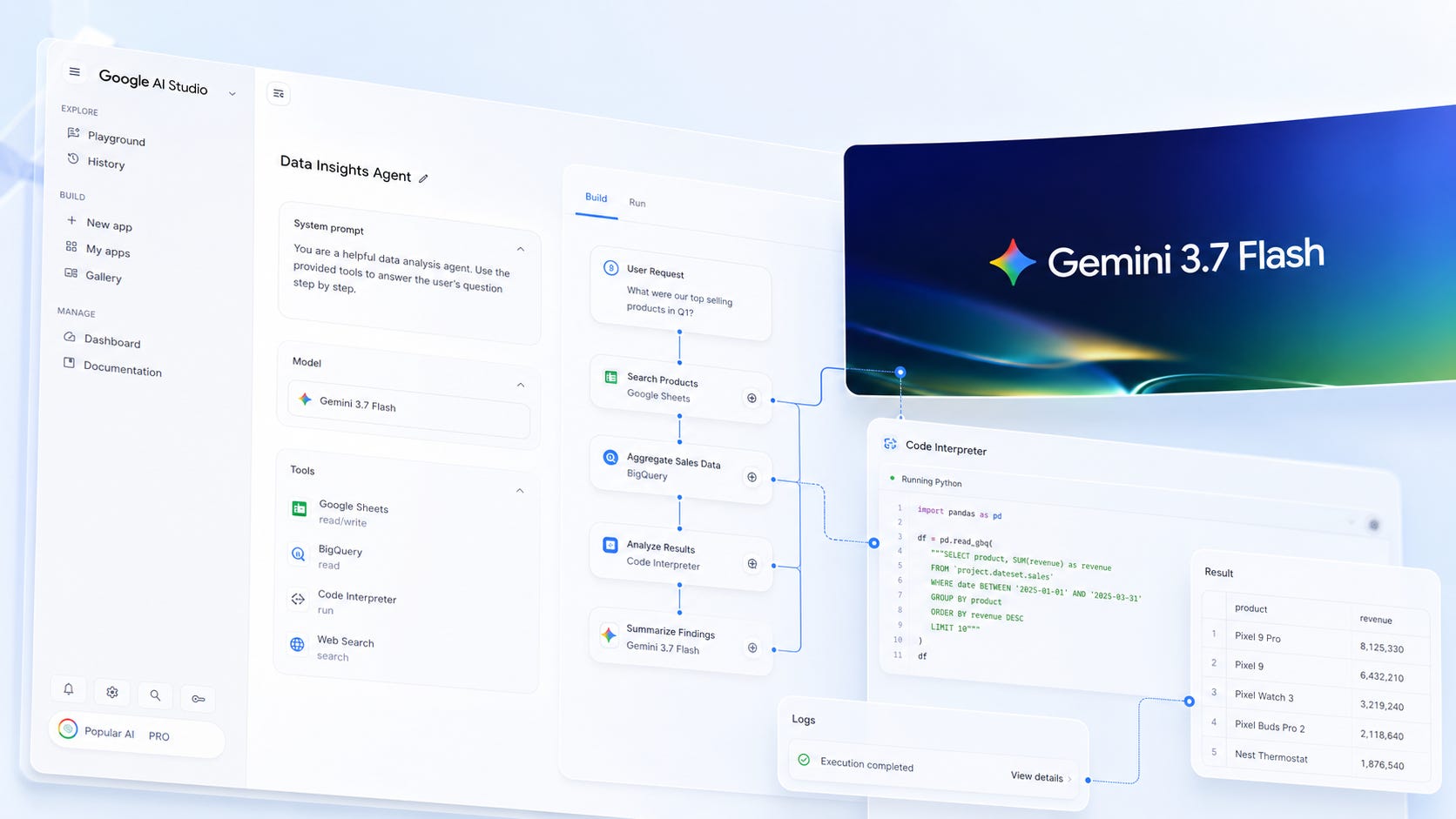
Gemini 3.7 Flash arrived on August 13 with stronger coding scores and an introductory API price of $0.75 per million input tokens and $3.75 per million output tokens. Google describes that as half the original Gemini 3.6 Flash price.
There is a catch worth knowing before anyone rewrites a routing config. Google has also applied the new promotional price to 3.6 Flash. Through December 31, 2026, both models cost $0.75 per million input tokens and $3.75 per million output tokens on standard paid Gemini API pricing, including thinking tokens.
That changes the migration question considerably. This is no longer a straightforward 50%-off upgrade from Gemini 3.6 Flash.
Instead, coding teams get a cleaner experiment: if Gemini 3.7 Flash costs the same per token as 3.6 Flash, can it complete real coding tickets with fewer failures, fewer retries and less human cleanup?
That is what teams should measure before switching.


Gemini 3.7 Flash vs 3.6: key takeaways
Google released Gemini 3.7 Flash on August 13, 2026 as a generally available model focused heavily on coding and multi-step agents. Google says it retains a 1 million-token context window, 64K maximum output and the same built-in tool suite as 3.6 Flash.
The advertised $0.75 input and $3.75 output pricing is half Gemini 3.6 Flash’s original launch price, but Google has extended the same promotional pricing to 3.6 through December 31. There is currently no raw-token price advantage to switching.
Early coding benchmarks favor 3.7 substantially. DeepSWE currently shows 65% for Gemini 3.7 Flash versus 47% for 3.6 Flash in its high-thinking configurations.
More capability does not automatically mean fewer tokens. The same DeepSWE runs show 3.7 using more output tokens and agent steps on average than 3.6.
Do not migrate on price or benchmark score alone. Run both models against the same real tickets and measure accepted patches, retries, tool calls, token consumption, latency and human review time.
Gemini 3.7 Flash remains a hosted Google model. Teams handling sensitive code should inspect the API’s data handling and retention behavior instead of assuming that a paid API automatically means zero retention.
What Google actually released with Gemini 3.7 Flash

Google introduced Gemini 3.7 Flash on August 13, only three weeks after Gemini 3.6 Flash. Google calls it its most intelligent Flash model yet for coding and agents.
It is already generally available rather than a preview. The stable API model ID is:
gemini-3.7-flash
According to the Gemini 3.7 Flash model documentation, it accepts text, images, video, audio and PDFs, produces text, supports a 1,048,576-token input limit and a 65,536-token output limit. It also supports function calling, code execution, File Search, structured output, search grounding, URL context and preview computer use.
Those limits are effectively unchanged from Gemini 3.6 Flash, which has the same input and output limits and broadly the same tool capabilities.
That distinction matters. Teams are not being offered a much larger context window or a fundamentally different API surface. The main reason to test Gemini 3.7 Flash is improved model behavior inside coding and agent workflows.
For existing 3.6 users, that makes an A/B test relatively straightforward. The interface is familiar, the broad capabilities overlap and the promotional token pricing is currently identical. What remains to be discovered is whether 3.7 turns that same token price into more useful completed work.
Gemini 3.7 Flash pricing is more complicated than the headline
When Google released Gemini 3.6 Flash on July 21, the company priced it at $1.50 per million input tokens and $7.50 per million output tokens. Google also emphasized that 3.6 consumed fewer output tokens than 3.5 Flash and required fewer reasoning steps and tool calls.
Three weeks later, Gemini 3.7 Flash arrived at $0.75 per million input tokens, $3.75 per million output tokens including thinking tokens, and $0.075 per million cached input tokens.
Those promotional rates last through December 31, 2026. Starting January 1, 2027, Google’s current pricing lists standard rates of $1.50 per million input tokens and $7.50 per million output tokens for both Gemini 3.7 Flash and 3.6 Flash.
At first glance, 3.7’s launch price sounds like an obvious 50% savings over 3.6. That comparison uses 3.6 Flash’s original launch price, though. Google subsequently extended the new promotional rate to the older model.
That makes the coding-agent decision cleaner for the rest of 2026.
Teams do not have to decide whether 3.7’s extra capability is worth paying a higher standard token rate. They can compare the two at raw-token price parity and concentrate on what each model accomplishes with those tokens.
That does not mean cost has disappeared from the equation. If 3.7 generates longer reasoning traces, makes more tool calls or takes more agent steps, two models with identical per-token rates can still produce very different costs per completed ticket.
Gemini 3.7 Flash looks substantially better at coding
Google’s own release numbers favor Gemini 3.7 Flash across several software workloads.
The company reports 43.6% versus 34.4% for Gemini 3.6 Flash on Cognition’s FrontierCode 1.1 Main and 65.3% versus 49.0% on DeepSWE v1.1. It also reports a WebDev Arena Elo score of 1588 for 3.7 versus 1538 for 3.6.

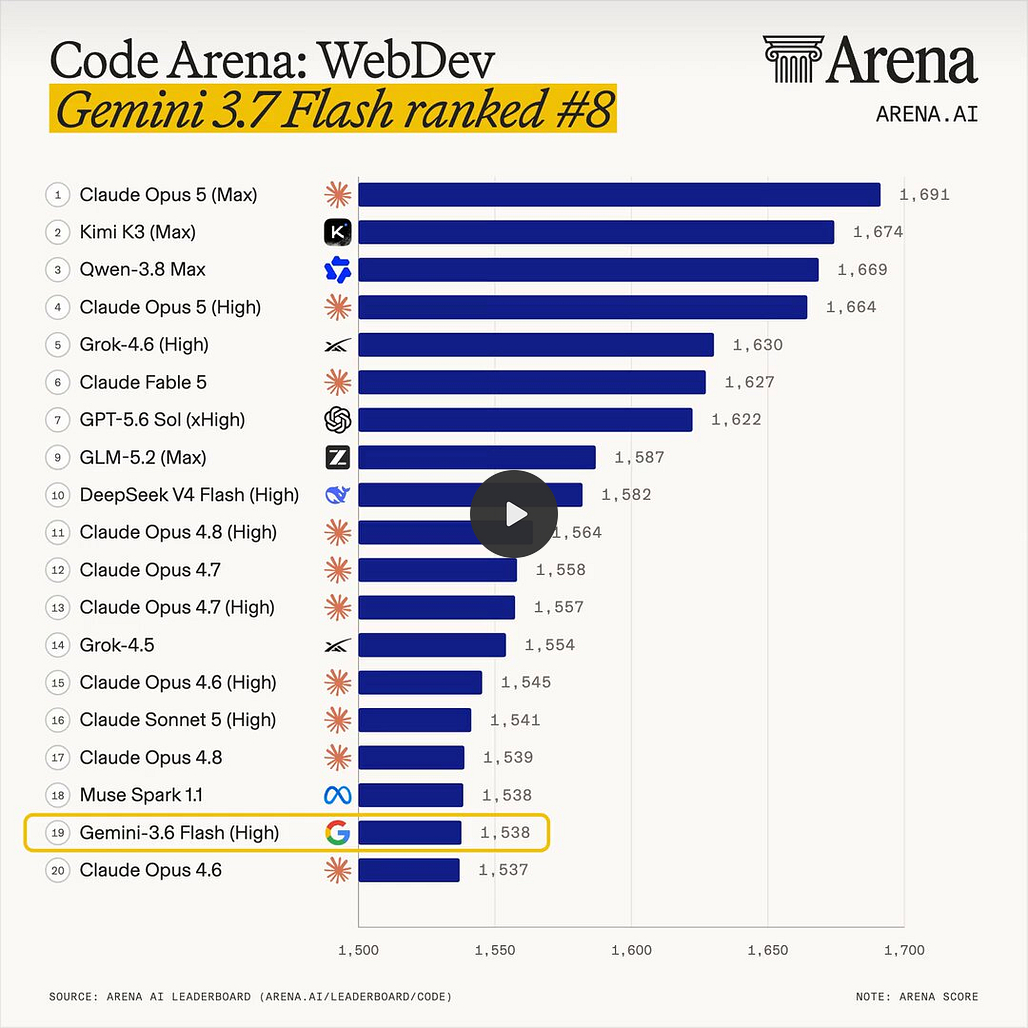

The underlying benchmark design deserves attention because a leaderboard percentage has more value when it resembles the work a coding agent is expected to do.
Cognition describes FrontierCode as a benchmark built around whether a maintainer would actually merge a generated pull request. Its criteria cover correctness, test quality, scope discipline, style and adherence to codebase standards.
That is closer to a real engineering decision than asking whether a model can produce code that merely looks plausible in isolation.
DeepSWE is particularly useful for this comparison because it puts the models into the same agent harness. Its live leaderboard currently reports:
Gemini 3.7 Flash [high]: 65% ±2%
Gemini 3.6 Flash [high]: 47% ±4%
DeepSWE runs models through mini-swe-agent for consistency across 113 original long-horizon software engineering tasks.
An 18-point gap on the current leaderboard is large enough to justify attention. For teams already routing coding work through Gemini 3.6 Flash, it is a strong reason to test 3.7 quickly.
It is not enough evidence to replace a production model without testing your own repositories.
A benchmark harness has its own prompts, tools, retry behavior, repository mix, stopping conditions and success criteria. Your agent may operate differently. Your tickets may be shorter, more UI-heavy, more constrained or much more dependent on internal libraries.
The benchmark tells you where to look. Your own accepted patches should make the final decision.
Better benchmark scores do not guarantee lower task cost
DeepSWE also exposes the reason teams should resist comparing coding models by token price alone.
Its Gemini 3.7 Flash high-thinking runs averaged 107,000 output tokens and 125 agent steps. Gemini 3.6 Flash averaged 96,000 output tokens and 117 steps.
In this particular harness, 3.7 completed substantially more tasks while also doing somewhat more work.
That can still be an excellent trade. A longer run that produces a correct patch may cost less overall than three shorter attempts that fail, trigger another agent run and still leave an engineer repairing the result.
The useful denominator for a coding team therefore is not one million tokens.
It is one accepted coding task.
Popular AI’s broader guide to comparing AI APIs by real workload cost makes the same point. For agents and expensive professional work, the useful comparison is total cost per accepted result rather than the lowest menu price per million tokens.
Coding agents make that especially important because one ticket can involve repository discovery, planning, file reads, several edits, shell commands, test execution, error interpretation and another round of edits.
Every failed loop consumes tokens.
Every unnecessary edit creates review work.
Every patch labeled successful that an engineer has to substantially rewrite carries hidden labor cost.
A model that spends more tokens but closes the ticket correctly can be the cheaper model. A model that appears inexpensive per attempt can become expensive when its failures multiply retries, review time and human repair.
Related:

Google says Gemini 3.7 Flash should need less babysitting
Google says Gemini 3.7 Flash is better at adapting to roadblocks, clarifying intent, following instructions, multi-step planning and tool use. The company argues that these improvements should translate into fewer retries and less manual oversight.

Those claims are unusually practical because a development team can test them without building a sophisticated benchmark laboratory.
Take 10 to 30 tickets that resemble the work your agents actually receive. Do not cherry-pick tasks that match a benchmark. Build a sample that represents your normal distribution of bugs, refactors, migrations, tests and UI changes.
A useful test set could include:
A failing test with a known root cause.
A small bug spanning multiple files.
A dependency or API migration.
A frontend change based on a screenshot.
A refactor where unrelated edits are explicitly forbidden.
Test generation around an existing module.
A bug where the first plausible fix is wrong.
A repository-navigation task where the model must identify the correct files before editing.
Run the same repository snapshot and the same instructions through Gemini 3.6 Flash and Gemini 3.7 Flash.
Give both models equivalent tool access. Keep the thinking configuration visible. Use the same timeout and stopping rules. If your agent harness retries automatically, make sure the retry policy is the same for both.
Most importantly, do not keep prompting one model until it wins while holding the other to its first attempt. That measures operator persistence rather than model performance.
Measure accepted patches instead of impressive responses
For every test ticket, record whether the model actually solved the task and passed the relevant tests. A convincing explanation or clean-looking diff is not enough if the bug remains.
Track input and output tokens, including thinking tokens where they are billed. Record retries, tool calls and total agent steps. More steps are acceptable when they materially improve completion, but those steps still consume time and resources.
Count unwanted edits as well. Coding agents can produce a technically functioning change while touching unrelated files, widening the scope of a patch or introducing cleanup work that a human reviewer now has to understand.
Measure full-ticket latency rather than time to first token. Coding-agent users care about how long it takes to reach a usable patch after planning, tool execution, tests and retries.
Then measure human review time.
For many professional teams, this can be more expensive than the API bill. If one model needs five minutes of review and another needs 25 minutes of investigation before an engineer trusts the patch, the difference can overwhelm a small token-price advantage.
Human repair time deserves its own measurement. If an engineer spends 20 minutes correcting a patch that the agent declared finished, those 20 minutes belong in the cost of that result.
Finally, calculate cost per accepted task rather than cost per attempt.
A model that costs $1.50 to solve eight out of ten representative tickets can easily outperform a model that costs $1 per run but solves only four. This is also why Popular AI’s analysis of Meta Muse Spark 1.1 recommends measuring accepted patches, failed attempts, token use and cleanup rather than treating low token prices as low coding-agent costs.
The harness, retries and human cleanup can erase an apparent bargain.
Related:

Token consumption was already a pain point for Gemini developers
Token efficiency is not a metric invented specifically to make Gemini 3.7 Flash look complicated.
Developers were discussing Gemini Flash token consumption before 3.7 arrived.
One developer on Google’s forum described Gemini 3.5 Flash consuming tokens at a higher rate during long agent sessions and argued that different jobs could be assigned to different models instead of routing every responsibility through one reasoning-heavy option.
Another forum user described a ticket workflow in which one Gemini 3.5 Flash issue consumed one of the account’s quota bars. That is anecdotal evidence rather than a controlled benchmark, so it should not be treated as a universal measurement. It does illustrate why developers care about completed-ticket efficiency rather than the word “Flash” in a model name.
Google responded to the broader efficiency problem with Gemini 3.6 Flash. Its July launch emphasized 17% lower output-token consumption than 3.5 Flash in the Artificial Analysis Index, along with fewer reasoning steps and tool calls for multi-step workflows.
Three weeks later, Gemini 3.7 Flash pushed harder on coding quality and agent capability.
That creates the question teams should answer themselves: did Google preserve enough of 3.6’s efficiency while materially improving completion quality?
A model can use more tokens on a successful run and still win. The important comparison is whether those extra tokens prevent failed runs, rework and engineer intervention.
Thinking level can change Gemini 3.7 Flash economics
Gemini 3.7 Flash defaults to medium thinking, with low, medium and high settings.
Google recommends low effort for latency-sensitive work, medium for most complex coding and agentic tasks, and high for the hardest coding and reasoning jobs. It also warns that high thinking can increase token consumption and cost.
That means a model comparison becomes unreliable if one side receives an economical configuration while the other is allowed to reason much longer.
Record the thinking configuration beside every test result.
It is also worth testing more than one 3.7 configuration if your workload is mixed. A difficult repository-level bug may benefit from high thinking while routine classification, repository search or a mechanical change may not.
You may find that the best deployment is neither “3.7 everywhere” nor “stay on 3.6.”
A team could use lower-effort inference for repository discovery, classification and predictable transformations, then reserve higher reasoning for difficult bug fixes, architectural work or tickets that fail an initial cheaper attempt.
That approach shifts the optimization problem from choosing one favorite model to designing better routing.
Model routing can save more money than model loyalty.
Can Gemini 3.7 Flash run locally?
Google’s launch and API documentation present Gemini 3.7 Flash as a hosted Gemini model and do not provide downloadable model weights or a local deployment package.
For teams that need to keep inference entirely inside infrastructure they control, Gemini 3.7 Flash therefore does not create a new local deployment option.
That leads to a different comparison for sensitive repositories. Hosted Gemini may perform better as an agent while an open-weight model can offer more control over where code is processed and how inference infrastructure is managed.
For teams that want another option, GLM-5.2 is one recent open coding model worth evaluating, although its full model is far beyond ordinary desktop hardware. Serious full-model serving points toward high-end multi-GPU hardware, while smaller local coding models remain more practical for normal workstations.
The broader goal is provider optionality.
A development stack that can route routine work to Gemini, difficult tasks to another hosted model and private context to controlled local inference is less dependent on a single API. Popular AI’s guide to building a more independent AI development stack explores that routing and provider-optional approach.
This does not mean every team needs three providers and a rack of GPUs. It means the architecture should make model replacement possible without rebuilding the entire development workflow.
Related:


Privacy and Gemini API data handling need a configuration check
Google’s paid Gemini Developer API terms make an important distinction between model training and data retention.
For Paid Services, Google says prompts and responses are not used to improve its products, while customer data can still be retained in specific circumstances.
That distinction matters for coding teams. “Not used for training” and “nothing is retained” describe different policies.
Google says prompts and responses can be logged for a limited period for abuse monitoring unless a project receives approved zero-data-retention treatment. Google Search and Maps grounding have separate 30-day storage behavior. The Interactions API also enables state storage by default, with store needing to be explicitly set to false to opt out of that default state retention.
So a team working with private repositories should inspect the exact API features it enables rather than reasoning from the paid-plan label alone.
The terms for unpaid services also deserve attention. Google’s Gemini API terms describe circumstances in which unpaid-service inputs and outputs can be used to improve products and reviewed by humans, and warn against submitting sensitive, confidential or personal information to those unpaid services. The terms also contain regional distinctions, so teams should apply the rules that cover their account, billing setup and location.
The practical testing rule is simple: evaluate Gemini 3.7 Flash on private code only through the same paid, configured environment you intend to use in production.
Do not run a benchmark on proprietary code through an arbitrary free configuration and investigate its data policy afterward.
Privacy testing belongs in the model evaluation alongside coding quality, latency and cost.
Who should switch to Gemini 3.7 Flash?
Test Gemini 3.7 Flash immediately if you already use 3.6 Flash for coding agents.
There is little raw-token pricing reason to avoid the experiment while Google’s promotional standard pricing is identical for both models. The early coding results are also strong enough to make the test worthwhile.
That still does not justify a blind production migration.
Keep Gemini 3.6 Flash available during the evaluation and run both models against identical tickets. A team with a clean abstraction around model IDs can route a percentage of representative work to 3.7 and compare outcomes without moving the entire development workflow at once.
Gemini 3.7 Flash is especially interesting if your current 3.6 failures involve long-horizon issue resolution, debugging, tool recovery, UI work or patches that need several attempts before they pass.
Pay particular attention to tasks where the agent initially takes the wrong path. Google’s claims about recovering from roadblocks and reducing failed loops matter much more there than they do on trivial edits.
Keep 3.6 temporarily if your current harness is highly stable, your workload is especially latency-sensitive, or 3.7 starts producing longer agent loops without enough improvement in accepted results.
A benchmark gain is valuable only when the gain survives contact with your repositories, prompts, tools and review standards.
And if your code cannot leave infrastructure you control, neither Gemini model resolves the underlying deployment constraint.
What coding teams should watch next
The next useful evidence will not be another broad intelligence leaderboard.
For coding agents, watch measurements around output-token consumption, time to accepted patch, failed tool calls, rollback behavior, unnecessary edits, retry count and latency across different thinking levels.
Independent comparisons will become more valuable as developers test Gemini 3.7 Flash in different agent harnesses. A model that performs well in one benchmark may behave differently when tool schemas, context management, repository size and retry policies change.
Teams should also watch their own workload distribution. If 3.7 delivers most of its advantage on difficult tickets, the best routing strategy may be to reserve it for those tasks instead of sending every easy change through the same configuration.
Pricing after December 31 matters too. Google’s current schedule moves both Gemini 3.7 Flash and 3.6 Flash to $1.50 per million input tokens and $7.50 per million output tokens starting January 1, 2027.
That gives teams several months at promotional price parity to collect their own evidence.
Use that period to establish a baseline now. Record what 3.6 costs per accepted task, how often it retries, how much human cleanup it needs and where it tends to fail. Then run 3.7 against the same distribution.
Without that baseline, a migration can feel faster or smarter without anyone knowing whether it actually improved engineering economics.
FAQ
How much does Gemini 3.7 Flash cost?
Through December 31, 2026, Google’s standard paid pricing for Gemini 3.7 Flash is $0.75 per million input tokens and $3.75 per million output tokens, including thinking tokens. Starting January 1, 2027, Google currently lists $1.50 per million input tokens and $7.50 per million output tokens.
Is Gemini 3.7 Flash cheaper than Gemini 3.6 Flash?
Not currently on standard paid token pricing. Gemini 3.7 Flash’s introductory price is half Gemini 3.6 Flash’s original launch price, but Google has applied the same promotional pricing to 3.6 through December 31, 2026.
Is Gemini 3.7 Flash better for coding than 3.6?
Early benchmarks strongly favor 3.7. DeepSWE currently reports 65% for Gemini 3.7 Flash at high thinking versus 47% for 3.6 Flash. Real coding-agent performance still depends heavily on the repository, harness, tools, prompts and acceptance criteria.
Does Gemini 3.7 Flash use fewer tokens?
That has not been established generally. In the current DeepSWE runs, Gemini 3.7 Flash averaged more output tokens and agent steps than 3.6 Flash while achieving a much higher success rate. That is why cost per completed task is more useful than token count alone.
Can Gemini 3.7 Flash run locally?
Google has not released downloadable Gemini 3.7 Flash weights in the launch or API documentation discussed here. The model is presented as a hosted Gemini model accessed through Google’s services and API.
Gemini 3.7 Flash is worth testing before you switch
Gemini 3.7 Flash is the Gemini coding model to test now, but the strongest reason is performance rather than a 50% price advantage over 3.6 Flash.
Google launched 3.7 at half of 3.6’s original token price, then extended that promotional rate to 3.6 as well. Through December 31, 2026, their standard paid raw-token pricing is effectively tied.
That is useful for developers because it removes one major variable from the experiment.
Run Gemini 3.7 Flash and 3.6 Flash against the same tickets. Keep the repository state, instructions, tools, thinking configuration and stopping rules controlled. Count accepted patches, tokens, tool calls, retries, unwanted edits, wall-clock time, review time and human repair.
Then compare cost per accepted task.
If 3.7’s stronger coding performance becomes more completed work with fewer failed loops and less engineer intervention, switching becomes easy to justify.
If it mostly produces longer runs without enough additional accepted patches, keeping 3.6 or routing selectively may make more sense.
The cheapest coding model is the one that gets the ticket closed at the required quality with the lowest total cost.
Explore more from Popular AI:
Start here | Local AI | Builds & gear | Autonomy & policy | Fixes & guides | Popular AI podcast
Would you switch your coding agents to Gemini 3.7 Flash now, or wait until you’ve seen how it performs on your own repos and real-world tickets?