


If you pay ElevenLabs mainly to turn scripts into narration in your own voice, local voice cloning has reached the point where canceling that subscription is a realistic option. Qwen3-TTS and Chatterbox can both clone a reference voice on hardware you control, without sending every script and recording to a hosted TTS service.
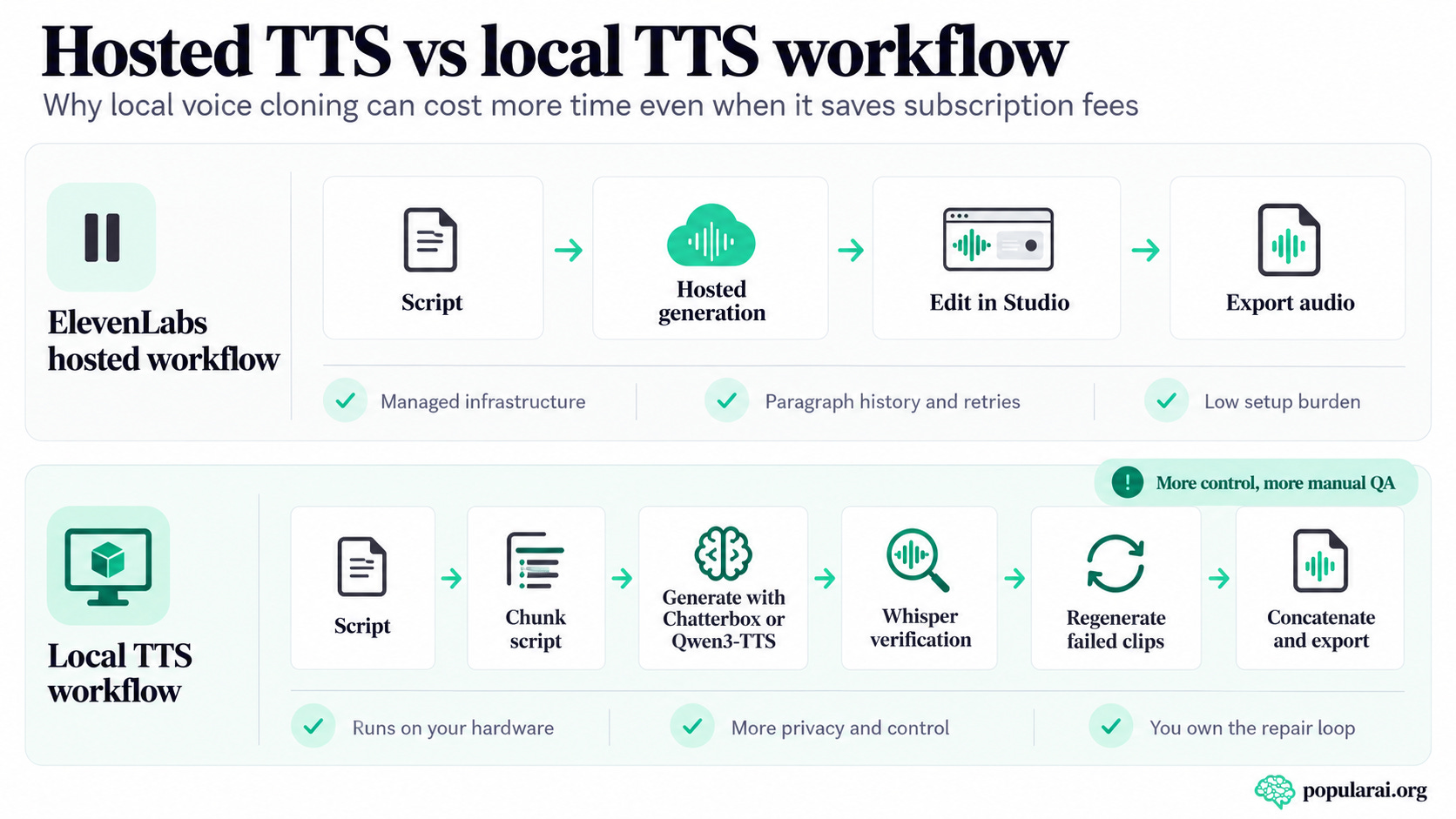
The catch is the production workflow. ElevenLabs still has a large advantage when you need long-form editing, pronunciation fixes, Professional Voice Cloning, broad language support, and audio that requires as little repair as possible. Local TTS gives you the model and the files. You become the production system.
For solo narration, that trade can now make sense. For paid long-form work, it can also create more cleanup than the subscription was costing you. The useful question is not whether a local model can produce one impressive clip. It is whether it can produce your finished narration with an acceptable amount of repair.
Key takeaways
Chatterbox is the local option I would start with for English narration. Turbo is a 350M English model with zero-shot voice cloning and expressive tags, while the original Chatterbox exposes useful CFG and exaggeration controls. Its smaller models also make the hardware requirement less intimidating.
Qwen3-TTS is the more interesting platform if you need multilingual cloning or want to experiment with designed voices. Its Base models support rapid reference-voice cloning across 10 languages, while separate CustomVoice and VoiceDesign variants cover preset voices and free-form voice creation.
Neither is a complete drop-in replacement for ElevenLabs as a production service. ElevenLabs Studio keeps paragraph-level generation history, lets you restore earlier takes, and can auto-regenerate bulk output when it detects problems.
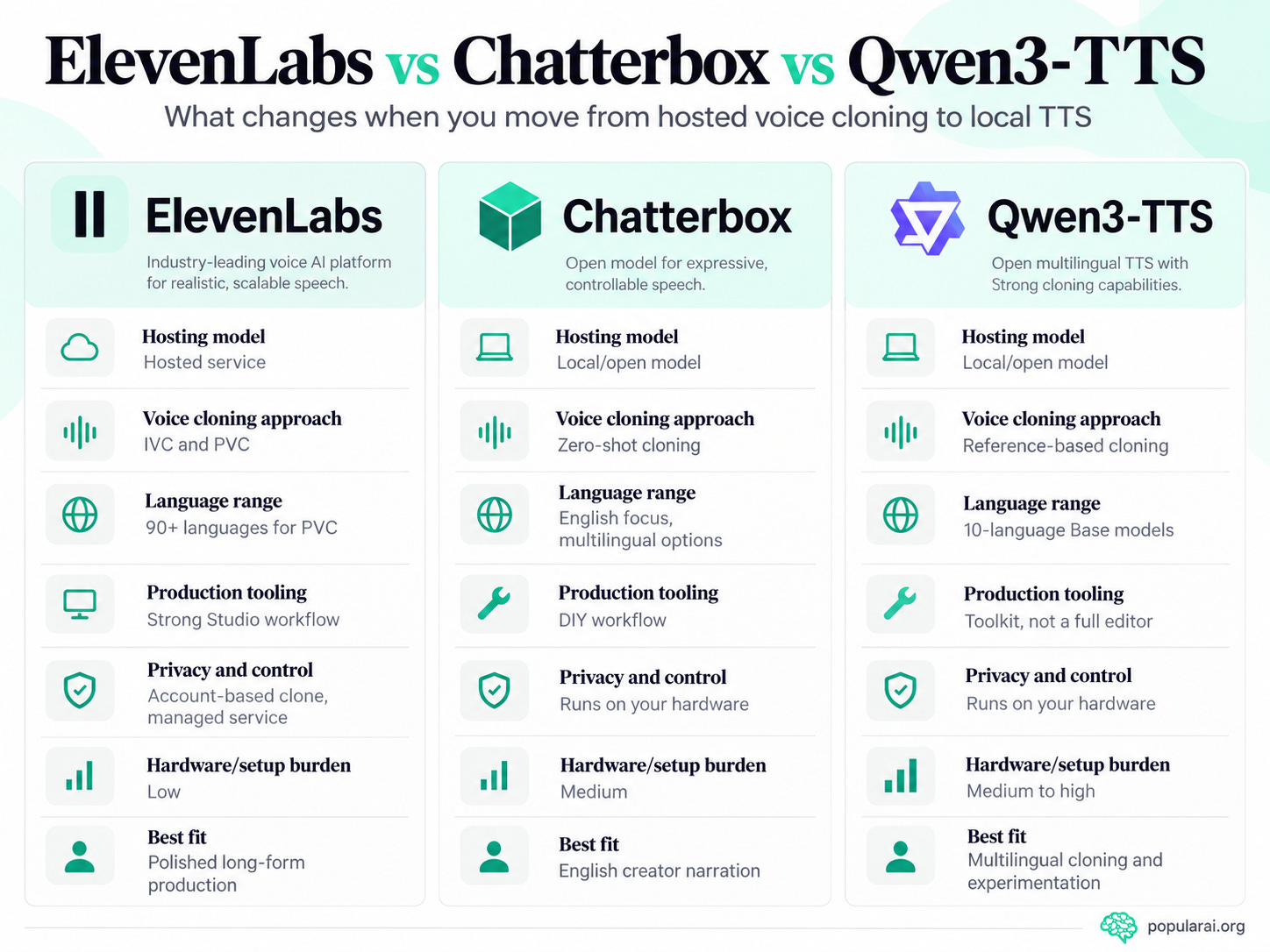
Local TTS is strongest as an alternative to ElevenLabs Instant Voice Cloning, not necessarily Professional Voice Cloning. ElevenLabs recommends 1 to 2 minutes of source audio for IVC and 30 to 180 minutes for PVC, which trains a dedicated model.
Long-form reliability is still the part to test hardest. Open-project issue trackers contain reports of repetition, hallucinated speech, pacing problems, and voice drift. Those reports do not establish a universal failure rate, but they describe exactly the failures that turn a good 15-second demo into a bad audiobook workflow.
The practical answer
Yes, you can replace ElevenLabs with local voice cloning if your work is mostly self-narration, YouTube voiceover, podcast inserts, draft audiobook narration, or similar jobs where you control the source voice and can tolerate some retries.
Start with Chatterbox for English narration. Its Turbo model gives you a relatively small local model, straightforward reference-audio cloning, and native tags for performance cues such as [laugh] and [chuckle]. That makes it a sensible first test if your current ElevenLabs use is mostly “my voice, my script, English narration.”
Try Qwen3-TTS when multilingual output is central or when the larger Qwen speech toolkit is part of the attraction. The Qwen family separates cloning, built-in voices, and text-described voice design into different models. That gives you more range, but it also creates a more complicated stack than a single hosted editor.
Keep ElevenLabs for polished long-form production when saving editing time matters more than removing the subscription cost. ElevenLabs is still the more complete production solution. The hosted service handles more of the boring work around generation history, paragraph repair, pronunciation control, and bulk export.
A hybrid setup is often the least painful transition. Make routine narration locally, then keep a hosted service available for demanding client work, unusual pronunciations, or jobs where manual cleanup would cost more than the subscription.
Voice cloning, preset voices, and voice design solve different jobs
The labels around local TTS get muddled quickly, which makes feature lists look more interchangeable than they are.
Voice cloning means giving the model a recording of yourself and asking it to produce new speech that preserves your voice identity. This is the capability that competes most directly with ElevenLabs Instant Voice Cloning.
Preset voice selection means choosing a voice supplied with the model. Qwen calls this CustomVoice and provides 0.6B and 1.7B variants with named built-in speakers. That can be useful for character work or narration, but it does not clone your voice, or anyone else’s.
Voice design starts from a text description rather than an existing human voice. Qwen’s 1.7B VoiceDesign model can create speech from a description of the desired speaker and delivery. Qwen also documents a workflow where you design a short synthetic voice first, then use that generated sample as the reference for the Base cloning model so the character can be reused. The Qwen3-TTS technical report covers the voice-design capability.
Do not judge a voice-cloning replacement by the prettiest VoiceDesign demo. A reader looking for a local ElevenLabs alternative usually wants their own voice reading their own script. That is a harder test, and it is the one that affects whether a subscription can actually go away.
What ElevenLabs still does better
ElevenLabs hides most of the machinery that local TTS puts on your desk.
As of October 15, 2026, ElevenLabs lists Starter at $6 per month with 30,000 monthly credits, Creator at $22 with 121,000 credits, and Pro at $99 with 600,000 credits. Starter includes Instant Voice Cloning. Creator adds Professional Voice Cloning. Introductory discounts and plan details can change, so the date matters.
Instant Voice Cloning is the fairer comparison with Qwen3-TTS and Chatterbox. Professional Voice Cloning asks for far more source audio and fine-tunes a dedicated voice. That extra training is one reason a local zero-shot clone and an ElevenLabs PVC should not be treated as equivalent products simply because both can say new words in your voice.
PVC also has a much broader documented language range. ElevenLabs says Professional Voice Cloning with the Eleven v4 model family supports more than 90 languages. Qwen3-TTS documents 10 languages for its released Base cloning models. Chatterbox Multilingual V3 covers 23-plus languages in its current model table.
Then there is Studio. It can keep previous generations for each paragraph, restore an earlier take, lock finished paragraphs, download individual generations, and automatically retry bulk output when its checks detect issues such as mispronunciations, missing or added words, voice-similarity problems, or volume distortions.
Those features are boring until you have 45 minutes of narration and paragraph 73 suddenly sounds drunk.
That production layer remains the strongest reason to keep paying. A local model can generate the WAV. ElevenLabs spends product effort on everything that happens after the first WAV is wrong.
The catch with ElevenLabs: your voice clone stays in the account
ElevenLabs lets you download generated audio, but you cannot download or export the cloned voice itself as a standalone file. The clone remains in your ElevenLabs account. Third-party software can use the voice through the API, but the model still lives behind the service. ElevenLabs also recommends keeping your original samples because recreated clones can sound different even when they use the same recordings.
That is a meaningful control difference from keeping local model weights, reference recordings, scripts, generation settings, and WAV files under your own control.
There is a data tradeoff as well. ElevenLabs says it uses certain submitted data to improve its audio models, allows users to disable future training use under Terms and privacy > Data use, and excludes Enterprise customer data from training by default except where needed to provide the service.
Its current privacy policy says data generated about a user’s voice will not be kept longer than three years after the user’s last interaction unless retention is required or permitted by law. The same policy says the company processes information to enforce its Prohibited Use Policy and Terms of Service.
For ordinary creator narration, that may be an acceptable bargain. It is still a bargain worth seeing clearly. The hosted clone is convenient because ElevenLabs operates it. The same arrangement also means your clone remains tied to an account and a service you do not control.
Qwen3-TTS is the broader local speech toolkit
Qwen3-TTS is a family of 0.6B and 1.7B speech models. The Base variants support voice cloning across Chinese, English, Japanese, Korean, German, French, Russian, Portuguese, Spanish, and Italian. Qwen describes the Base models as capable of cloning from a reference as short as roughly three seconds.


For serious narration, use more than the theoretical minimum when you can. A clean recording that captures your normal cadence gives the model more useful material than a heroic attempt to clone yourself from one sentence.
The full cloning mode takes both reference audio and its transcript. Qwen also supports an embedding-only mode that does not require the transcript, but the documentation warns that cloning quality may drop. The project examples show that a cloning prompt can be created once and reused across single or batch generations, which is useful when you are processing a whole script.
Qwen’s other variants add capabilities that voice-cloning comparisons often blur together. VoiceDesign creates a new voice from a written description. CustomVoice supplies built-in speakers and, on the 1.7B model, instruction-based style control.
There is an important architectural catch. The Base voice-cloning model is not the same model as Qwen’s instruction-controlled VoiceDesign or CustomVoice model. If your goal is “clone my exact voice, then tell that same clone to sound furious, exhausted, suspicious, or cheerful on command,” Qwen’s feature family is more awkward than the headline list first suggests.
That does not make the toolkit weak. It means you should map the model to the job before judging it. Cloning your voice, selecting a supplied voice, and designing a new voice are three different workflows.
Where Qwen3-TTS still breaks
The public issue tracker contains several reports worth knowing before you build a narration pipeline around Qwen.
One user reported that the 1.7B Base clone could sometimes switch to the wrong speaker identity, with other commenters describing similar behavior. Another issue reports cloned speech running faster than the reference speaker and compressing pauses. A separate report describes the generated clip repeating the end of the reference recording before beginning the requested text.
These are reports from particular installations, not measured failure rates for Qwen3-TTS as a whole. Issue trackers are where problems accumulate. They are still useful because they show what your repair loop needs to catch.
For long narration, generate short sections, listen to them or automatically transcribe them, reject bad clips, and concatenate the accepted output. Do not send an entire chapter and assume success because a 20-second sample sounded excellent.
The more expensive failure is not a crash. It is a plausible clip with one wrong speaker turn, one duplicated phrase, or one burst of bad pacing that slips into a finished episode.
Chatterbox is the local option I would try first for English narration
Chatterbox is now a family rather than one model.
Chatterbox Turbo is a 350M English model aimed at low-latency synthesis. It supports zero-shot cloning from a reference clip and accepts paralinguistic tags for events such as laughter.
Chatterbox Nano cuts the model to 110M and can run on CPU. Resemble AI says Nano reaches three times real-time speed on eight CPU cores.
Chatterbox Multilingual V3 is a 500M model covering 23-plus languages, with dedicated single-language models also available.


For a creator trying to replace ElevenLabs narration, that range is useful. Turbo gives English users a lighter entry point. Multilingual V3 handles cross-language cloning. Nano gives machines without a strong GPU a lower-resource route into the same family.
The original Chatterbox model also exposes exaggeration and CFG weight controls. Resemble recommends defaults of 0.5 for each and documents lower CFG values plus greater exaggeration for more dramatic speech. Those controls are directly useful when the thing you are cloning is the narrator, rather than a separate preset voice.
Chatterbox output from the official implementation also includes Resemble AI’s PerTh neural watermark, which the project describes as imperceptible and designed to survive common audio transformations. That is another concrete difference to account for if your workflow assumes local generation means a completely untouched output path.
Chatterbox has credible quality evidence, with an asterisk
A public Podonos preference test compared Chatterbox Turbo with ElevenLabs Turbo v2.5. Its displayed response counts total 2,500 judgments. Adding the two Chatterbox-favoring scores gives 65.28 percent, the tie score is 10.2 percent, and the two ElevenLabs-favoring scores total 24.52 percent.
That is useful evidence that an open local model can compete with a commercial TTS model in perceived speech quality.
It does not prove that Chatterbox beats ElevenLabs overall. The comparison covers specific Turbo models. It does not settle Professional Voice Cloning, Studio workflow quality, long-form narration, or how well either system clones your voice.
Use it as evidence that Chatterbox belongs in the comparison. Do the final listening test yourself.
Chatterbox still has a long-form problem to test
One open Chatterbox issue reports Turbo degrading on text above roughly 350 characters in that user’s setup. Another report describes premature end detection followed by duplicated phrases in multilingual generation.
Again, issue trackers collect failures rather than representative samples. The practical lesson is simpler: chunk your script.
Generate at the sentence or paragraph level. Keep each clip short enough to audition or automatically verify. Join the accepted clips after generation. If one paragraph fails, regenerate one paragraph instead of an entire chapter.
ElevenLabs Studio has built that repair philosophy into the product. With a local model, you build it yourself. That difference is easy to ignore when comparing model demos and impossible to ignore when a deadline is approaching.
Qwen3-TTS vs Chatterbox for a local ElevenLabs alternative
▪ For English YouTube narration, podcast inserts, and solo creator voiceover, I would start with Chatterbox Turbo. The smaller model and direct expressive controls make it the cleaner first experiment.
▪ For multilingual narration, test Chatterbox Multilingual V3 and Qwen3-TTS 1.7B Base side by side with your own voice. Chatterbox covers more languages in its current multilingual model. Qwen gives you a broader surrounding speech toolkit and a reusable prompt workflow for repeated cloning. Neither should win because of a spec-sheet checkbox.
▪ For character voices you invent rather than clone, Qwen3-TTS VoiceDesign is the more interesting part of the comparison. That is a different job from replacing ElevenLabs with your own voice.
▪ For audiobooks, paid client work, or production schedules where editing time is expensive, ElevenLabs remains easier to justify. Professional Voice Cloning and Studio attack the parts of narration that local model demos tend to skip.
That is why “best local TTS” is not the most useful search question here. The better question is which system leaves you with the least expensive repair loop for the work you actually publish.
The real metric is repair time
A ten-second sample is a poor way to choose a narration system.
The useful benchmark is closer to this:
How many minutes of human repair are required to produce ten finished minutes of usable narration?
A model that sounds spectacular nine times out of ten can lose to a slightly less impressive model if the tenth generation repeats words, changes speaker, accelerates through punctuation, or invents a noise at the end.
For a proper Qwen3-TTS vs Chatterbox vs ElevenLabs test, use the same authorized reference voice and the same scripts. Start with the author’s own voice.
Test four things:
Ordinary narration. Use a few hundred words of normal prose that sound like your real work.
Pronunciation stress. Include names, acronyms, dates, numbers, URLs, and technical terms.
Expressive delivery. Use dialogue or a paragraph that needs an obvious emotional turn.
Long-form production. Produce at least ten finished minutes in realistic chunks.
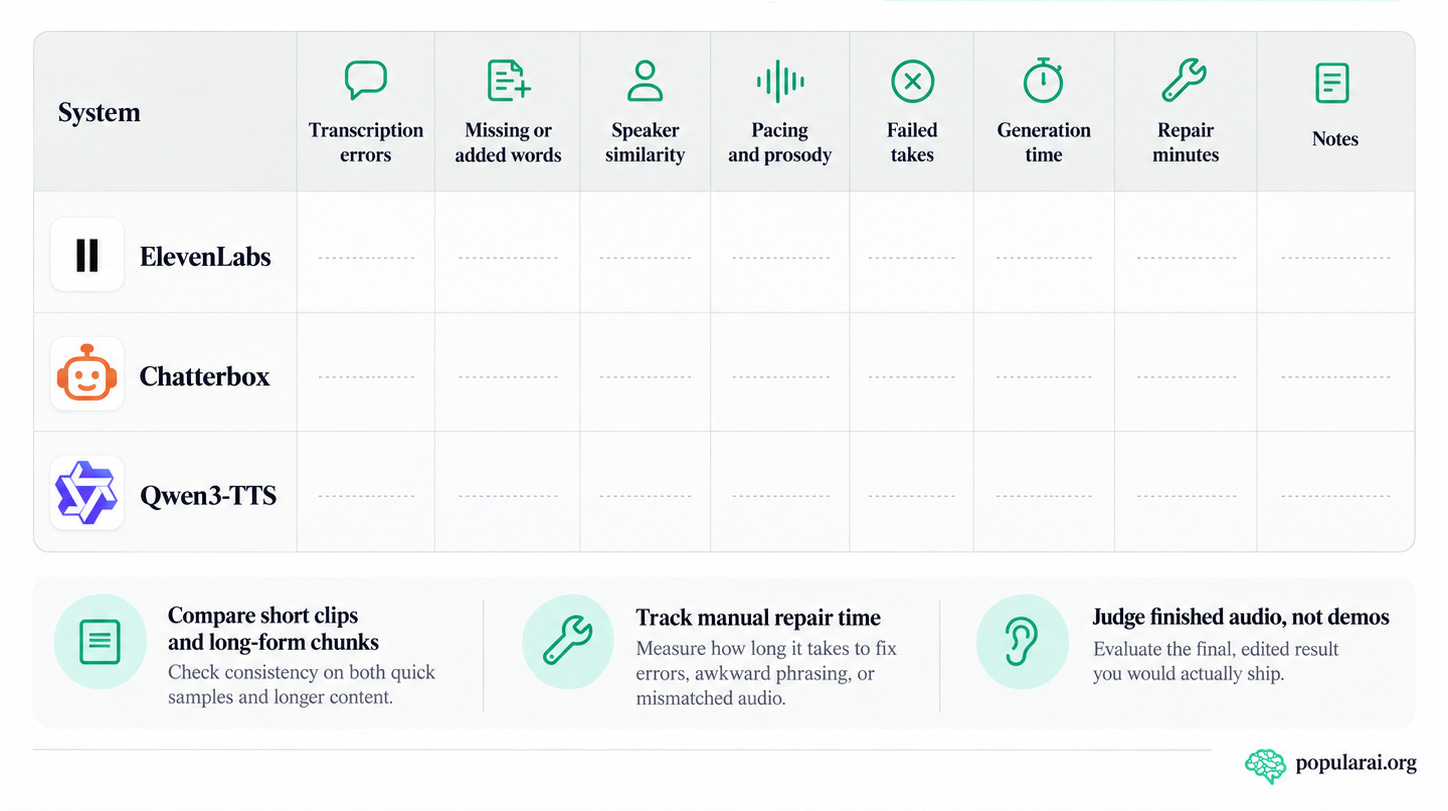
Score transcription errors, missing or added words, speaker similarity, pace, prosody, generation time, failed takes, and manual repair time. Keep the same scoring sheet for all three systems.
Run one strict zero-shot comparison using the same short reference clip. Then run a second practical comparison where each product gets the input its developer recommends. ElevenLabs recommends 1 to 2 minutes for Instant Voice Cloning, so forcing it to use only a three-second Qwen-sized reference would make a tidy benchmark and a lousy buying decision.
The strongest version of this article would publish the audio beside the scores. Readers could then judge the voices themselves. Without that controlled listening test, the recommendation here is a workflow and capability verdict rather than a claim that one model objectively sounds better than another.
Hardware and setup: local means you own the problems too
Qwen’s official examples are GPU-oriented. The project shows its 1.7B Base model on CUDA with BF16 and FlashAttention 2, while the broader tooling exposes other data types and does not make every workflow depend on that exact configuration.
Chatterbox’s current documentation supports CUDA, CPU, and Apple MPS paths depending on the model. Nano is the obvious first test for CPU-only hardware. Turbo and the larger multilingual model make more sense on a GPU when turnaround time matters.
Do not buy a new GPU merely to save a $6 or $22 monthly subscription without doing the math first. If you already own a capable NVIDIA card for local AI, the incremental cost of running TTS can be modest. If you need to spend hundreds of dollars solely for narration, ElevenLabs can remain cheaper for years.
Time counts too.
An April 2026 LocalLLaMA thread captures the messier side of the local route. One user reported getting Qwen working on CPU but finding it too slow, then running into GPU and dependency problems, while Chatterbox cloned the voice but needed troubleshooting around speed, repetition, and garbled output. That is one person’s setup, not a controlled benchmark. It still illustrates the kind of work that hosted-service pricing hides.
If you already use local audio tools, the stack becomes more attractive. Popular AI’s local Whisper transcription guide can help turn generated clips back into text, which gives you a practical way to flag narration that diverges from the script. A similar local-first approach already works for private meeting transcription with Whisper and Ollama.
The local advantage grows when you can reuse the same transcription, scripting, storage, and GPU setup across several jobs. If TTS is the only local workload you have, the maintenance overhead is harder to ignore.
The creator default: Chatterbox plus chunking
Record one clean reference clip of your normal narration voice. Load Chatterbox Turbo, split scripts at sentence or paragraph boundaries, and generate clips individually.
Automatically transcribe the result with Whisper. Flag clips where the transcript diverges from the source. Listen to the remaining clips, regenerate obvious pacing or voice failures, then normalize and concatenate them in your audio editor.
This adds machinery compared with ElevenLabs. Once the pipeline is scripted, much of the boring work can become routine. You still need to watch for failures that transcription alone will not catch, including bad pacing or a voice that sounds wrong while saying the correct words.
The privacy-first multilingual workflow: Qwen3-TTS
Use Qwen3-TTS Base with a clean reference recording and an exact transcript. Precompute the reusable cloning prompt, then generate a batch of short narration segments.
Keep the model files, reference recording, scripts, intermediate WAV files, and final audio locally. That makes Qwen attractive when private voice generation is part of the goal rather than a side benefit.
If you also need invented character voices, run VoiceDesign separately and turn the successful designed samples into reusable cloned character voices. Qwen documents that design-then-clone path as part of the same toolkit.
The important point is to keep those jobs separate in your head. A designed character voice can be excellent without telling you anything about how faithfully Qwen will reproduce your own speaking identity.
The low-friction hybrid
Use local cloning for drafts, private material, routine narration, and bulk generation. Keep ElevenLabs for work where its Professional Voice Clone or Studio editor saves enough cleanup time to justify the subscription.


This is probably the best transition path for a working creator. You can learn the local stack without making tomorrow’s upload depend on whether CUDA feels cooperative.
The hybrid also gives you a clean way to measure the real cost. If local narration keeps winning jobs because its repair burden stays low, the hosted service becomes easier to downgrade or cancel. If you keep reaching for ElevenLabs whenever a script gets long, technical, or client-facing, the subscription is buying more than raw speech generation.
Privacy is the cleanest local win
With a properly local Qwen3-TTS or Chatterbox setup, your reference recording, script, and generated audio can stay on your machine. You still need to download model weights and software dependencies, so local does not mean nothing ever touches the internet during setup. After the files are present, the inference workflow does not require submitting every script and voice sample to a hosted TTS account.
The control difference is larger than the monthly fee.
ElevenLabs gives you a managed voice that lives in your account. Local cloning gives you the source recording, model files, code, generation settings, and outputs. The Qwen3-TTS repository is licensed under Apache 2.0, while Chatterbox uses the MIT license.
The trade is maintenance. You become responsible for the Python environment, model versions, drivers, storage, batching logic, backups, and quality checks.
That work is not free. It is the price of owning more of the stack.
Choose Chatterbox for the fastest English test
Choose Chatterbox if you mainly create English narration, want the shortest route into local cloning, value direct expressive controls, or want smaller models that leave more room for modest hardware.
Turbo is my first recommendation for testing whether local TTS can replace an ElevenLabs IVC workflow. It is focused enough that you can learn quickly whether the core bargain works for you: acceptable voice similarity and narration quality in exchange for local control and more hands-on repair.
If that test fails, you have learned something useful without building a complicated multi-model pipeline.
Choose Qwen3-TTS for multilingual cloning and a wider speech toolkit
Choose Qwen3-TTS if you need its 10-language Base cloning range, want reusable reference prompts and batch generation, or also want to experiment with free-form designed voices and built-in speaker models.
Qwen is the more ambitious speech toolkit. It asks you to understand which model variant handles which job. That extra machinery is worthwhile when you actually need the range. It is unnecessary overhead if all you want is dependable English narration in your own voice.
Keep ElevenLabs when editing time costs more than the subscription
Keep ElevenLabs if your income depends on finishing long-form narration with minimal technical attention, Professional Voice Cloning gives you an audible advantage, you need its broader language coverage, or Studio saves meaningful editing time.
At $6 for Starter or $22 for Creator, buying and maintaining a dedicated local machine solely to avoid the subscription can be a false economy. The arithmetic changes if you already own suitable hardware, generate a lot of speech, value local privacy, or can reuse the same machine for other local AI jobs.
A subscription is expensive when you only need the model. It can be cheap when it removes hours of repair.
Start with Chatterbox, then test Qwen3-TTS against your real workload
Do not cancel ElevenLabs first.
Install Chatterbox and Qwen3-TTS while your current workflow still works. Record one clean reference clip that you have permission to use. Generate the same five-minute script with all three systems. Count failed takes and editing minutes instead of listening only for the prettiest sentence.
If local output gets close enough and the repair burden stays reasonable, move routine narration over. Keep the original reference recordings regardless. ElevenLabs itself recommends preserving them because its hosted clones cannot be exported and recreated clones can differ even when they use the same samples.
For English creator narration, Chatterbox is the local ElevenLabs alternative I would test first. For multilingual work and broader voice experimentation, Qwen3-TTS is the stronger next test.
ElevenLabs still wins when you are buying the whole production system instead of only speech generation. Professional Voice Cloning, long-form editing, pronunciation tools, generation history, and automatic retries remove work that a local setup leaves on your desk.
Replace ElevenLabs when you are mainly paying for speech generation and your local repair loop is cheap enough.
Keep it when you are paying to avoid becoming your own TTS engineer.
More on local audio AI:


Explore more from Popular AI:
Start here | Local AI | Builds & gear | Autonomy & policy | Fixes & guides | Popular AI podcast
Would you switch from ElevenLabs to a local AI voice generator if the quality were close enough, or is setup friction still the deal-breaker?