


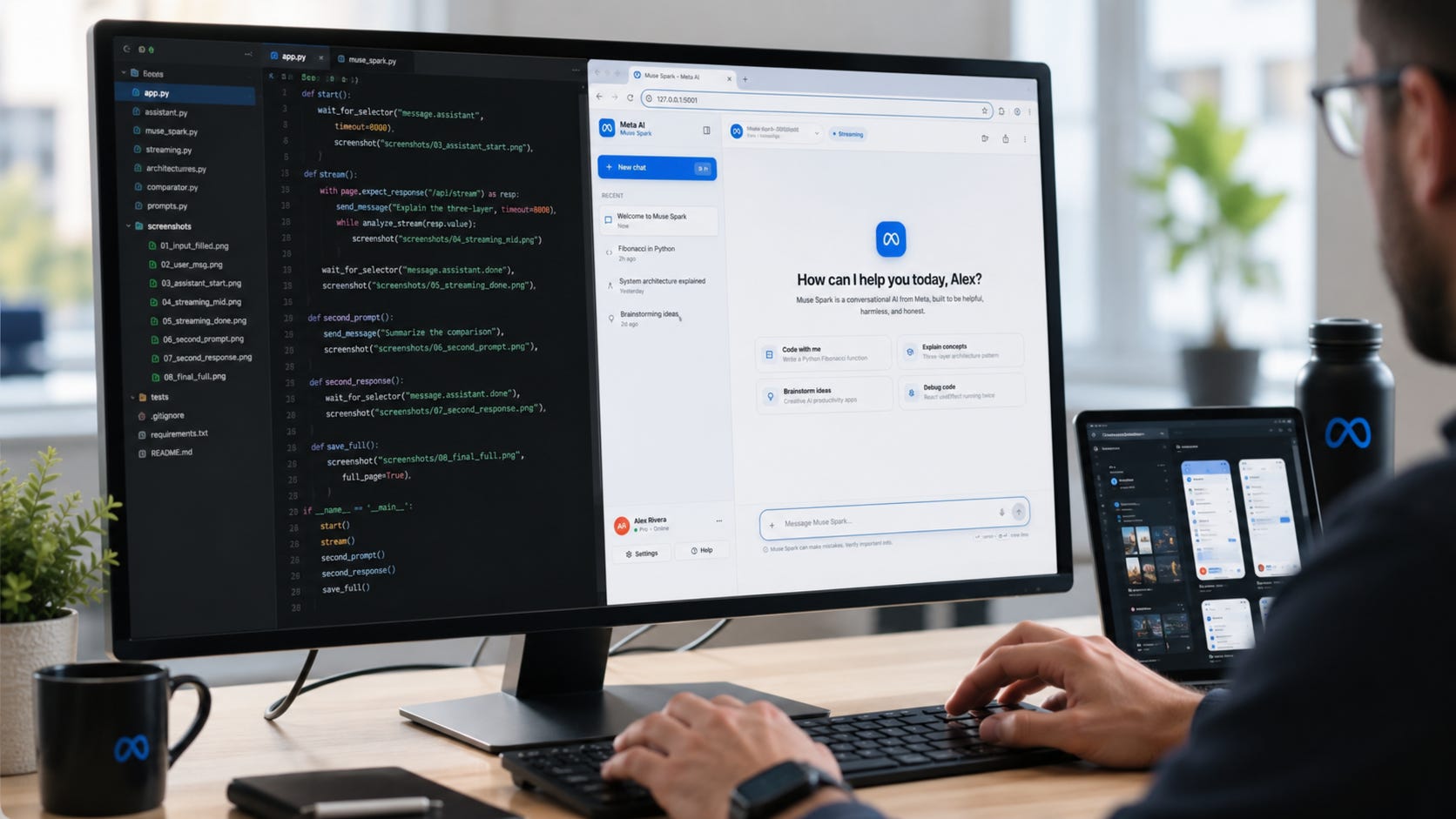
If you use AI coding agents, Meta Muse Spark 1.1 is worth testing for one reason: price pressure.
Meta opened public preview access to Muse Spark 1.1 through the new Meta Model API, and the raw token price is low enough to make Codex, Claude Code, Gemini CLI, and local-model users recheck their monthly spend. The catch is simple. Cheap tokens do not automatically create cheap agent work.
Agent cost comes from retries, long context, tool calls, failed runs, permissions, and the cleanup you still do after the model edits your repo. That is why Muse Spark 1.1 should be treated as a serious benchmark candidate, rather than an instant replacement for the coding-agent setup you already trust.
Key takeaways
Muse Spark 1.1 is available to U.S. developers in public preview through the Meta Model API, with $20 in starter credits and pay-as-you-go pricing after that. Reuters reported Muse Spark 1.1 pricing at $1.25 per million input tokens and $4.25 per million output tokens.
Meta is aiming directly at coding and agentic workflows. Meta says Muse Spark 1.1 improves tool use, computer use, coding, multimodal understanding, multi-agent orchestration, and 1 million token context handling.
The price is strongest against high-output coding models. OpenAI lists
gpt-5.3-codexat $1.75 input and $14 output per million tokens on standard API pricing, while Anthropic lists Claude Sonnet 5 at $2 input and $10 output through August 31, 2026, then $3 and $15 after that.
Gemini CLI is still the cheapest casual test path for many developers. The Gemini CLI repo lists a free tier of 60 requests per minute and 1,000 requests per day with a personal Google account, although Google says Gemini CLI and agent mode share quotas and one prompt can consume multiple model requests.
Do not test Muse Spark 1.1 first on private client repos. Developers should inspect account-level API terms, data-use rules, retention, and enterprise controls before sending sensitive code.
What Meta actually released
Meta introduced Muse Spark 1.1 on July 9, 2026. The company describes it as a multimodal reasoning model built for agentic tasks, with gains in tool use, computer use, coding, and multimodal understanding. It is available in Thinking mode in Meta AI and through the new Meta Model API public preview.
This is a different Meta story from Llama. Muse Spark 1.1 is a hosted model available through Meta’s product surfaces and API. Meta has not presented it as a downloadable open-weight model that ordinary users can run at home. That matters because the control point is the API account, not hardware you own.
Reuters reported that U.S. developers can access the model in public preview, receive $20 in free credits, and then pay $1.25 per million input tokens and $4.25 per million output tokens.
That price is the article. Meta is not merely launching another chatbot model. It is pricing a coding-agent model low enough to make high-volume agent users compare it against Codex, Claude Code, Gemini CLI, and local coding models.
What changed for coding agents
The useful change is that Meta is targeting the work loop where AI coding becomes expensive.
Meta says Muse Spark 1.1 can gather context, plan, delegate to subagents, manage a 1 million token context window, diagnose and fix complex bugs, implement features, handle migrations, and work with common agentic coding setups such as planning mode, goal conditioning, subagent delegation, and context compaction.
That is the right feature list for modern coding agents. A coding agent does not merely answer questions about code. It reads files, reasons across context, calls tools, proposes diffs, runs tests, interprets failures, and tries again.
This is why raw token pricing matters more for coding agents than for ordinary chat. A single agent run can burn through a lot of input tokens by reading files, terminal output, logs, test traces, docs, and previous attempts. Output tokens can also pile up when the model writes plans, explanations, patches, command summaries, and follow-up fixes.
A simple raw-token example shows why developers will test it. A coding-agent run that uses 1 million input tokens and 200,000 output tokens would cost about $2.10 on Muse Spark 1.1 at Reuters’ reported $1.25 input and $4.25 output rates. The same raw token shape would cost about $4.55 on OpenAI’s standard gpt-5.3-codex API pricing and about $4 on Claude Sonnet 5 during Anthropic’s introductory period. That comparison excludes tool charges, subscription limits, retries, hosted shell costs, and any vendor-specific caching behavior.
Cheap enough to test? Yes.
Cheap enough to switch blindly? No.
Benchmarks are useful, but agent tests matter more
Meta’s release makes broad performance claims around coding, tool use, computer use, multimodal understanding, and agentic workflows. It also describes internal coding evaluations and examples where the model builds apps, takes screenshots, traces issues, fixes bugs, and validates changes.
Those claims are worth paying attention to, but agent benchmarks are usually a starting point rather than the buying decision. Coding-agent performance depends on the model, the harness, the permission system, the repo, the test suite, the task shape, and the developer who reviews the patch.
A model can look strong on a published coding benchmark and still be frustrating in a real repo if it over-edits, misses project conventions, makes risky dependency changes, loops on failed tests, or produces patches that are technically correct but hard to maintain.
That is why the right comparison is not “Muse Spark 1.1 versus Codex” in the abstract. The right comparison is Muse Spark 1.1 against the tasks that already cost you time: repo mapping, flaky test diagnosis, frontend fixes, dependency updates, small refactors, migration prep, test generation, and bug reproduction.
Where Muse Spark 1.1 could fit
Muse Spark 1.1 is most interesting where token volume matters and where the task benefits from multimodal or long-context reasoning.

For large repo exploration, lower input cost matters. If you routinely ask an agent to inspect a codebase, summarize architecture, find related files, and propose a patch plan, token cost can become a real constraint. A 1 million token context window gives the model more room, although context size does not remove the need for good retrieval, clean file selection, and disciplined prompts.
For frontend and UI debugging, Meta’s examples emphasize coding plus screenshots, visual inspection, tool calling, and validation. That makes Muse Spark 1.1 worth testing on UI bugs, browser screenshots, PDF-to-app tasks, layout issues, and visual-to-code workflows.
For high-volume agent scaffolding, output price matters. If you run Cline, OpenCode, internal agents, or custom harnesses across many small tasks, the output side of the bill can dominate. Meta’s reported $4.25 output price is the part that should get the attention of teams already paying for large agent runs.
For non-sensitive automation, Muse Spark 1.1 may be a good test model for repetitive refactors, test generation, codebase explanations, internal tools, and throwaway prototypes where the code is not confidential.
It is less compelling as a first stop for private client repos, regulated code, production credentials, unreleased products, or anything where you have not verified the API terms for your own account.
Access, pricing, and availability
Muse Spark 1.1 is available in Meta AI’s Thinking mode and through the Meta Model API public preview. Reuters and The Verge both reported that the public API preview is for U.S. developers, and Reuters reported the $20 free-credit offer with pay-as-you-go pricing after that.

The current pricing picture is straightforward, but the product comparison is not.
Meta Muse Spark 1.1: $1.25 input and $4.25 output per million tokens, based on Reuters’ report.
OpenAI Codex: OpenAI says Codex is included in ChatGPT Free, Go, Plus, Pro, Business, Edu, and Enterprise plans. For API use, OpenAI lists gpt-5.3-codex at $1.75 input and $14 output per million tokens on standard pricing, with higher priority pricing available.
Claude Code: Claude Code depends on Anthropic’s Claude plans or API usage. Anthropic lists Claude Sonnet 5 at $2 input and $10 output per million tokens through August 31, 2026, then $3 and $15. Anthropic lists Claude Opus 4.5 at $5 input and $25 output.
Gemini CLI: Google’s Gemini CLI is open source, terminal-first, and tied to Gemini Code Assist quotas. The repo lists 60 requests per minute and 1,000 requests per day for the free tier with a personal Google account, while Google’s quota docs warn that one prompt can result in multiple model requests.
Local coding models: Local models have no per-token vendor bill once you own the hardware, but they do have hardware, setup, power, and quality costs. Qwen3-Coder-Next is an open-weight coding model designed for coding agents and local development, with 80B total parameters, 3B activated parameters, and native 262,144 token context according to its Hugging Face model card.
This is why raw pricing comparisons can mislead. A cheaper model that fails three times can cost more than an expensive model that produces one clean patch. A subscription tool that includes agent usage can be cheaper than API calls for one developer and more expensive for a team running automated harnesses all day.
Can you run Muse Spark 1.1 locally?
No public evidence shows that ordinary users can run Muse Spark 1.1 locally. Meta’s release frames the model around Meta AI and the Meta Model API, not downloadable weights.
That means Muse Spark 1.1 is a hosted coding-agent model. It may be cheap. It may be useful. It is still rented access.
For local coding, look at open-weight models instead. Qwen3-Coder and Qwen3-Coder-Next are the obvious current comparison points because they are explicitly aimed at coding agents and local development. Qwen says Qwen3-Coder supports repo-scale context and agentic coding, while Qwen3-Coder-Next is designed for local and agent deployment with lower active-parameter cost.
Local models still have limits. They are usually weaker than the best hosted models on messy, long-running, high-judgment work. They are better when privacy, reproducibility, cost ceilings, and offline fallback matter more than maximum capability.
License, privacy, and control points
The control lever is API access.
A hosted coding model can be inexpensive and still create dependency. The account controls the model, the model controls the work loop, and the provider controls pricing, availability, rate limits, policy enforcement, logging rules, and future model changes.
For Muse Spark 1.1, developers should check these points before using it on serious code:
Does Meta use API inputs or outputs for training by default?
What retention period applies to prompts, code, files, and tool outputs?
Can enterprise accounts opt out of training or logging?
What usage policy applies to security research, vulnerability testing, malware analysis, reverse engineering, or dual-use code?
What happens to access if Meta changes policy later?
Can you export prompts, outputs, tool logs, and generated diffs?
Are there region limits beyond the U.S. preview?
What are the rate limits and abuse thresholds?
On top of that, the public Meta Model API terms may or may not please developers depending on their use-case. That is not a reason to avoid the model. It is a reason to read the terms inside the account before sending private repositories, customer code, credentials, unreleased products, or regulated data.
Do not assume that a coding API is private because it is paid. OpenAI, Anthropic, Google, and Meta separate consumer, developer, business, and enterprise terms in different ways. OpenAI, for example, says ChatGPT Business data is not used for training by default in its Codex pricing page, while API usage follows API terms and token pricing.
For private repositories, the safest pattern is still boring and effective:
Use local models for first-pass review, architecture summaries, and sensitive context.
Use hosted models on isolated branches, scrubbed code, synthetic examples, or non-sensitive modules.
Keep secrets,
.envfiles, production credentials, customer data, and private logs out of the agent context.Run agents inside worktrees, containers, or disposable clones.
Require human approval for dependency changes, migrations, network calls, and destructive commands.
Popular AI has covered the same private-repo risk in AI coding agents through the Alibaba and Claude Code dispute over private repositories. The practical issue is bigger than one vendor: coding agents now touch telemetry, account rules, private code, jurisdiction, and enterprise policy.
More on private-repo risk in AI coding:

How Muse Spark 1.1 compares
Muse Spark 1.1 should be compared against the full workflow, not only the model name. A coding agent is the model plus the harness, permissions, repo integration, tool access, recovery behavior, and review process.
That matters because Codex, Claude Code, Gemini CLI, and local models solve different problems.
Codex is a more mature product environment. Claude Code has a strong developer-machine workflow and permission story. Gemini CLI is attractive for free and low-friction terminal work. Local models offer privacy and cost ceilings. Muse Spark 1.1’s first obvious advantage is low API token pricing for agentic coding experiments.
Muse Spark 1.1 vs OpenAI Codex
Codex is more mature as a coding-agent product. OpenAI has the desktop app, CLI, IDE extension, cloud workflows, code review, and ChatGPT plan integration. OpenAI describes the Codex app as a command center for running multiple agents, reviewing changes, using worktrees, and managing long-running tasks.
Muse Spark 1.1’s advantage is price and Meta’s multimodal-agent pitch. Its disadvantage is maturity. The model may be strong, but a coding agent is model plus harness plus permissions plus repo integration plus recovery behavior.
Use Muse Spark 1.1 if token cost is blocking you from running bigger agent experiments. Keep Codex if you already rely on its desktop, cloud, review, CLI, IDE, or ChatGPT workflow.
This is also a lock-in question. If your agent workflow becomes dependent on one hosted product, pricing, limits, and behavior can change around you. Popular AI has covered that dependency problem through the lens of GPT 5.3 Codex and the quiet end of software as a product.
More on AI coding agent lock-in:

Muse Spark 1.1 vs Claude Code
Claude Code remains one of the strongest serious coding-agent experiences because it runs on the developer’s machine and has well-developed permission behavior. Anthropic says Claude Code asks by default before running commands or modifying files, and its auto mode was built to reduce approval fatigue while catching risky actions.
That permission layer matters. Anthropic’s own containment writeup says Claude Code has access to the user’s filesystem, shell, and network, so its safety model depends on controlling that access.
Muse Spark 1.1 may be cheaper than Claude Sonnet and far cheaper than Opus on output tokens. Claude Code may still be the better choice when you need a proven local-agent workflow around a real repo.
Use Muse Spark 1.1 when output price is the bottleneck and the repo is safe to send to a hosted API. Use Claude Code when you need the richer local workflow, mature command permissions, and a developer-facing review loop. For a broader hybrid setup, Our guide to building an independent AI dev stack with Claude Code is a natural companion.
More on local-cloud hybrid AI coding:

Muse Spark 1.1 vs Gemini CLI
Gemini CLI is hard to beat on price for casual and light usage. It is open source, terminal-first, and supports file operations, shell commands, web fetching, MCP, and Google Search grounding. The free tier is generous for individuals.
The catch is quota shape. Google says Gemini CLI and agent mode quotas are combined, and one prompt can trigger multiple model requests. That makes real agent capacity less obvious than the headline daily request number.
Use Gemini CLI when you want a free or low-friction terminal agent. Test Muse Spark 1.1 when you need API access, predictable token pricing, or a different model for high-volume harness experiments.
Muse Spark 1.1 vs local coding models
Local coding models win on privacy, offline use, repeatability, and cost ceilings. They lose when the task needs frontier-level reasoning, very strong tool use, or polished agent recovery.
Qwen3-Coder-Next is the most relevant local comparison because it is open-weight, coding-agent focused, and built for local development. The model card says Qwen3-Coder-Next can be served with vLLM, SGLang, Docker, and quantized formats for llama.cpp, Ollama, LM Studio, or compatible apps.
Use local models for private repo reading, code explanation, simple patches, tests, small scripts, and sensitive context. Use hosted models when the local model gets stuck and the code can safely leave your machine.
Our GLM-5.2 analysis for open coding models is a useful follow-up for readers building a private coding fallback. If you are choosing hardware for that fallback, our RTX 3090 local coding-agent build covers the hardware angle.
More on building your first local AI coding machine:

What cheap tokens do not solve
Cheap token pricing helps, but coding agents waste money in ways a pricing table does not show.
Retries still cost money. A cheap failed run is still a failed run.
Long context can become a tax. If the agent keeps stuffing the same irrelevant files into context, a low input price only delays the bill.
Tool calls matter. Web search, hosted shells, code execution, file search, and external tools may have separate costs depending on the platform.
Permissions still matter. The cheaper the agent is, the more tempting it becomes to let it run longer and do more. That is exactly when permissions and isolation matter.
Cleanup is still labor. If the agent produces a messy patch, your cost is not only tokens. It is review time.
Research on real-world coding-agent use shows why this market matters. AIDev reported 932,791 agent-authored pull requests across five agents, spanning 116,211 repositories and 72,189 developers. A separate 180 million repository census found that single-signal detection can badly undercount agent use, including a 30x undercount for Claude Code when relying on bot-account lookup alone.
Coding agents are no longer a novelty. That makes price competition real.
Who should test Muse Spark 1.1 now
Test Muse Spark 1.1 if you run Cline, OpenCode, or your own coding-agent harness and want a cheaper model for high-volume repo tasks. It is also worth testing if you need multimodal coding workflows, especially UI and screenshot-driven debugging, and can start with non-sensitive repositories.
It also makes sense if you already have eval tasks for Codex, Claude, Gemini, or local models. The teams that will learn the most are the ones that can run Muse Spark 1.1 against the same task set, measure token use, track failure modes, and compare cleanup time.
Do not start with Muse Spark 1.1 if you need a mature desktop coding-agent product today, work mostly with private client repos, cannot verify Meta’s API terms for your account, need offline local use, or need strict enterprise controls now.
Also do not start with it if your first task is a production migration, a dependency rewrite, or a multi-service change without guardrails. A cheap model can still create expensive review work.
A practical test plan
Do not ask Muse Spark 1.1 to rewrite your main product on day one.
Start with five controlled tasks.
Repo map: Ask it to explain the architecture and name the files it used.
Small bug fix: Give it a failing test and measure whether it fixes the cause or patches the symptom.
UI screenshot fix: Give it a screenshot and ask for a targeted frontend change.
Test generation: Ask for tests around a known module, then inspect whether it invents behavior.
Refactor with guardrails: Give it a small refactor and forbid new dependencies.
Track four numbers.
Tokens used.
Wall-clock time.
Number of failed attempts.
Human cleanup time.
The winner is not the model with the lowest price per million tokens. The winner is the model that gets accepted patches with the least cleanup for your workload.
A simple scoring sheet is enough. Give each task a pass, partial, or fail. Note whether the model respected instructions, whether it touched unrelated files, whether it added dependencies, whether it ran tests, and how much human review was needed. Then run the same sheet against Codex, Claude Code, Gemini CLI, and your preferred local model.
FAQ
Is Meta Muse Spark 1.1 open source?
No public evidence shows that Muse Spark 1.1 is open source or open weight. Meta describes Muse Spark 1.1 as available through Meta AI and the Meta Model API, not as downloadable weights for local use.
How much does Muse Spark 1.1 cost?
Reuters reports Muse Spark 1.1 API pricing at $1.25 per million input tokens and $4.25 per million output tokens, with $20 in free credits for new API accounts.
Is Muse Spark 1.1 cheaper than Codex?
On raw API token output pricing, yes compared with OpenAI’s listed
gpt-5.3-codexstandard price. OpenAI listsgpt-5.3-codexat $1.75 input and $14 output per million tokens. Codex also exists inside ChatGPT subscription plans, so the real comparison depends on whether you use the API, CLI, IDE, cloud app, or ChatGPT plan.
Is Muse Spark 1.1 cheaper than Claude Code?
It is cheaper than Anthropic’s listed Claude Sonnet 5 and Opus pricing on raw output tokens. Anthropic lists Claude Sonnet 5 at $2 input and $10 output per million tokens through August 31, 2026, then $3 and $15, while Claude Opus 4.5 is $5 and $25. Claude Code’s product value also includes its agent workflow and permission model.
Is Gemini CLI still the better free option?
For light and casual use, probably yes. The Gemini CLI repo lists 60 requests per minute and 1,000 requests per day on the free tier with a personal Google account. Heavy agent use may hit quotas faster because one prompt can trigger multiple model requests.
Should I use Muse Spark 1.1 on private repos?
Not until you inspect the API terms, retention rules, training-use rules, and account controls for your own Meta Model API account. Start with non-sensitive repos, test branches, worktrees, and synthetic tasks. Popular AI’s coverage of the Alibaba and Claude Code private-repo dispute is a useful reminder that coding-agent risk is about accounts, telemetry, permissions, and policy as much as model quality.
Further reading for AI coding workflows
For readers building a broader agent stack, Our guide to GLM-5.2 as an open coding model pairs naturally with our breakdown of whether local AI hardware is worth buying in 2026.


The smart move is to benchmark Muse Spark, not switch blindly
Muse Spark 1.1 is the cheap coding-agent model to test next, especially if output-token cost is blocking bigger agent experiments.
Test it against Codex, Claude Code, Gemini CLI, and your best local coding model on the same five tasks. Use it first on non-sensitive code. Measure accepted patches, retries, token spend, and cleanup time. If Meta’s price holds and the model performs well in your harness, it can become a strong low-cost agent layer.
Keep Codex or Claude Code for mature agent workflows. Keep Gemini CLI for free terminal experiments. Keep local models for private repos and fallback capability.
The right answer is a stack: cheap hosted agents for safe high-volume work, mature agent products for serious repo tasks, and local models for private context. Muse Spark 1.1 has earned a place in that test. It has not earned blind trust yet.
Explore more from Popular AI:
Start here | Local AI | Fixes & guides | Builds & gear | Popular AI podcast