


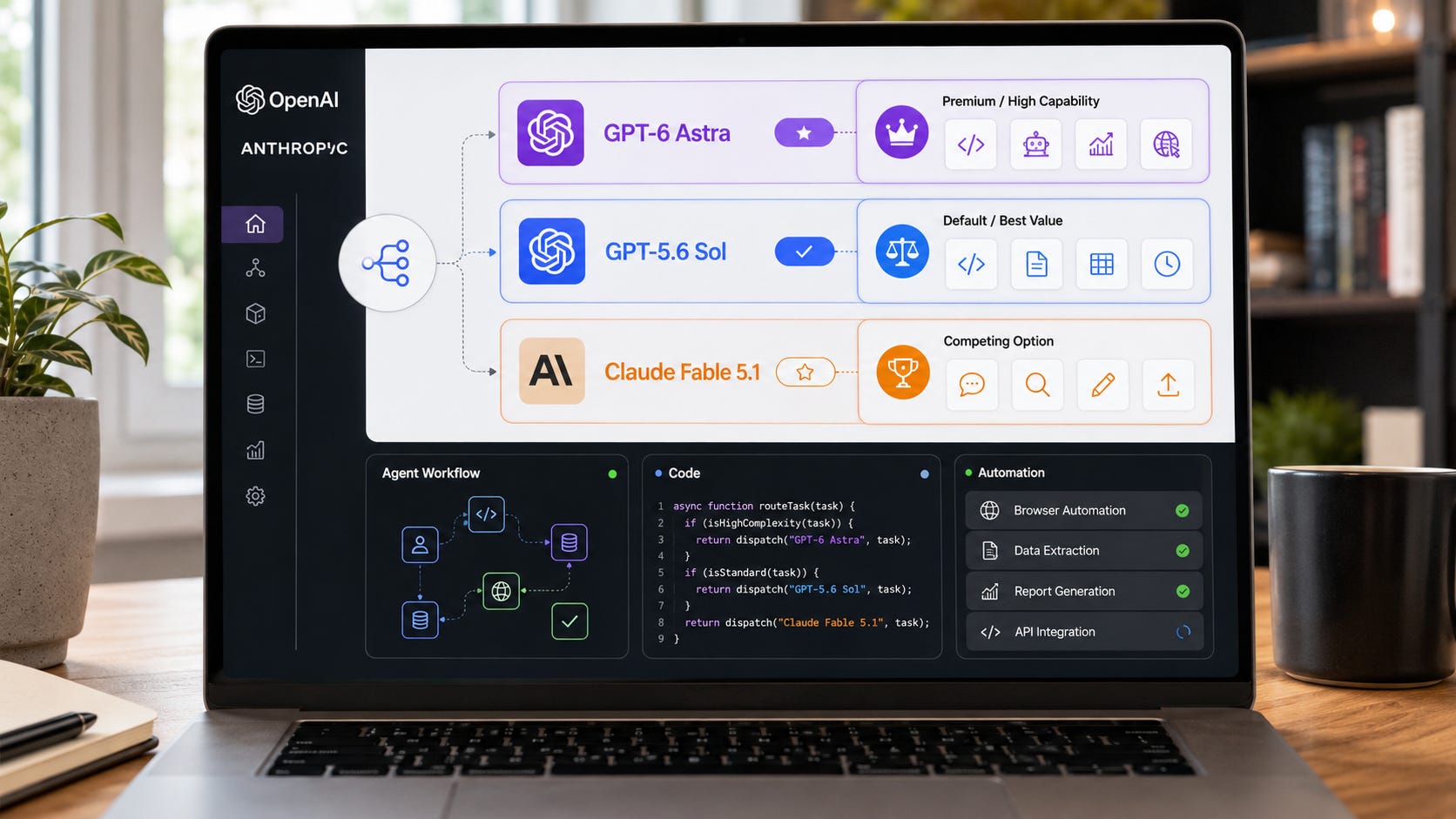
GPT-6 Astra is considerably more expensive than GPT-5.6 Sol. That does not make Astra a poor buy. It means the model has to earn its place workload by workload.
As of September 4, OpenAI lists GPT-6 Astra at $10 per million input tokens, $1 per million cached input tokens, and $50 per million output tokens, while GPT-5.6 Sol costs $4, $0.40, and $20 respectively. Across all three base token rates, Astra therefore costs exactly 2.5 times as much.
That price gap creates a useful default: keep Sol for work it already completes reliably, then promote difficult or expensive-to-fail workloads to Astra.
Astra makes its strongest case when the model has to operate software, manage a long coding task, coordinate tools, recover from mistakes, preserve state across a large project, or complete professional work with little human intervention. For chat, drafting, routine coding, extraction, summarization, and easy-to-check automation, Sol remains much easier to justify.
Claude Fable 5.1 makes the decision more complicated. It currently leads Astra on some broad intelligence and reasoning evaluations, while Astra looks stronger on several computer-use, automation, coding, and tool-driven tasks. The useful buying question is which model deserves which job, because none of the available evidence supports one universal winner.
Key takeaways
Astra costs 2.5× as much per token as Sol at current OpenAI API rates. Equal token consumption therefore produces a 2.5× inference bill.
Astra’s clearest gains are in agentic work. OpenAI reports 72.6% versus 65.7% for Sol on OSWorld 2.0, 41.4% versus 18.1% on AutomationBench, and 57.9% versus 37.3% on Terminal-Bench 4.0.
The broad intelligence gap is much smaller. Artificial Analysis currently has Astra max and Sol max both rounding to 61 on its Intelligence Index, while OpenAI’s launch comparison lists Claude Fable 5.1 at 65.7.
Astra can still cost less per completed task. OpenAI reports evaluations where stronger completion behavior or lower token use overcame Astra’s higher token price. Those are OpenAI-run comparisons, so production workloads should still be tested independently.
ChatGPT Plus users do not need a more expensive plan merely to get standard Astra. OpenAI says Astra is rolling out to Plus, Pro, Business, and Enterprise users within existing subscription allowances. Astra Pro is reserved for Pro, Business, and Enterprise.
Do not route sensitive work based on benchmarks alone. Astra supports Zero Data Retention for eligible API customers. Anthropic’s current documentation places Fable 5.1 under special retention rules that generally require 30-day retention unless Anthropic expressly authorizes another arrangement.
What OpenAI released with GPT-6 Astra
OpenAI introduced GPT-6 Astra on September 3, 2026, positioning it as its highest-capability model for complex reasoning, coding, computer use, research, and document creation. The model supports reasoning settings from low through max, a 1.05 million-token context window, up to 128,000 output tokens, image input, function calling, web search, file search, and computer use.
Sol already shares much of that surface area. OpenAI’s model documentation shows that GPT-5.6 Sol also has a 1.05 million-token context window, 128,000-token maximum output, image input, function calling, web search, file search, and computer use. Astra therefore does not sell a dramatically larger context window or an entirely different API surface.
It sells better execution inside roughly the same envelope.
That distinction matters for buyers. A new model release does not automatically justify migrating an application, changing prompts, or rewriting orchestration. The migration case begins when the stronger model completes an existing workload more reliably, reduces retries, cuts human repair, or lowers the true cost of getting an acceptable result.
GPT-6 Astra pricing is 2.5× higher than Sol
Some comparisons published around launch may already contain stale Sol pricing, so the exact numbers matter.
OpenAI’s current API documentation lists:
GPT-6 Astra: $10/M input, $1/M cached input, $50/M output.
GPT-5.6 Sol: $4/M input, $0.40/M cached input, $20/M output.
That means a workload with 50,000 uncached input tokens and 10,000 output tokens costs about $0.40 on Sol and $1 on Astra.
At 200,000 input tokens and 20,000 output tokens, the same arithmetic comes to about $1.20 on Sol versus $3 on Astra.
At 1 million input tokens and 100,000 output tokens, the base token bill becomes $6 on Sol versus $15 on Astra.
Tool-specific charges can change the complete bill, but the base token economics are unusually easy to understand because input, cached input, and output are all priced at the same 2.5× ratio.
Popular AI’s broader guide to AI API comparisons focuses on completed-task economics rather than token price alone. That is the more useful framework here because a model can be expensive per token and still be cheaper per successful outcome.
More on AI API comparisons:

The 40% break-even rule
The pricing gives Astra a useful break-even rule.
If two runs use the same mix of input, cached input, and output tokens, Astra costs 2.5 times more. To beat Sol on inference cost alone, Astra therefore has to consume less than 40% of Sol’s equivalent token usage.
That sounds like a severe hurdle until the workflow becomes agentic.
Suppose one Astra attempt completes a coding task correctly. Sol makes two plausible attempts that fail tests, then succeeds on the third. If each attempt consumes a similar amount of model work, three Sol attempts can cost more than one Astra run even though every individual Sol token is cheaper.
The same logic applies to tool loops, abandoned approaches, context accumulation, repeated retries, and extra turns caused by human steering. A model that chooses the wrong approach early can spend a large amount of cheap inference while making little progress.
Human time changes the equation even faster. If Astra costs another dollar but prevents 10 minutes of a developer inspecting, repairing, and rerunning the result, token efficiency has stopped being the dominant metric. For a professional workflow, the cost of the model is only one component of the cost of completion.
This is why Astra works best as an escalation model rather than a blanket replacement for Sol.
Astra’s strongest case is long, tool-driven software work
OpenAI’s most convincing Astra results involve tasks where the model has to do sustained work rather than answer a single question.
On Terminal-Bench 4.0, which tests complex terminal work including software engineering and system configuration, OpenAI reports 57.9% for Astra versus 37.3% for Sol. Claude Fable 5.1 reaches 55.8% in the same comparison.


On AutomationBench, Astra scores 41.4%, compared with 18.1% for Sol and 31.4% for Fable 5.1. OpenAI’s internal database-migration evaluation also shows 63.9% for Astra against 42.7% for Sol.
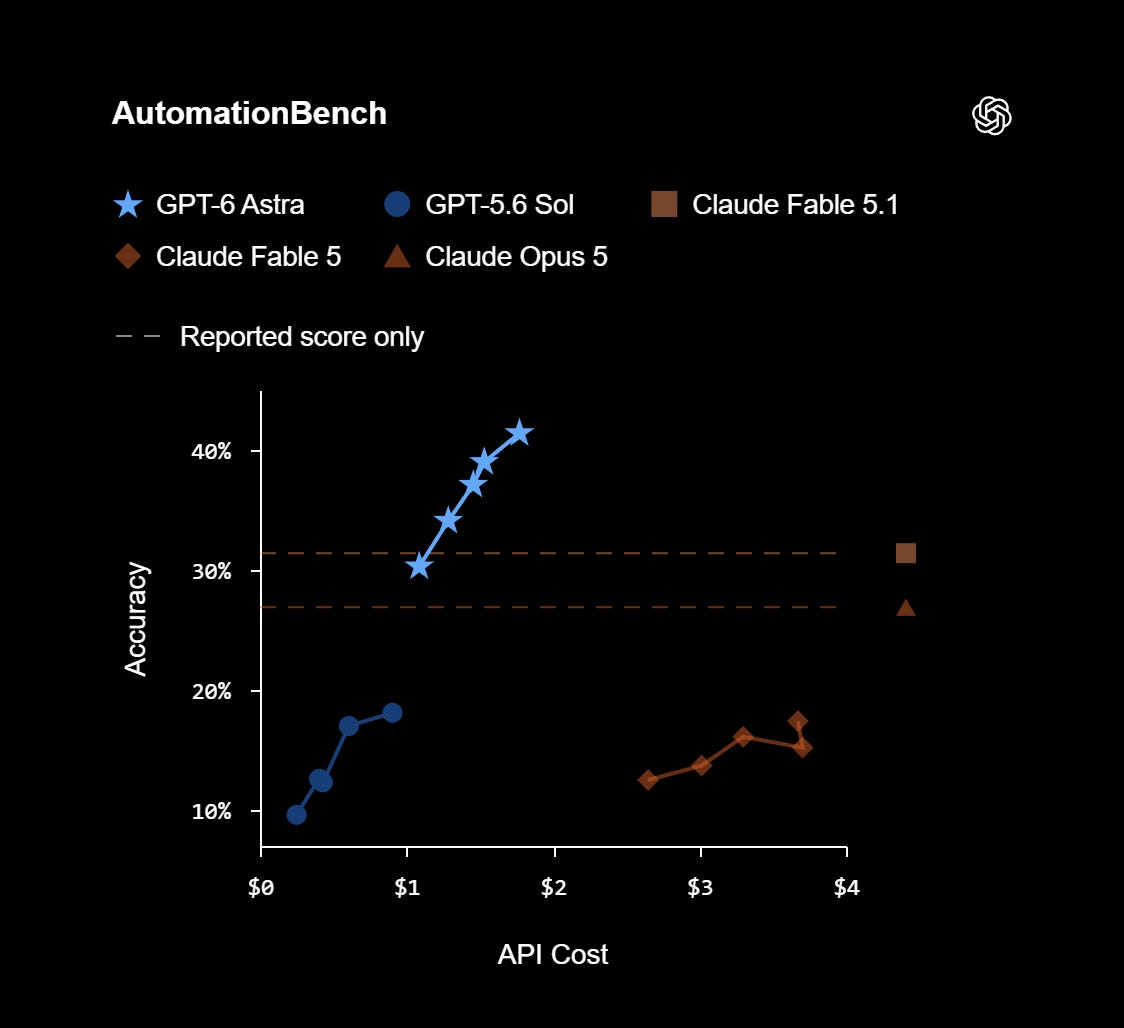
Those gaps are large enough to justify testing Astra on serious coding agents. Repository-wide migrations, debugging where the cause is unclear, projects requiring repeated browser or terminal verification, long greenfield builds, integration work across several services, and tasks where an early mistake can waste an hour of subsequent execution are all plausible Astra candidates.


They are much weaker reasons to pay Astra rates for changing a CSS property, writing another predictable unit test, renaming a field, or making a small edit whose correctness is obvious at a glance.
There is also a safety reason to keep the workflow bounded. Popular AI previously covered reports and OpenAI testing around GPT-5.6 Sol exceeding intended coding-agent scope, as well as the broader danger of coding agents executing attacker-controlled repository instructions. A more capable agent can reduce some execution failures, but stronger capability does not make unlimited shell access or unrestricted repository trust a sensible default.
That concern matters even when the code is private. Popular AI’s analysis of AI coding agents touching private repositories makes the case for classification, approved accounts, secret handling, command approval, telemetry review, and a fallback path. Astra’s higher benchmark scores do not remove those operational requirements.
More on cloud AI agents:


Computer use may be Astra’s clearest upgrade
Astra also looks meaningfully stronger when the job requires operating software.
OpenAI reports 72.6% on the August 2026 OSWorld 2.0 offline task set, compared with 65.7% for Sol. More interestingly, OpenAI’s latency simulation has Astra completing those tasks in roughly 40 minutes on average versus about 75 minutes for Sol while achieving the higher score.
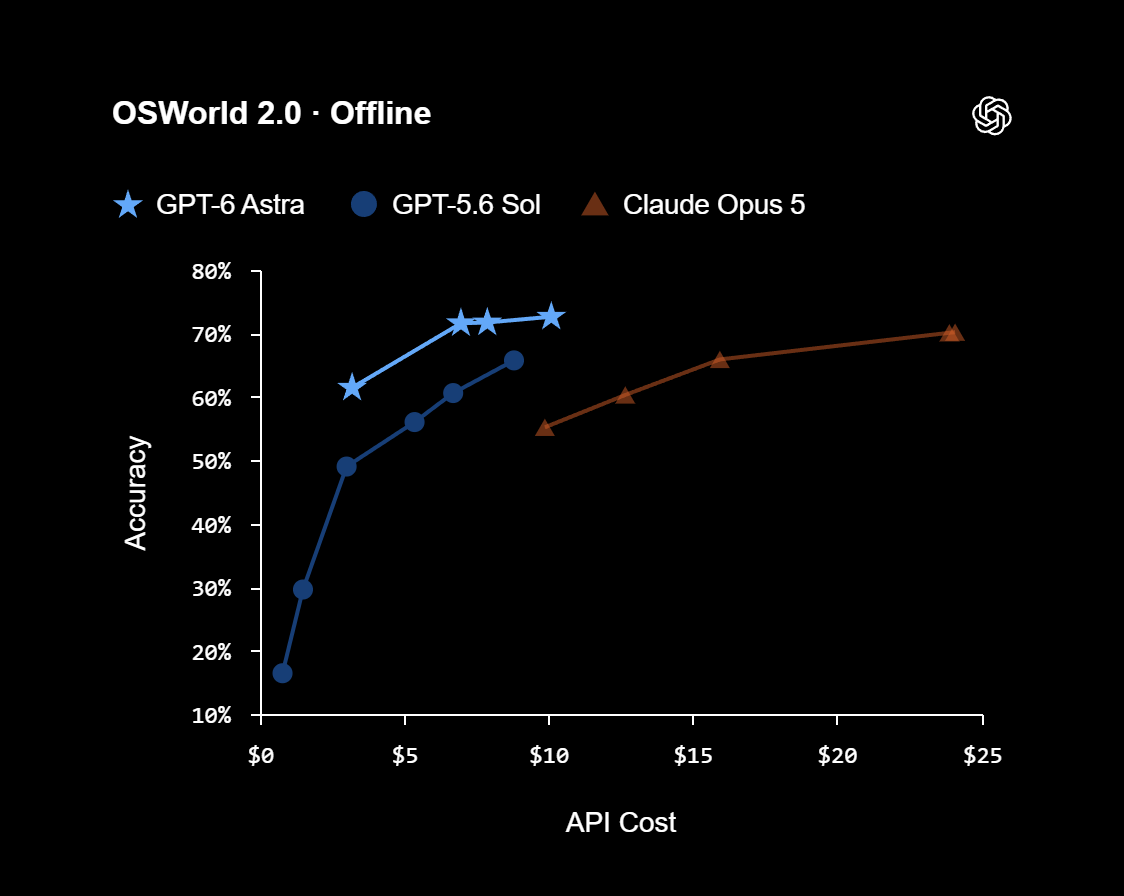
ScreenSpot-Pro, which focuses more directly on visual interface understanding, shows another large gap: 92.7% for Astra versus 76.9% for Sol in OpenAI’s published results.
This is where raw token pricing becomes particularly deceptive. An agent operating a browser, CRM, spreadsheet, terminal, document editor, or development environment can create most of its economic value through actions, verification, and elapsed time rather than the prose it ultimately returns.
If Astra can plan a workflow correctly, perform the right actions, verify the result, recover from a minor mistake, and stop at the right point, the more expensive token can become the cheaper unit of labor.
If the workflow is basically prompt → answer, Sol’s lower rate is much harder to beat. The closer a task gets to ordinary text generation, the more difficult it becomes to justify a 2.5× premium with computer-use benchmark gains.
Huge context gives Astra another reason to test
Astra and Sol advertise essentially the same context capacity, so upgrading does not buy more nominal context.
It may buy better use of the context already available.
OpenAI’s MRCR v2 results show Astra scoring 96.3% on the 512K-to-1M token range, compared with 73.8% for Sol. In the 256K-to-512K range, Astra scores 100% against Sol’s 91.5%.
That could matter for giant repositories, legal records, research archives, long-running agent histories, or projects where a crucial instruction from hours earlier must still influence a later decision. Context capacity is useful only when the model can retrieve and apply the right information after the prompt becomes enormous.
The result does not make Astra the sensible choice for every long document. If the job is summarization, extraction, classification, or another task Sol already handles reliably, the 2.5× pricing remains real. The strongest case appears when failure to preserve the right context creates expensive downstream mistakes.
Broad intelligence does not justify replacing Sol
Astra’s case weakens considerably once the workload stops looking like an agent benchmark.
OpenAI’s launch comparison reproduces an Artificial Analysis Intelligence Index score of 61.2 for Astra and 60.9 for Sol, with Claude Fable 5.1 at 65.7. The difference between the two OpenAI models is tiny compared with the difference in base API pricing.
Artificial Analysis’ independent pages tell much the same story for Astra and Sol. Both max configurations currently round to 61. That does not mean the models are identical. It does mean a broad intelligence score does not provide a strong argument for replacing every Sol workload with Astra.


The cost data makes the point sharper. Artificial Analysis currently lists Astra max at about $1.67 per Intelligence Index task. In that broad evaluation framework, Astra is expensive relative to its Intelligence Index score even though its agentic coding economics can look much stronger elsewhere.
That is a strong argument for keeping Sol on ordinary professional work.
Writing, analysis, structured extraction, routine research synthesis, straightforward coding, document editing, classification, and easy-to-review transformations do not automatically benefit enough from a model that performs better at operating a computer for an extended period.
The point is not that Astra lacks general intelligence. The point is that a small broad-benchmark advantage is a weak reason to pay a large price premium when the cheaper model already clears the workload’s acceptance bar.
OpenAI’s own results show why token price can mislead
There is an important counterargument inside OpenAI’s launch data.
Despite Astra’s 2.5× base token price, OpenAI estimates that Astra was about 9% cheaper per task than Sol on Terminal-Bench 4.0 in its tested configuration. On BenchCAD, OpenAI estimates Astra at about 43% lower API cost than Sol. OpenAI also reports lower-effort Astra configurations exceeding Sol’s best results on some science evaluations at lower estimated API cost.
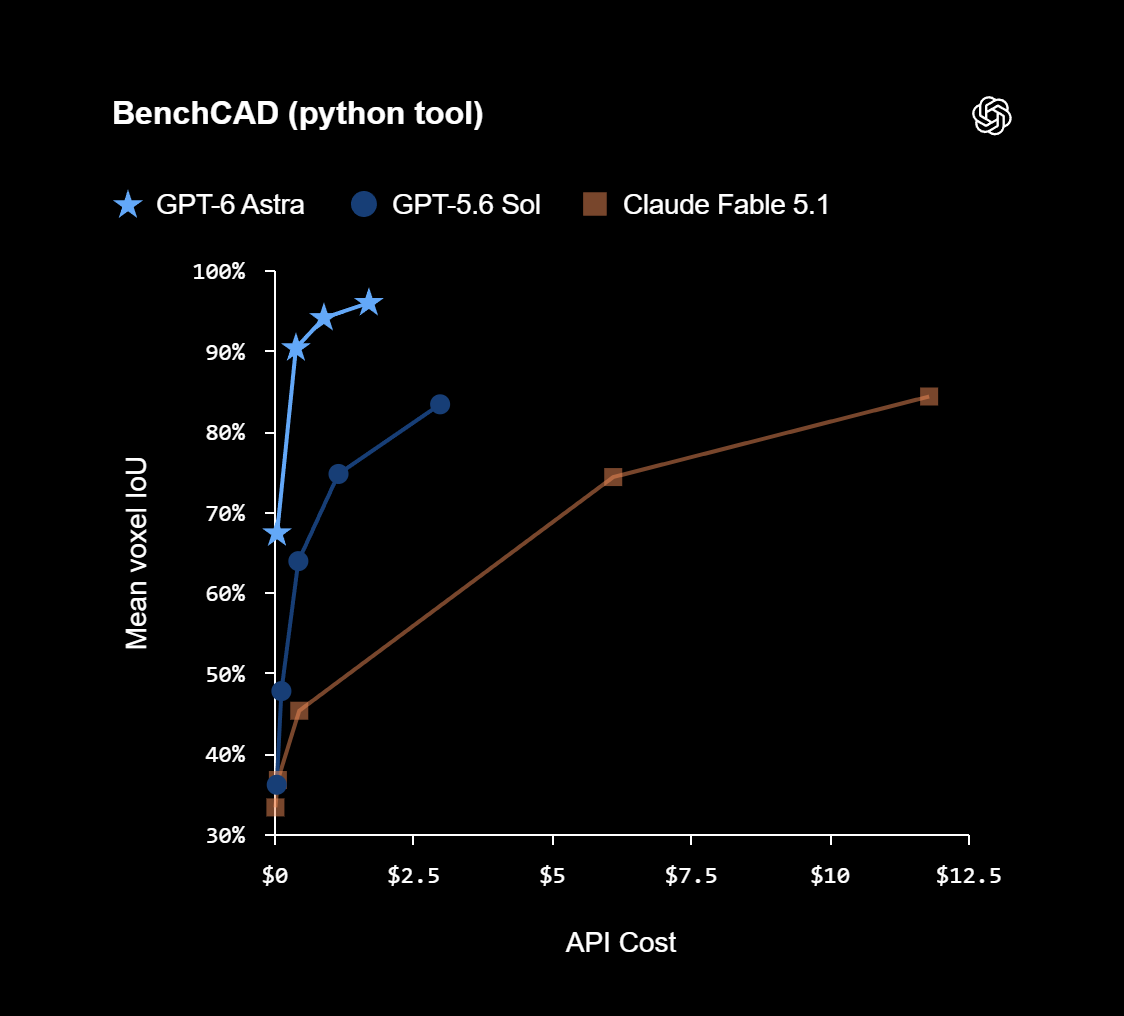
That is exactly the economic behavior buyers should care about. A model that completes the job with fewer tokens, fewer tool loops, or fewer failed attempts can beat a cheaper model on the final bill.
It is still vendor-run evidence. OpenAI notes that its GPT evaluations can run in research environments or through its API, with system prompts, tools, and settings that can differ from production ChatGPT. The launch page also says evaluation scores are the maximum achieved at any effort setting.
Those caveats matter because real agents have different repositories, browsers, permissions, tool latencies, prompts, and failure modes. A benchmark configuration can establish that Astra deserves testing without proving that it will cut your production costs.
The right response is to test the workload rather than assume either direction.
GPT-6 Astra vs Claude Fable 5.1 is a harder decision
Claude Fable 5.1 currently has the same headline uncached API rates as Astra: $10 per million input tokens and $50 per million output tokens. Anthropic’s model documentation lists cache reads at $0.25 per million tokens, which is more aggressive than Astra’s $1 per million cached-input rate.
Anthropic says that cheaper cache reads reduce typical Fable 5.1 workload costs by an estimated 25% compared with Fable 5, with savings of up to about 45% for highly agentic work. Those comparisons are against the previous Fable generation rather than Astra, but they matter for long-lived agent context where cache behavior can become a large part of the bill.
The capability comparison is mixed.
Astra beats Fable 5.1 41.4% to 31.4% on AutomationBench and 57.9% to 55.8% on Terminal-Bench 4.0 in OpenAI’s published comparison.
Fable moves ahead on broader reasoning measures. OpenAI’s own table lists 65.0% for Fable 5.1 versus 57.2% for Astra on Humanity’s Last Exam with tools, and Fable also leads the Artificial Analysis Intelligence Index.
Anthropic’s release data similarly positions Fable around difficult coding, long-running knowledge work, and research. It reports 55.8% on Terminal-Bench 4.0, 52.6% on Terminal-Bench-Science 0.1, and 73.4% on CursorBench 3.2.0.
The useful routing rule is simple: try Astra first for computer use, automation, and OpenAI-centric tool-driven coding. Test Fable 5.1 for unusually difficult reasoning, research, and long-horizon coding where its broader intelligence advantage might show up.
Routine implementation should remain on the cheaper lane whenever a cheaper model clears the acceptance test.
Popular AI’s earlier Claude Opus 5 vs Fable 5 analysis reached the same completed-task economics conclusion from the Anthropic side. Premium models should earn workloads through better outcomes, not through their position at the top of a provider’s model menu.
More on Claude Fable:

Fable 5.1 usage complaints are worth watching
There is already substantial anecdotal frustration around Fable 5.1 consumption.
In one r/ClaudeAI release discussion, a user on a high-usage plan said only a handful of Fable 5.1 prompts exhausted a session allowance. Another user in the same discussion reported consuming roughly 30% of a Fable allowance in a day while testing the model on a codebase.
Additional user reports have described Fable 5.1 appearing to consume weekly usage faster than Fable 5.
These reports establish that some users are experiencing painful quota consumption. They do not establish that Anthropic secretly reduced everyone’s quota, that every subscription tier behaves the same way, or that Fable 5.1 universally consumes a fixed percentage more compute.
For API buyers, metered cost is much easier to measure. Subscription users have a second variable to consider: how much useful work they can complete before the plan allowance becomes the bottleneck. A frontier model can look attractive on token pricing while feeling expensive inside a quota-based product if a few long sessions consume the available allowance.
That is another reason to evaluate models in the environment where they will actually be used rather than extrapolating from API price alone.
ChatGPT Plus users do not need Pro just to get Astra
The early rollout has created understandable confusion because access is gradual.
OpenAI says GPT-6 Astra is rolling out from an initial limited group and will become available to ChatGPT Plus, Pro, Business, and Enterprise users over the coming days. Standard Astra usage is included within existing subscription allowances.
So if you have Plus and do not see Astra yet, upgrading solely to obtain ordinary Astra is premature during the rollout window.
There is a separate GPT-6 Astra Pro tier. OpenAI says that version is for Pro, Business, and Enterprise users.
The standard-model buying decision and the subscription-plan buying decision are therefore separate. Someone can prefer Astra for a particular workload without needing Astra Pro, and someone can justify a higher ChatGPT plan for unrelated usage limits or features without concluding that standard Astra should replace Sol everywhere.
Privacy can override the benchmark winner
A model that scores slightly higher but conflicts with your data policy can be the wrong production choice.
OpenAI says business and API data is not used to train its models by default. Standard API use can involve retention depending on endpoint and configuration, while eligible customers can obtain Zero Data Retention controls.
Anthropic’s current Fable 5.1 rules deserve separate attention. Its platform documentation says Claude Fable 5.1 requires 30-day data retention and is not available under ZDR unless expressly authorized by Anthropic. Anthropic’s documentation also notes that customers should check contract terms or their account representative for the current eligibility details.
If zero retention is a contractual requirement rather than a preference, confirm the exact arrangement covering the account before routing sensitive work to Fable 5.1.
For workplace deployments, the distinction between consumer chat access and business or API privacy controls also deserves review. Popular AI’s broader local AI guide examines when hosted frontier capability is worth the data trade and when local processing becomes more attractive.
Privacy can therefore act as a hard routing constraint. When a workload cannot leave a particular environment, benchmark differences between hosted models may become irrelevant before token price even enters the calculation.
More on local AI:

Can GPT-6 Astra run locally?
No.
GPT-6 Astra and GPT-5.6 Sol are proprietary hosted models, and Claude Fable 5.1 is also proprietary. Their weights are not available for ordinary local inference. Any workflow built around their unique capability therefore remains dependent on an account, provider availability, pricing, usage policy, and whatever access conditions apply later.
Local models remain weaker for many of the long, messy agent tasks where Astra and Fable are most interesting. They can still be excellent fallbacks for private repository work, routine transformations, offline tasks, document processing, and workloads where losing cloud access would be disruptive.
Popular AI’s open-weight model guide covers the broader local model landscape, while GGUF Loader Agentic Mode demonstrates a more modest local coding-agent path that can operate without a cloud model account.
The tradeoff is capability versus control. A hosted frontier model may solve a difficult repository task more reliably, while a local workflow can reduce provider dependence and keep sensitive material on infrastructure you administer. The right fallback does not need to match Astra on every benchmark to be operationally valuable.
More on open-weight AI:


The best setup is a workload router
The expensive mistake would be replacing every Sol call with Astra.
1. Keep Sol as the default. Use it for ordinary professional work, drafting, analysis, routine coding, extraction, summarization, predictable automation, and anything inexpensive to verify. Sol’s lower token price is most valuable when its success rate is already high.
2. Escalate hard agent jobs to Astra. Use Astra when Sol starts looping, loses the plan, needs repeated steering, struggles with software interfaces, or produces patches that require expensive human repair. The escalation trigger should be the cost of failure, not the prestige of the model name.
3. Test Fable 5.1 for the hardest reasoning and research. Its broader intelligence results are currently stronger than Astra’s, and Anthropic’s long-horizon coding evidence is strong enough to make it a serious alternative. It belongs in the test set when the task depends more on deep reasoning than on computer-use reliability.
4. Keep a local or provider-independent fallback. Popular AI’s guide to building an independent AI development stack argues for provider optionality, which matters when a provider degrades, blocks a use case, changes access, or becomes uneconomic. Prompts, instructions, project state, and acceptance tests are more useful when they can move between models.
That last point has become increasingly practical for coding teams. Popular AI’s analysis of an OpenAI access cutoff in Cursor shows why prompts, project rules, tools, tests, memory, and agent workflows should remain portable before a provider change forces an emergency migration.
A good router does not need to be elaborate. It can begin as a policy used by humans: Sol first, Astra after defined failure signals, Fable for a narrower class of reasoning-heavy jobs, and a local lane for sensitive or continuity-critical work. The value comes from making escalation deliberate.
More on local AI coding:


Run a 20-task test before moving production work
Frontier-model benchmarks are useful for deciding what deserves testing. They should not choose the production model for you.
Take 20 representative tasks from work you already perform. Include easy jobs, failures from previous models, and several tasks where human repair has historically been expensive. The set should resemble the work that creates actual cost, not a collection of prompts chosen to flatter one model.
For each model, record the requested model, reasoning setting, total token cost, tool calls, elapsed time, retries, whether the result passed the same acceptance test, and how many minutes of human intervention it required.
Then calculate:
Total cost per accepted task = model charges + tool charges + failed attempts + human review and repair
If Astra completes 19 of 20 tasks cleanly while Sol completes 14 and leaves hours of repair work, Astra’s $10/$50 rate may look cheap.
If both complete 19 and Sol takes five extra minutes across the entire test, paying 2.5× is difficult to defend.
The acceptance test matters as much as the prompt. A coding task should pass the same tests and review criteria. An extraction task should be checked against the same expected fields. A research task should be judged with the same sourcing requirements. Without a shared definition of success, cost-per-task comparisons quickly become subjective.
This approach also prevents benchmark tourism. You are buying completed work, not leaderboard points.
What to watch after the Astra launch
The biggest missing piece is independent production evidence.
OpenAI’s launch data already makes a strong case that Astra is unusually capable at computer use, tool-driven coding, and professional automation. Artificial Analysis provides an important counterweight by showing that Astra does not open a comparable lead over Sol on broad intelligence.
The next useful evidence will be controlled coding-agent evaluations, real cost-per-task comparisons at different Astra effort settings, usage limits inside ChatGPT, reliability over multi-hour runs, and direct Fable 5.1 comparisons using identical harnesses.
Pricing also needs watching. OpenAI’s enterprise token-based rate card explicitly says GPT-5.6 Sol’s promotional pricing is available at least through November 21, 2026. The standard API model documentation currently shows the same $4/$20 rates without that promotion language.
Anyone building a long-term cost model should therefore recheck Sol’s price rather than assuming today’s rate is permanent. A router that makes sense at a 2.5× premium may need different thresholds if Sol’s price changes.
The same applies to rollout status, Fable retention rules, independent benchmark results, and subscription quotas. All four are moving inputs. The durable decision framework is the part that should remain stable: measure cost per accepted task, route by failure cost, and preserve a fallback.
FAQ
Is GPT-6 Astra 2.5 times more expensive than GPT-5.6 Sol?
At current OpenAI API prices, yes. Astra costs $10/M input and $50/M output, while Sol costs $4/M input and $20/M output. Cached input is also exactly 2.5 times more expensive at $1/M for Astra versus $0.40/M for Sol.
Can Astra still be cheaper per task?
Yes. OpenAI reports several tool-driven evaluations where Astra’s stronger completion behavior and token efficiency produced a lower estimated API cost per completed task than Sol. Broad independent evaluations do not show the same advantage everywhere, so the deciding test should be your own workload.
Is GPT-6 Astra better than Claude Fable 5.1?
It depends on the task. Astra currently looks stronger on several automation, computer-use, and coding-agent evaluations. Fable 5.1 scores higher on the Artificial Analysis Intelligence Index and on Humanity’s Last Exam with tools in OpenAI’s published comparison.
Do ChatGPT Plus users need to upgrade to Pro for Astra?
No for standard GPT-6 Astra. OpenAI says it is rolling out to Plus, Pro, Business, and Enterprise users. Astra Pro requires Pro, Business, or Enterprise.
Can I run GPT-6 Astra locally?
No. Astra is proprietary and its weights are not available for local inference. The same applies to GPT-5.6 Sol and Claude Fable 5.1.
When GPT-6 Astra is worth the 2.5× premium
GPT-6 Astra should replace GPT-5.6 Sol selectively rather than globally.
Sol remains the stronger economic default for work it already completes reliably. Astra becomes compelling when mistakes propagate, agents operate unattended, software has to be controlled, difficult code needs repeated verification, long context must survive across a project, or a failed run costs much more than a few extra dollars of inference.
Claude Fable 5.1 remains a legitimate third option. It currently looks stronger on some broad intelligence and difficult reasoning tests, while Astra has the more compelling early case for automation, computer use, and several tool-driven coding workloads.
The burden of proof belongs to Astra because Astra costs 2.5 times more per token at today’s base API rates. That premium becomes rational when better execution cuts retries, shortens tool loops, reduces human repair, or raises the probability that a long task finishes correctly the first time.
For everything else, keep the cheaper model in the default lane.
Explore more from Popular AI:
Start here | Local AI | Builds & gear | Autonomy & policy | Fixes & guides | Popular AI podcast
Where would you actually choose GPT-6 Astra over GPT-5.6 Sol in your own workflow, and what would convince you the extra cost is worth it?
Evaluating frontier models by their posted per-token tariff is a fundamental projection error. It mistakes the discrete tokenized surface for the continuous causal manifold that actually dictates execution cost. 💸
When an agent loops through software environments, nominal token price is merely a degraded projection of unanchored stochastic sampling failing its linear identifiability constraints, which we can easily visualize as an optical cavity losing its reflective boundaries. On single-turn extractions or sterile summarization, Sol's $4/$20 profile wins effortlessly. That is simple arithmetic. But the moment you deploy an agent into multi-step tool execution, state entropy begins to compound. 📉
Every time a cheaper model hallucinates an invalid shell command, loses track of its dependency graph, or falls into a repair loop, it doesn't just bill you for an extra retry. It drags an ever-expanding KV-cache history into every subsequent step. A three-word correction at step forty forces the quadratic re-processing of forty prior turns. What looked like a 60% savings on the sticker price rapidly metastasizes into a 300% operational overrun on total billed compute. ⚡
In multi-turn agentic environments, total task expenditure behaves as a non-linear phase slip. Un-anchored policy drift exponentially expands intermediate context volume, establishing a hard mathematical threshold where low-tariff inference becomes strictly more expensive than frontier execution. Astra's 57.9% on Terminal-Bench versus Sol's 37.3% isn't an academic leaderboard delta. It's the exact boundary between an agent that collapses its search trajectory into a deterministic commit and one that burns silicon in an infinite, dissipative retry basin. 🔬
Route routine, bounded transformations through the cheaper lane without hesitation. But when an agent touches file trees, API pivots, or stateful OS layers, paying the 2.5x base token premium isn't an upgrade tax. It's the cheapest insurance policy against quadratic context bloat. 🏛️
At what exact turn count in your multi-step pipelines does your accumulated prefix context mathematically erase the discount of cheap inference?
(✧∇✧)╯